
This essay is part of the “Post-American Christianity” Series, exploring what faithful Christian witness requires in this moment.
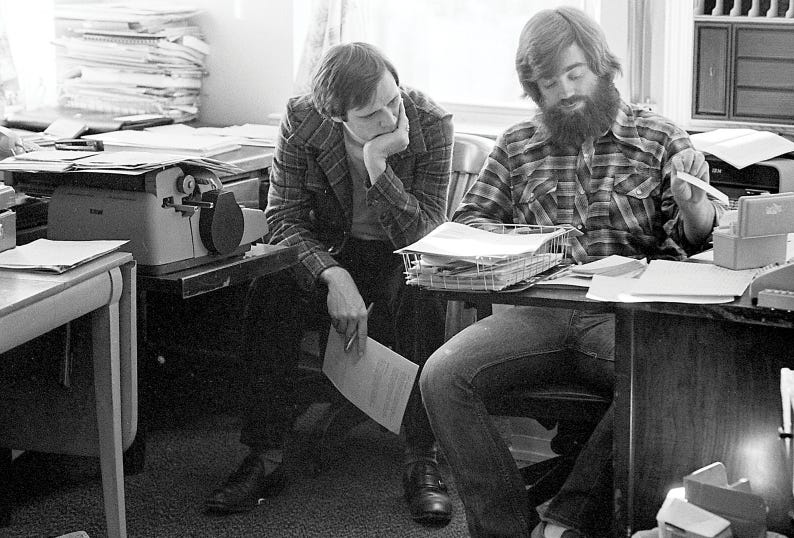
“We find ourselves in the midst of a radical awakening, among people who are raising basic and critical questions about the nature of our society and about the quality of life in the world we inherit.”
This was the first sentence written in the public ministry of Jim Wallis. Having worked with Jim for the past 11 years, I can say that it remains the animating core of everything he does. His message has been remarkably consistent across decades, and it is as prophetic and prescient today as it was over 50 years ago when it was first written. I would even argue that his message is even more needed in our current moment.
In this first column, Jim names some of the major challenges facing contemporary society: racism, materialism and consumerism, economic inequality, mistrust in corrupt institutions and systems, unjust and destructive war, a culture devoid of connection and focused on hollow success, and an anemic, captured Christianity.
It reads eerily similar to what we are still experiencing now. I would contend, however, that the threats we face today are, in many ways, even greater than those in the early 1970s.
When Post-American Christianity was written, the landmark civil and voting rights legislation of the 1960s was less than a decade old. While imperfect and incomplete, these laws represented significant progress in addressing systemic and structural injustices. Today, we have witnessed the total dismantling of their most important protections, ushering in a new wave of racialized attacks. Our civil and voting rights are less protected now than they were then.
Opposition to the Vietnam War was a major mobilizing issue of that era. It was a prolonged unjust war with no clear objective or end goal that wrought destruction and death on the people of Vietnam and treated the lives of young Americans, many of whom came from impoverished and marginalized communities, as expendable. Today, we are approaching 25 years of forever wars, conducted without the required explicit congressional authorization and at the cost of thousands of young American lives. Many of those lost come from the same impoverished and marginalized communities that have historically borne the burden of war. And that is not even taking into account the untold numbers of enemy combatants and, most horribly, thousands of innocent civilians who have been killed.
In the 70s, economic inequality and destructive consumerism trapped many Americans in cycles of generational poverty. People faced job insecurity due to emerging technologies and were ensnared by the pursuit of an increasingly unattainable notion of the American Dream that left them disconnected, despondent, and devoid of meaning. Since then, both economic inequality and consumerism have only deepened. Today, the bottom 50% of Americans, which is about 170 million people, control only 3% of the nation’s wealth, while the top 1% control more than 30% of all wealth. And emergent technologies, especially AI, are putting millions of jobs at risk while fundamentally reshaping every aspect of life with little public consideration or regulation. A reality that is fueling the rise of a new class of ultra-wealthy, with the top 0.1% holding roughly 18% of all wealth, up from about 7% in the late 1970s. Meanwhile, wages for low and middle class Americans have failed to keep pace with inflation and the staggering cost of living.
When Jim sat down to write the original piece, the unpopularity of the Vietnam War, the release of the Pentagon Papers, Watergate, and the eventual impeachment and resignation of Nixon triggered the largest drop of public trust in government since Pew began recording it in 1958. Trust had stood at 60% when Nixon first took office and fell to below 40% by the time he resigned. It also marked a long and steady decline in public trust that continues today. For the past 15 years, overall public trust in government has remained below 20%.
And while the religious right and their distorted theology were only emerging fifty years ago, they have since become one of the most potent and predictable political voting blocs set on preserving the rights and privileges of a shrinking white minority rather than promoting the common good for all. In recent years, the growing influence of a distinct and particularly pernicious form of white Christian Nationalism has sought to narrow and redefine what it means to be American in ways that intentionally exclude millions of people from the definition.
Given all of this, it is not surprising that we are facing a crisis of democracy. As more Americans don’t see a political system interested in ensuring opportunities for them and future generations, there is growing acceptance, or outright support, for autocratic forms of government.

Political scientist Valerie Bunce says, “Democracy demands that people accept uncertainty over outcomes in order to have certainty over process.” Other forms of government, particularly autocratic ones, provide certainty of outcomes over certainty of process. As more Americans experience a system that feels incapable of delivering even the most basic needs and desired outcomes, they become more willing to trade the certainties of democratic process for the promise of tangible outcomes—even when that means embracing autocracy.
There is a lot of work to be done.
As Jim said 50 years ago, Christians need to lean more deeply into our faith as a source of both personal and social transformation. In partnership and solidarity with people of different faiths and ethical traditions, we must take seriously the radical Gospel’s call to bring “good news to the poor”.
Over his fifty years of public ministry, Jim Wallis has helped countless people, myself included, find and deepen their understanding of this calling.
Jim closes his first column by saying, “We must be radical disciples applying the comprehensive Christian message to all areas of life, culture, and human need—committed to reconciliation, justice, peace, and faith”. Only by embracing that vision can we bring about a more just, equitable, and democratic future that allows all to thrive. Let us commit ourselves to that work.
Jim Simpson has served as executive director of Georgetown’s Center on Faith and Justice since its creation in 2021. Previously, he served as political director at Sojourners and held legislative roles in the U.S. Senate, including with Senator Mary Landrieu and the Senate Committee on Small Business and Entrepreneurship.
I wouldn’t be fulfilling my duties as Executive Director if I didn’t use this opportunity to ask you to support our work. This Substack, Jim’s weekly podcast, and the broader work of the Center on Faith and Justice are made possible through the generous support of people who share our commitments. While this Substack is free, I ask you to consider making a monthly or annual donation to support the Center on Faith and Justice. We believe the work we are doing to address the issues discussed in this column is critically important, and your support will help sustain and strengthen that work.
No posts
Comments
Nothing yet. Say the first thing.
Sign in to join the conversation.