
This essay is part of the “Post-American Christianity” Series, exploring what faithful Christian witness requires in this moment.
Have you seen the portrait by teen artist Betty Shanefelter, entitled “Falling”? It was part of an exhibit called The Teen Experience, hosted by American University Museum in partnership with the Museum of Contemporary American Teenagers. In the piece, a teenage girl in a free-fall claws the air, alone, with a look in her eyes that is both desperate and resigned. It moves me to tears.
The portrait is an indictment of the society we have built and are handing down to our children—a society, as Jim Wallis puts it in his original reflection on Post-American Christianity, that suffers from “a perverted mentality,” “whose values are corrupt and destructive.” Since he wrote the piece in 1971, the path to flourishing has become ever more obscure, and it is easy to fall into disillusionment and despair. As Jim observes, “We are all prisoners, victims of our society and ourselves, struggling to find the humanity that has eluded us.”
Reclaiming our humanity is the subject of Pope Leo XIV’s recent encyclical, Magnifica Humanitas, which invites us to “join forces in building up the common good, so that humanity will never lose its beauty.” “What saves humanity,” he tells us, “is not enhanced self-sufficiency, but a relationship that liberates, a communion that transforms.” Because everything is interconnected, nurturing relationships is the path to countering violence and despair. For this to work, we must first become comfortable with the unexpected things that can emerge when we allow ourselves to be vulnerable to communion.
But the values that call us to embrace vulnerability and communion are precisely those that have been deemed “feminine” and excluded from moral discourse. The destructive, “perverted mentality” that motivates division and dominance, isolating us in our own prisons of despair, is fundamentally patriarchal, and a Christianity that expresses and safeguards the fullness of humanity must also take on the task of deconstructing the patriarchal scaffolding that has sustained it.
The notion of power as dominance, control, and even benevolent paternalism stems from a hierarchical worldview rooted in scarcity and sustained by the logic of domination. This logic has shaped American Christianity and culture, teaching us to understand our worth as defined in comparison to others, and that moral superiority justifies control. In accordance with this logic, we would render ourselves inferior if we try to acknowledge our own moral failures, or celebrate another person’s gifts. If we view the world through the lens of scarcity, power looks like taking for ourselves the goods we enjoy, and excluding others, whatever the costs.
We see this reflected in Deputy Chief of Staff Stephen Miller’s description of power: “We live in a world, in the real world … that is governed by strength, that is governed by force, that is governed by power,” he said. “These are the iron laws of the world since the beginning of time.”
These are not the ‘iron laws of the world ‘—they are just the inherently self-defeating rationale for patriarchy.
We are seeing a different kind of power emerge in contradiction to this false sense of patriarchal domination. For example, the response in Minneapolis to the ICE crackdown offers a clear refutation of dominative logic—echoing Jim’s critique of “a perverted mentality that destroys … villages to ‘save them.’” Rather than “learning their lesson” and accepting the violent “protection” of ICE agents “for their own good,” Minnesotans are taking courage from one another and rallying in support of their community. They are refusing to be cowed by violence, showing that real strength exists in the bonds of mutual care. In spite of the danger and despair that can feel overwhelming, joining together with others to act has changed the trajectory of our future.

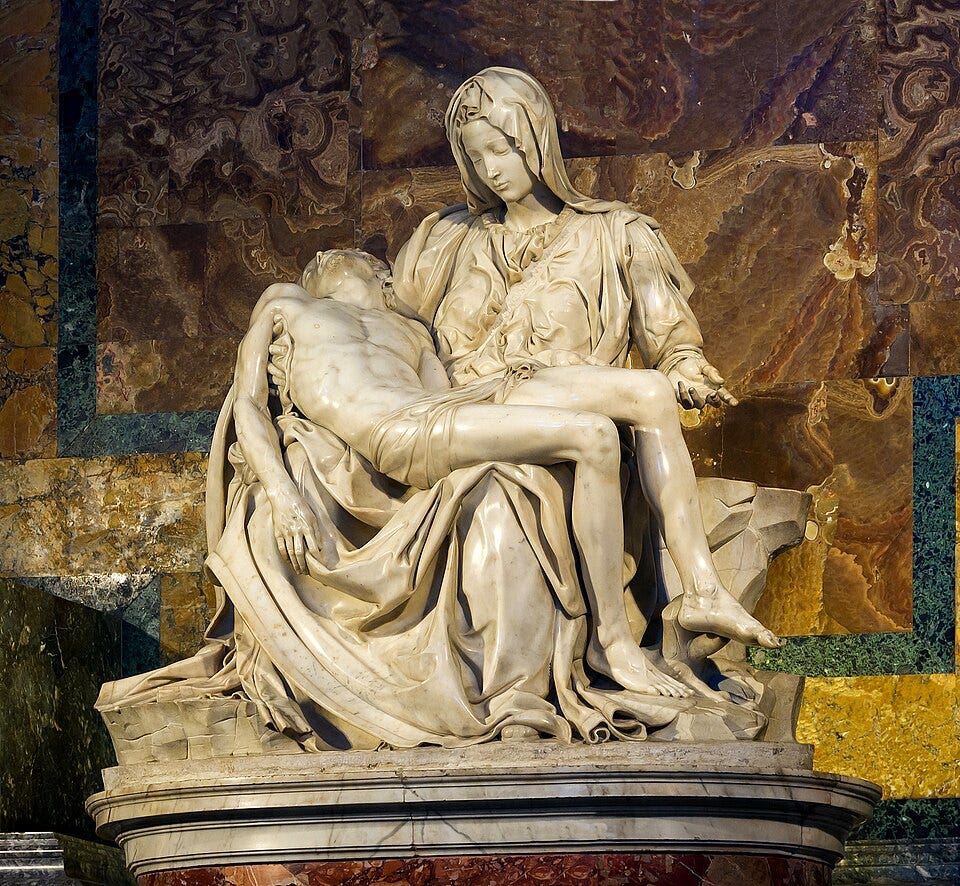
A dear friend of mine, Sister Arlene Flaherty, OP, once shared that Michelangelo’s La Pietà, depicting Mary cradling her dead son, is for her one of the most profound reflections of God’s presence. “It is the feminine face of God,” she says. Situated at the entrance to St. Peter’s Basilica in Vatican City, the sculpture greets visitors as they enter the sanctuary. Mary’s strong, compassionate presence sits there “as if to say,” Sister Arlene observes, “that if we don’t get this, we won’t get any of it.”
This image invites us beyond a patriarchal understanding of God as only the Almighty Father ruling over us with absolute power, to encounter a God who is embodied, who holds the suffering of the world, and who nurtures the new life that emerges when we allow ourselves to be vulnerable to change.
Perhaps lamentations about “the feminization of society” are actually just fears about the power that emerges when we nurture the bonds of community and hold one another with compassion. While women and people of color are actively losing rights and protections in this country, they are also carrying the large majority of resistance and care work—leading their communities with resilience and strength. Men who reject the alpha-male narrative and demand a fully human experience are coming alongside, and I hope more will do so.
So how do we begin to re-humanize Christianity and bring our full humanity to bear at this moment?
We remember that incarnation is the heart of our faith. We start taking concrete steps to help us live into interdependence and mutual care rather than remaining captive to the logic of domination.
Maybe we will integrate more feminine expressions of the divine into our spiritual practices. Maybe we will check our prejudice when we laugh at jokes that demean boys who show emotional depth, or assume that men cannot be nurturing; maybe we will resist the stereotype that tells us women are too nurturing or emotional to hold leadership positions. Maybe we will join a mutual aid network in our community to ensure that our neighbors have what they need to flourish; maybe we will join protests, register people to vote, or boycott businesses that support the work of violence. Maybe we will stop othering those we oppose in the name of fighting the good fight, and will start the slow and arduous task of rooting out the dominative tendencies in ourselves, blocking harm while inviting all into the fullness of community.
Whatever form it takes, our work needs to begin by fully embracing the virtues our culture too often dismisses as “feminine”. If we all take steps to deconstruct the hierarchical worldview that has consumed us and tells us to undervalue compassion, vulnerability, care, and mutual responsibility, we will all emerge from our current moment more fully human.
Would Betty Shanefelter’s portrait evoke something different if the girl’s hands were clasped with another’s? In a moment when we can feel in free fall, let’s reach out to hold each other.
Dr. Kathleen Bonnette facilitates the academic programs and student engagement and formation for the Center on Faith and Justice at Georgetown University, where she also teaches theology. She regularly publishes with America: The Jesuit Review and U.S. Catholic, and she is the author of (R)evolutionary Hope: A Spirituality of Encounter and Engagement in an Evolving World. She is developing the themes of this essay in her forthcoming book with Orbis Press/Yale University’s Ecology and Justice Series. Stay tuned!
No posts
Comments
Nothing yet. Say the first thing.
Sign in to join the conversation.