
This essay is part of the “Post-American Christianity” Series, exploring what faithful Christian witness requires in this moment.
Where can we find the voice of moral outrage adequate to our times? Lurking in the background of our settled lives, our AI chatbot fascinations, our numbed-by-Netflix senses, is an awareness: all is not well in the world. Antisemitism and anti-Muslim hatred are spiking. The United States is at war with Iran, but also, seemingly, the world? Inequality is rising; societal cohesion is falling. All around us we hear xenophobic cries demonizing migrants.
I was invited to write this post as the last in a series reflecting on Jim Wallis’s inaugural article in the magazine that became Sojourners, “Post-American Christianity.” Even so early in his career, Jim’s clarion voice in 1971 still resonates today. If anything, the problems that he was calling the church to face five decades ago—consumerism, warmongering, inequality, racism—are worse now.
The last year and a half has been a brutal crash course in how frail our democracy is, and how little our institutions can do to constrain a wannabe authoritarian. Remember: ICE and CBP thugs brutalizing migrants and becoming a de facto paramilitary wing of MAGA on the streets of Minneapolis; the ongoing cold-blooded murder of hundreds of people on boats in the Caribbean, with Trump and Hegseth playing judge, jury, and executioner; the wanton inhumanity of initiating a war with a nation, Iran, that had not attacked us and, in the process, sloppily hitting a girls’ school with a missile and killing more than a hundred children. No apologies have been forthcoming from this remorseless administration.
What has made this desecration of American democracy even worse is that it has been justified with a brazen invocation of Christian principles. The violence, the dehumanization, the callous corruption are perpetrated in the name of Jesus and openly promoted as part of restoring America as a “Christian nation.”
I grew up evangelical. I attended an evangelical seminary. I did evangelical ministry for seven years with college students, and I weep for what mainstream American evangelicalism has become. Christian leaders, respected ministers, fawn and prophesy over an authoritarian thug.
I have a new book coming out in October, Defying Tyrants: Following Jesus in a World of Christian Antichrists. In it, I try to find that voice of moral outrage. I try to understand: how did Christianity become so entwined with empire? How is it that our fellow Christians can be so cozy with incipient American fascism?
And I think the best answer comes from before there was even a word or concept of “America.” The origin point of our current crisis was the conversion of Constantine in 312 CE.
I maintain that the New Testament church couldn’t even conceive of a Christian on Caesar’s throne. They were so far down on the underside of the Roman Empire: episodically persecuted, substantially made up of poor people, the enslaved, noncitizens, and living a near-subsistence life.
Plus, Jesus had taught his followers to give up the quest for coercive power over others: Love your enemies, that is, do not conquer or force your will on them. Whoever wants to be the greatest must be the slave of all, because that is the position Jesus occupies. The first shall be last, and the last shall be first, because our God is a stooping God. They had had their imaginations reprogrammed by Jesus’s subversive teachings on power. That was definitional to them of what it meant to join the Jesus movement.
Constantine’s predecessor, Diocletian, was one of the worst perpetrators of Christian persecution. He maimed, tortured, and killed church leaders throughout the empire.
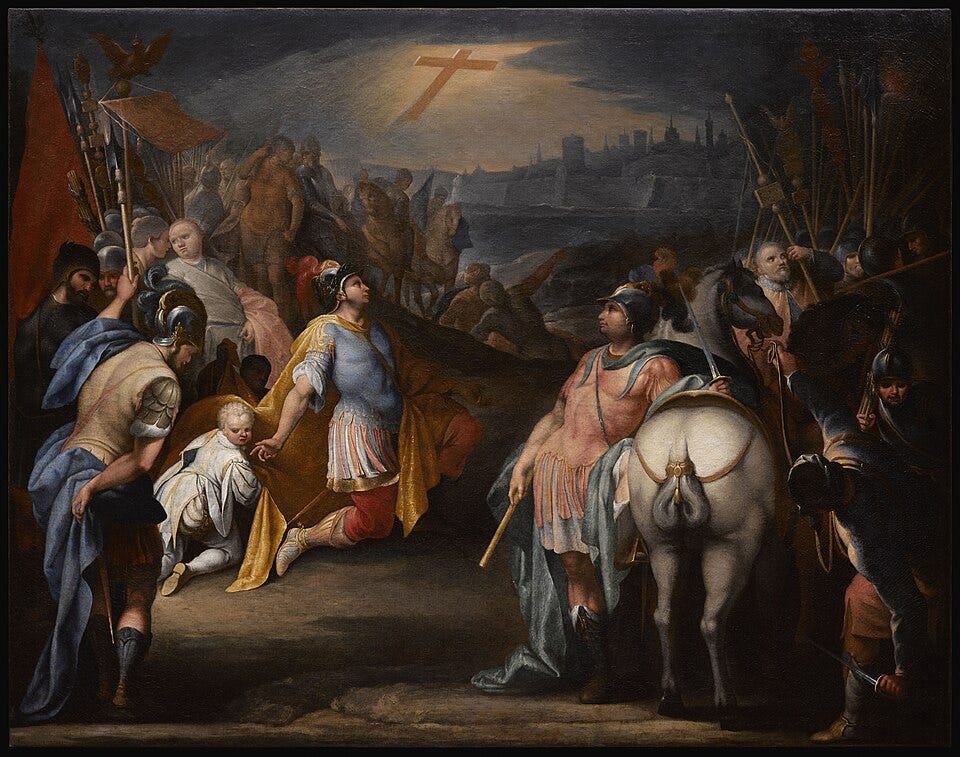
It was precisely at this moment of Christian vulnerability that the Emperor Constantine presented Christians with a new temptation: What if we could be the ones guiding the empire? Though Christians were a minority religion in the early 300s (perhaps 10-15 percent of the empire by some estimates), the emperor decided to convert to Christianity. And what a story he told of his conversion: He was locked in battle against his rival emperor Maxentius. On the eve of the decisive battle in 312, he saw a vision from Jesus of the cross with the words “by this, conquer.” So, Constantine had his soldiers mark their shields with the cross (or, in some versions, the chi-rho, an ancient Christian symbol), and they were victorious over Maxentius, and suddenly Christianity was in the catbird seat.
Constantine legalized Christianity, ending the centuries-long alienation and persecution. Within a few decades, some historians estimate that more than half of the empire was Christian.
I know many people, previously myself included, who would celebrate Constantine’s conversion and the ensuing mass growth of Christianity. More souls in heaven, right? But what were these new converts converting into? It’s a very different thing, signing up to be part of the persecuted, marginal religion and counting that cost versus signing up to join the faith of the emperor, the new “it” religion. By the end of the fourth century, the empire was officially Christian, church and state were bound together, and we’re off to the races.
I refuse to believe Constantine’s story that Jesus had any supernatural or revelatory hand in his conversion. The cross is a symbol of sacrifice and self-denial in Jesus’s vocabulary. Crucifixion was the punishment reserved for enemies of the state—pirates and insurrectionists. So are we really to believe that Jesus appeared to Constantine, blessed the empire that executed him, inverted the meaning of the cross, and turned it into a symbol of Roman imperial conquest? Perhaps Constantine really saw a vision or had a dream; such things are common enough, but by the very content of his vision, we can know it did not come from Jesus Christ.

The Roman Empire colonized the body of Jesus during his earthly life in the first century. Three centuries later, Constantine colonized the image of Jesus (or, more accurately, the Christian imagination) and entwined Jesus with the project of empire: coercion and conquest. Follow that path down through the centuries: Christian imperialism – pogroms and the persecution of Jews – hatred and rivalry with Muslims – the Crusades – the Inquisition – the Christian empires of Europe and the US, that colonized the world, enslaving millions – the Holocaust.
Constantine touched nearly everything in the Christian tradition that followed after him: he convened the Council of Nicaea, which produced the Nicene Creed, the most pivotal and monumental statement of Christian faith. Constantine declared Sunday, the Christian holy day, a day of rest for the empire, creating the precedent for our Sunday-anchored weekend. He fixed the date of Easter to where we still celebrate it today. All that we know of Christianity has been touched by the hands of that grubby dictator, the first Christian tyrant.
Donald Trump and the whole MAGA project to baptize their corruption, theft, and warmongering in Christ aren’t anything new. They’re doing something very old. Donald Trump is just a Temu Constantine.
In “Post-American Christianity,” Jim incisively writes:
We find that the American church is in captivity to the values and lifestyle of our culture. Institutional Christianity in America has allowed itself to become a conservative defender of the status quo, a church largely co-opted and conformed to the American system in direct disobedience to Biblical teaching (Romans 12:2).
He was right in 1971, and he’s right now, but I want to press it a bit further. No longer is institutional Christianity content to be “a conservative defender of the status quo.” Now institutional Christianity has shacked up with another Constantine, a tyrant aiming to merge church and state for the sake of blessing his own violence and greed. We have sold our birthright for a mess of pottage.
The question that the second Trump administration poses to us is not merely can we find a way to inhabit a post-American Christianity. The brutality of the Trump Era has exposed a far deeper rot within institutional Christianity: its comfort in forsaking Jesus when Constantine comes knocking. The theological question posed to the American church in 2026 is: Can we truly embrace the gospel of Jesus and forsake the gospel of Caesar? Can we cleave our Christian belonging from this toxic power of empire and be willing to live on the underside of society again? Can we, at last, exorcise this damn ghost of Constantine from our Christianity?
Matthew D. Taylor is a senior visiting scholar at the Center on Faith and Justice at Georgetown University. He is the author of The Violent Take It by Force and, forthcoming, Defying Tyrants. A public-facing theologian and religious studies scholar who specializes in American Islam, Christian nationalism, and Christian extremism, he is also the creator of two limited podcast series–American Unexceptionalism and Charismatic Revival Fury. Taylor holds a PhD from Georgetown University and an MA from Fuller Theological Seminary.
No posts
Comments
Nothing yet. Say the first thing.
Sign in to join the conversation.