
First off, I’m not complaining. That list of the fifty “best” thrillers of the 21st century didn’t reflect my tastes, but so what? My tastes are my tastes. Yours are yours. And the tastes of the 291 authors and industry professionals asked to contribute their choices? They’re entitled to theirs.
As an avid reader of crime fiction, and an avid advocate of just plain reading, anything that elevates the genre — which, in my opinion, produces most of the great social novels of contemporary times — is a good thing. And while I’ve read 29 of the 50, and have little desire to read more on that list, I did get some great ideas for future reads from the favorites of some of the participating authors.
That said, I have less of an idea of what constitutes a “thriller” than I did before I read the Times’ thriller story package.This list contained not just conventional pulse-pounders, but a great deal of more cerebral fare, like puzzle mysteries (The Magpie Murders by Anthony Horowitz), sciencey fare (Dark Matter by Blake Crouch), literary thinkers (The Goldfinch by Donna Tartt and The Sympathizer by Viet Tranh Nguyen), deeply interior journeys (Winter’s Bone by Daniel Woodrell), cerebral spy tales (The Constant Gardener by John Le Carré).
And then there’s the novels of Tana French, whose books were selected by dozens of the participants. More on that in a bit.
If there’s a through-line that coherently connects all of these … well, I can’t see it (and, based on a number of comments in the main article, I’m far from the only one). And I’m trying to be generous here; I realize that even novels that are more of a head trip than a body trip can still thrill; little gray cells surely can turn pink with excitement, I suppose.
That “it’s all in how it hits you” rationale is apparent in the explanations offered by Sarah Lyall, the Times’ thriller columnist, who put together this project. Said Lyall, in the comments:
These are the kind of books that consume your waking hours, that have you reading into the night, that make you miss your subway stop and just keep going… You’re desperate to find out what happens, yet you don’t want the book to end; the intensity of it all leaves you dizzy, off-kilter, not quite yourself. That’s what the best thrillers can do for you.
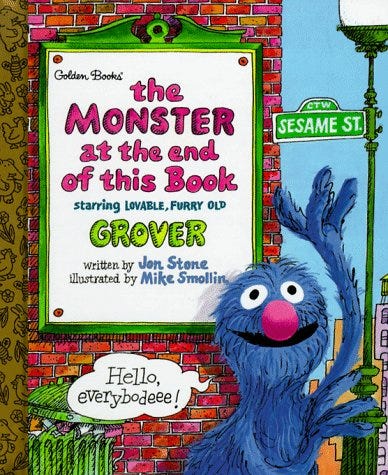
Well … fine, but a description of a highly individualized experience doesn’t do much to define “thriller” as a category. (My idea of the greatest thriller ever is a tie between The Holy Bible and The Monster at the End of This Book, but I wouldn’t waste my time trying to get anyone to agree with me.)
I think that’s why this is a subgenre so shot through with derivative works; all anybody knows is what thrilled someone before, based on sales or word-of-mouth, so how about some more? Hence, the pallid ever-rising piles of stories about missing children, evil children, aspirational class warriors, unreliable narrators, amnesiacs, evil twins and gaslighting spouses. (I often joke that I’m going to pitch a thriller featuring a husband who hasn’t told his wife everything about his past and a wife who keeps deep secrets from her own history, and call it Every Marriage Ever.)
Because, if I am an author trying to pitch a thriller to a literary agent, what else have I got to go on? It means that I’m vulnerable to the highly subjective whims of an agent who may or may not have a personally thrilling experience with a story that otherwise hits all the standard thriller beats — breakneck pacing, high emotion, lots of twists, twisted psychology, etc. That reduces pitching to dating-type chemistry — does this agent want to take my book to bed with them?
I looked far and wide for cogent definitions of “thriller” — more objective than Lyall’s, anyway — and I rather liked this one from Eric Beetner, author for more than 30 novels that would fit well in the thriller category (I think). On my Facebook page, he wrote:
My simplified definition has always been: Thrillers are stories that constantly move forward. Mysteries are stories that look back.
So a thriller is A leads to B leads to C and so on and I don’t know how it will resolve, a mystery is “Something has happened and we need to figure our what but I know the resolution is the solving of a crime or figuring out what happened in the past.
Echoing my own thoughts, Beetner added: “Matters of pace and what constitutes ‘pulse-pounding’ or other desecriptions is entirely subjective. I find most books described as ‘pulse-pounding’ ot ‘breakneck’ are far from it.”
That last line could describe at least a dozen of the titles on the New York Times list (and maybe more, but, like I said, I’ve read fewer than 60% of them). Including the works of Tana French, whose names graces three titles on the Times list.
I love the works of Tana French. But I’m not thrilled by the works of Tana French, apart from the immense feeling of satisfaction I feel after reading one, or knowing that a new one is on the way, which may not be anybody’s definition of “thrill,” and maybe not even mine. Her books work on my mind more than my nerves (of course, your mileage may vary, but we’re trying to find at least a standard mileage range here).
But the critics seem to see it more my way; they make references to her books’ twists, their psychological acuity, their tightening of tensions, but they also make reference to their “nuance,” their “deliberate pacing,” their prioritizing of character over plot. Hillary Kelly, writing a less-than-complimentary critique of French’s most recent works in The Atlantic, said “Introspection is French’s speciality.” Retired Times critic Janet Maslin, who reviewed several French books during her time there, wrote in an overview of her early work: “To a degree that is perhaps uncharacteristic for a writer of mysteries, a genre that often demands meticulous planning, French seems to thrive on uncertainty. She concedes that plot is not her strong suit. Rather than mapping out the twists and turns of an investigation, she starts with a character and a settung and feels her way to a story.”
Even Lyall gets in on the act. In her review of the newsest French novel, The Keeper, not even six months ago, Lyall wrote of French’s body of work: “They’re slower paced and more interior than conventional mysteries; much of the suspense arises from the nuances of small details. Conversations that seem like exchanges of pleasantries become masterly interrogation scenes.”
Not very thrillish. But I shouldn’t pick on Lyall; after all, she was not one of the dozens of authors whose contributions to the thriller list included works by Tana French, nor is their any indications that she could, did or would have put her thumb on the scales of the list.
As for the thriller authors who put Tana French novels on their lists? (Fifty-nine of the 291 shared their ballots; 26 picked a French book, and five of them picked more than one.) It’s perfectly fair for them to say, “Well, I found them thrilling, so there.” And it’s also perfectly fair to say that this settles the matter not at all.
Certainly not for the many people who weighed in on the article’s comments section to not just share their own picks but to complain about the picks made, practically to the point of insisting that the Times substitute their judgment for its own. Many of them felt puzzled and even aggrieved by Tana French’s dominance of the list. Said one: “Nothing Tana French writes is a thriller.” Said another: “I read several Tana French novels, and I don’t remember any thrills.”
Maybe the least thrilling thing about the thriller debate? Unlike most thriller novels, there will never be a satisfying ending. Which may be the most unsatisfying ending for an author with a thriller on submission.
No posts
Comments
Nothing yet. Say the first thing.
Sign in to join the conversation.