
Hi, all. I haven’t abandoned Substack. I just haven’t had anything substantively post-worthy to say for the last several weeks.
But, let’s catch up.
Yesterday, June 29, I turned sixty years old. I’ve actually been saying I’m sicty for several weeks in order to render anticlimactic the actual day, and I think it worked. It didn’t help that my amazing wife Sue, in cahoots with my sister Chris and sister-in-law Kim, cooked up a wonderneful birthday weekend that included several incredible meals, surprise tickets to see Lyle Lovett and His Large Band at Remlinger Farms (a pastoral setting east of Seattle), and a new iPhone with what I am told has a much sharper camera than does my old iPhone 11. I can’t wait to go to downtown Seattle during a summer golden hour and noir the coming night away. As soon as I do, I’ll share some images here.
How have I changed in the last decade? Easy answer. When I turned fifty, I rented out a community hall in my hometown and threw myself a big potluck party. More than one hundred people came, and it went on for about ten hours. A great time.
Today? I wanted anything but an epic party. But it was a bit disquieting to realize that I’m still actively friends with only about five percent of those who came out to my 2015 shindig. There were a few fallings-out, but mostly a lot of drifting apart. There are several reasons for this: One, I just lost interest in the social swirl, and that’s largely because a) I’m no longer single; and in my wife, I have just about everything I want in a friend and b) coincidentally or not, I lost any sense of FOMO that held sway over me in those days.I see pics of my former “gang” at various barbecues, beach parties, concerts and other gatherings, and I admit I feel a bit of a pang for those bygone times, but it lasts for only a few seconds and then fades like dandelion spores in the slightest breeze. I love those people, but I no longer feel any need to be in the center of their universe. They feel differently, and if that’s in the service of their happiness and their journey in perpetuating happiness, that’s great.
Another big part of that is the switch that seemed to flip inside me during the pandemic. I just lost my desire to be with any crowd, let alone my crowd, and I embraced the inner introvert which I think had always been there, waiting to be invited out to take over. And when the pandemic receded, the switch never flipped back, and I find that not only can I not force that flip, I have no particular desire to. I’m simply happy sitting on our side deck after a day of work, sipping drinks with my wife, reading or playing a few rounds of gin rummy. The rest of the world is free to go on about its business without me.
Am I happier now than I was ten years ago? The answer is an unqualified yes. I miss a lot of those old friends, but I have very little battery or bandwidth for them (which says everything about me and not too uch about them). Although in some cases I hope for a drift back into each other’s orbits. I suspect the keepers will keep, and as such I will keep my heart and my availability open to them.I’m still sorting and delivering mail four days a week. I’ve pretty much mastered the mechanics of the job and have the route down cold. I’ve settled into it. The pay is still not great, but I’m doing the job faster while making fewer mistakes, and more than ever I love that I get to work at my own pace and largely on my own. It’s a McJob, but it’s a highly tolerable one, and these last few months it’s saved my ass financially.
My editing business is starting to come back … a bit. I admit that May was a hard month, in large part because it was my first zero-income month since I started the business in 2009. That was deeply dispiriting. But then people started reaching out to me, inquiring about open dates on my work calendar, and I got a few surprise drop-in referral gigs. It keeps me busy on a couple of afternoons after my mail work, and on two of the three days I have off from the post office, but nothing more than that. Yet. I don’t yet have any real faith that my business will ever return to its self-sustaining glry days, but I’m grateful for what I get and glad that I’m not grinding to little avail to gin up work the way I used to in the psychic equivalent of a cold sweat.
Plus, a little praise these days goes a long ways. From a recent client who, over about a year, I helped develop what was essentially a very long short story into a proper novel not just in word count but in character depth and thematic heft:
After working with you on this story, I can see why many writers gush about their editors in their acknowledgements. Obviously, this novel (or attempt at one) wouldn’t exist such as it now is without your developmental coaching and insights. It seems that one mistake I was making was thinking that because it’s a kind of mystery novel I could leave a lot of stuff in the dark, so to speak, but you helped me see that a reader might not enjoy so many gaps in logic and questions left unanswered and so forth.I’ll be honest: The affirmation that I’m still good at what I do was badly needed.
As you’ll notice from some of the verbiage that accompanies this Substack, my original purpose for launching this site was to indulge three of my personal passions: all things 1970s, great crime fiction, and film noir-style photography. In the spirit of getting back to that a little, I’m going to share some of my favorite reads of the past few months:
Murderapolis, by Anthony Neil Smith.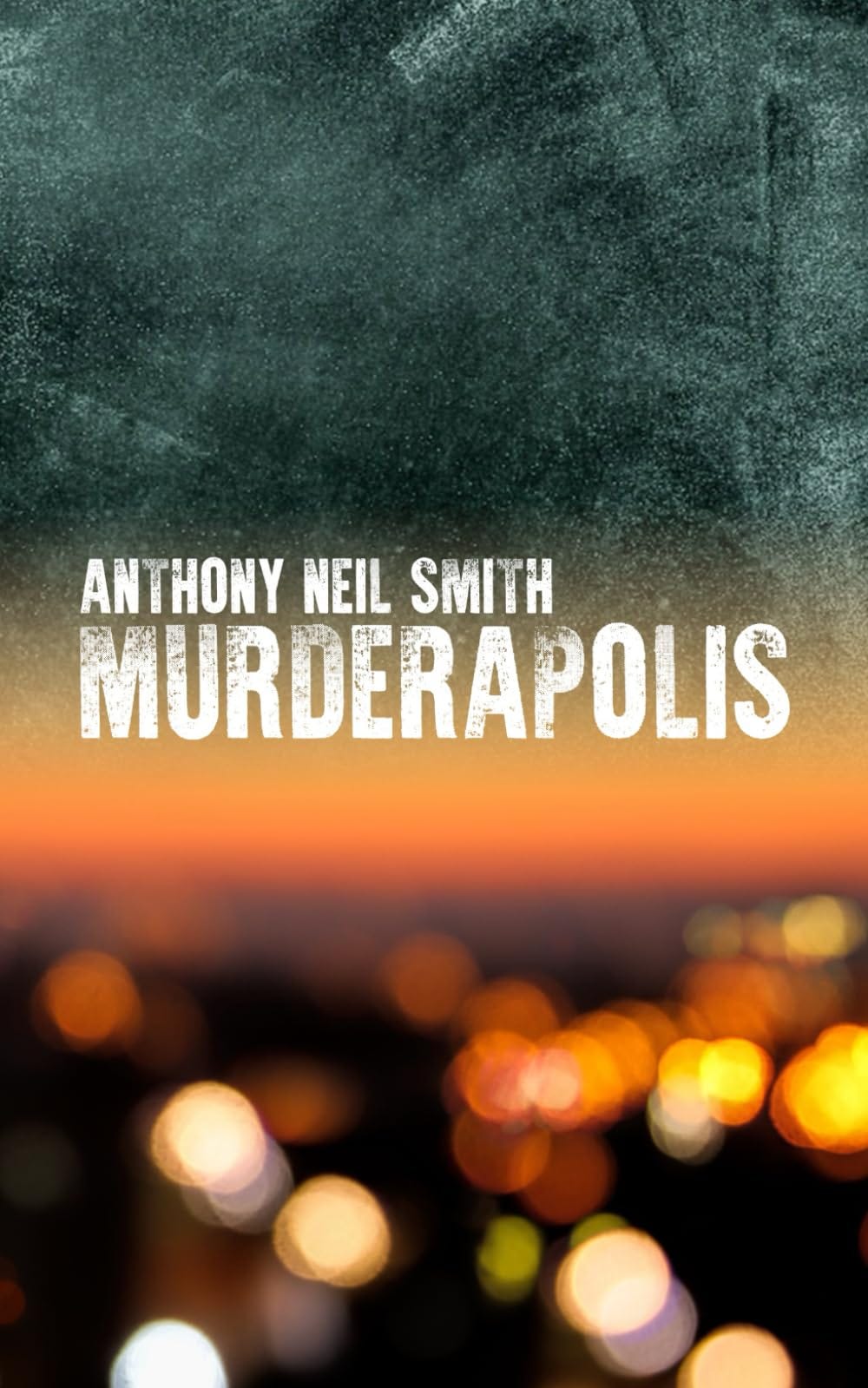
There’s little if any honest curation in crime fiction — most book and media outlets seem to follow the publicist-driven crowd toward the same handful of major-publisher releases — and so a small-press marvel like Murderapolis doesn’t have much of a chance to grab eyeballs, let a lone a second’s thought. But this is a wonderful novel of ambition, skill and bravery, as Smith — a white man — puts himself confidently in the shoes of members of the Somali community in Minneapolis for a a tale of gangs that run large swaths of the city and the few with the will to resist them directly when one up-and-coming crew all but takes over a high school. It’s not only thrilling but expertly written, well paced, and as fresh as a constantly refreshed news-app page. I know Smith a little and think of him as something like the Crash Davis of crime fiction; he’s smart, well-respected and seriously talented, a college professor, but one who’s been toiling in te genre’s minor leagues his whole career and hasn’t been able to level up to the bigs for reasons that are maddeningly ambiguous to me. But Murderapolis is exactly the kind of novel they’re looking for — or should be looking for. Taut, relevant, suspenseful, supremely realistic, unsentimental but full of subtle heart.
The Length of Days, Lynn Kostoff. Like Smith, Kostoff is one of those talents who hasn’t been able to establish a firm foothold in publishing, and as such he’s been able to publish only a handful of noir classics in the past thirty-plus years. But everything about his work is major-league: he’s got a unique voice and perspective, a pointed lack of interest in pat forumlaics, One of my favorites of his is 2010’s Late Rain, set in the fictional community of Magnolia Beach, South Carolina. So is The Length of Days, drawing dark smudgy lines between the haves and have-nots of an waterfront town, and the profitable vices that connect them — and hold each other hostage to a degree. Here, a missing girl from a burned-down whorehouse pits forces eager to distance themselves from a large-scale tragedy against those eager to gain from those who make the mistake of letting their desperation show. Some people in this story may not get permanently dark, but the shadows over their heads seem destined to stay with them wherever they go. And Kostoff’s cool mastery of tone makes it gown down like good smoky bourbon. (Releases July 4 from Stark House Press.)
Murderland, Caroline Fraser. This nonfiction book seeks to explain why the Pacific Northwest incubated so many serial killers in the 1940s, ‘50s and ‘60s, and comes up with a culprit — poison. Namely, lead and arsenic, thanks to the many smelters that once belched filth from smokestacks up and down Puget Sound and beyond. It’s an odd but endearing tome, a funky mix of pointy-headedness and populism and puckish humor. (i.e., in discussing Charles Manson’s likely exposure to lead and arsenic during his six years in the federal prison on McNeil Island in south Puget Sound, she concludes with “Helter smelter.”) But there’s something oddly endearing about her sincerity, and the marshaling of her considerable prose-crafting powers in the service of her digressions and obsessions … and, well, it’s my backyard (I grew up on Bainbridge Island). It’s a little like reading a term paper by a gifted student on the autism spectrum.Speaking of books, a lot of my (fleeting) free time these last several weeks has been spent re-reading a forever favorite: the novel Nobody’s Fool by Richard Russo. It is a comfort-food read for me, but it also has extra resonance for me because, like me, Sully — the unheroic hero of the story, the greatest losing non-loser in contemporary fiction, as far as I’m concerned — is also sixty.
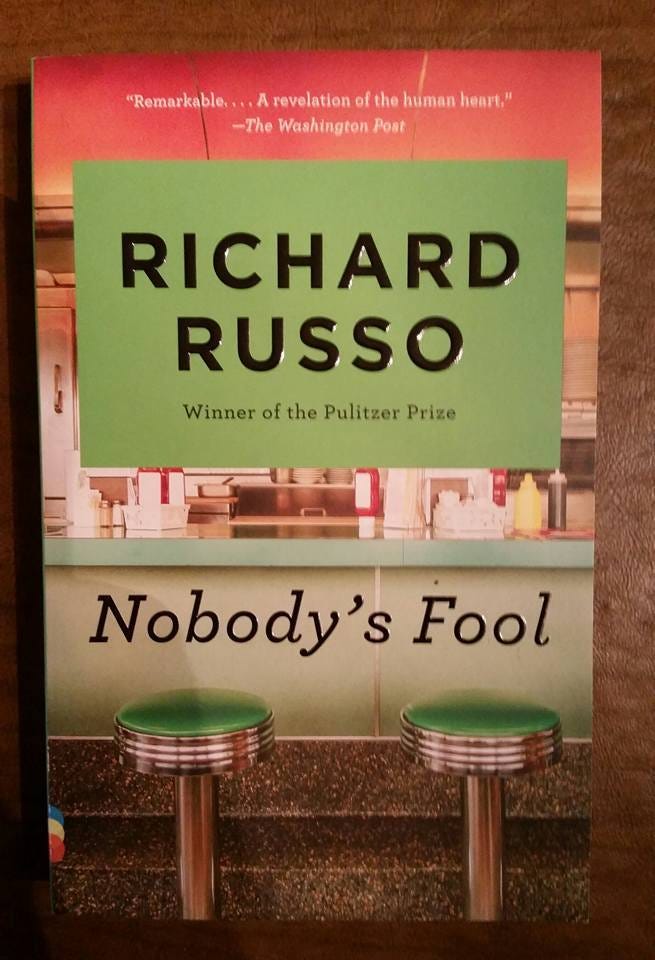
Sully and I have some substantive things in common, and some important differences, and I’ll unpack them all in a future post. But I’ll leave you with this lovely line from the novel, which strikes me as particularly pertinent to my existence right now:
One of his theories about life: You missed what you didn’t have more than you appreciated what you did have. It was for this reason he’d always felt that owning things was overrated. All you were doing was alleviating the disappointment of not having them.We’ll talk again soon.
Comments
Nothing yet. Say the first thing.
Sign in to join the conversation.