
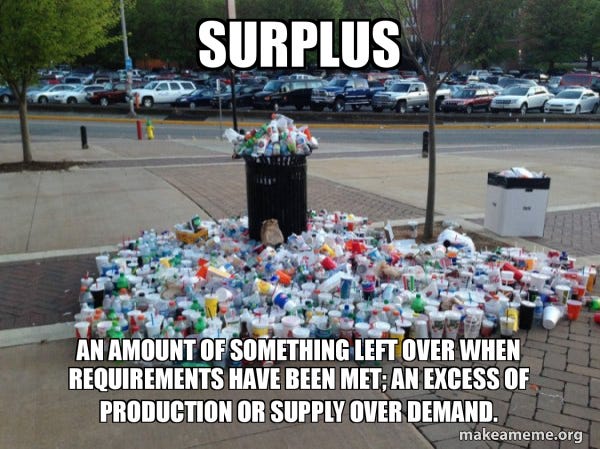
Surplus Elites and Revolution - Edgar and Co. argues that when societies produce more credentialed people than available elite positions, the frustrated surplus destabilizes the existing order. The French Revolution was initiated by bourgeoisie lawyers like Robespierre and not by peasants. The most interesting historical precedent is Victorian Britain, who avoided revolution by channeling surplus elites into colonial emigration and industrial expansion. This is one of the subtle reasons for fiat money’s durability in that bureaucracies can be expanded much further than normal, giving surplus elites more places to go.
Old Money Estates - Ben Black argues that modern families should stop dividing wealth equally and instead concentrate assets to compound across generations like the British landed gentry. He profiles a cautionary tale of a family farm held five generations, liquidated by a stepmother within a decade due to lack of governance structures. The modern solution isn’t rigid primogeniture but family trusts, constitutions, and intentional successor selection based on fitness. A fascinating blend of historian and financial strategist pushing back against what he calls the “shortsightedness of modern individualism.” Unfortunately, the biggest barrier is still the government, who in England have destroyed many historical estates through taxes.
Young Adult Costs - Johann Kurtz shows how previous generations accessed valuable social capital like trusted communities, functional schools, and safe neighborhoods for free, which current young adults must now purchase. His main insight is that these things are still available but are rolled into home prices. This has resulted in home price-to-income ratios hitting 5.0 in 2024 versus 3.2 in the 1990s, median first-time buyer age jumping from 29 to 40, and the “desired husband” income being 58% higher than what available men earn. Expensive suburban housing isn't luxury but now necessary infrastructure. You're buying supervised childhoods, quality schools, and safety that communities once provided organically. Societal debasement is as real as the fiat debasement which caused it.
AI Boom Trajectory - Groundbreaker makes a purely financial analysis of the AI boom, and it has some real insight. He does this because he argues that the boom isn't a tech cycle but a credit-driven real estate cycle identical to 2008. Credit-driven cycles only require deceleration and not collapse to break the market as these companies are on something like a refinancing treadmill. He notes that the risk is very centralized. Of the roughly $2.1 trillion in cloud obligations, half is owed by just OpenAI and Anthropic. OpenAI's valuation step-ups decelerated from 1.9x to 1.23x per round while burning $115 billion. And these aren’t even the worst! There are lots of leveraged players who only need a little softening of sky high prices to blow them up.
Rigged Betting - Quoth the Raven writes this reflection on gambling, markets and trading. He was triggered by a McGregor bout where the fighter appeared compromised and argues both sports betting and financial markets have become rigged. He cites massive puts on oil before a Trump ceasefire announcement, NBA players manipulating prop bets, and officials trading in companies affected by their own policies. He made me wonder how much of the daily anxiety we feel is suspicion that zero-sum games are being rigged against you.

Orange Pill Order - I talked on this podcast for two hours, talking about everything from my origin story to BIP110 and Production Ready. I thought the most interesting parts were where we discussed strategies for young people today and how to take advantage of the opportunities that Bitcoin gives them.
BTC Prague Debate in Korean - The panel I did with Jeff Booth and Natalie Brunell has been translated to Korean. This is a debate we need to have more of given how much video content a relatively short panel from the conference has produced. Here is Part 2.


Bitcoin Core GUI Preview - The Bitcoin Core design community released downloadable signet preview builds of their new Qt Quick graphical interface for both macOS and Linux. The app showcases block status, activity tracking, and send functionality in a clean modern UI that looks nothing like the dated Qt Widgets interface Bitcoin Core has shipped for years. They explicitly warn against using it with mainnet funds since these are experimental builds continuously updated from the gui-qml branch.
BIP110 Bug - This technical writeup identifies a consensus vulnerability in Bitcoin Knots v29.3 where nodes that upgrade to enforce BIP110 rules can unknowingly retain pre-existing blocks that violate those rules, diverging from nodes that enforced them from the start. The core issue is that BIP110 validation lives inside ConnectBlock() but nodes trust their persisted chainstate on restart without re-running those checks. The authors compare this to the SegWit upgrade, which included explicit guards like NeedsRedownload() to catch exactly this scenario, and demonstrate the bug across three rule violations on regtest.
Safe Coin-Splitting - Robin Linus proposes an elegant method for spending forked eCash coins (coming 8/15) without exposing corresponding Bitcoin holdings to replay attacks. The trick is constructing a transaction that spends both the valuable pre-fork UTXO and an eCash-only dust UTXO that cannot exist on Bitcoin, with SIGHASH_ALL binding the signature to the entire transaction including the chain-specific dust input. Since removing or changing the dust input invalidates the signature, the transaction becomes mathematically unreplayable on Bitcoin. It’s been a minute since replay protection was an issue, but from my observations, it’s really only a problem for the first couple of days before solutions like faucets become more widely known.

BitFitness - BitFitness merges physical fitness culture with Bitcoin philosophy, creating a community where participants earn satoshis through exercise challenges, tournaments, and health-focused educational content. The concept treats fitness achievements as literal proof of work, making the connection between bodily effort and micropayment compensation explicit through Lightning rewards. Members compete in structured challenges that link physical exertion to sat stacking. It is a niche but growing intersection of the Bitcoin wellness community that takes “health is wealth” literally.
SuperScalar - ZmnSCPxj’s SuperScalar channel factory design now has a working C implementation that puts 127 self-custodial Lightning clients behind a single on-chain UTXO with no soft fork required. The team demonstrated a full lifecycle on public signet with cooperative closure in one transaction, plus 24-hour sustained operation routing 99 payments across independent clients. Security testing includes cheat drivers that successfully defeat LSP dishonesty attempts, and the system integrates with unmodified Core Lightning nodes via a bridge. Splice runtime and PTLC support remain incomplete, with external audit required before any mainnet deployment.
Path Queries v2 - A revised bLIP proposing three optional peer messages (query_path, reply_path, reject_query_path) that enable cooperative payment path construction in Lightning. This works by allowing nodes to query peers for routing information from first-hand channel knowledge rather than relying solely on the gossiped graph. The v2 revision migrates from a BOLT to a bLIP since adoption can be partial, overhauls the wire format to use TLV streams with MPP path components, and adds DoS protections. This could meaningfully improve routing reliability by supplementing stale gossip data with real-time channel state, especially for mobile nodes with incomplete graph views.

Orange Juice - Orange Juice is a permanent capital holding company that acquires stable businesses generating $1-10 million in annual cash flow, backing them by a Bitcoin treasury and targeting an eventual public listing. The founding team includes Jeff Booth, Lyn Alden, and Andi Pitt from Ego Death Capital, with Ricardo Salinas as a major investor. Unlike traditional PE shops constrained by fund cycles, sellers can retain equity stakes and transition gradually. For me, this is the first instance of a Bitcoin-based small-business acquire-and-improve private equity firm, which has been all the rage in the fiat world for the past 10 years. The fiat versions rely heavily on debt, which I hope this company does not.
The African Bitcoin Ecosystem - Farida Bemba Nabourema delivers a scathing critique of Bitcoin adoption projects across Africa, arguing they have devolved into performative initiatives that exploit communities for fundraising rather than delivering genuine economic transformation. She estimates that combining all genuinely active participants across celebrated adoption initiatives likely totals fewer than 10,000 people on a continent exceeding one billion. The piece draws uncomfortable parallels to international development patterns where communities become marketing material while enriching project founders through speaking fees and sponsorships. Her core argument is that Bitcoin’s revolutionary potential for African monetary sovereignty is being hollowed out by this performative rent-seeking.
Venezuelan Earthquake Relief - After a recent earthquake in Venezuela, grassroots organizers bypassed traditional NGO channels entirely and launched Bitcoin crowdfunding campaigns on the Agora platform. Three specific campaigns emerged: medical field brigades, psychosocial support for displaced children, and installing Starlink antennas to restore connectivity in blacked-out zones. Instead of top-down KYC paperwork, Agora uses a decentralized web-of-trust model where local activists with established civil society networks vouch for campaigns. It is a compelling real-world demonstration of borderless peer-to-peer fundraising when traditional channels are either too slow or too bureaucratic.

Bitcoin Price DB - A historical price archive spanning 12 years of daily BTC data.
Tollbooth DPYC - A way to monetize MCP servers through Lightning without KYC.
BIP110 Fork Monitor - A clean real-time dashboard tracking BIP110 activation.
The ETF Numbers - A Substack analysis examines overlooked correlations between Bitcoin ETF mechanics and price dynamics.
Fiat delenda est.
No posts
Comments
Nothing yet. Say the first thing.
Sign in to join the conversation.