
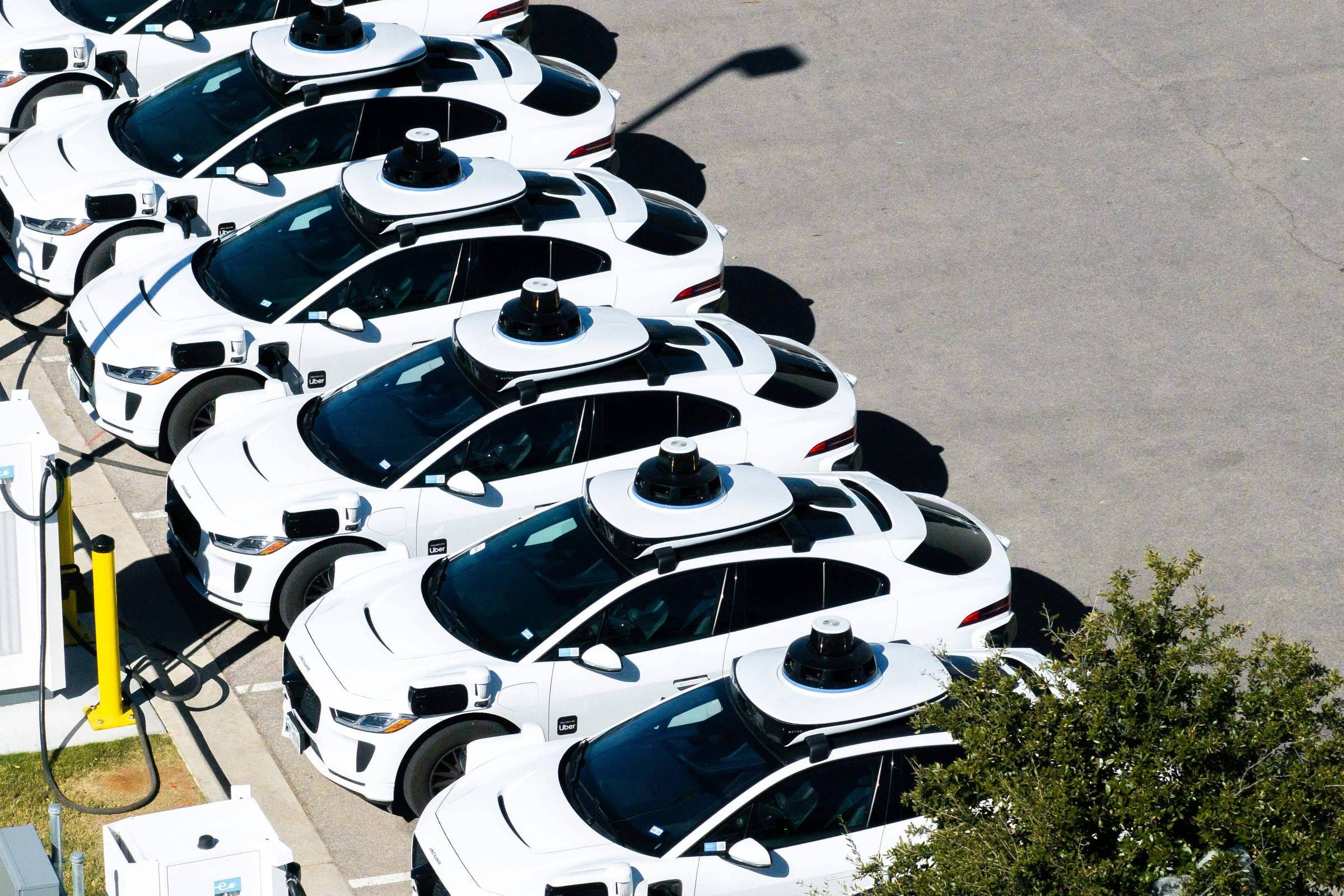
When people talk about “Physical AI” - a theme that has become increasingly popular across Substack and X - the first image that usually comes to mind is humanoid robots replacing workers in factories or helping with everyday household tasks.
But we often overlook the fact that the closest thing we have today to a truly operational and commercially viable wave of Physical AI is already on the road: autonomous vehicles (AVs).
These same AVs have become a major topic of debate in recent days, especially among investors who are bullish/bearish on Uber ($UBER) - thanks to the never-ending saga involving Waymo, Google’s ($GOOGL) autonomous vehicle company.
Much of the discussion, however, still reflects different interpretations of a market that remains relatively new and difficult to measure.
Our goal with this deep dive - if we can even call it that - is to bring more context to the debate by exploring operating metrics, unit economics, global comparisons - especially China - and several other topics.
More importantly, we’ll share our view on who is best positioned to win over the long term - and whether this race will ultimately produce a single winner at all.
I hope you enjoy the read. Don’t forget to subscribe to Jimmy’s Journal and share this article using the link below.
Introduction
Brief History
The Current Landscape
The 2030/2035 Projection
The Battle of Business Models
Competitive Strategy
Unit Economics
The China Parallel
Endgame: Who Wins?
Final Thoughts
On Friday, July 24, the Financial Times reported that Waymo was considering ending its partnership with Uber amid growing tensions, including disagreements over regulation.
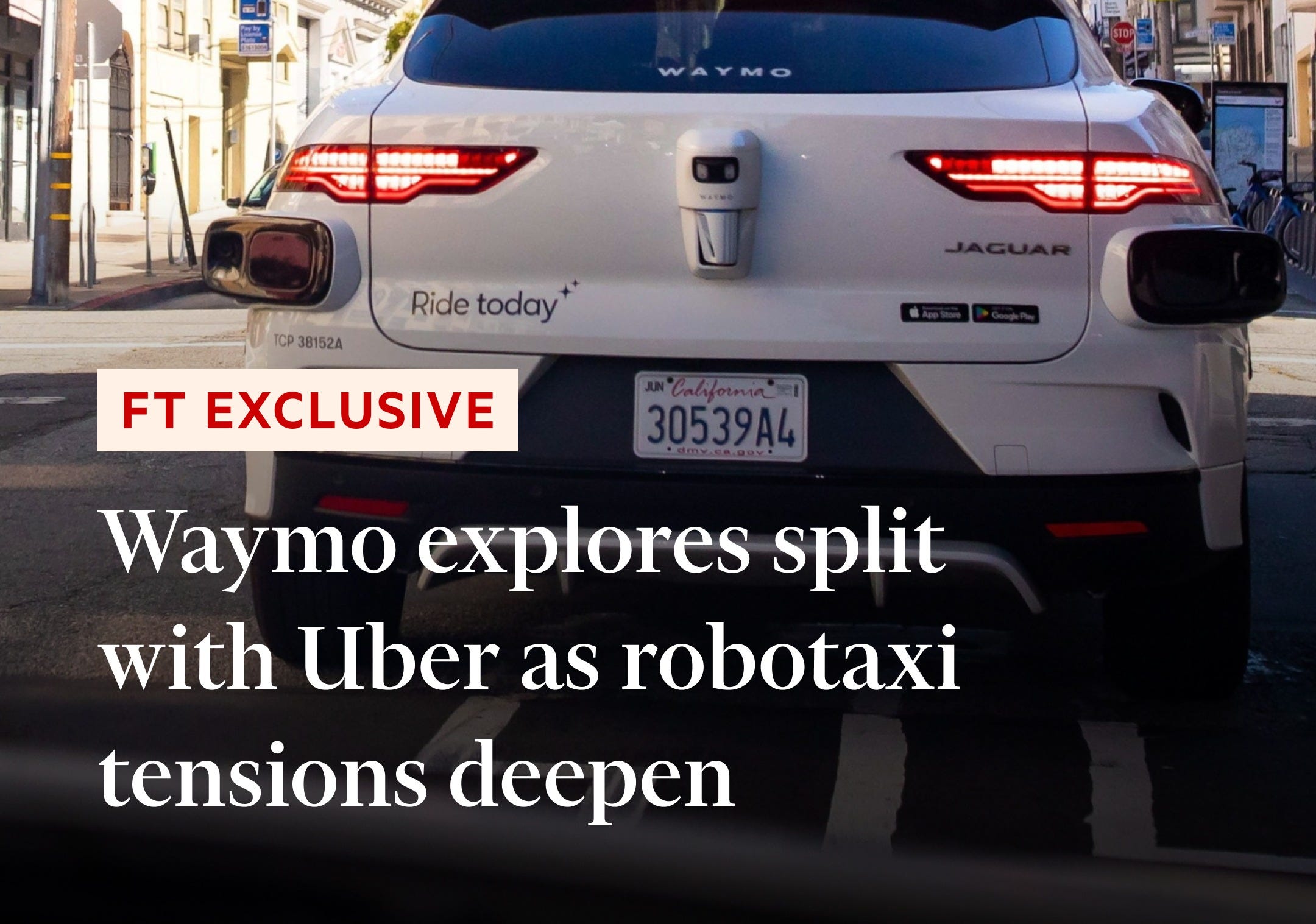
At first, it looks like a simple contract dispute. But it points to the question that will define the entire sector: once the car drives itself, who owns the customer - the company behind the vehicle, or the platform that controls the demand?
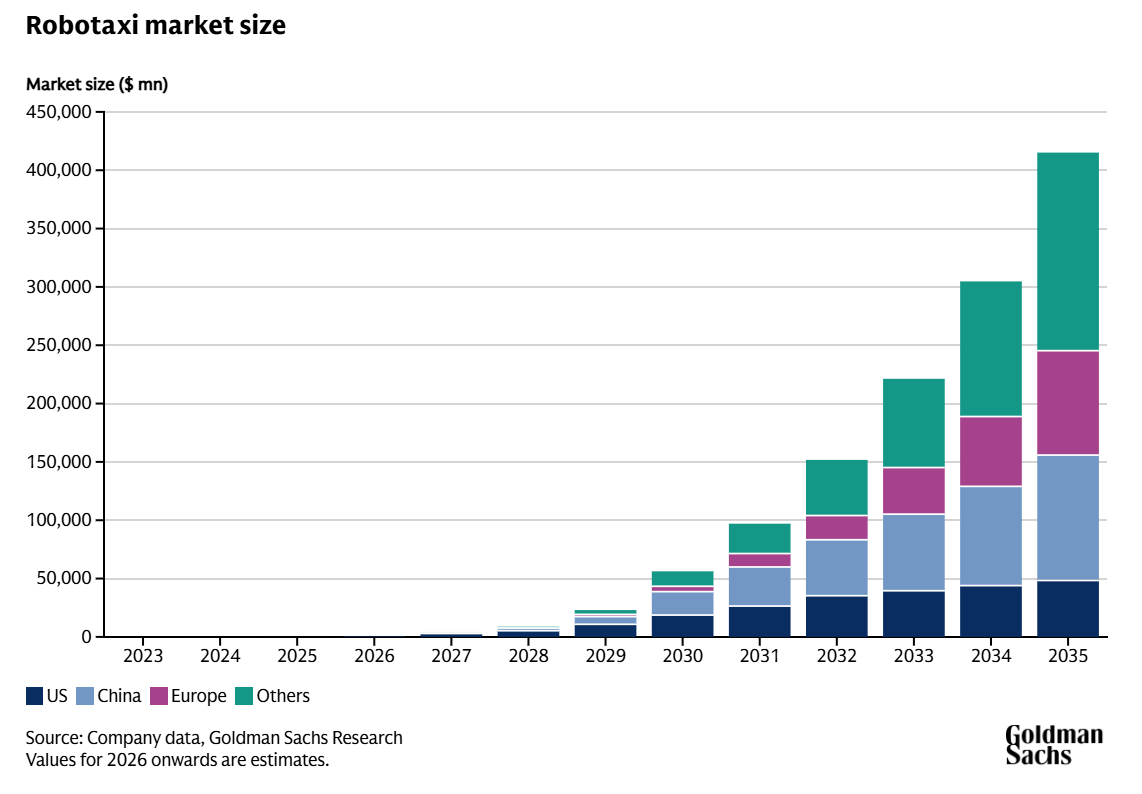
According to Goldman Sachs, that question could be worth $415B by 2035, if its estimate for the size of the global robotaxi market proves correct.
As we always like to do around here, the best place to start is with the historical context - which we will explore next.
The modern AV industry has an unusual origin - although one shared by many major technological breakthroughs: the US military.
In 2004, the Defense Advanced Research Projects Agency, better known as DARPA, offered $1M to any team capable of driving a vehicle across a 142-mile route through the Mojave Desert without a human on board.
If you’re in the mood for a little nostalgia, here’s a video I found buried on YouTube from the event: (maybe save it for the end, so you don’t lose the flow of the article).
The result wasn’t particularly encouraging. Every entrant failed, and the best-performing vehicle covered only 7.5 miles before becoming stuck.
One year later, however, 5 vehicles completed the course. A Stanford team led by Sebastian Thrun won the race - and the $1M prize. Google later hired Thrun and launched its self-driving car project in 2009. That project eventually became Waymo in 2016.
What followed was more than a decade of investment with little or no financial return.
Uber, General Motors, Ford, Amazon, Baidu, and a long list of startups poured tens of billions of dollars into the promise that fully autonomous fleets were always “two years away.”
And guess what?
They weren’t.
Uber eventually sold its self-driving unit to Aurora in 2020, following a fatal test crash in 2018 and years of heavy losses.
Ford and Volkswagen shut down Argo AI in 2022.
GM stopped funding Cruise’s robotaxi operations in December 2024 after a serious incident involving a pedestrian in San Francisco - a decision the company expected to save it more than $1B annually.
The companies that emerged in the strongest positions were generally those supported by very deep pockets: (i) Zoox, backed by Amazon; (ii) Waymo, backed by Alphabet; and companies such as (iii) Tesla and (iv) Baidu, which could fund their autonomous vehicle ambitions through much larger existing businesses.
Pony.ai and WeRide, two of the largest independent players still standing, don’t enjoy the same degree of financial protection. That helps explain why they have been much more vocal about achieving unit economics breakeven city by city before aggressively scaling their fleets. Pony.ai has already reported reaching this milestone in Guangzhou and Shenzhen, while WeRide has done so in Abu Dhabi.
While billions of dollars were being burned across the industry, Waymo quietly did the hard part.
It opened fully driverless rides to the public in Phoenix in 2020 and later expanded into San Francisco and Los Angeles. In May 2024, the company was completing approximately 50,000 paid rides per week.
Then the curve bent sharply upward…
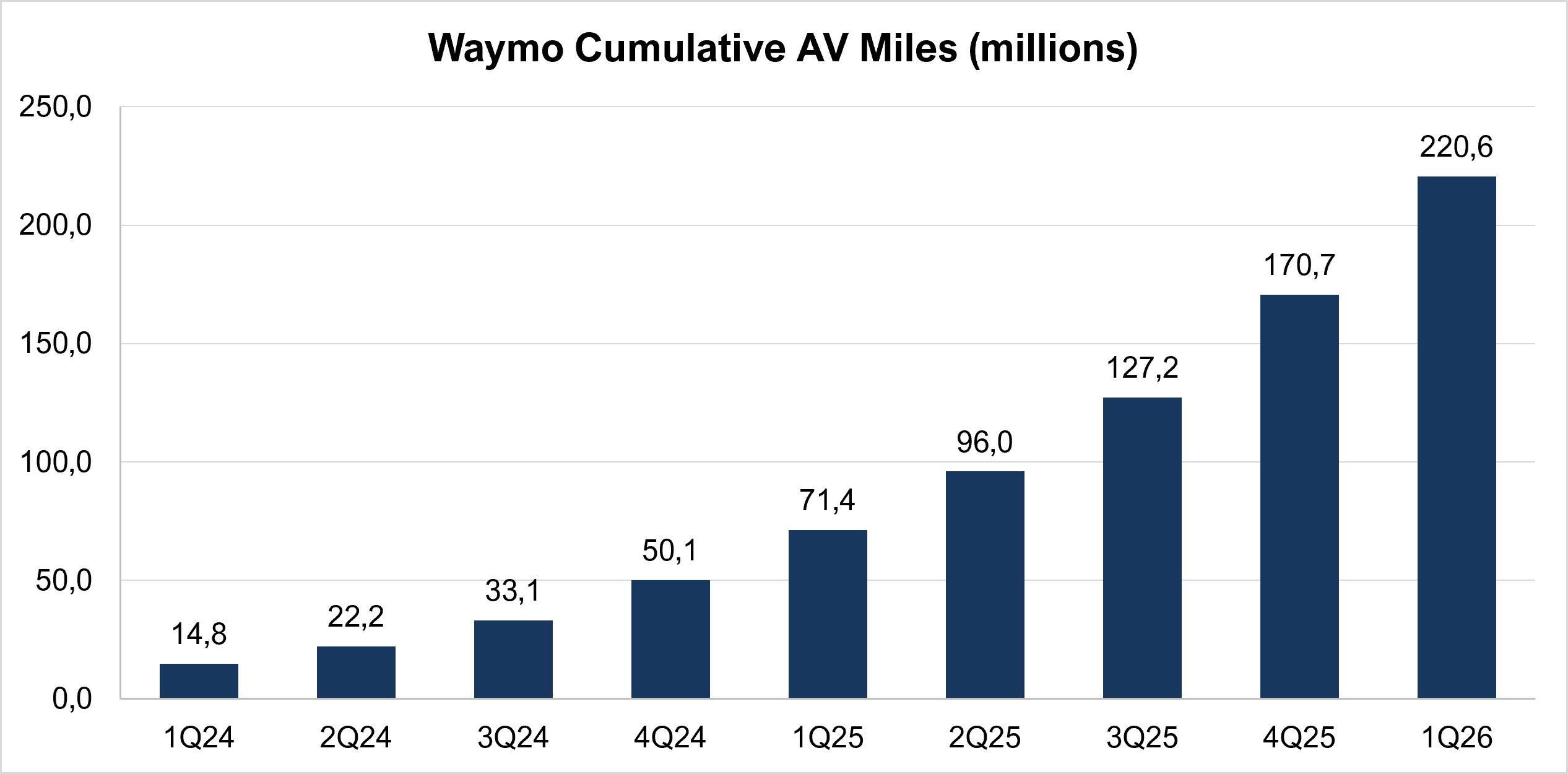
That shift - from demo to real scale - is why 2026/27 marks the moment when the debate moves from the technology to the business model.
Found this content valuable? Share it with your network! Help others discover these insights by sharing the newsletter. Your support makes all the difference!
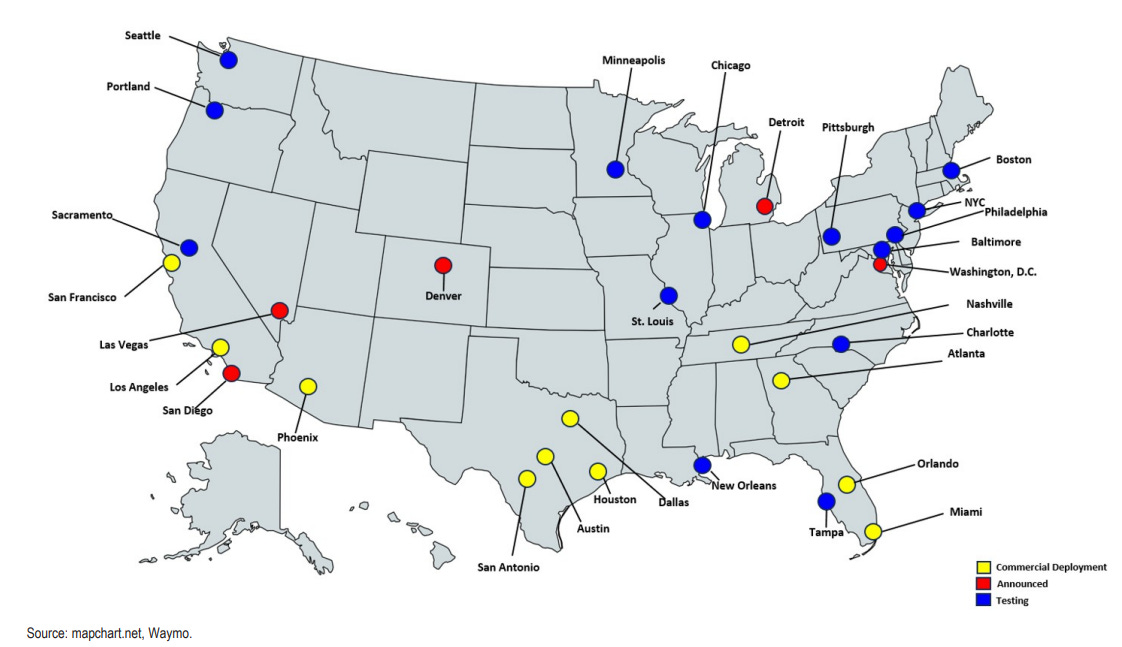
By the end of Q1 Waymo had crossed 500,000+ paid rides per week across 10 US cities - a 10x increase in less than 2 years.
In February 2026, it raised $16B at a $126B post-money valuation, a record-setting round for the AVs industry – and almost in line with $UBER, which, at $70/share, has a market capitalization of around $144B.
Waymo currently operates a fleet of around 3,000 vehicles (NHTSA filings showed 3,067 5th-generation cars as of December 2025), driving more than 4M fully autonomous miles every week. It is, by a wide margin, the largest standalone operator in the US market.
Pony.ai had produced 1,446 robotaxis by late March.
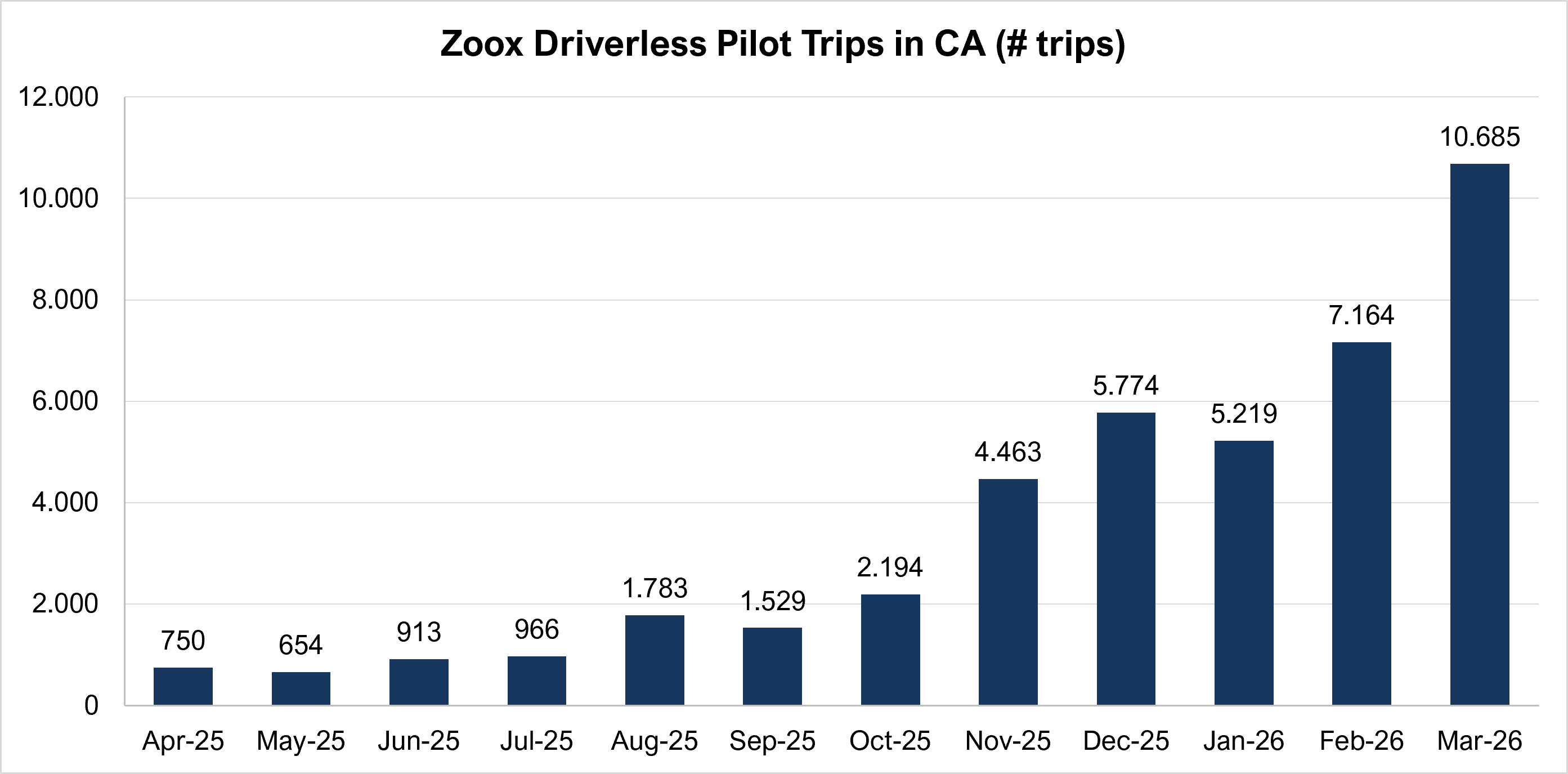
Zoox, owned by Amazon, was expanding toward a fleet of only around 100 purpose-built vehicles and was still waiting for the regulatory approval required to charge passengers at scale.
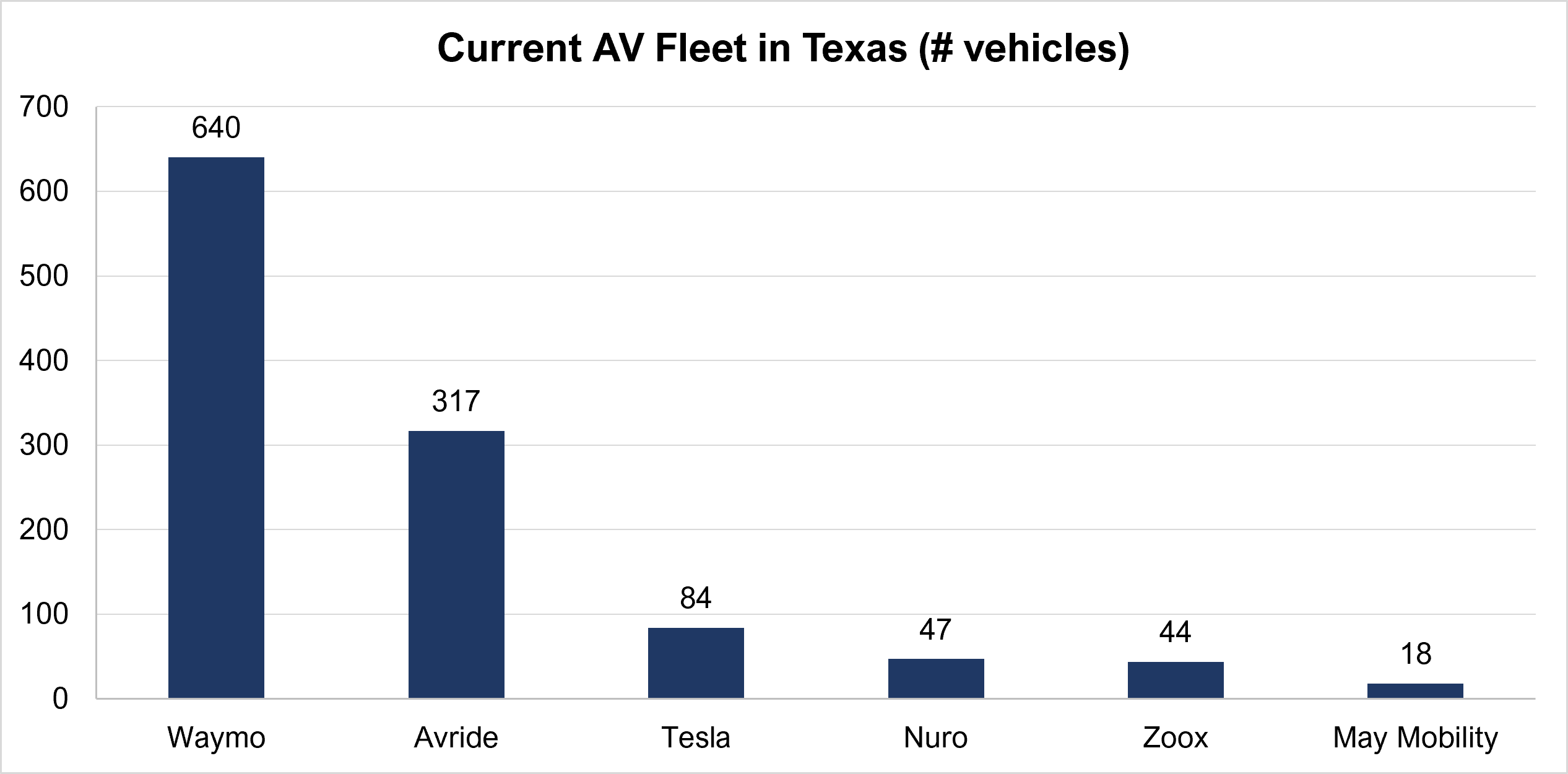
Tesla - whose robotaxi ambitions account for a meaningful part of its equity story - was also operating at a much smaller scale. By late spring, it had around 84 autonomous vehicles registered in Texas and only ~20 operating without an in-car safety monitor.
Texas registrations offer a useful, although imperfect, proxy for who’s actually putting vehicles on the road. Waymo leads with ~640 registered vehicles, followed by Avride with 317 and Tesla with just 84. Zoox, Nuro, and the remaining players are all below 100 vehicles - and most aren’t yet charging fares.
For comparison, Uber and Lyft drivers complete ~675,000 trips every day in New York City alone.
Yes, you read that correctly.
After 20 years and likely more than $100B+ poured into autonomous driving, Waymo still completes fewer paid rides in an entire week than Uber and Lyft complete in a single day in one American city.
Can you see how capital-intensive this business is?
Alphabet’s Other Bets segment - which includes Waymo - reported $411M in revenue against a $2.1B operating loss in Q1 2026 alone.
Meanwhile, Waymo’s estimated annualized revenue was around $355M when it raised capital at a $126B valuation. That implies a multiple of almost 355x EV/Sales (and you thought the SpaceX IPO was expensive).
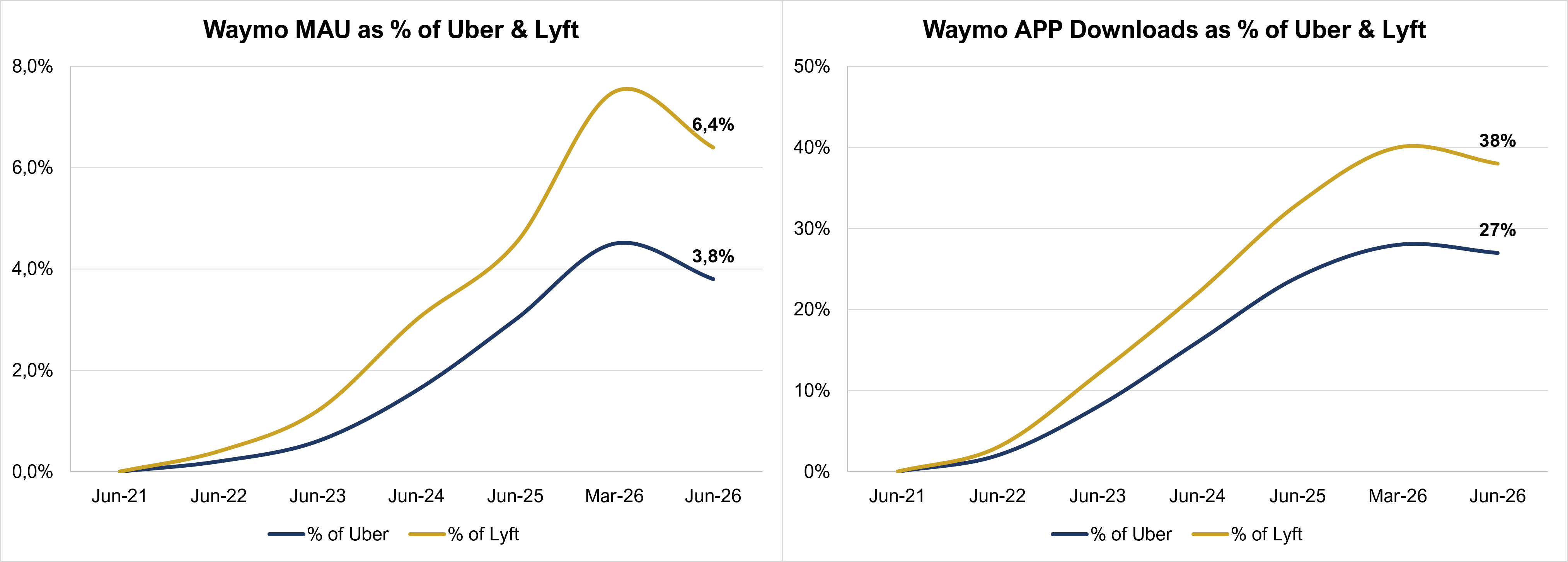
Enjoying the content? Upgrade to Jimmy’s Journal Pro to unlock the full experience.
Of course, these numbers can only be justified by the company’s future growth potential.
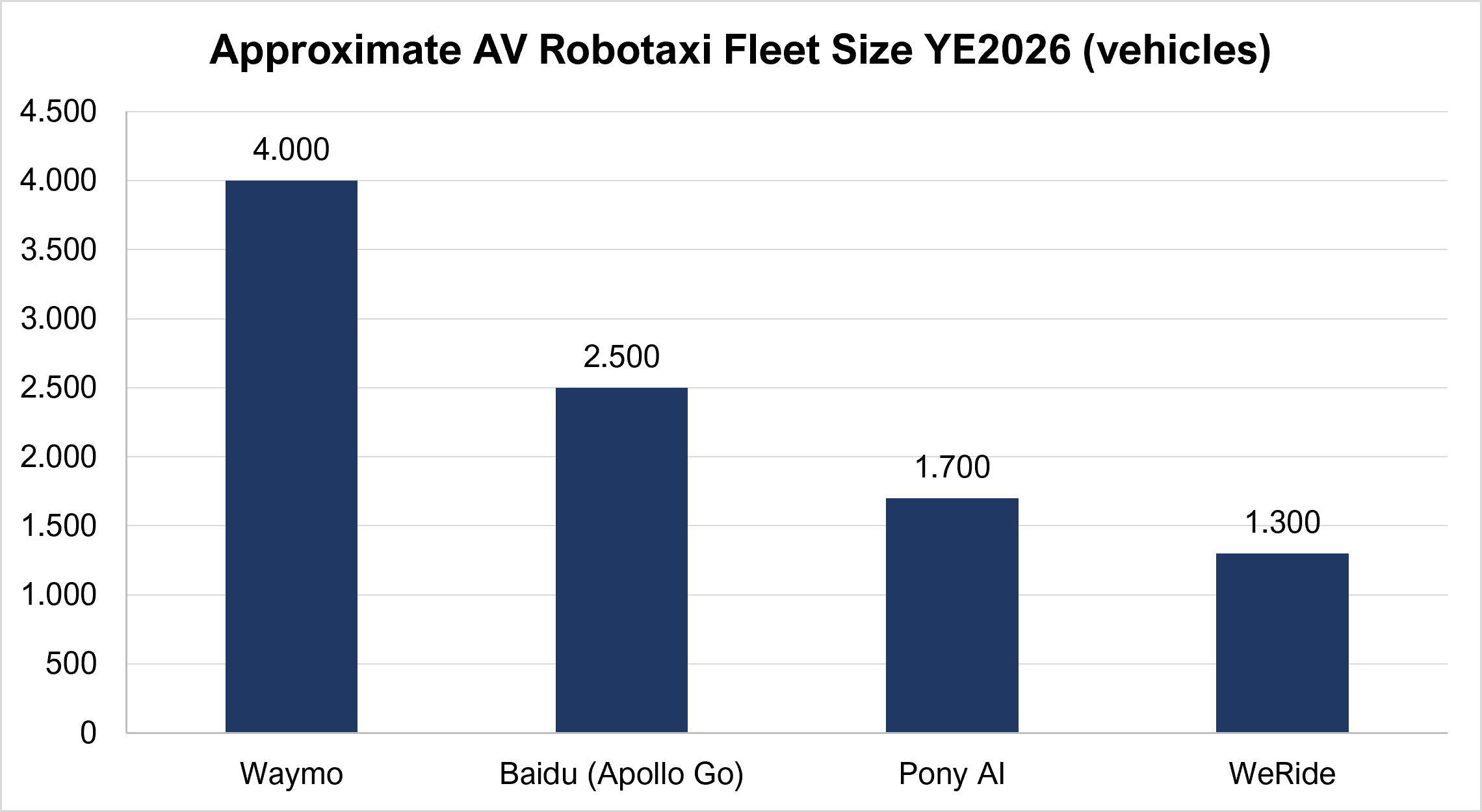
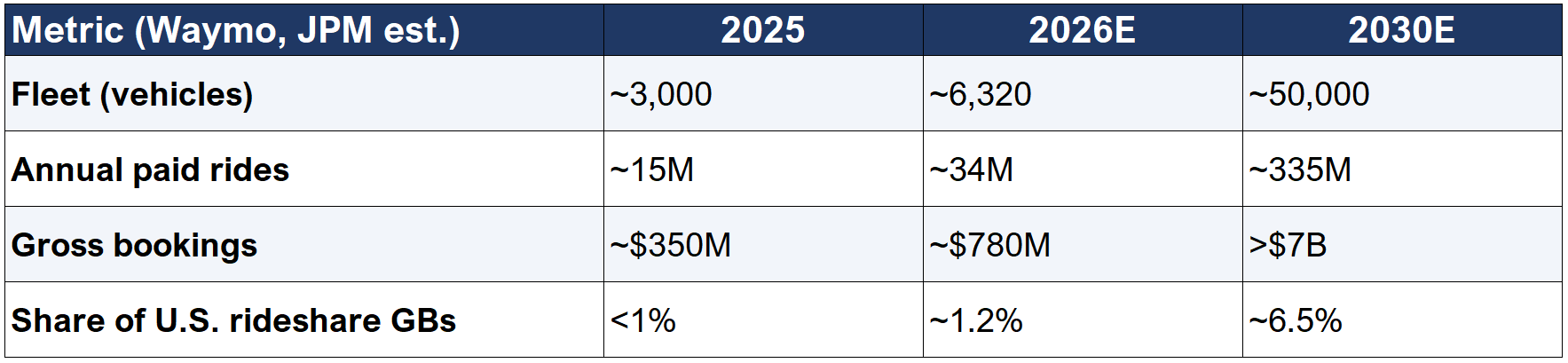
According to JP Morgan’s estimates, Waymo’s fleet is expected to grow from ~3,000 vehicles at YE2025 to around 6,320 by YE2026, and to almost 50,000 by 2030 - an incredible +76% CAGR.
Rides are expected to scale even faster, from ~15M in 2025 to 34M in 2026 and around 335M by 2030 - an +87% CAGR - pushing Gross Bookings above $7B by the end of the decade.
Under these estimates, Waymo is expected to capture around 1.2% of US rideshare GBs in 2026, rising to 6.5% by 2030. In other words, even the bull case leaves much of the US rideshare market in human hands at the end of the decade.
In Goldman Sachs’ long-term projections mentioned earlier, the global robotaxi market reaches $415B by 2035, with the US market reaching $19B in 2030 - revised sharply upward from a previous estimate of $7B - and $48B by 2035. The global commercial robotaxi fleet, meanwhile, grows from 7,000 vehicles in 2024 to 1M in 2030 and 6M in 2035.
These projections also contain a few interesting points, the most important one being geography.
GS puts China at $61B and the US at around $48B in 2035. That means approximately $306B - nearly 3/4 of the global forecast - must come from markets such as Europe, the Gulf, Japan, and Latin America, where commercial driverless services are still almost nonexistent today.
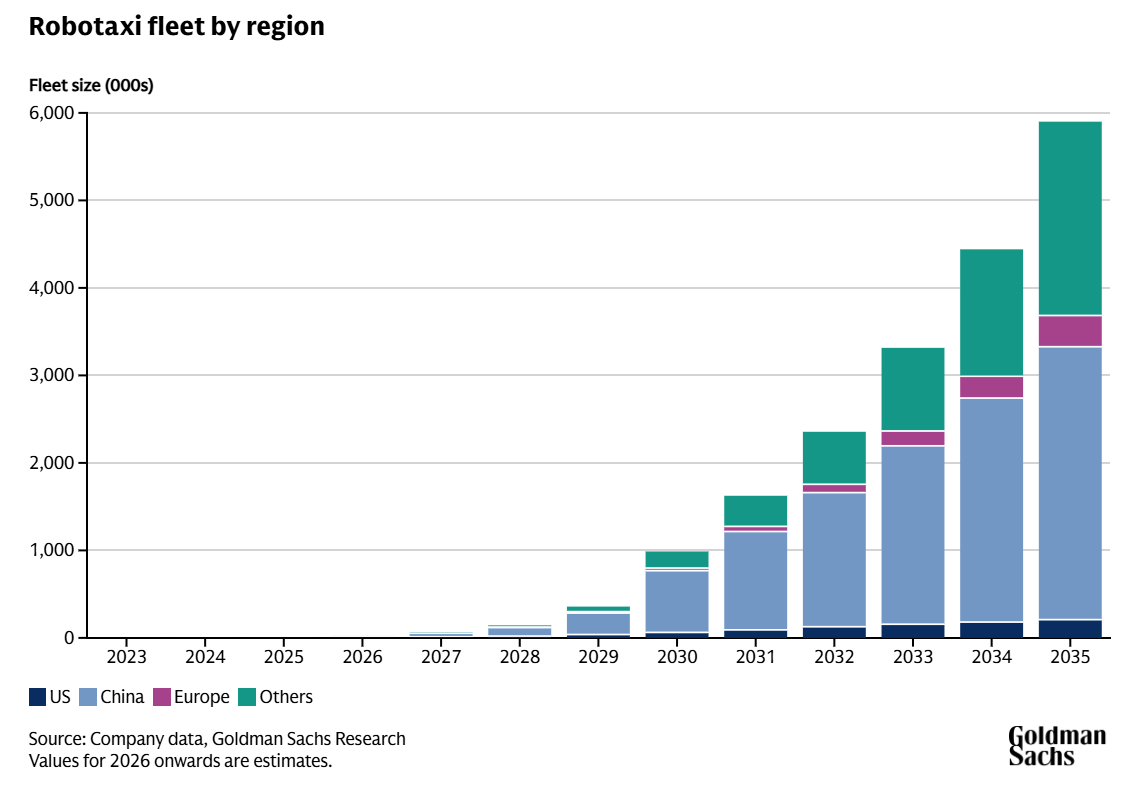
As of mid-2026, robotaxis exist in Europe through a commercial service in Zagreb charging around $2.30/ride, while Waymo hasn’t yet completed a paid driverless trip in London.
Still under the same projections, GS expects margins of 30-50% for a vertically integrated operator that both builds and runs its own fleet. That would imply a global gross-profit pool of $150B in 2035 and cumulative gross profits of around $440B over the decade.
Widen the lens to the entire AVs sector - including hardware, software, trucking, delivery robots, and consumer autonomy subscriptions - and Goldman sees roughly $2T in revenue by 2035, of which around $300B would be directly attributable to AI (through virtual-driver software and autonomy subscriptions).
That brings us to the discussion in the next section: the business models that are emerging - and who ultimately captures the largest share of the profit pool.
Found this content valuable? Share it with your network! Help others discover these insights by sharing the newsletter. Your support makes all the difference!
There are, in practice, four distinct business models chasing the same industry - and the players aren’t running the same company at all.
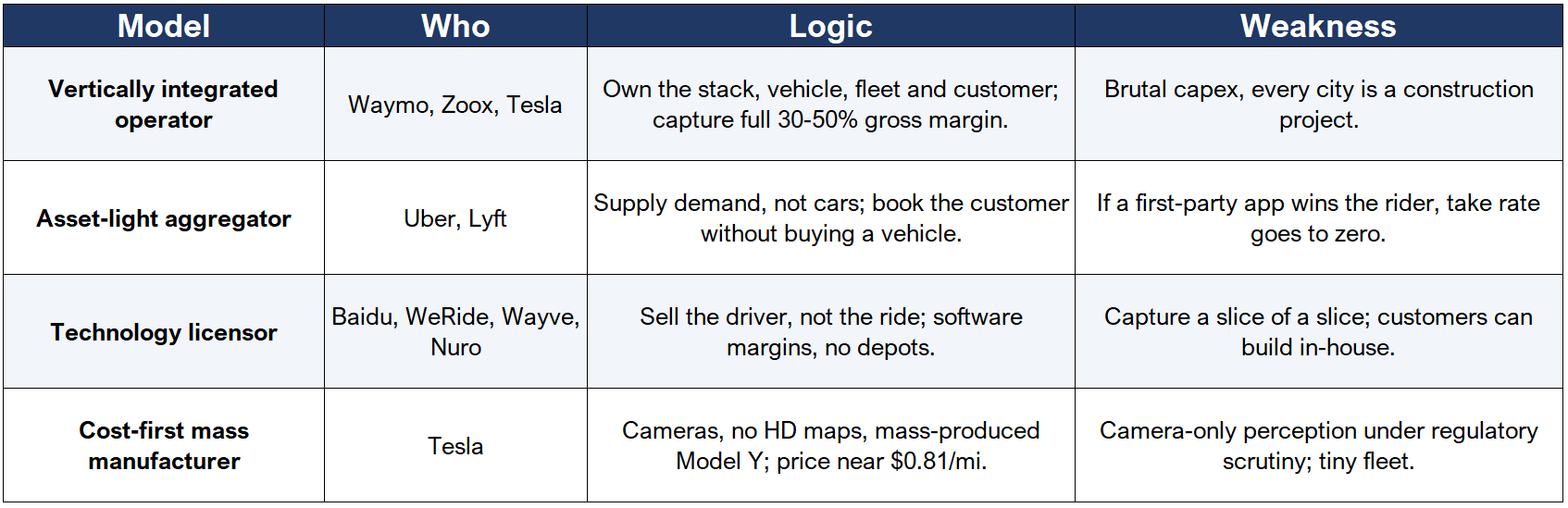
Uber is an asset-light aggregator, while Waymo positions itself as a vertically integrated operator.
Each model has its own strengths and weaknesses, and those differences shape the competitive strategy of each company.
The rest of this report is exclusively for Pro members.
Below the fold, we explore:
how Uber and Waymo are approaching the AV market - and why price and availability will ultimately determine the winner;
Waymo’s unit economics, including vehicle costs, utilization, remote assistance, depreciation, insurance, maintenance, and the cost of entering a new city;
whether the economics of a vertically integrated robotaxi operator can actually work at scale;
what China can teach us about the future of robotaxis; and
the main risks behind Uber’s capital-allocation strategy.
Join Jimmy’s Journal Pro to unlock the full report and our complete library of deep dives, valuation models, portfolio updates, and investment research.
Comments
Nothing yet. Say the first thing.
Sign in to join the conversation.