
Investing in companies is, above all, about finding discrepancies between price and value.
As Warren Buffett put it in one of his most famous lines:
“Price is what you pay. Value is what you get.”
The important point is that gaps between price and value can show up almost anywhere - from the best businesses in the world to companies circling the drain. From “great compounders” to classic “cigar butts”.
Given that reality, many of our readers sometimes ask why we spend almost all of our time studying a relatively narrow group of exceptional companies when mispricings can be found across the entire market.
The unsurprising answer is focus.
We’re certainly leaving some gains on the table by ignoring ordinary businesses. But we’re also convinced that the largest and most repeatable long-term opportunities tend to sit inside the best ones.
I could spend hours explaining why. But, put simply, exceptional companies possess qualitative characteristics that allow them not only to protect the value they have already created, but also to build new value year after year.
That dynamic - the slope of the intrinsic value curve over time - is ultimately the most important driver of long-term returns. It’s also one of the factors the market most consistently underestimates, because investors are naturally drawn to valuation gaps that are easier to identify and quicker to close.
Remove the ticker and the short-term price fluctuations, and what remains is this: any estimate of intrinsic value ultimately rests on a company’s ability to generate future cash flows.
The future, by definition, is uncertain. And cash flows (especially future ones) are the outcome of a constantly evolving interaction between the company, its industry, competitors, and customers, all of which are changing at the same time.
The investor is, therefore, always aiming at a moving target.
For most companies - especially cyclical ones - that target moves in ways no one can predict with precision in the short term, let alone over the long term. No amount of diligence can fully protect you, because the outcome was never entirely in the company’s hands to begin with.
A small group of businesses, which we define as high-quality companies, behave differently.
They possess competitive advantages strong enough to withstand attacks without suffering permanent damage.
They operate in growing industries with enough room to support a long reinvestment runway.
And they are led by management teams capable of anticipating change, adapting early, and allocating capital accordingly.
They can’t eliminate uncertainty. But they can exert far more control over their own destiny.
Quality investing offers several important advantages to investors, whether individual or institutional.
The investor who buys an asymmetry in an ordinary business hopes that the stock price rises toward the intrinsic value he estimates as soon as possible. The more time passes, the longer it takes to realize the expected return, and the more exposed he becomes to uncontrollable risks.
The investor in an exceptional business, on the other hand, can be almost indifferent to the trajectory of the stock price, because the more time passes, the more the value of the investment grows.
In that same sense, you also depend less on market opinion or sentiment for a re-rating. If earnings continue to grow, the adjustment becomes increasingly inevitable as time passes.
When a company is truly exceptional, the return can far exceed any price arbitrage that can be found in an ordinary business.
A company that compounds EPS at +15% annually for 10 years would generate a return of 4x for its shareholders.
How many ordinary companies could do that, with the same level of risk taken?
Large permanent losses of capital usually occur when something fundamental breaks inside the business.
Exceptional companies are, by definition, better equipped to withstand the forces that can permanently destroy value: competitive attacks, technological disruption, poor capital allocation, economic downturns, and changes in customer behavior.
This doesn’t make them immune to mistakes, recessions, or falling stock prices. But it makes permanent impairment of the underlying business less likely.
An investment in an ordinary business often needs to be replaced once the gap between price and value closes.
An investor focused on exceptional companies, on the other hand, can participate in the development of those businesses over time, accumulating knowledge and strengthening conviction along the way - instead of constantly spreading attention across countless short-lived opportunities.
A portfolio built around exceptional businesses also reduces the need to constantly move capital around.
When you understand a company deeply, trust its management, believe its competitive advantages remain intact, and see a long runway for reinvestment, there’s far less pressure to react to every quarter, headline, or market swing.
You don’t need to continuously search for the next idea simply because the current one has already “worked”. As long as the business keeps increasing its intrinsic value at attractive rates, doing nothing can often be the most rational decision.
Charlie Munger, in one of his famous speeches, delivered a line that captures much of the essence of investing in high-quality companies:
“A great company keeps working when you’re not. A great company will eventually earn more and more and more while you’re just sitting and doing nothing. And a mediocre company won’t do that. So you’re harnessing a long range force that will help you. It’s very important. These mediocre companies, they by and large are going to cause a lot of agony and very modest profits. If you do fine, you’ve got to sell it and find another one. It’s a lot of work. Whereas you just buy one great company, and if you get the right thing at the right price, you just sit there.” — Charlie Munger

Found this content valuable? Share it with your network! Help others discover these insights by sharing the newsletter. Your support makes all the difference!
The fact that we believe exceptional businesses can consistently create value and offer some of the best long-term opportunities doesn’t mean we’re indifferent to price.
Any business, no matter how good, can eventually reach a valuation that’s simply too high to justify the expected return.
The market is full of them. And paying too much is one of the biggest mistakes an investor - regardless of philosophy - can make.
Defining a fair price is difficult - even for investors with 20+ years of experience in the market.
Companies with steeper value-creation curves naturally carry more optionality and, therefore, a wider distribution of possible future outcomes.
Mr. Market, in one of his bipolar episodes, may decide that today’s favorable conditions will last forever - and pay too much. Or he may assume that temporary storms will never pass - and abandon those same stocks altogether.
Our job, as quality investors, is to find the best possible balance between the long-term value-creation potential of these businesses and the price the market is asking us to pay for that potential today.
The positive side of quality businesses is that even if you pay a valuation somewhat above what would be considered ideal, the company can often find new ways to create value through new products, adjacent markets, or simply by strengthening and expanding its existing operations.
The arithmetic of value creation is relentless.
And tha’s exactly what we will discuss next.
Stock returns can basically be decomposed into two components: (i) growth in earnings per share (EPS) and (ii) changes in the earnings multiple at which the stock trades.
EPS is perhaps the purest way to reflect a company’s underlying fundamentals (for simplicity, we’re ignoring dividends and assuming that all earnings are reinvested back into the business).
The multiple, on the other hand, reflects market sentiment toward the company, as it captures the level of growth and returns investors are implicitly pricing in.
A recent Credit Suisse study looked at the historical drivers of US equity returns since 1964, measuring how much each factor contributed to returns across different holding periods.
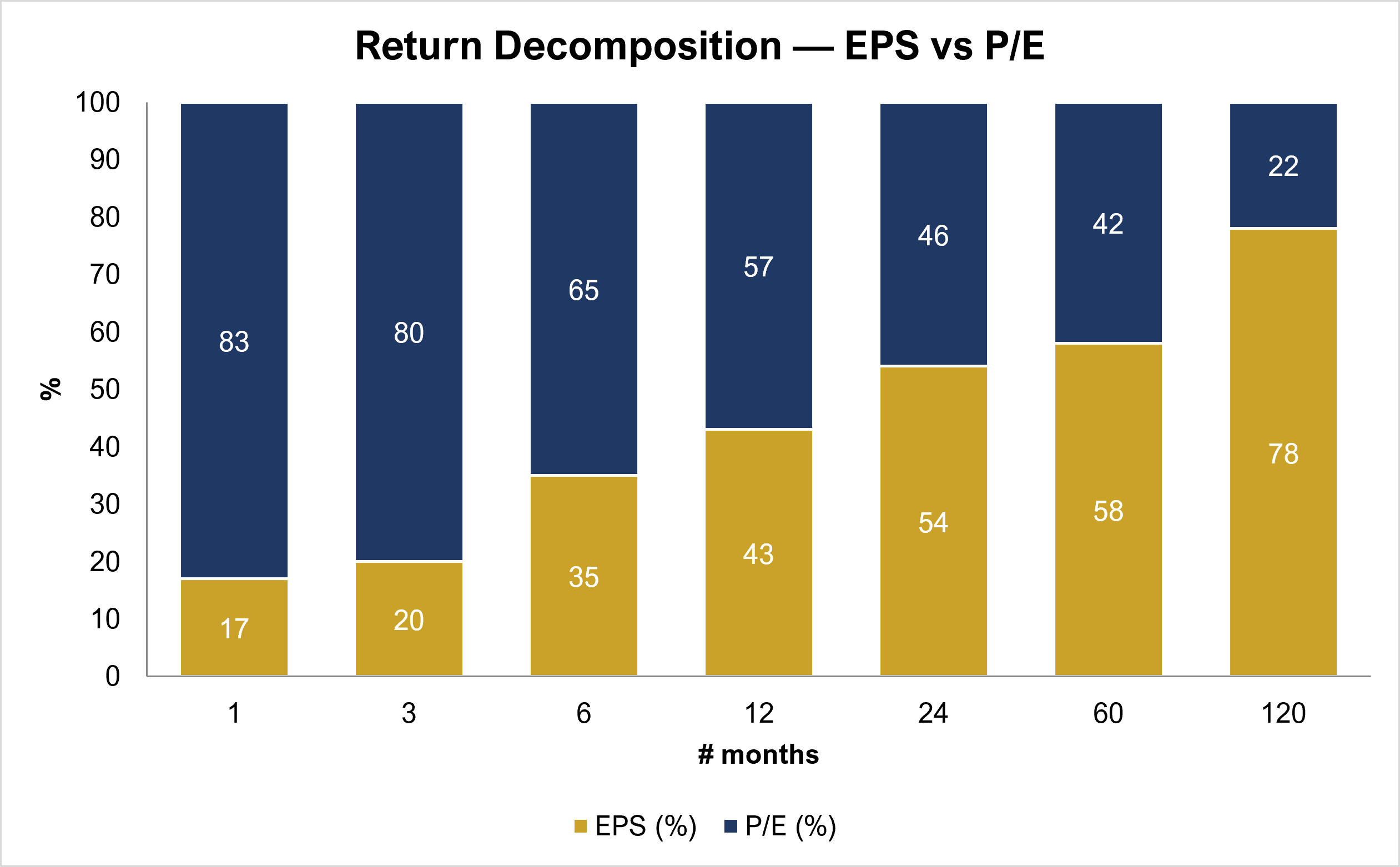
The study’s conclusion, illustrated in the chart above, is that the longer the investment horizon, the less relevant the starting valuation multiple (“P/E” in the chart) became, while EPS growth played an increasingly important role in driving returns.
Put differently, the impact of multiple expansion or contraction tends to fade with time, while earnings growth compounds year after year.
And, in fact, when we run the numbers ourselves, the conclusion is quite similar.
The table below shows the annualized return of a 5-year investment under different EPS growth rates and levels of multiple compression.
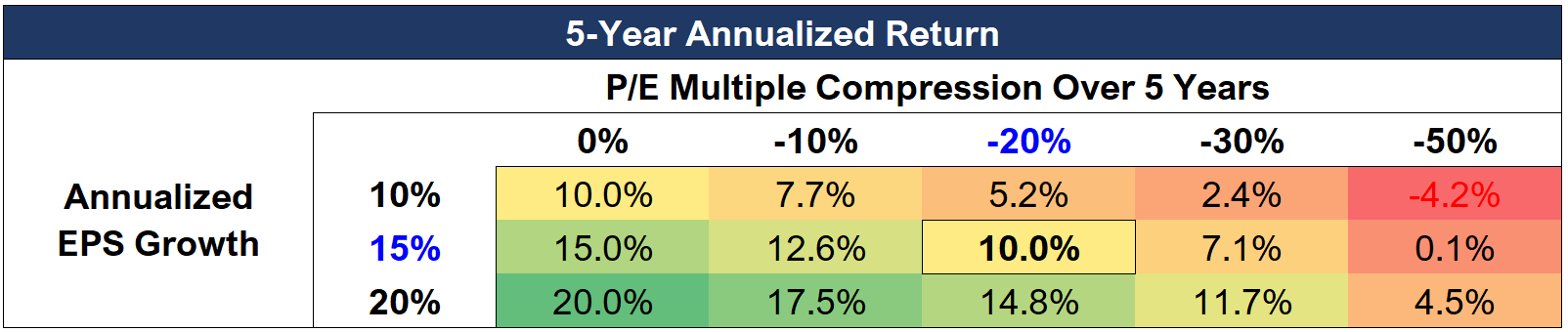
As expected, a company that experiences no multiple compression delivers an annualized return equal to its annualized EPS growth.
On the other hand, a company that grows EPS by +20% per year but sees its valuation multiple compress by 30% still delivers an +11.7% annualized return - slightly above the S&P 500’s historical average of ~11%.
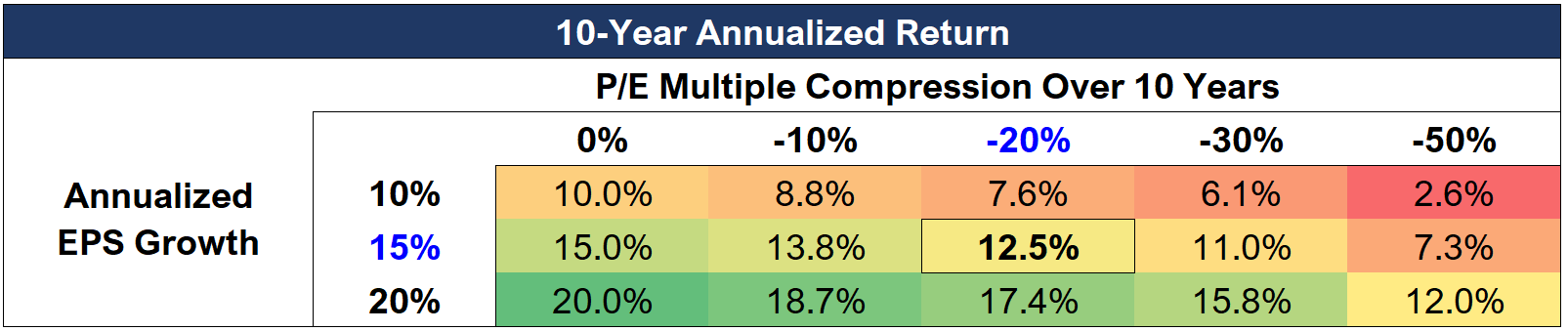
When we extend the investment horizon, the impact of the starting multiple becomes even smaller.
Over a 10-year period, the same company growing EPS at +20% per year while experiencing 30% multiple compression would still have delivered a +15.8% annualized return.
Extend the investment horizon even further - this time to 20 years - and this is what you find:
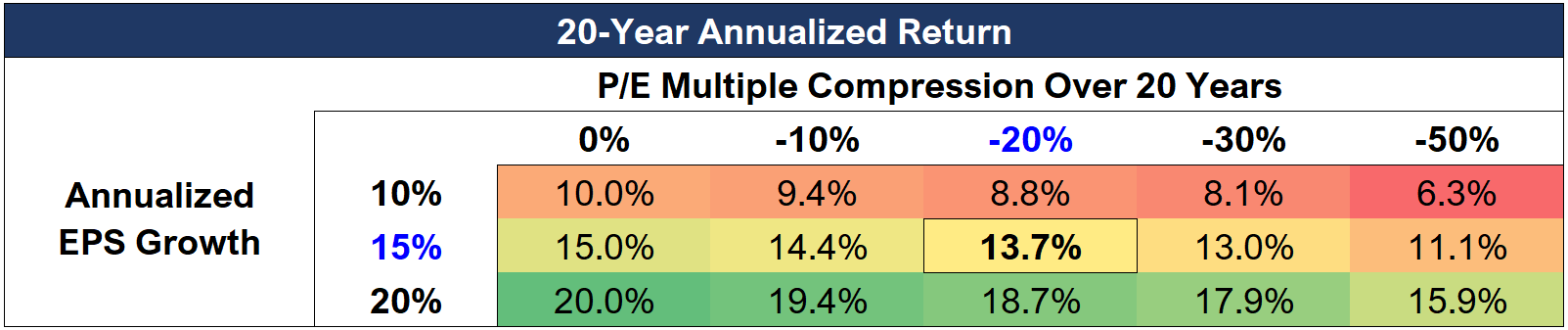
The conclusion is that, as long as the entry multiple is reasonable - not excessive - the main driver of long-term returns is EPS growth.
In practice, that means a company’s ability to (i) grow revenue, (ii) expand margins, (iii) generate strong returns on invested capital, and (iv) reduce its share count through buybacks.
Quality companies fit naturally into this framework because they give us greater confidence in the trajectory of their future earnings.
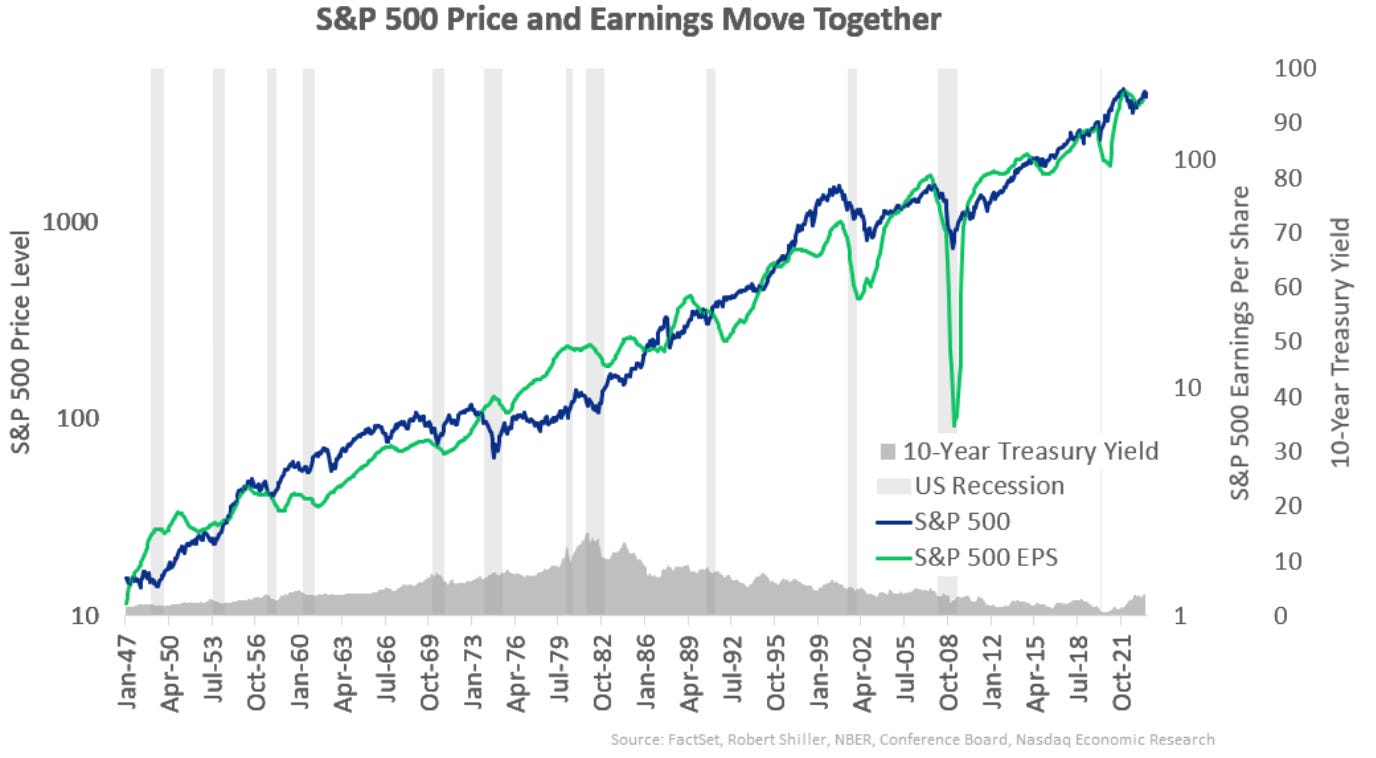
And to further reinforce the argument above, we leave you with this classic chart showing how closely long-term stock performance has tracked EPS growth - with a correlation of nearly 99%.
Enjoying the content? Don’t miss out on more exclusive insights and analyses. Subscribe now and stay updated.
The market - and its participants - love to separate investments into neat boxes: “value” for companies that grow slowly, “growth” for companies that grow quickly, and so on.
We think quality investing cuts across those labels.
A company doesn’t become high quality simply because it grows fast. Growth can come from favorable industry conditions, aggressive pricing, acquisitions, or heavy capital deployment - and still leave the business vulnerable to competition, disruption, or poor returns on invested capital.
Growing for a year or two means little if the company has no runway to keep reinvesting. And growth is equally unattractive when it requires enormous amounts of incremental capital without generating adequate returns on that capital.
What truly matters is (i) how growth is produced and (ii) how durable it is.
A high-quality business combines growth with strong competitive advantages, attractive returns on capital, a long reinvestment runway, and an ability to defend and expand its economics over time.
Growth, by itself, is not quality. Durable and value-accretive growth is.
Nothing better than a real example - one that both I and our paid subscribers actually lived through - to illustrate what the math above is telling us.
For that, let’s use our real investment thesis in Broadcom ($AVGO), a position we initiated in January 2025, when Jimmy’s Journal had been on Substack for only 2-3 months.
We bought our first shares at around $205, shortly after the DeepSeek event, when the market was once again debating whether the AI trade was over (yes, this has happened several times already).
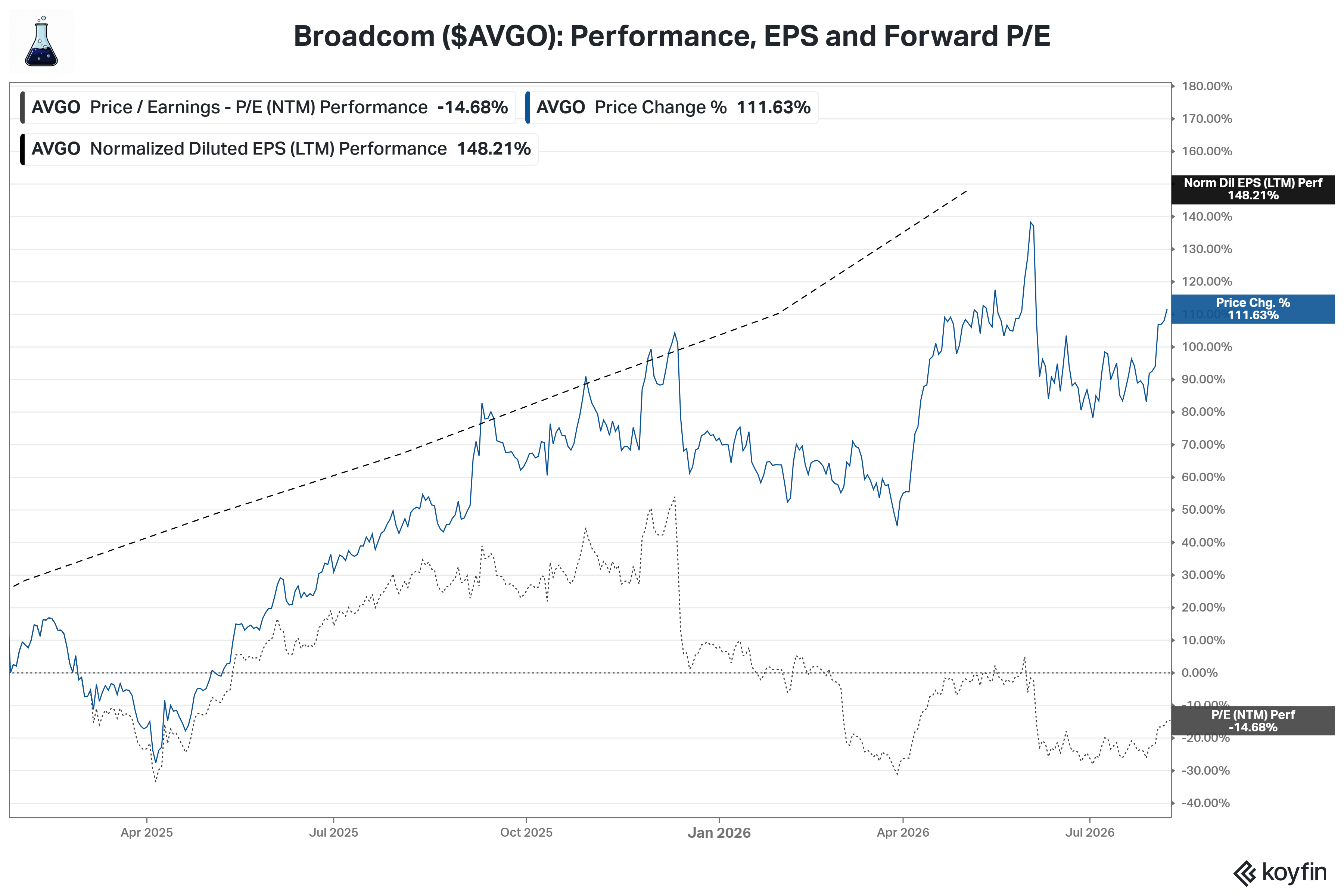
Since then, that first purchase has appreciated +111.6% - an excellent return for an investment held for just over a year and a half, and well ahead of the S&P 500, which returned “only” +29.1% over the same period.
What makes me even more satisfied is where that return came from.
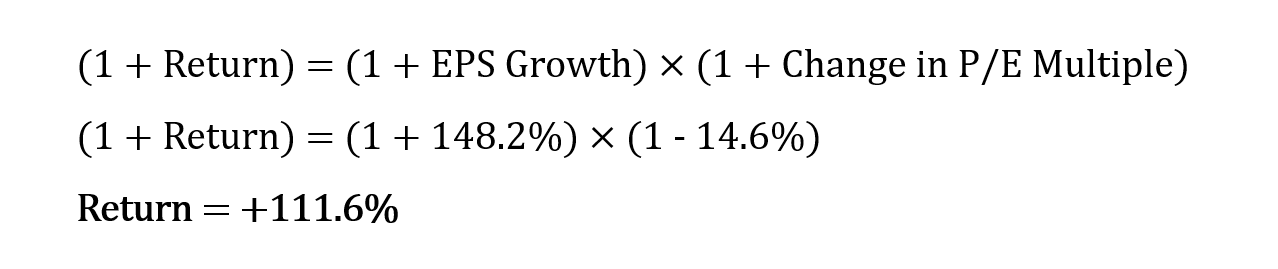
Broadcom’s EPS increased +148% over the period, more than enough to offset a -14% compression in its P/E multiple. In other words, the return was driven by fundamentals rather than by an improvement in market sentiment.
Notice how, early on, the stock’s return was driven primarily by changes in the multiple, with both moving almost in the same direction. Over time, however, the gap begins to widen as EPS growth accumulates.
The period is still relatively short, but it illustrates quite well the investment philosophy we follow here.
And none of this would have been possible without what we identified in the business from the beginning: (i) a durable moat, (ii) a long reinvestment runway, and (iii) a management team aligned with long-term value creation.
If everything above resonated with you - the patience, the focus on quality, and the idea that time should work in your favor - I’d love to have you inside Jimmy’s Journal Pro.
At Jimmy’s Journal Pro, you’ll find in-depth deep dives, stock ideas, our full portfolio (+33.7% CAGR ~4Y), the reasoning behind every position, and new opportunities as we find them - always focused on high-quality businesses. Broadcom at ~$205/share was one of them.
For this round, I’m opening 10 spots at 25% OFF: $397/year $297/year - and you’ll keep that discounted rate for as long as you remain a subscriber.
I intentionally keep these offers limited so I can stay close to the community and engage with the people who join. Once the 10 spots are filled, the offer is gone.
Click the button below and secure your spot today.
See you inside.
Best,
Jimmy
As a reader of Jimmy’s Journal, you agree with our disclaimer. You can read the full disclaimer here.
Comments
Nothing yet. Say the first thing.
Sign in to join the conversation.