
When considering painting a portrait, there is space between what I observe and how I translate that onto the canvas. It’s not a matter of copying what sits in front of you as a photographer or hyper-realism artist might do. It’s a different observation.
It starts with trying to figure out what makes this person unique in a world of billions. It seems that when people look at a photograph of a group, and they are in that photo, they often focus on their own image, critiquing it verbally or in their minds. People often like a certain image of themselves, while not liking other images of themselves for various reasons. I get into this discussion to learn about how they think about their own image.
Full smile with a lot of teeth? Resting face? Looking at the camera or not? Profile, straight on, or in between? Are hands part of it and why? Lots of color, or minimal color. Leaning towards realism or abstract? Any symbolic images that may be relevant? Location or no location? And a host of things that come up during my discovery.
Although the eyes often dominate a portrait, this is not where I go next. I look at the geometry of a person’s skull. There are what I call bone landmarks, like the sweep of the jawbone, the shadow beneath the cheekbones, the depth of the eye sockets, the profile of the nose, and the overall shape of the face, that catch my interest.
If I get these foundational aspects right, then the artistic execution part kicks in. Let’s conclude this article by looking at some well-known artists who have made interesting observations about this discipline of painting one’s portrait.
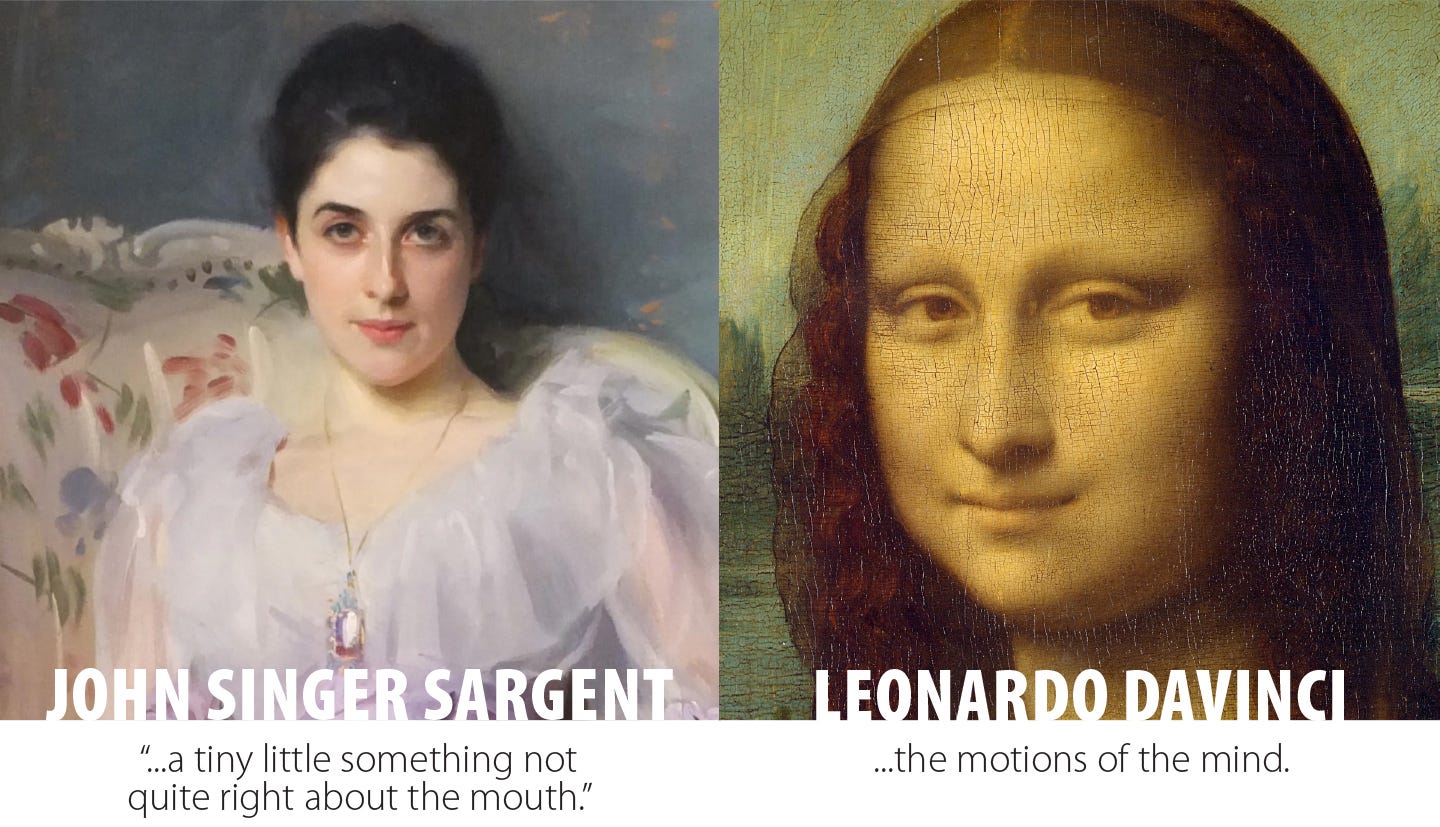
I’ve often thought about a quote by John Singer Sargent, who was an amazing portrait artist. “A portrait is a picture in which there is just a tiny little something not quite right about the mouth.” My thinking is that as he painted from live subjects, their mouth (which can be a constantly shifting muscle) may be unconsciously moving while they are consciously trying to keep their head still. I’ve observed people sitting still, thinking about all the things running through their heads, and noticed how their lips often move and shift. Maybe that’s what he was talking about.
Leonardo da Vinci was obsessed with the connection he gained with a subject who let their guard down for a moment while posing. In his notebooks, he wrote that a painted figure must be depicted so that the spectator can easily recognize the purpose of their mind through their attitudes and gestures. He called this moti mentali—the motions of the mind. Who the hell knows what the Mona Lisa was thinking!
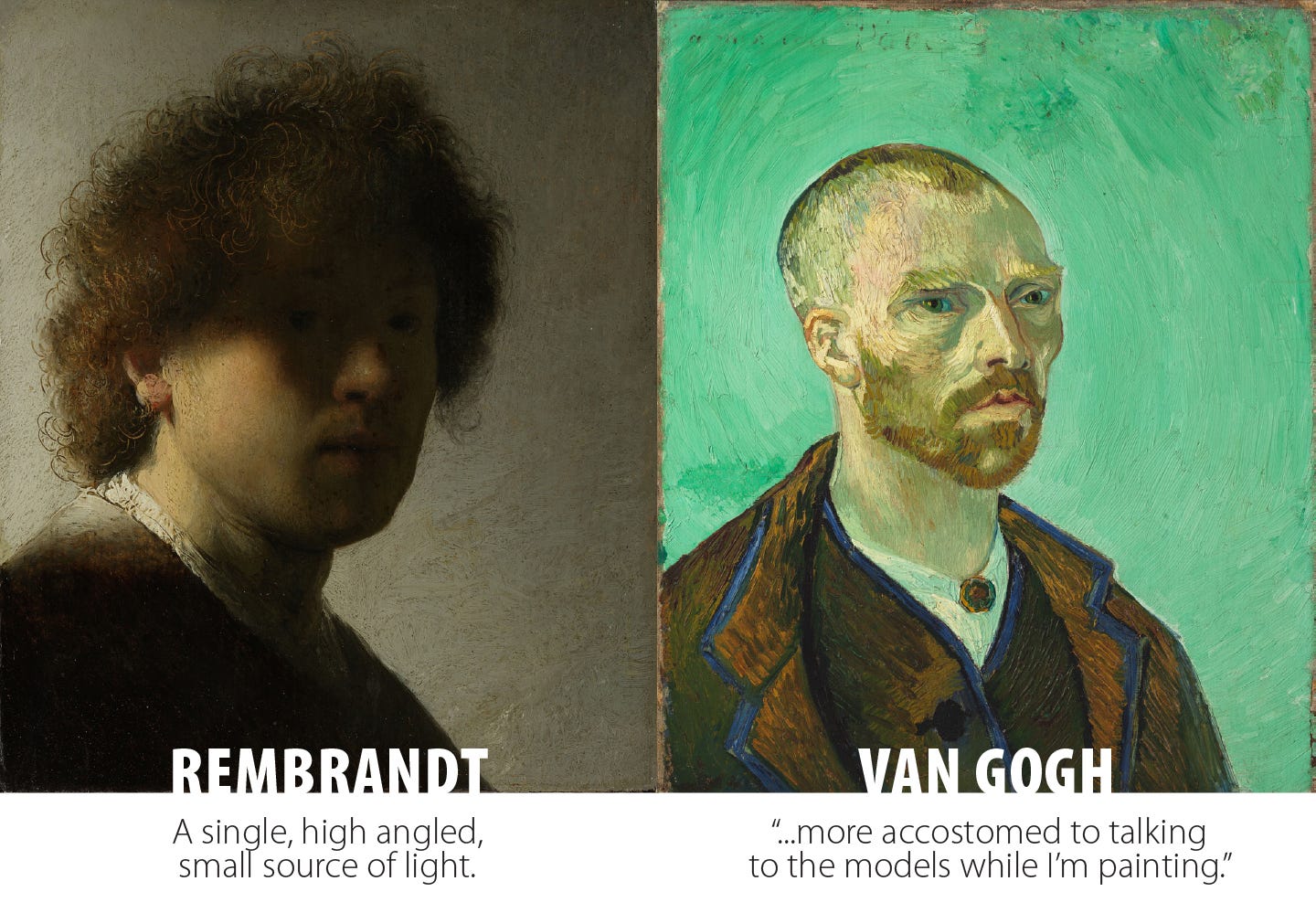
Another amazing artist is Rembrandt. Especially his use of light and shadow. Of course, any good artist considers light and shadow, but his particular approach is interesting. He liked a single, high-angled, small source of light, like a partially covered window, that cast light on one side of the face, creating a deep, mysterious shadow on the other side, often leaving only a small, luminous triangle of light on one cheek.
Vincent van Gogh said this. “At the moment I’m getting more and more accustomed to talking to the models while I’m painting, so as to keep the liveliness in their faces.” Maybe he realized that if a sitter remained in a frozen, stony silence, their features might stiffen and seem a bit lifeless.
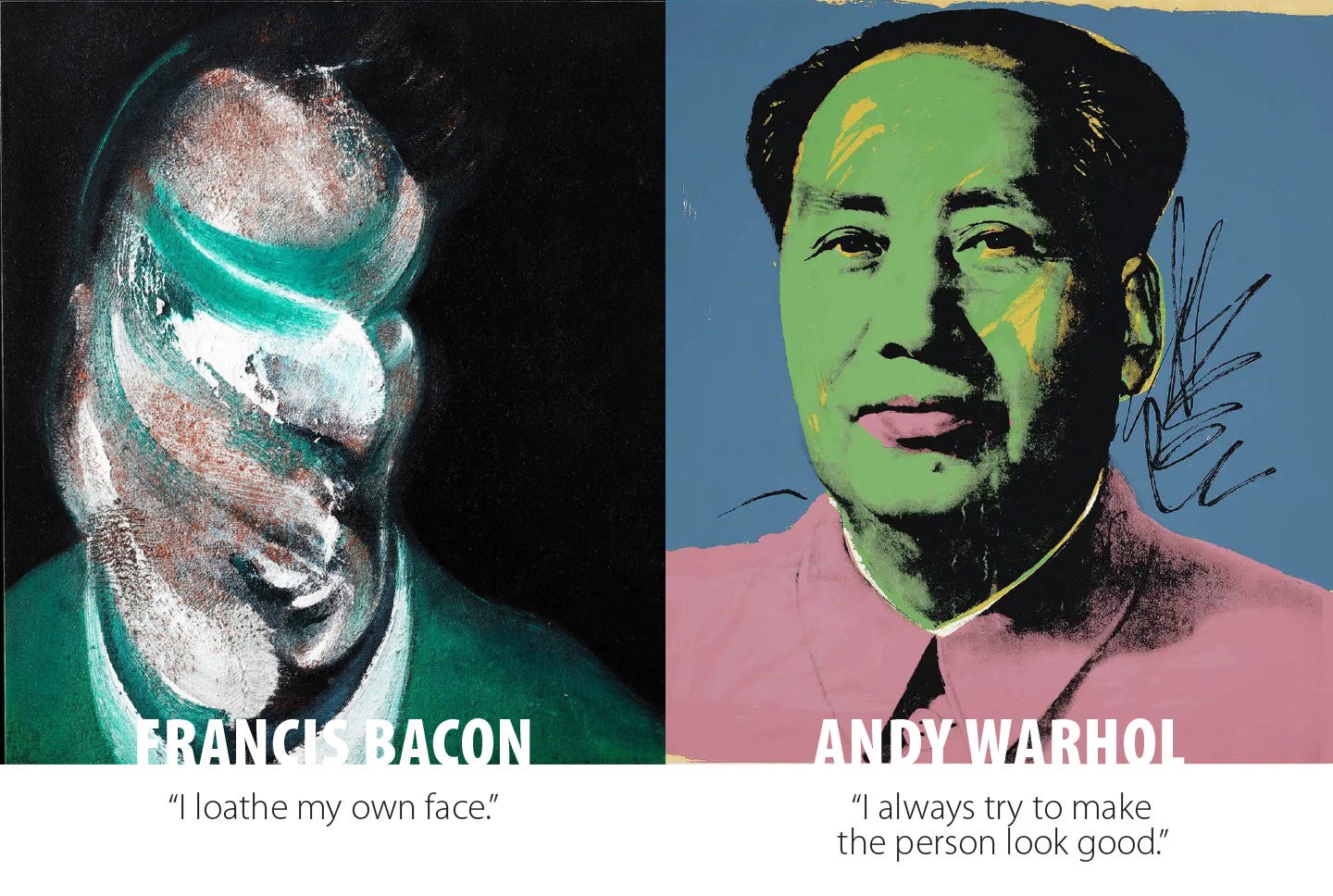
“People have been dying around me like flies, and I’ve had nobody else to paint but myself… I loathe my own face.” That would be Francis Bacon, and his distorted, visceral portraits of his friends and himself. Some of the most haunting in art history.
Then you have Andy Warhol, who didn’t seem to spend a lot of time delving into the deep, spiritual feeling of portrait painting. “I always try to make the person look good. It’s easier if you give somebody something back that looks like them. Otherwise, if I were more imaginative, it wouldn’t look like the person.”

No posts
Comments
Nothing yet. Say the first thing.
Sign in to join the conversation.