
Previous segments:
Forged by Death – Prologue, Chapter 1, Chapter 2, Chapter 3, Chapter 4, Chapter 5, Chapter 6, Chapter 7, Chapter 8, Chapter 9, Chapter 10, Chapter 11, Chapter 12, Epilogue
Chained by Fear – Prologue, Chapter 1, Chapter 2, Chapter 3, Chapter 4, Chapter 5
This is the 21st installment of a Substack series where I share the opening paragraphs from each chapter of The Death Wizard Chronicles, followed by my author’s breakdown of the context, themes, conflict, and the choices that shaped the scene.
The Death Wizard Chronicles is an adult epic fantasy set on the world of Triken, where death is not an ending but a source of magical power—one that can be harvested, controlled, and weaponized. The series follows an ancient wizard whose long stewardship has preserved centuries of peace, until a greater power emerges and forces him toward choices that carry irreversible cost. This story is written for mature readers and includes graphic violence and explicit sexual content.
This project continues a format I’ve used before with Dark Circles, my teen fantasy adventure trilogy, where readers experienced each chapter in stages—through selected opening paragraphs—alongside commentary on how the book was built.
The Death Wizard Chronicles is a trilogy, with each of its three volumes containing two complete novels.
Volume 1: Forged by Death and Chained by Fear.
Volume 2: Shadowed by Demons and Torn by War.
Volume 3: Blinded by Power and Healed by Hope.
Below are the opening paragraphs of the Chapter 6 of Chained by Fear. My author breakdown follows.
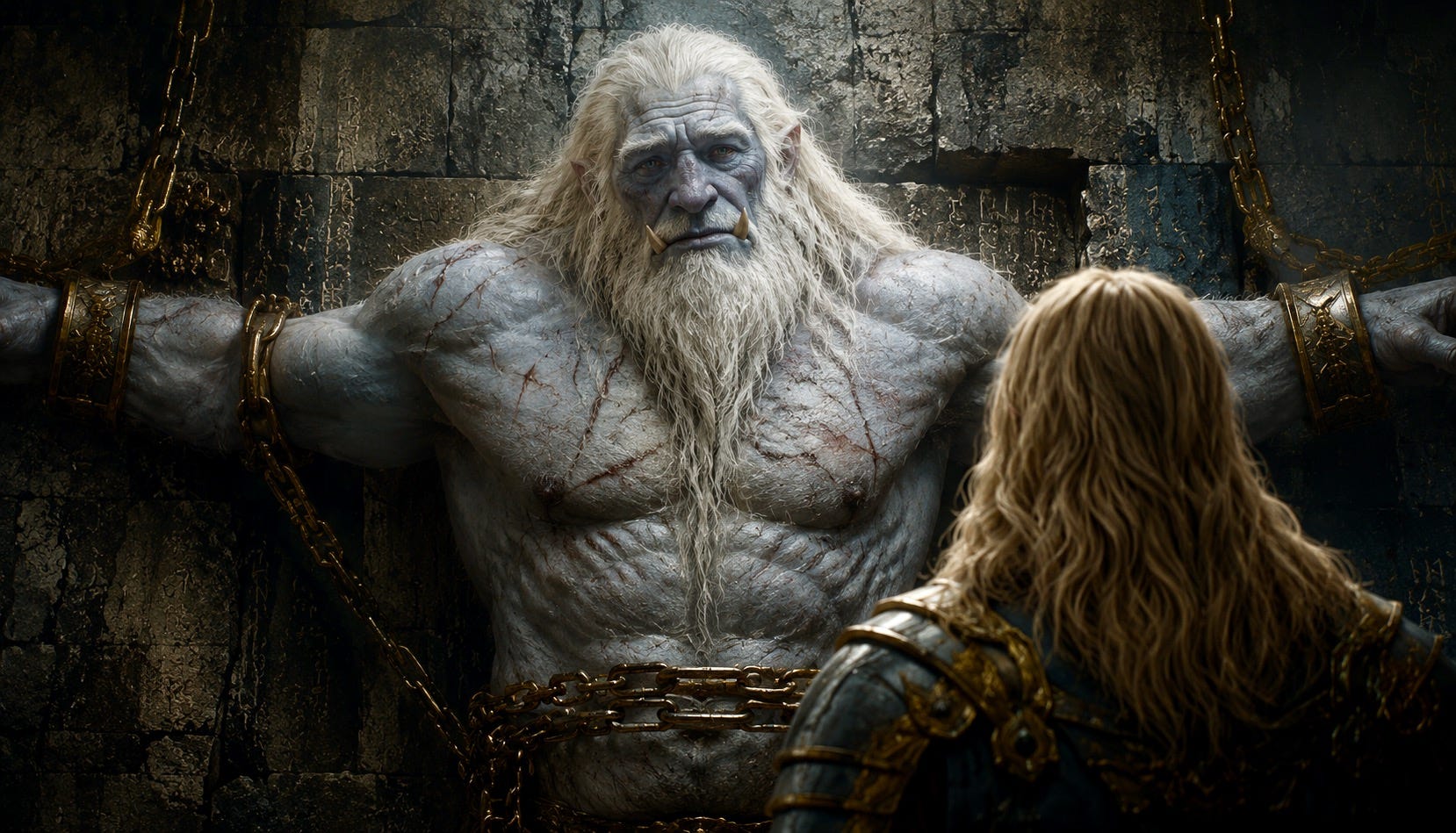
Context: After nearly a decade in Avici, General Lucius finds himself increasingly disillusioned with the empire he helped build. Though he still loves Invictus as the being who gave him life, years spent witnessing the sorcerer’s cruelty have eroded his loyalty. Beneath the city, in hidden chambers few ever see, Lucius confronts horrors that force him to question not only his king, but the future of Avici itself.
CHAINED BY FEAR ||||| CONSPIRACY
It’s one thing to love your creator, another to respect him. After all that had occurred, General Lucius still loved Invictus for giving him the gift of life. But he no longer respected him. Lucius had seen too much.
Laylah’s hatred of her brother had been born above the surface. But the sorcerer’s worst deeds, as far as Lucius was concerned, occurred in the labyrinth of dark tunnels beneath Uccheda.
As general of Invictus’ growing army, Lucius had spent many hours in the hidden chambers the sorcerer had bored out of solid rock using his magic. Invictus’ powers appeared limitless. Where it might take a thousand slaves more than a year to tunnel through a wall of granite, Invictus could do it in the time it took to dig a single grave.
Not that the sorcerer lacked slaves, some of whom were better treated than others. For the most part, the newborns from Kilesa were respected in Avici. Almost all the males became soldiers while the females filled the most prestigious servile needs. But the slaves brought from outside the Golden Wall were not so lucky. Invictus took great delight in the art of torture, both viewing and performing. And most of it occurred in the underground.
Sadistic sexual orgies were a major part of what the general found so distasteful. But what else would you expect from a collection of monsters? They hungered for suffering as much as blood. The more fear and anguish they inspired, the more they relished it.
Invictus often summoned Lucius to watch the proceedings. They sat on stone benches in a cathedral-sized chamber. When you received a direct invitation from the sorcerer, you agreed enthusiastically without protest. But the libidinous gatherings secretly sickened Lucius. Most times, he could barely fend off vomiting.
As repulsive as the orgies were, they were not what caused Lucius to betray his king. Instead, it was the ruin of the snow giant. The general had paid little attention to the creature, considering him just one prisoner of many. But an unplanned encounter disturbed him profoundly. Lucius was making his rounds through the lower chambers, which served as a dungeon for the most volatile and valuable prisoners, when he came upon the cell that held Yama-Deva.
“You are like him and yet are not,” the snow giant said. Golden chains imbued with the sorcerer’s magic pinned him against a wall of granite. He’d been whipped, beaten, and starved. But his voice still sounded kind. “What I mean is, you look like him. But you don’t behave like him.”
“Haven’t you learned by now to keep your mouth shut?” Lucius said. “If someone hears you, you’ll be castigated. Why do you risk further abuse?”
“Do you see?” the giant said, laughing softly. “You are not like him. You care about the innocent.”
“I do what I’m told. My personal feelings mean nothing.”
“I can see your future,” the giant said. “You will perform remarkable deeds before your life takes its final unexpected turn. A great many will rally around you and call you a king.” Then Deva lowered his head and sighed. “I can see my future, as well. It won’t be as heroic as yours.”
“What do you mean?”
“I will become the thing I most despise. But that’s not the worst of it.”
“What could be worse?”
“I won’t be able to remember who I am. My name is Yama-Deva. My people call me The Wanderer. But I won’t remember. It will be as if I’m dead, but my body will live on without me. Could you do me one favor?”
“I make no promises,” Lucius said, stepping back.
“Fair enough. But at least I can ask. If you’re ever given the opportunity, would you tell whoever might listen that I’m sorry for the harm I will cause? Yama-Deva doesn’t intend to hurt anyone. But what I’ll become will take pleasure in inflicting pain. My only hope is I will redeem myself in the end.”
“How can you know this?”
“Eso aham himamahaakaayo (I am a snow giant),” he said, as if that explained it all.
The next time Lucius saw Yama-Deva, the snow giant no longer existed. Mala, a.k.a. the Chain Man, stood in his place. Lucius soon recognized that his days as the king’s right hand were over. In some ways, he no longer cared. In others, he was appalled. Yama-Deva had been such a wondrous creature, and now he was the epitome of evil. It was an affront to anything sane. This pleased Invictus, of course. In his twisted mind, ten years of torture and humiliation had paid off handsomely.
Lucius still loved Invictus. How could he not love the being who gave him life? But he also despised him. How could he not despise the being who introduced him to evil?
End of excerpt
Themes
Love without admiration
When loyalty becomes complicity
The gradual acceptance of evil
The courage to betray a tyrant
One encounter in particular alters the course of Lucius’ life—and the fate of Triken.
The central tension of this chapter lies within General Lucius himself. He’s not a rebel by nature, nor is he driven by personal ambition. In many ways, he remains exactly what Invictus created him to be: loyal, disciplined, and devoted. That devotion is what makes his growing disillusionment so significant. Lucius doesn’t turn against Invictus because he ceases to love him. He turns against him because he can no longer reconcile that love with what he witnesses.
The transformation of Yama-Deva serves as the chapter’s emotional and philosophical centerpiece. Before he becomes the Chain Man, he remains remarkably compassionate despite years of imprisonment, torture, and humiliation. Even while speaking of his own destruction, his concern isn’t for himself but for the innocent people he fears he will one day harm. In many respects, Yama-Deva demonstrates more humanity in captivity than many of his captors display in freedom.
His conversation with Lucius also introduces one of the recurring ideas that runs throughout The Death Wizard Chronicles: the distinction between identity and memory. Yama-Deva understands that his body will survive while the person he truly is will disappear. The tragedy is not simply that he’ll become a monster, but that he’ll lose the ability to remember that he was ever anything else.
Lucius recognizes that tragedy immediately. Watching the snow giant become Mala forces him to confront a truth he has spent years avoiding. Invictus isn’t merely conquering kingdoms or building an empire. He’s reshaping living beings into tools, weapons, and reflections of his own cruelty. For Lucius, that realization marks the beginning of a conspiracy that will eventually change the fate of Triken.
The moment Lucius begins to question Invictus isn’t the moment he stops loving him. It’s the moment he realizes love alone can’t excuse evil.
This chapter serves two important functions within the larger story. First, it provides a deeper look into the hidden machinery of Invictus’ empire. Previous chapters have shown the grandeur of Avici and the loyalty it inspires. Here, readers finally see what lies beneath the surface. The underground chambers reveal that Invictus’ power is sustained not only through charisma and ambition, but through cruelty carried out beyond public view.
Yama-Deva’s appearance explores a different kind of tragedy. Many fantasy villains begin as villains. Mala does not. Before becoming the Chain Man, he’s compassionate, thoughtful, and remarkably forgiving despite years of suffering. His transformation is horrifying precisely because it isn’t the destruction of a monster but the destruction of a noble being. In many ways, the ruination of Yama-Deva represents one of Invictus’ greatest crimes.
Lucius’ role in the chapter is equally important. Throughout much of the story, he exists between two worlds. He genuinely loves Invictus as his creator, yet he possesses enough empathy to recognize the evil surrounding him. Rather than presenting rebellion as a sudden decision, his eventual betrayal emerges from a series of small moral fractures that accumulate over time. His encounter with Yama-Deva becomes one of the moments where those fractures can no longer be ignored.
The greatest evil in this chapter isn’t what Invictus destroys. It’s what he transforms.
Comments
Nothing yet. Say the first thing.
Sign in to join the conversation.