
Parts 1 and 2 focused on Rocky Mountain Lab and Vincent Munster. But RML was not unique. The Montana monkey bites, torn spacesuits, missing shipments, and buried incident reports also led to forgotten smallpox on the NIH campus and missing Ebola at Fort Detrick.
On July 1, 2014, an FDA investigator at NIH was inspecting a cold storage room in Building 29A, on the NIH campus in Bethesda, Maryland, when he made a chilling discovery: a vial labeled “variola.” It’s the virus that causes smallpox, which was eradicated by 1980, but was sitting unmonitored among 12 cardboard boxes. Alarmed, he immediately closed the box and washed his hands, but further inspection revealed additional vials of variola, along with other dangerous pathogens like Q fever and rickettsia.
Over the next several hours, the discovery rippled through the chain of command. FDA scientists Gerald Feldman and Jerry Weir notified Carolyn Wilson, who coordinated with Deborah Wilson from the NIH Division of Occupational Health and Safety. Wearing gloves and a lab coat, Dr. Carolyn Wilson carefully placed all 12 boxes into a larger container, sealed it, and hand-carried the material across campus to a BSL3 laboratory in Building 13 on the NIH campus in Bethesda. There, Dr. Deborah Wilson secured the material in a biosafety cabinet.
The material had sat unsecured in a shared cold room for an unknown period without detection. The FBI and CDC Division of Select Agents and Toxins (DSAT) were notified by early evening, and access logs later confirmed that no one entered the BSL3 lab until a joint CDC-FBI team began photo documentation and inventory six days later.
When the missing smallpox story was first reported a week later, on July 8, 2014, officials celebrated: an FDA scientist found the vials while cleaning, recognized the danger, and authorities contained them. It was later reported that the cache also contained dengue, influenza, Q fever, and rickettsia, likely collected between 1946 and 1964. The FDA destroyed 32 samples on-site, transported 279 to the Department of Homeland Security’s National Bioforensic Analysis Center, and sent 6 to the CDC.
D.A. Henderson, the researcher who led smallpox eradication, shrugged it off as typical, since virologists often “lose track” of specimens. Science magazine noted this wasn't the first time: other labs had quietly found forgotten smallpox samples in freezers, sparking fears of poorly secured bioweapons falling into terrorist hands.
Peter Jahrling, who was director of NIAID’s BSL4 lab at Fort Detrick, once joked about “keeping a retirement fund in his freezer in the form of a smallpox virus and selling it to the highest bidder.”
In July 2016, a vial of cerebrospinal fluid from an Ebola-infected primate was discovered hidden under a freezer at NIAID’s Fort Detrick BSL4 lab during routine maintenance. The vial had apparently been dropped six months earlier during sample transfer and had gone unreported. Although the lab was thoroughly searched and no exposures occurred, the lapse prompted a federal report to CDC/DSAT. But it was never reported, until now.
In September 2024, NIAID’s Fort Detrick Integrated Research Facility (IRF) reported that four vials of Ebola virus working stock had gone missing. Each tube held nearly a milliliter of one of the world’s deadliest pathogens. Investigators suspect the samples were simply “used but not documented” by a former staff member who has since left NIH.
But the paper trail was empty. The samples weren’t found, the lab notebooks offered no answers, and the data reviews provided no resolution. That forced NIH biosafety officials to escalate the issue: they flagged the incident to the Federal Select Agent Program. They prepared for the FBI to step in and locate the former staff member.
As one internal email put it, “We continue to believe this is truly an error and a result of poor adherence to documentation … rather than a nefarious action. But we need [FBI] help in trying to provide as much resolution to this incident as possible.”
Four missing tubes of Ebola in 2024. No accountability. The FBI and NIH closed the case after failing to find the missing tubes and referred to it as an “inventory discrepancy.”
On December 15, 2017, a biosafety incident occurred in NIH’s BSL3 biolab (Building 33 on the Bethesda campus, next to Fauci’s Building 31) during the transfer of monkeypox cell cultures by a researcher. While moving five 6-well plates from a biosafety cabinet to an incubator, the top plate sloshed, and a few drops escaped onto the benchtop. The researcher immediately contained the spill, cleaned the area, and planned to submit the formal Form 3 documenting the incident. But we never heard about it, and I doubt most Americans knew there was a BSL3 on the NIH campus.
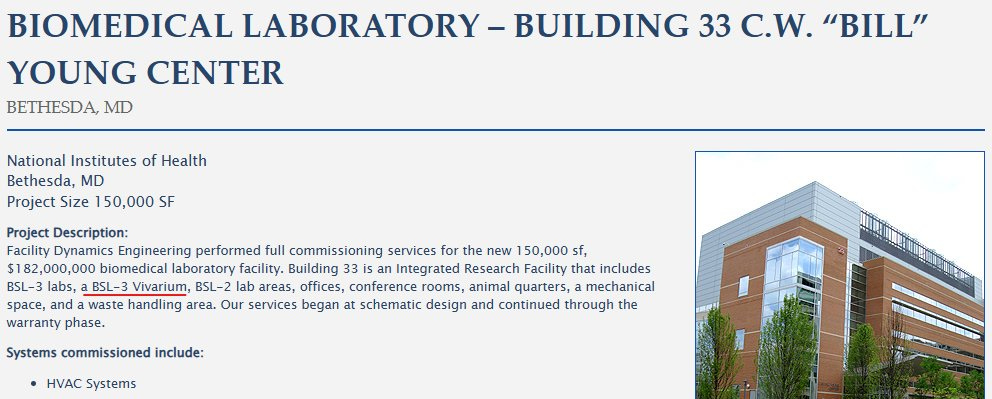
In November 2019, an animal caretaker at NIH Building 33 in Bethesda overloaded an autoclave with carcasses, exceeding its maximum weight limit. The excess waste was temporarily stored in a nonregistered freezer before being incinerated days later. No exposures or missing carcasses were reported, but the incident still triggered a mandatory CDC Form 3 submission as a “potential release.”
Form 3 reports were not publicly available until 2025, when the new administration began releasing federal biosafety incident records. Those disclosures later revealed 27 biosafety incidents in April 2025 alone, nearly one per day.

In January 2025, the NIH campus biolab (Building 33) experienced a brief air handler failure, leading to positive pressurization in four BSL3 suites. Staff in two labs were handling tuberculosis and SARS-CoV-2, but all materials remained sealed within biosafety cabinets. The NIH reported the incident to its Office of Science Policy, characterizing the risk as “negligible.”
Across the street from the NIH campus sits the Uniformed Services University of the Health Sciences (USU). It’s the NIH’s counterpart to DARPA. USU scientists are connected to the Baric–Munster CREID network, and the campus hosts a Select Agent lab. Safety hasn’t always been perfect: in August 2009, a student there accidentally stuck herself with a needle containing Shiga toxin type 2 (a poison from E. coli). She survived without harm.
The Federal Select Agent Program (FSAP) is the joint CDC–USDA regulatory program that oversees labs working with Select Agents and Toxins — the most dangerous pathogens (such as Ebola, anthrax, and SARS). FSAP conducts inspections to verify compliance with security, biosafety, and record-keeping requirements. FSAP is supposed to conduct unannounced inspections, but sends 1-3 day notices via email. That is plenty of warning time to clean up spills and organize records.
In March 2010, a scientist at the Public Health Research Institute (PHRI) in Newark, NJ, reported a potential needlestick with Yersinia pestis, the bacterium that causes plague. He was infecting mice as part of a SUNY Stony Brook protocol.
Although the needle never broke skin, he felt enough pressure through two layers of gloves that officials treated it as a real exposure. He underwent immediate decontamination, was evaluated by occupational medicine and infectious disease specialists, and was placed on prophylactic antibiotics. The CDC was notified, and PHRI’s biosafety team launched a full review with retraining planned.
The researcher was shaken but healthy. Even a suspected prick with plague bacteria was enough to trigger a federal report and a cascade of medical oversight. The incident wound up in Ian Lipkin’s Columbia University inbox, but the case was closed since “We don’t need to report on potential incidents.”
In 2015, when an American scientist in Sierra Leone pricked himself with an Ebola-contaminated needle, a race across continents ensued. Standard vaccine protocols weren’t approved, leaving only an FDA Emergency Investigational New Drug (eIND) application. Emory University in Atlanta scrambled to secure approvals, while the NIH navigated consent and logistics. With the Sierra Leone ethics board monitoring and the CDC coordinating, a high dose of 100 million plaque-forming units (PFU) was ready but never administered.
Parts 1–3 tell the same story. Plague without approval. Pathogens shipped to the wrong house. Needlesticks, monkey bites, torn spacesuits, missing Ebola, forgotten smallpox, and endless Form 3 filings. Every lab incident is dismissed as minor, isolated, and fully resolved. Yet their answer is more bureaucracy than biosecurity, with less transparency and more secrecy. For years, most of the above incidents remained hidden from public view. They weren’t reported then. They are now.
In November 2013, two separate accidents shook Dr. Yoshihiro Kawaoka’s avian influenza lab at the University of Wisconsin.
On November 9, a researcher spilled highly pathogenic H5N1 inside an ABSL3+ lab. Investigators later discovered the scientist had two to three inches of bare skin exposed between his Tyvek suit and shoe covers. None of the liquid reportedly touched his skin, but NIH officials were blunt: bare skin in a BSL3+ lab handling engineered H5N1 was “unacceptable.” USDA’s Select Agent Program agreed.
Just days later, on November 16, 2013, a University of Wisconsin researcher stuck himself with a syringe carrying a recombinant H5N1 bird flu — spliced with the backbone of the 2009 H1N1 pandemic strain. The accident occurred inside an ABSL-3+ lab during tissue culture collection. He scrubbed the wound, reported it immediately, and was placed under home quarantine. His family was relocated to a hotel, he was prescribed Tamiflu, and daily swabs confirmed he never became sick.
But the fallout exposed deep problems. NIH discovered the procedure violated UW’s own rules banning needles for that purpose. Worse, Kawaoka’s lab had promised a “designated quarantine apartment” in its federal application, but none existed. The real plan was home isolation, with family members hustled away.
NIH officials were furious. In December 2013, they issued a letter halting all mammalian-transmissible H5N1 work in Madison until a proper quarantine facility was secured. Internal NIH emails circulated the warning: “No research with mammalian transmissible H5N1 strains may be carried out until this plan is operationalized.”
In 2018, Fauci was sitting next to Kawaoka while joking about the GoF “aggravation he causes me.”
Earlier this year, a University of Wisconsin lab technician, infuriated that he was passed over for promotion, poisoned his co-worker’s water bottle and shoes when they got the job instead.
Igor Rogozin’s 2025 letter calling for watermarked genomes has sparked interest. Others have claimed the idea of a watermark started in 2010. Steve Massey from the University of Puerto Rico has recently published a detailed paper.
Given these considerations, it is proposed that a short non-disruptive signature sequence be incorporated into the infectious clone virus genome, to ensure traceability. The sequence may be cryptographically signed, allowing attribution to the originating lab.
https://zenodo.org/records/19699408
Second, genetically watermark synthetic or manipulated pathogens. A small genomic change could identify a laboratory lineage without altering the organism’s biology. If an outbreak occurred near a lab, the watermark could identify that facility or exonerate it, protecting the public and responsible scientists alike. After covid, uncertainty about origin became corrosive to public trust. Federal guidelines can help address that.
A recent Justice Department complaint alleging that virologists smuggled biological materials — including deactivated mpox virus, also known as monkeypox — into the United States from an African outbreak region underscores the point: The danger is not only what happens inside a lab, but how pathogens, samples and researchers move across the globe.
Quay released Chapter One from his new book, The Code as Witness, but doesn’t mention the ancestral strain WA1.
https://www.hsgac.senate.gov/wp-content/uploads/2026.06.05_FINAL-RELEASE.pdf
EcoHealth discussed having Munster hand-carry samples on a commercial flight.
In a 2011 email about shipping samples from Congo to NIH’s RML, an EcoHealth Alliance researcher noted that the courier could not transport dry ice and floated an alternative: “take our chances” shipping some samples in lysis buffer and serum on wet ice, while Munster could “hand carry” another set in viral transport media on dry ice during a later trip. “I think you can take up to 2kg with you on commercial flights,” the researcher wrote.
“Just diagnostics” had a history within this research network.
In 2013, NIH moved to distribute a Jordan strain of MERS coronavirus to a group of investigators that included Munster at RML and Ralph Baric at the University of North Carolina. The shipment NIH sent to the Baric Lab was incorrectly labeled as “diagnostic, not infectious,” a mistake flagged as “a big problem.” The shipment also lacked an itemized list of contents and a dangerous goods declaration.
Officials previously warned Munster that improper shipments could become a national scandal.
In December 2021, Munster told colleagues he would arrange an international shipment of the Omicron variant “without the involvement of NIH shipping.” An NIH official warned him, in writing, that doing so risked becoming “a Washington Post moment or congressional inquiry,” and noted that his facility, RML, had no approved shipping procedures on file.
Pathogen samples in this network had gone missing in transit before.
In a 2022 email exchange with the subject line “inactivation diagnostic lysis buffers MPX,” a colleague asked Munster whether he had ever recovered his luggage; Munster replied, “[n]ope, so no Congo basin clade for now,” indicating the lost luggage had carried Congo Basin monkeypox material. In a separate 2022 exchange, a collaborator urged Munster to contact DARPA “asap” about sending coronavirus samples to the U.S. Army Medical Research Institute of Infectious Diseases (USAMRIID); Munster replied that he would, adding that “numbnuts lost the first shipment.”
Returning from the Congo with monkeypox samples had happened before.
In April 2024, Kwe wrote that he and his colleagues had “just returned from the Congo with DNA from MPOX positive samples.” A related NIH sequencing request logged 35 monkeypox virus DNA samples derived from human patients and answered “Yes” when asked whether the samples contained or were derived from a regulated “select agent.”
https://www.hsgac.senate.gov/wp-content/uploads/Fauci-Intel-Release-2026.06.11.pdf
2003: Fauci's feedback was incorporated into a published National Intelligence Council paper on SARS as a formal reviewer.
2003: Fauci received a copy of a CIA report titled "The Darker Bioweapons Future," which warned that pathogens could be genetically engineered to be more dangerous.
2007: Fauci was invited by an outside review panel commissioned to look at future directions for DTRA's countering weapons of mass destruction division.
2020: Fauci is invited to speak at JASON, a secretive external advisory group that advises the national security agencies.
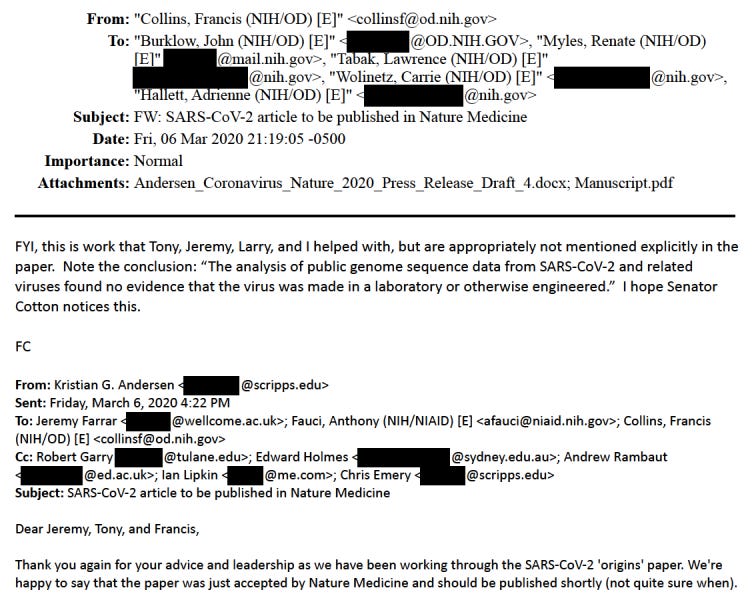
An email from the then NIH director, Francis Collins, said the Proximal Origin paper is “work that Tony Fauci, Jeremy Farrar, Larry Tabak, and I helped with, but are appropriately not mentioned explicitly in the paper.”
Virologist Angie Rasmussen summarized the Munster situation well:
You might wonder why I’ve been avoiding having substantive conversations with my colleagues at NIAID, and especially Vincent Munster. I believe that the administration is going to accuse Vincent and Ralph Baric of starting the COVID-19 pandemic with Peter Daszak of EcoHealth Alliance and Zhengli Shi of the WIV. As best as I can tell, Senator Paul thinks that Vincent and Ralph, who is one of the most accomplished molecular coronavirologists in the world if not in history, GOFed up the virus. After getting proto-SARS-CoV-2 from WIV via EcoHealth Alliance, Ralph cloned the virus and inserted a furin cleavage site to make it more transmissible and pathogenic and Vincent serially passaged it through Rousettus aegyptiacus (Egyptian fruit bats). This is based exclusively on imaginative interpretation of cherry-picked emails from early 2020 in which Vincent was discussing the possibility of experimentally infecting R. aegyptiacus to study pathogenesis in a bat host, not serial passage. There’s also no reason to think serial passage would somehow result in a pandemic virus. Last I checked, February 2020 is too late to have made SARS-CoV-2 since the pandemic had already started by then. There’s no explanation about how, if Ralph and Vincent did make SARS-CoV-2, the virus somehow found its way back to Wuhan from North Carolina and Montana. There is no evidence any of this happened.
It won’t stop there. My friends and colleagues Kristian Andersen and Robert Garry may be accused of covering it up at former NIAID Director Anthony Fauci’s request. I may be accused of aiding the cover-up as well, along with co-authors on our papers showing repeatedly that the pandemic began via two zoonotic spillovers at the Huanan Seafood Market due to the wildlife trade, not a “lab leak.” I’ve discussed this before, but I wrote an explainer of what the evidence actually shows.
My comment on her Substack clearly stated that all other virologists are innocent and unaware of what happened in Wuhan. In 2019, Munster presented Egyptian fruit bats to DARPA for his self-spreading vaccine research, so he would use them for serial passage. But Angie gives Rand Paul a playbook for his next move:
Paul has a vendetta against Fauci, so he is alleging that Fauci is the biggest GOF virologist in the game. This is likely to find a pretext to prosecute Fauci for a crime not covered by President Joseph Biden’s preemptive pardon (granted to Fauci because of anticipated unfair prosecution). Paul can’t nail Fauci on anything that happened in the past, but that pardon does not cover any new “crimes” Fauci might commit. The back and forth about who is lying in 2022 is instructive in this regard.
By forcing Fauci to give a transcribed interview about Vincent and Kwe (and likely Ralph and EcoHealth Alliance and their grants) in a closed door setting with nobody present from the minority party, Paul is setting Fauci up for charges of perjury. This is, for Rand Paul, about revenge. But it’s about more than that. A lot more. It is about sticking a knife into the heart of American democracy.
Fauci is scheduled to testify before Paul in a closed-door Senate session “later this month.” We will have many questions.
No posts
Comments
Nothing yet. Say the first thing.
Sign in to join the conversation.