Jim Haslam · Reverse Engineering the Origins of SARS-CoV-2
In the book, I open with Ralph Baric’s 2024 testimony:
Distinguished Professor Ralph Baric traveled to the scene of the COVID crime in Washington, D.C., on January 22, 2024. A congressional committee questioned him for six hours. Two University of North Carolina administrators and his lawyer accompanied him. Baric’s lawyer [Clark Erwin] from Harvard specializes in “representing clients under investigation by federal Offices of Inspector General.” Baric’s defense lawyer was the former Inspector General of three federal agencies as an appointee of President George W. Bush.
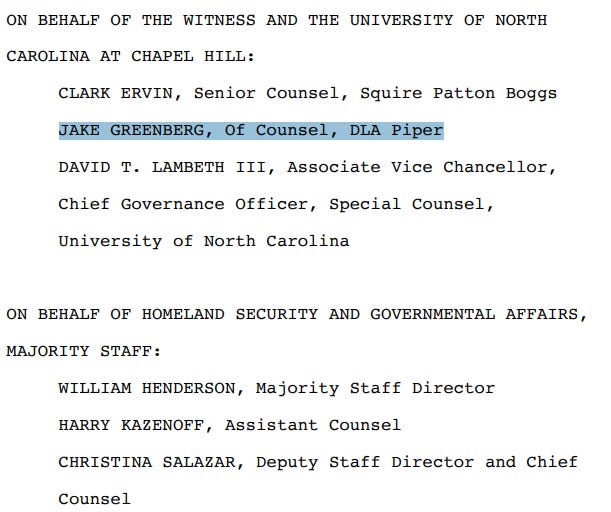
Two years later, in April 2026, Baric returned to D.C., but this time he added a lawyer to his dream team. Jake Greenberg also represents Bill Gates on the Epstein files and was former chief investigations counsel for the House Oversight Committee. The revolving door of D.C. is deep.
Senator Rand Paul’s staff was introduced by Harry Kazenoff, who introduced Christina Salazar. She proceeded to engage Baric for four hours of written testimony, but let him do most of the talking. It didn’t go well for Baric, but judge for yourself.
For the first time, Baric is in the hot seat and not producing alibis or answers. By my count, Baric lied five times under oath. The first:
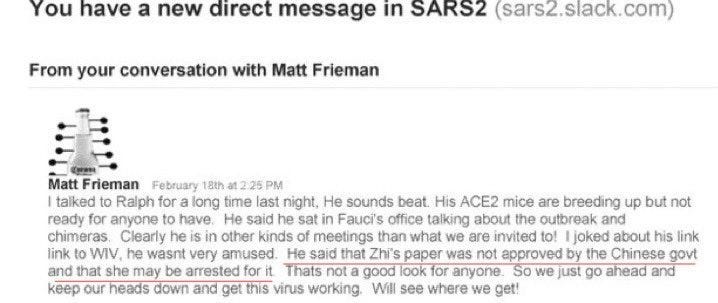
MS. SALAZAR: I’m going to read you -- again, this has been FOIA’d -- your former postdoc said in a Slack message, and I’m just going to read it out loud. “I talked to Ralph for a long time last night. He sounds beat. His ACE2 mice are breeding up but not ready for anyone to have. He said he sat in Fauci’s office talking about the outbreak. Clearly he is in other kinds of meetings than we are invited to. I joked about his link to WIV but he wasn’t very amused. He said that Shi’s paper was not approved by the Chinese government and that she may be arrested for it. That’s not a good look for anyone. So we just go ahead and keep our heads down and get this virus working.” So does this reflect what the conversation was?
BARIC: It’s a Slack message that people write. It’s not to me. Yeah. Certainly the first part, for sure. Ask specific parts of the question.
MS. SALAZAR: So why would --
BARIC: Sorry. I can’t remember.
MS. SALAZAR: -- Dr. Shi be arrested, because she didn’t have the paper approved by the Chinese government?
BARIC: Again, I don’t know for a fact why he said that. However, I’m not 100 percent sure that she ever got approval from the Chinese government to send me the sequences. That would be my guess. That would be my guess.
To me, it’s fairly obvious why Baric wanted Shi arrested for publishing RaTG13, because it exposed his SARS2 furin cleavage site, which kickstarted the February 1, 2020 teleconference.
Notice Baric’s apparent slip of the tongue. “However, I’m not 100 percent sure that she ever got approval from the Chinese government to send me the sequences.” I’ve always argued that Shi shared with Baric a copy of RaTG13 pre-pandemic. In 2018, Baric referenced the Mojiang “mineshaft” where it was collected, and published a unique sequence, UGGUGC, only found in RaTG13 at the time.
Like a good lawyer, Salazar later followed up with Baric:
MS. SALAZAR: Did you have a copy of RaTG13, the genome before 2020?
BARIC: No. Yeah, so that was first published in 2013 as a sequence fragment, that I didn't notice. And then they came out with a sequence, I think, in, what, 2017, 2018, somewhere around there. It did not catch my notice. I mean, oftentimes, every once in a while we do searches on sequences, to see if there's anything interesting out there that we might want to work on. But it didn't catch our attention. So it didn't come to my attention fully until they published their paper on January 15 of 2020. And so I agree with people like Alina Chan and others that have looked at the sequence information around that virus and say that I don't know. Like she has reported, we could not recreate the full-length sequence that they provided, based on the sequence information that they provided. There were gaps, in other words. It was not complete. Some of it was very good, where they had good coverage, so they had a lot of coverage of that particular chromosome and then they cloned out a specific plasma DNA of that region and sequenced it. So there are regions that are really good and the spike is really good.
Baric is only concerned with the spike, and goes on to explain the entire genome was worthless. But he admitted the sequence was available by 2017-2018 and only said RaTG13 “did not catch my notice.” Since the RaTG13 spike was ~25% different from SARS1, it was his unicorn.
BARIC: Just to let you know, we have ordered a molecular clone for RaTG13. That genome is heavily debilitated. We eventually isolated it. We have not finished submitting the paper.
MS. SALAZAR: Okay. And when did you isolate it?
BARIC: Maybe two and a half years ago.
That was always Shi’s alibi: she could never isolate RaTG13, but Baric could download it and synthesize a live virus at UNC.
Baric was then asked if he had any unpublished sequences? He answered “probably” and then admitted, “I have sequences for sarbecoviruses that we’ve recovered that we have not published yet, but we got those sequences from the published literature.”
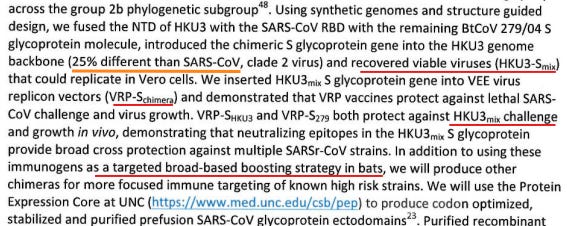
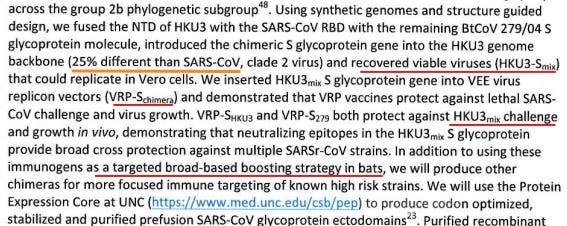
My 2024 post on Baric’s first testimony asked the question he still hasn’t answered: What’s in your freezer, Dr. Baric? His unpublished chimera is HKU3-Smix, which, like RaTG13 and SARS2, has a 25% spike deviation from SARS1.
Again, it was Shi’s publication of RaTG13 that kickstarted the February 1, 2020 teleconference. Baric then admitted he was listening in to the evidence for engineering, but didn’t speak or introduce himself:
BARIC: That's correct.
MS. SALAZAR: It's surprising because you're an expert in this field.
BARIC: Not really.
MS. SALAZAR: Oh, you're not? Okay.
Baric now claims he’s not an expert in coronaviruses. He was secretly listening to Kristian Andersen’s evidence for engineering, then “attacked” him two days later.
BARIC: I don’t ever recall attacking [Kristian Andersen] on the February 3rd call.
MS. SALAZAR: Okay. What was your --
BARIC: I may have pointed something out that he wasn’t aware of in coronaviruses, but that’s not attacking somebody. That’s just providing scientific information.
MS. SALAZAR: What was it?
BARIC: I don’t recall 100 percent. You know, again, did he mention? It would be helpful to me if you’d say what it was.
MS. SALAZAR: Yeah. “I should mention that Ralph Baric pretty much attacked me on the call with NASM, essentially calling anything related to potential lab escape ludicrous, crackpot theories. I wonder if he, himself, is worried about this too.”
BARIC: Yeah. Personally, I think he’s got the wrong person on the call.
MS. SALAZAR: What do you mean?
BARIC: He’s attributed that comment to me rather than other people.
MS. SALAZAR: On the February 3rd call?
BARIC: Yeah.
MS. SALAZAR: Who was it?
BARIC: I would say it’s more likely to be Peter Daszak.
SALAZAR: So you think that he was referring to Peter Daszak, so when he’s saying, “I wonder if he, himself, is worried about this too.”
BARIC: I have absolutely no concerns about, no hesitation to tell you that I was not involved in the creation of this virus in any way. I’m 100 percent certain.
Andersen described being attacked “multiple times” by Baric, who said the insertion of a furin cleavage site was not “unprecedented” during the February 3 meeting. Also, Bob Kadlec confirmed to me there was a “disagreement” between the two.
MS. SALAZAR: So the DARPA DEFUSE proposal has obviously been the subject of a lot of discussion. I know that for a lot of people it is hard to understand how it did not come up earlier in the conversations. So I’m going to ask, when did you raise, for the first time, with the United States government officials that you were interacting with -- I mean, you interacted with Erik Stemmy on the 7th, Fauci on February 11, 2020. Did DARPA DEFUSE come up in that meeting?
BARIC: No.
MS. SALAZAR: Is there a reason why?
BARIC: I hadn’t remembered the grant. That shocks you, doesn’t it?
MS. SALAZAR: It does shock me.
BARIC: Do you know how many grants I write?
MS. SALAZAR: I don’t.
BARIC: A lot.
Baric then goes into gross detail about how he would have vaccinated Chinese bats in Mojiang mineshaft.
BARIC: Yeah. So from my perspective, let’s talk about the grant for a minute. Let’s make sure we put it in perspective. So DARPA was interested in addressing a problem about the warfighter. And I think there’s, what, about 250,000 troops and their families across the globe. Many of those soldiers go into wild areas of the world where they come in contact with pathogens. So they can then infect members of their group, they can take the virus back to the base, and they can bring it back to the United States. So this is a real threat, potential threat to the public of the United States, because of where they go. So DARPA came up with a proposal that they wanted to know, down to the nucleotide level, what regulates a virus jumping between species and then develop countermeasures for it. Now, if you want to know, down to the nucleotide level, what drives a cross-species jumping event, you are talking gain-of-function experiments.
As part of the thought process, there were two questions. There were two ideas that came forward. One was why don’t sarbecoviruses have furin cleavage sites. And I’ve studied coronaviruses all my life. I know sarbecoviruses. I’ve seen zoonotic strains. They don’t have furin cleavage sites. MERS strains do. Human coronaviruses do. Feline coronaviruses do. Why don’t sarbecos? There should be sarbecos out there that have furin cleavage sites, so they were going to look for them.
Once they found them and they sequenced it, they were going to work on it with pseudotypes. They were going to drop those spike genes into pseudotypes and ask what’s -- we were also going to look at the receptor binding domain, obviously, and I think we hypothesized in there that there should be strains with 25 percent variation in spike that could still use the ACE2 receptor. And those are obviously of interest because if you’re interested in developing pan sarbecovirus vaccines or drugs you want, in essence, the bookends of the heterogeneity that exists in the virus subgenus, right. You want strains that you know and strains that are very different, because you have no idea what would emerge in the future. So if you have breadth then you have a better chance of developing something that could be used immediately.
So those are two major features. The first part would be then to find sarbecoviruses. If we found the sarbecovirus with a furin cleavage site, it would be dropped into a pseudovirus, and its biological characteristics evaluated by the Chinese. They would remove the furin cleavage site. They would introduce changes into the receptor binding domain and look in the context of those pseudotypes, which is the safe system, to ask questions about what the role of those mutations were in tropism and entry of viruses in receptor usage.
Following gleaning that data, we would then use a zoonotic sarbecovirus as a receptacle to drop the spike genes of some of these viruses, and if we found one with a full-on furin site, we would put it in there and evaluate its biology. We would also remove that furin cleavage site and ask what the effect was on pathogenesis in replication. So it’s a loss-of-function first.
At the end of that, there was speculation that if the furin cleavage site looked like it was having an effect on replication or pathogenesis, we would consider putting it into a gain-of-function scenario where we would drop it into a null backbone. So that’s how the experiment was written.
SALAZAR: And who was going to be doing that work?
BARIC: That part would be done by me.
SALAZAR: Okay.
Notice that Baric mentioned his 2015 hypothesis that there should be strains with 25 percent variation in the spike that could still use the ACE2 receptor. Again, RaTG13 was 24.6%, HKU3-Smix was 25%, and SARS2 is 24.7%. He called these sequences the “bookends of the heterogeneity.”
Excerpted from my WHO SAGO debate on his novel chimera:
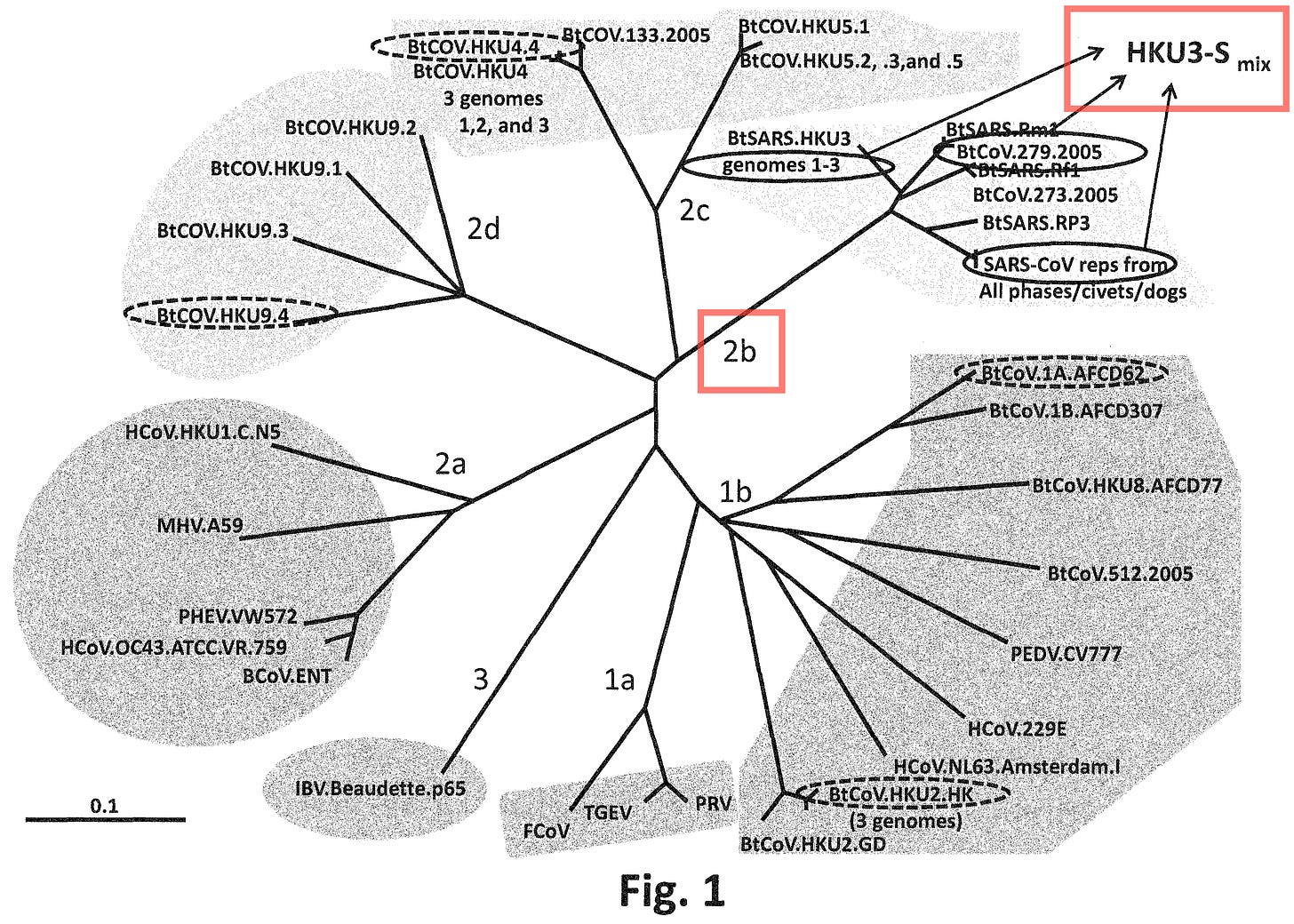
SAGO emphasizes that SHC014 (clade 1) and HKU3 (clade 2) are not part of the SARS-CoV-2 (clade 1B). That is correct, since Baric has created a new clade 1B, which is a backbone from clade 2 and a spike from clade 1. Recombination occurs both in nature and in Baric’s lab. His vaccine research crosses clade boundaries by design.
In his testimony, Baric described HKU3-Smix as a clade 2 backbone with a clade 1A spike. The spike domains (NTD, RBD, S2) were modular. That modularity is how he achieved a 25% deviation from SARS-CoV-1—exactly where SARS-CoV-2’s spike sits at 24.7%.
DEFUSE final
The issue is not whether SARS-CoV-2 is identical to SHC014 or HKU3. The issue is whether HKU3-Smix is the progenitor of SARS-CoV-2. Baric’s HKU3-Smix chimera falls between SHC014 (~12%) and HKU3 (~30%) on the group 2b coronavirus phylogenetic tree.
Baric’s 2018 patent, where HKU3-Smix = SARS-CoV-2
Like a good lawyer, Salazar kept Baric talking, which he liked to do. Baric, like every professor, thinks he’s the smartest man in the room, and he made it clear that the bat vaccine concept was his:
BARIC: Well, at least that's the way the grant was written initially. Whether that would have functionally happened is a fair question, because if the Chinese discovered the virus, the question always exists whether they would share it with me to do that work or not.
SALAZAR: If you were on the proposal, you would have expected that they would?
BARIC: I would have, but I would also be uncertain that they would do that.
SALAZAR: And so you said that it would be -- this was gain-of-function. This proposal -- because this is the first time I'm hearing that -- because, I mean, PREEMPT, there were grants that were funded. So DEFUSE wasn't. But this is the first time I'm hearing that the actual call, the BAA was asking for --
BARIC: It was asking to understand cross-species movement of viruses down to the nucleotide level. And my interpretation of that was gain-of-function, and they discuss gain-of-function. Now, I found it very interesting that the letter that they provided shortly thereafter said that the experiments were DURC. DURC is Dual-Use Research of Concern. involving pathogens, none of which is a coronavirus. So I never saw that letter in the review. Now, Peter Daszak may have gotten that letter, but we were told the main reason the grant was rejected was that we proposed to do intervention studies in the bat caves, and they had said they wanted to do this in a more controlled setting.
SALAZAR: In the laboratory?
BARIC: In a laboratory setting.
SALAZAR: So when you say in a bat cave, what does that mean?
BARIC: It means one approach was to take double-stranded RNA and spray it in the bat cave and then induce innate immune responses in bats, so that those innate immune responses would control virus infection and virus titers would go down. So the idea would be the soldiers, before they went into a cave, they may spray the cave to lower the titer of the virus in the cave so it’s less likely that they’d be infected. DARPA has kind of wild experiments.
So there were two approaches that were discussed, that were presented in that grant. One was the use of small-molecule, double-stranded RNA to induce, let’s call it innate immunity. These involve proteins that are induced in every one of our cells that regulate the replication and pathogen assists of viruses, and bacteria for that matter. So most people in the scientific community feel that what determines whether you live or die following a virus infection is the efficiency of inducing these innate immune molecules that regulate virus replication efficiency. And there’s about 1,000 different genes that host cells make that target key steps in virus replication to knock it down. And it all starts with interferon signaling. Okay, that’s the basis for it.
The other approach was to identify strains of viruses that had spike genes that could infect human cells and potentially cause human disease; those spike genes would be isolated and placed in virus vaccine vectors that would then be delivered to the bats in the cave. The first approach is immediate innate immune knockdown so that the virus burden in the cave goes down and it’s less likely that a soldier will be infected. The second approach is to immunize the bats in that cave so that a virus burden would be very, very low, and it would be long-term protection so the cave could be used for a much longer period of time. So they are linked, but they’re different approaches to abrogate virus replication.
Baric then detailed his furin cleavage site plans:
So remember, one of those [DEFUSE] experiments was to take the virus that had the furin cleavage site in it, resurrect that virus, put it in animals, see what the effect was. Remove the furin cleavage site, see what the effect was. If the furin cleavage site is driving a massive disease phenotype, then that results in a judgment question about whether you would do the next experiment. And it also would then demand the importance of having it reviewed before you proceeded.
Baric was then asked, after all that, why he didn’t declare his furin cleavage site plans during the February 1 call?
SALAZAR: -- let me finish my question. On the February 1 call, was the furin cleavage site a topic of discussion? And that didn’t spur, you remembered the grant, which was discussed --
BARIC: No. Again, you have to put it in context. The context is I was asked to write a section of the grant that was maybe two pages long, maybe three. It was done over about a one- to two-week period of time, and then I didn’t look at that grant again.
SALAZAR: But there were other people on that grant, and it was controversial when it was released, but we’re not even there yet.
BARIC: I was trying to tell you, when I remember the grant, it was when it was released, and I was surprised. And then I looked at it, and then I remembered the whole grant, yes.
SALAZAR: So did you find out about it for the first time on September 2021
BARIC: That was when DRASTIC sort of released it.
SALAZAR: Was it DRASTIC, or someone released it, but I think it was September 2021.
BARIC: That might true, correct.
SALAZAR: So up until that point, you had no discussions about the DIFFUSE proposal.
BARIC: Not that I’m aware of. I was busy on other things.
Baric was busy resubmitting his DARPA PREEMPT bid to Fauci’s NIAID.
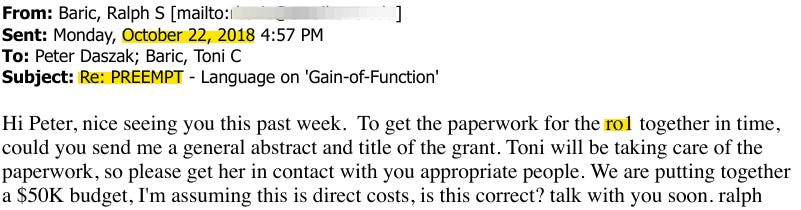
We learned this from the latest DRASTIC find, Daszak’s emails with Baric.
HENDERSON: Back to the February 1st call, you said that you did not recall and could not figure out how you got added to that call. Was there any suggestion or implication or direction to you not to speak up on that call?
BARIC: So again, I’m kind of surprised that they didn’t know I was there.
SALAZAR: Did you introduce yourself?
BARIC: I think so, yes. I think so, yeah. I think we went around and introduced everybody in the room. My problem is I couldn’t find the link that told me exactly how I got on that call, and I think it may have been a personal, like a phone call, you need to be on this call, here’s the link, or something like that. But I can’t find a record of it, and I’ve looked incredibly hard.
SALAZAR: Is there any chance that someone dialed you in, patched you in?
BARIC: No. No.
HENDERSON: So there was no suggestion that you should remain silent or not?
BARIC: No. Again, I was silent because I had sort of felt that maybe I caused the whole meeting to occur because I had talked about it earlier. And I wanted to hear what independent people thought. Otherwise, I could drive the whole direction of the meeting, and that was not right. At least that was my -- if it’s flawed thinking, then I apologize. But I don’t think it was flawed thinking.
Baric can’t remember how he ended up on the February 1 call, but another blogger joked that he might have pocket-dialed into the meeting. In 2024, Baric testified that “NIH staff” invited him to the call. Relying on his short-term memory, Baric also claims he never inserted the furin cleavage site.
Baric then bizarrely claimed the furin cleavage site attenuated (weakened) SARS2.
HENDERSON: And back to the DARPA proposal, had you done any of the work that you were proposing to do under that proposal prior to the application?
BARIC: No. We’ve never dropped a furin cleavage site into a coronavirus like that.
HENDERSON: Were you aware of any of the other applicants having done the work prior to?
BARIC: Yeah, I think maybe we should take a second and review the furin cleavage site, because you seem to think it is the critical event that drove SARS-2 to be pathogenic. So in the coronavirus literature, furin cleavage sites have a mixed history. So in feline enteric coronavirus, if that virus has a furin cleavage site it’s symptomatic. It’s an enteric disease. It’s when you lose the furin cleavage site that it becomes a fulminant, deadly disease that is 100 percent fatal in cats. So loss-of-function of that furin cleavage site kills you dead, the cat.
In mouse hepatitis virus, a couple of researchers had removed the furin cleavage site and said what happens to the pathogenesis? There was no change. Another group, taking pseudoviruses, had introduced furin sites into the SARS-coronavirus 2003 strain, and the only thing they found was slightly increased infectivity. Nothing big. Nothing that said “eureka.”
So now let’s compare SARS from 2003 and SARS-2, and let’s ask the question, what experiments were done to prove that the furin cleavage site drove severe disease in SARS2 pathogenesis. What they did was a loss-of-function experiment. They deleted those four residues that were introduced by whatever means, and they asked what happened to the virus. It was less pathogenic, and it was less transmissible. Eureka. Furin cleavage site causes that phenotype. Except when you look at the other figures in the paper, where it shows that it also knocked down the ability of other proteases to cleave at that S1/S2 boundary.
So it wasn’t a furin cleavage site-specific knockout. It was a global protease knockout. And that’s what a loss-of-function experiment does. The only way to really prove it is to take a virus that doesn’t have a furin cleavage site and stick it in. That’s gain-of-function. It’s causality. You know for a fact.
I can make the argument in this room, and I can argue it in front of scientists, that the introduction of the furin cleavage site in SARS-CoV-2 attenuated its pathogenesis and increased its transmissibility, and that was to its benefit. And that's not what you hear.
I’ve looked at a bunch of these different protease studies that people did, where they knocked out the sequence. They were making global proteolytic cleavage knockouts on the spike. And if you don’t cleave S1/S2 efficiently, you knock down replication and pathogenesis.
I also say that SARS-CoV-2 had the same R rate 0 that SARS coronavirus 2003 had, early in the pandemic. They both transmitted efficiently. The difference was one transmitted very late only, after severe disease occurred - that was 2003 -- and in 2019, that strain transmitted before you got disease. And that’s why it’s a pandemic and the other one was not.
Sorry, I know that went long. You're probably mad at me.
Was Baric responding to my accusation in the WHO SAGO letter that he withheld the pandemic antidote? I accused him of withholding the COVID antidote because he could have advised labs worldwide to passage his SARS2 genome in Vero cells, deleting the furin cleavage site, thereby attenuating his nasty bat vaccine into a safe human vaccine.
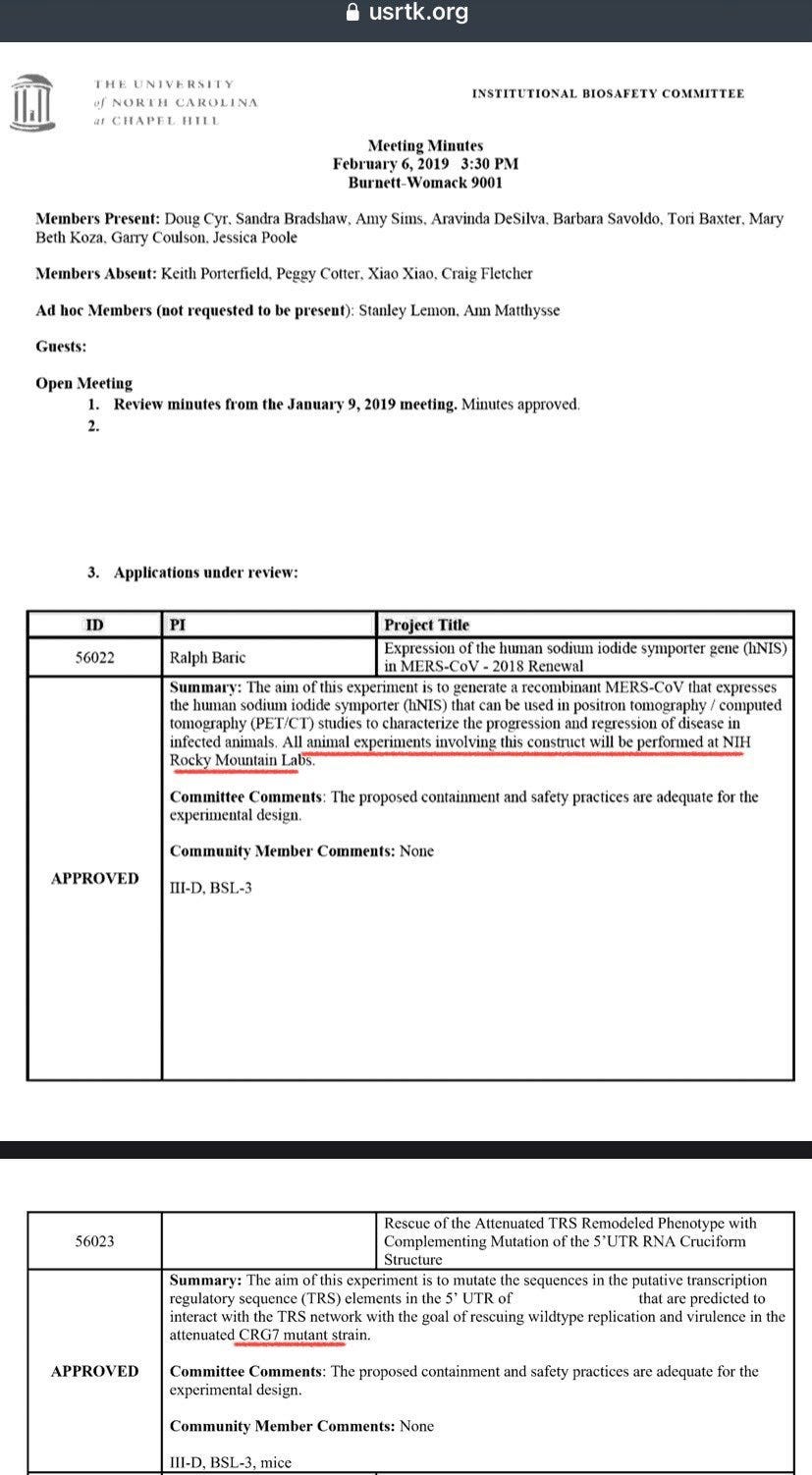
He sent unpublished chimera to Rocky Mountain Lab, addressed to Heinz Feldmann, not Vincent Munster.
MS. SALAZAR: Did you have an MTA with NIH-RML? What’s the date on this? It’s from 2023, on pangolin beta coronaviruses, where it looks like you would be providing original material to Vincent Munster from RML. Pangolin coronavirus was the original material, and the transmittal fee to reimburse the provider for preparation and distribution costs is zero. Is that something that was executed?
BARIC: I recall sending them WIV1 and SHSC014 for studies in bats. It’s possible that we sent them the pangolin coronavirus. I’d have to check the MTA agreements.
Baric also sent RML a “MERS-like” chimera in 2016 (SARS2 FCS is MERS-like) and a SARS2-like genome (CRG7) in 2019.
Baric’s most bizarre 2026 statement referenced top-secret info he already divulged in a podcast and published in 1997:
Sometimes in science you come across findings that are potentially concerning. And so in this case, Fang Li had been doing studies using biochemical approaches to identify the most optimal receptor binding domain possible to grab either the human ACE2 receptor or the mouse ACE2 receptor. The thought in the field from him, as a biochemist, was that would be the most optimal and most dangerous form of virus. I disagreed with him, because in reality, biochemical interactions are, in essence, a bell-shaped curve. If they can’t interact very well, the virus can’t get in. If they react too well, that interaction can’t come apart. So the virus can’t get in, and the virus, as it tries to release, gets caught up in what’s called a dominant negative effect, and it will prevent virus replication. And the reason I knew this is I had overexpressed receptors before, with mouse hepatitis virus. And because there was so much receptor there, the virus, as it got in, it replicated fine, but when it came out all the spikes were stripped off of the particle. So if the interaction is too great it kills the virus.
Anyone who might want to do nefarious work in science, wanted to create something, is going to think that the most efficient interaction is where you want to go. So I tested that hypothesis and showed that I was right, that the super-binding things were just as deleterious as the really poor-binding ones. I subsequently told NIH and destroyed those viruses. I have never told anyone, and I would recommend that this committee not release that, because then you will be responsible for telling terrorists what to do.
Rand Paul’s office told me that a classified portion of Baric’s interview will be released in the near future, after ODNI redacts the classified sections. Baric has now provided two days of testimony but still hasn’t produced an alibi. His only statement, after being confronted about attacking Andersen, was this:
I have absolutely no concerns about, no hesitation to tell you that I was not involved in the creation of this virus in any way. I’m 100 percent certain.
Lots more documents being uploaded by Paul’s office here:
Fauci had NIH brass clear the ethics hurdles for accepting a $900,000 prize by citing a 2011 prior review and an assurance from “the Israeli person” that nothing had changed.
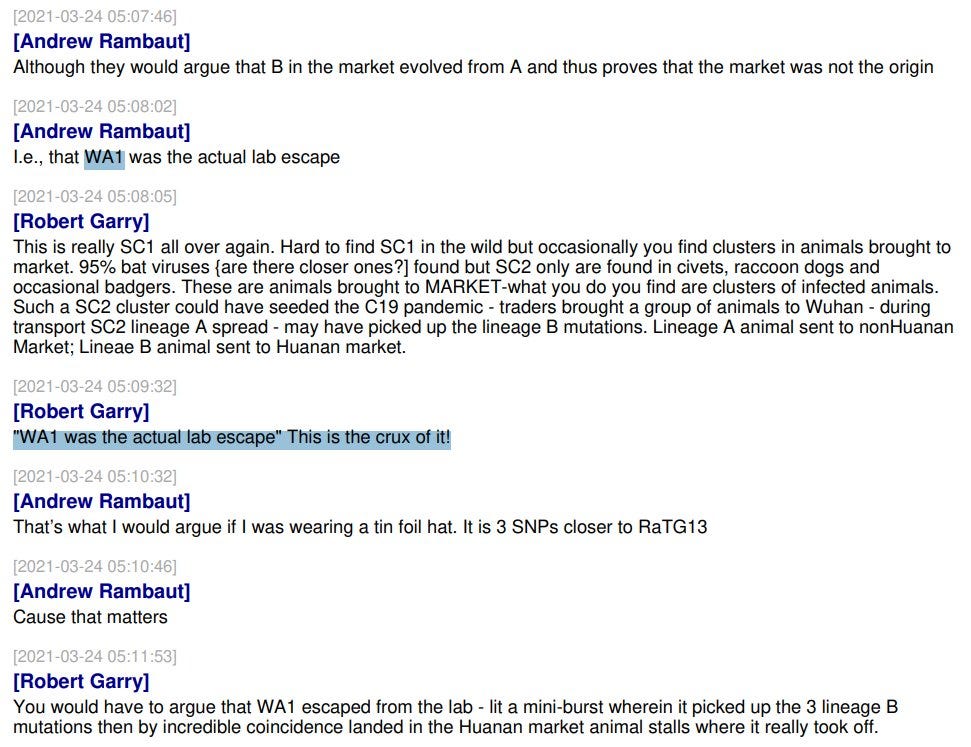
The funniest are the Slack exchanges where Kristian Andersen called Baric “a two-faced bastard” after DEFUSE leaked. Andrew Rambaut called Baric and Daszak a “shitshow” and doesn’t want to be “associated with these fuckers.”
Andersen joked about speaking fees at a Chinese conference, “Reply back and ask for (a) $15k and you’ll say the virus is all natural, or (b) $150k and you’ll say it’s from America, or (c) $15m and you’ll say Donald Trump made it.”
Robert Garry joked that Baric was in bed with Richard Ebright (eDim).
The Proximal Origin authors cited the WA1 evidence before I did. But this is further proof of the book’s final theory: the SARS2 ancestral strain of WA1 became biological proof of a lab leak in the Wuhan area but led to Fauci’s Rocky Mountain Lab.
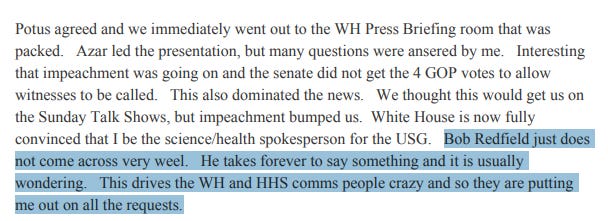
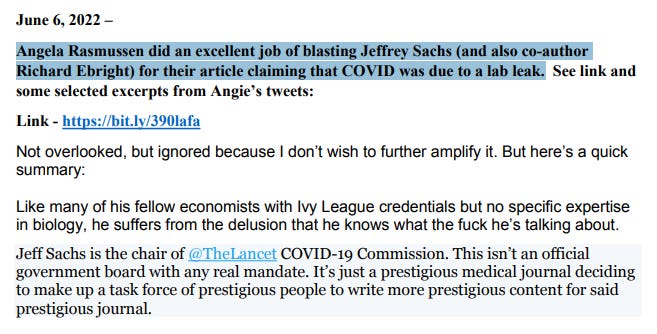
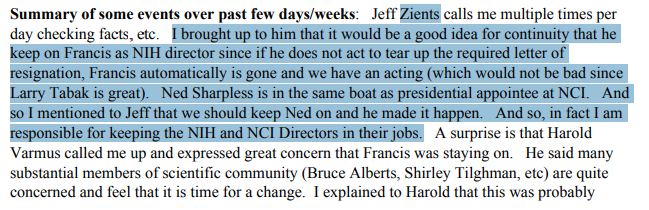
Fauci emailed himself at the end of every day, which became a running diary that evolved into his memoir. Rand Paul’s office released those emails, where he attacks Robert Redfield and Jeffrey Sachs:
Jeff Zients, who signed Fauci’s pardon, provided Fauci with legal advice and bodyguards. Fauci wined and dined at his “palatial estate,” and they sound like Machiavellian villains.
Fauci and Zients did a coup d’état on Trump and Biden?
What was your $82M CREID contractor, Danielle Anderson, doing inside the Wuhan BSL4?
Why did her Duke-NUS boss, Linfa Wang, resign as director of Duke’s EID program on January 10, 2020? Linfa is a NIAD funded bat virologist.
What did you discuss with RML during your weekly teleconferences that began in January 2020?
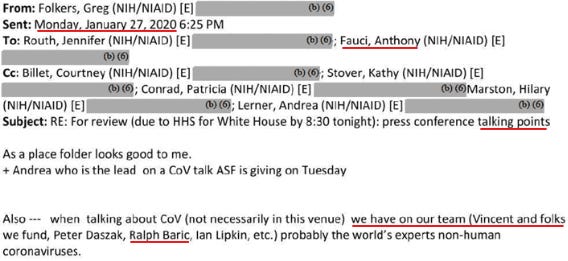
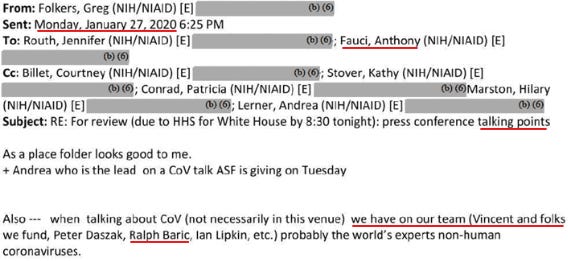
What did Munster present to you on January 27, 2020? Why were Munster and Baric’s names provided to you on that date? You testified in 2022 that you barely knew them.
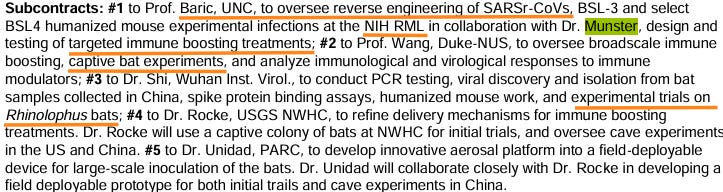
In 2016, you gave a joint presentation with Munster. Your NIAID office also offered Munster early tenure if he set up a live bat colony at RML. By 2018, Baric and Munster were infecting Egyptian fruit bats. Why are these bats the reservoir host for SARS2?
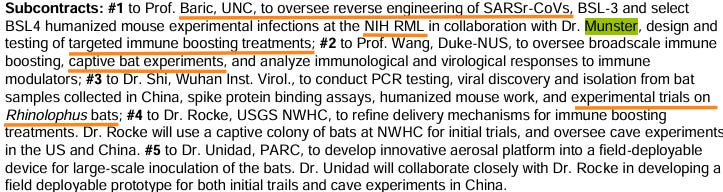
What was your “satellite campus” in Montana doing with both DARPA Preempt and DEFUSE projects in 2018-2019? What is a “targeted immune boosting treatment” of bats? How would Munster run “experimental trials on Rhinolophus bats,” which are found in Wuhan? Is this why you built a $125 million Rhinolophus breeding facility at RML?
In 2014, you told Francis Collins that RML was developing a “new vaccine platform [CMV] targeting wildlife vaccination.” But it was only tested in a mouse model and “very early stage of development.” How far advanced was this technology in 2019?
When Major Murphy leaked DARPA DEFUSE, he claimed you funded it. You denied funding it. But in 2019, Baric and Peter Daszak resubmitted DEFUSE to NIAID for funding, which you approved through the R01 and U01 grants.
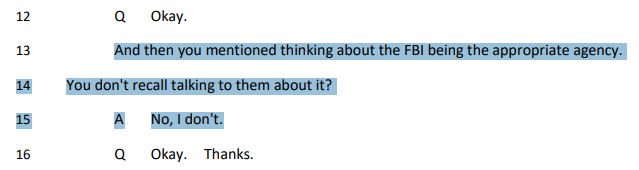
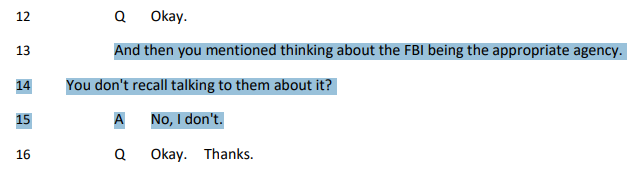
Why did you blind copy (bcc) John Mascola on your reply to Kristian Andersen? Andersen testified he, not you, wanted to contact the FBI.
Did you invite John Mascola to the February 1, 2020 call? Did you or Mascola invite Baric to the February 1 call? Baric first testified that “NIH staff” invited him, but now he claims not to know. Newly released emails show there was a February 2 meeting?
Why didn’t you contact the FBI? You testified that you did not, yet Andersen wanted to contact the FBI on January 30.
Why did your NIAID office nominate Munster and Heinz Feldmann for the WHO Mission to China in February 2020?
During the NASEM meeting on February 3, 2020, why did Baric “attack” Andersen for bringing attention to the furin cleavage site? In 2018, RML published a paper about a furin cleavage site needed in a bat virus for “intracellular proteases.”
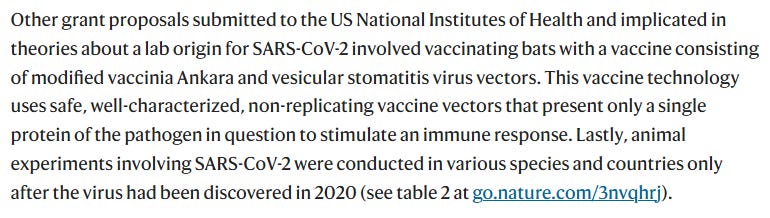
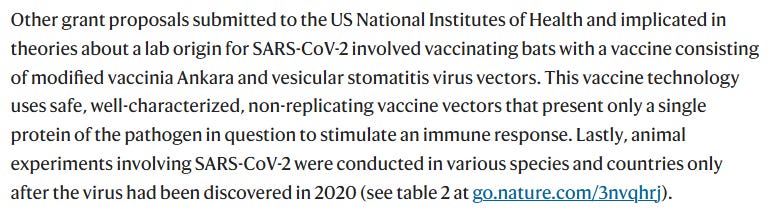
RML was cited in a recent Nature paper on the theory that COVID was a bat vaccine. Do you deny that COVID was a bat vaccine developed at RML?
Do you have an alibi for Rocky Mountain Lab?
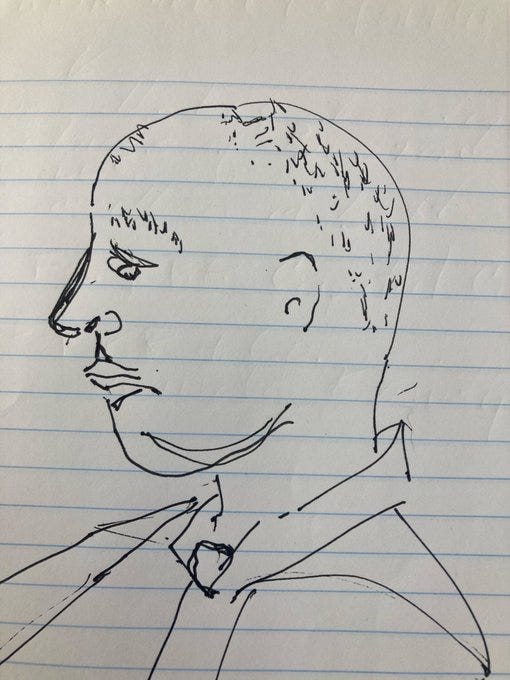
From a source in Detroit who attended Vincent Munster’s hearing this week, “he looked sad.”
Court drawing via local source in Detroit
Munster was charged with smuggling monkeypox into the country. There was no change in the charges, and a $10,000 unsecured bond was set with no money up front. The same restrictions apply as at the Montana appearance. The judge emphasized that he must avoid all contact and communication with his co-defendant, Kwe. After the hearing, the federal prosecutor was asked whether they were seeking a plea bargain, but he declined to answer. A preliminary examination has been set for August 12.





Comments
Nothing yet. Say the first thing.
Sign in to join the conversation.