
🧭 On money, pressure, and learning the hard way
There’s a lesson I learned slowly, and more than once.
The desire to make a lot of money, and to make it quickly, can quietly lead you into bad decisions.
Not reckless decisions in the obvious sense, but decisions that sound reasonable when you’re under pressure.
When you find yourself in an undesirable set of circumstances, financial stress, career uncertainty, or simply the feeling that you’re falling behind, it’s natural to want an exit. A clean break. A fast solution.
That’s usually where the trouble starts.
There’s an important distinction that experience eventually forces you to see.
You can work your way out of a difficult situation, or you can try to buy your way out of it.
They can look similar on the surface, but they feel very different over time.
Working your way out means building skills patiently, strengthening fundamentals, making small decisions that compound, and accepting that progress often takes longer than you’d like.
Trying to buy your way out feels faster.
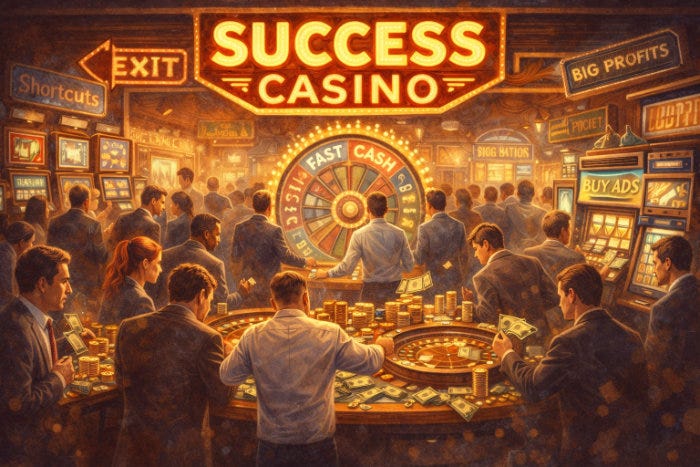
That usually shows up as expensive software that promises leverage, shortcuts that claim to bypass fundamentals, paid ads funded with money you don’t really have, or investments made out of anxiety instead of clarity.
I’ve gone down both paths.
And the second one almost always costs more than money.
One of the hardest things to recognize in the moment is when pressure is driving the decision.
Under pressure, everything feels urgent. Every offer feels like the missing piece. Every delay feels like falling further behind.
That’s when rational thinking quietly gives way to hopeful thinking.
You start telling yourself things like, this tool will finally fix it, this system will save me time, or this investment will pay for itself.
Sometimes those things are true.
More often, they’re an attempt to transfer responsibility from judgment to tools.
Experience eventually teaches you an uncomfortable truth.
You can’t outsource clarity.
No amount of software compensates for a lack of direction. No shortcut replaces understanding. And no amount of ad spend fixes a weak foundation.
Over time, I stopped doing a few things, not because they never work, but because they didn’t work for the reasons I was using them.
I stopped buying tools out of frustration.
I stopped assuming faster was better.
I stopped believing that spending money automatically meant progress.
Most importantly, I stopped confusing movement with improvement.
That shift didn’t make things easier overnight, but it made them more honest.
And honesty compounds.
Working your way out of a difficult situation doesn’t feel impressive. It doesn’t give you a story to tell. It rarely feels like momentum in the moment.
But it builds something solid.
It forces you to understand what you’re doing, why you’re doing it, and who you’re doing it for. It sharpens judgment instead of bypassing it. It replaces urgency with intention.
Over time, that changes the kind of decisions you make.
You stop asking, how do I get out of this quickly, and start asking, how do I build something that doesn’t put me back here again.
That’s not a flashy shift, but it’s a lasting one.
When I look back now, I don’t regret wanting more. Ambition wasn’t the problem.
The problem was believing that speed could replace understanding.
Experience doesn’t eliminate pressure, but it does change how you respond to it. You learn to pause instead of react. You learn to separate opportunity from urgency. You learn when patience is the smarter move.
And you learn that most meaningful progress happens quietly, without shortcuts, and without drama.
If you’re in a season where things feel tight, uncertain, or slower than you’d like, there’s nothing wrong with wanting improvement.
Just be careful how you pursue it.
Working your way forward may take longer, but it builds judgment, resilience, and stability. Trying to buy your way out often delays the real work and makes it more expensive.
Experience doesn’t make you immune to bad decisions.
But it does teach you which ones to stop making.
If this reflection resonated with you, you’re welcome to subscribe. I’ll continue sharing thoughts like this as we move forward, quietly, honestly, and without the noise.
https://www.jimgaliano.com
No posts
Comments
Nothing yet. Say the first thing.
Sign in to join the conversation.