
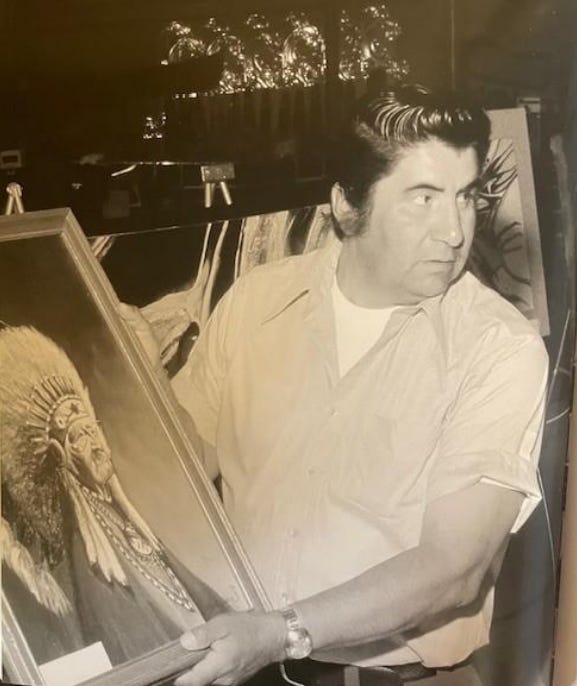
Warroad, Minnesota, is the hometown of five artists known in the international art world as members of the Woodlands School of Canadian Native Art. Eddy Cobiness was the first, the eldest. His nephews — Robert Jr. (1948-2020), John (1951-2024), and Don Kakaygeesick (b. 1959) — and his son, Ernest Cobiness (b. 1967) were also born in Warroad and members of the Woodlands School. They are considered Canadian artists and largely underappreciated this side of the border.
Eddy Cobiness was born in Warroad in 1933. His parents, Peter Cobiness and Rose James, had been living at Buffalo Point in Manitoba, according to the 1930 Census. Eddy grew up on Lake of the Woods, spending time in Warroad, Buffalo Point, the Northwest Angle and the islands on Lake of the Woods, like most of his relatives.
In the 1940 and 1950 Census, Eddy was listed with his family living in Warroad. To avoid their children being sent to an Indian residential boarding school, his parents kept a Warroad residence. Eddy’s older sister, Florence Barbara Cobiness (1922-2017), married Robert Kakaygeesick in 1946.
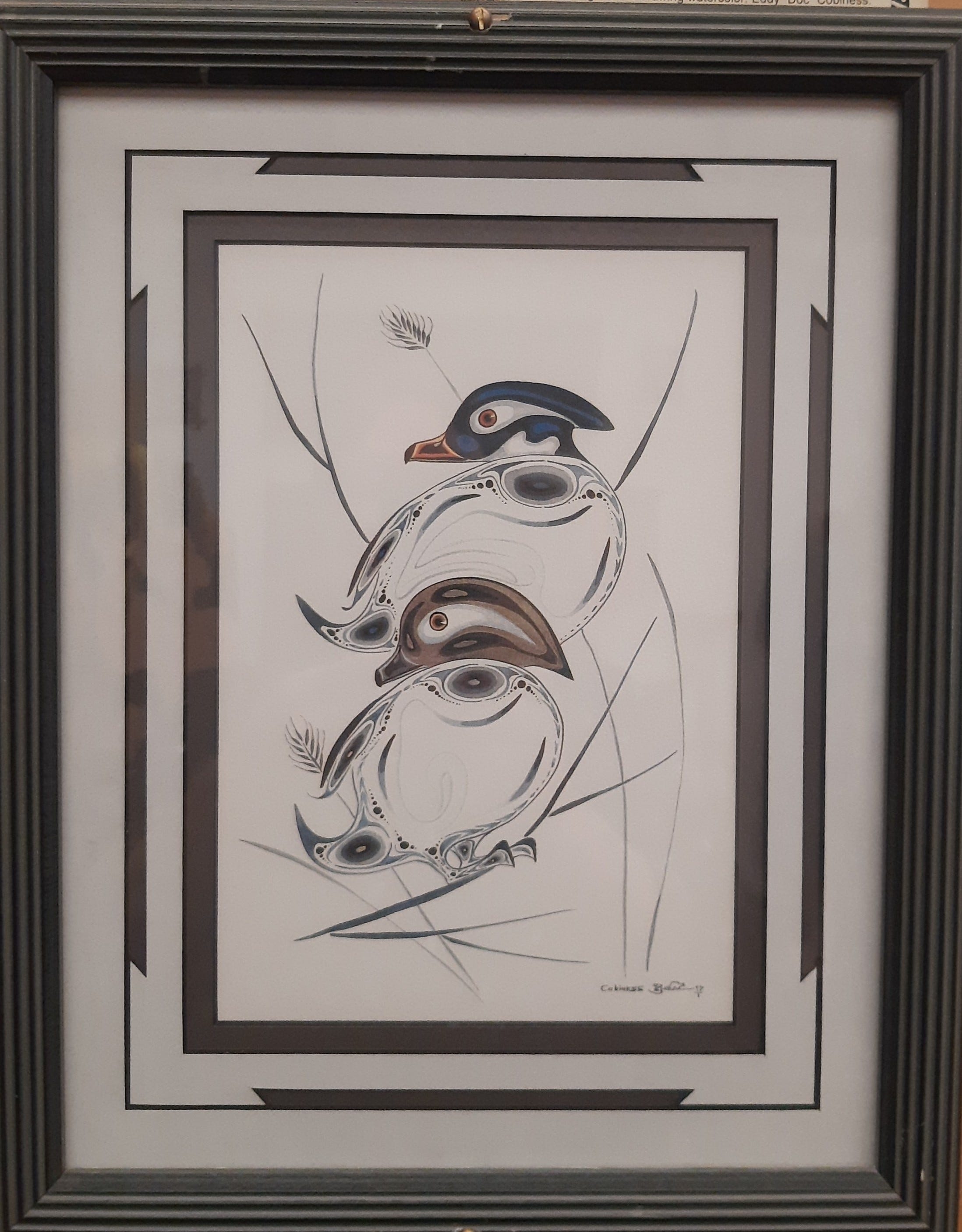
From 1954-1957 Eddy Cobiness served in the US Army where he became a Golden Gloves boxer. He also sketched in his free time; he’d been drawing since he was a kid. He continued to develop his own style with pen and ink drawings, watercolors, oil and acrylic paints.
When he returned from military service, he worked cutting timber and fishing, and had his art studio at Buffalo Point. He married Helen Accoby of Roseau River First Nation and they had eight children.
Through the 1960s and 70s, Eddy Cobiness kept painting and began to exhibit and sell his artwork in Winnipeg.
Daphne Odjig, an Odawa-Potawatomi artist with her own studio in Winnipeg, invited Cobiness in 1973 to join the Professional Native Indian Artists, Inc., an art collective that included Alex Janvier, Jackson Beardy, Norval Morrisseau, Carl Ray, and Joseph Sanchez.
The distinctive style of these painters became known as the Woodlands School of Art. Winnipeg Free Press reporter Gary Scherbain nicknamed them the Indian Group of Seven. The nickname was a play on a previous “Group of Seven” — seven white male artists who painted the Canadian landscape in the 1920s, known as the Algonquin School. The exhibitions of the art created by members of the Indigenous art collective were for the first time treated as art. They appeared in art galleries instead of museums as cultural artifacts.
In 1970, Queen Elizabeth II commissioned Eddy Cobiness to do a painting for her. His artworks are on display in the Canadian Museum of History, the McMichael Canadian Art Collection, Clarkson University Art Gallery, the Douglas Family Art Centre in the Lake of the Woods Museum in Kenora, Ontario, and the Warroad Heritage Center. Portage College in Alberta, Canada, holds one of the largest collections of his work. This video offers a virtual tour of some of his work.
Eddy Cobiness died in Winnipeg at the age of 62 from heart and kidney failure in 1996.
His son, Ernest Cobiness (b. 1967), followed in his father’s footsteps as an artist. He has spent the last couple of years collaborating with Cam Brown at the Sprague and Historical District Museum on the opening of a new building last September, dedicated to the Indigenous history of this southeastern tip of Manitoba. Sprague is a half-hour northwest from Warroad, and due west from Buffalo Point. The new building displays artwork by both father and son.
Cam Brown interviewed Ernest Cobiness for his new book, Sprague and District Historical Museum: Local First Nations History. I’m reading an electronic version of an Advance Review Copy and hope to meet both of them when I am in Warroad on the evening of July 9 at the Public Library.
Comments
Nothing yet. Say the first thing.
Sign in to join the conversation.