
Seven goats felt like too many. I tossed ideas around in my head about how to reduce numbers. Keep the youngsters and sell the old girls? Keep the older girls plus the doe kid Chai and sell all the boys? I spent weeks overthinking it and changing my mind.
There was no point, I figured, in keeping a lot of male goats. They don’t give milk. I don’t want to keep a breeding buck, for many reasons: I would need to set up a separate enclosure to keep him in most of the time; keeping an entire male with milking does can taint the milk. (That’s what usually causes the ‘goaty’ taste many people associate with goat milk.) Bucks can be much harder to handle than does. In any case, the three male kids bred from my girls were not an option to keep as breeding males for my small herd, due to them being related to the girls. Besides which they had been castrated when they were a couple of weeks old. This of course limited their future roles to those of pets, weed eaters or dinner. There is a limit to how many pet goats I need to feed and look after.
I thought about eating them. There were pros and cons. I eat meat and have on occasion eaten goat. From an ethical perspective, it makes sense to eat meat raised here. I knew they were healthy and had been well raised. I could not contemplate dispatching them myself, but I could have found someone to do the slaughtering and butchering. It could have been done quickly and humanely, with the goats never having to leave the property and go through the stress of transport. But… I had named them. That was probably the first mistake in terms of maintaining a suitable detachment from them. Although even before the naming, I had been at their births. Watched in awe as they came into the world. I had bottle fed Charlie and his sister Chai after Cinnamon refused to feed him. I had delighted in watching them play and chase each other. There was a lot of emotion in the way. They were pets.
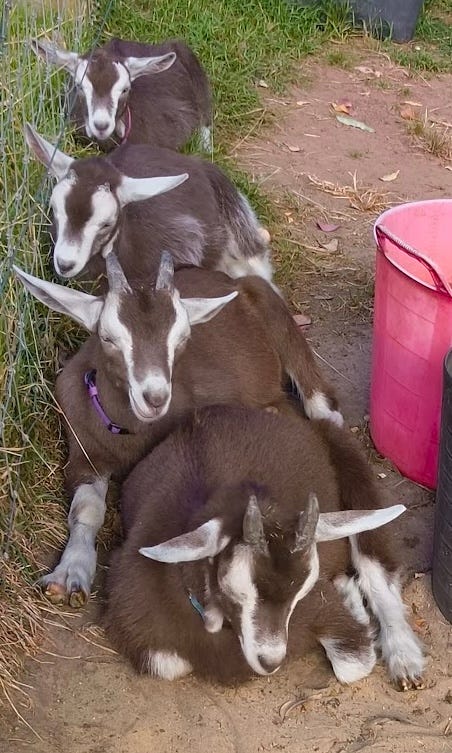
Four kids - cute, but too many!
There were also practical considerations. Three kids would yield a fair amount of meat. We don’t eat much meat. We would have a freezer full of it for months, if not years. (Besides, the freezer was already full of goat milk waiting to be made into cheese!) On balance, eating them was out of the question. Keeping them was neither practical nor sensible, and I have moments of being both practical and sensible.
Eventually, I advertised the three young boys: Sesame’s twins Boo and Berry, and Cinnamon’s boy Charlie.
It’s a strange thing when you advertise goats for sale. Lots of people love the idea of having goats. They message or ring and want to talk to you all about goats. They have ideas that their human kids could play with the goat kids and they could grow up together. They have ideas that the goats will neatly trim their lawn and not eat their garden. They also don’t want to pay any money for them, because they think they are doing you a favour taking them off your hands. They would like you to keep them for another six months while they get their fences ready. They would like a goat in milk so would like to buy the mothers not the castrated male kids that you have advertised. They would like to visit to see the goats. You get the idea. Lots of people have very unrealistic ideas about the whole thing. Goats will not trim the lawn. They will eat the garden. They will break through weak fences. They will push small children over. They will make noise. They will require feeding, even when you want to go away on holiday. Sometimes they will need veterinary care. They will need worming and hoof trimming. They will cost money. If you milk a doe, it will quite possibly turn out to be the most expensive milk you have ever had in your fridge (at least for the first season), and that’s not accounting for your time.
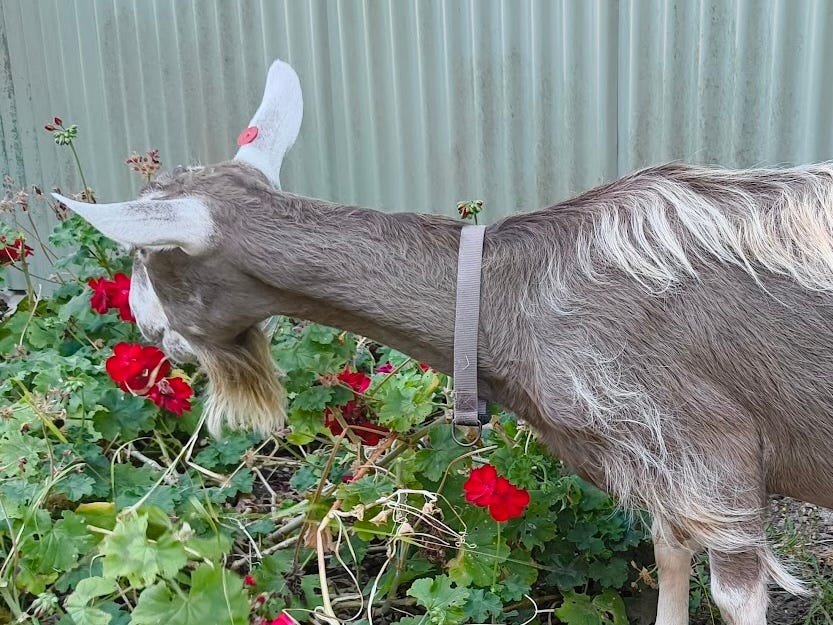
Cinnamon demonstrating garden-eating prowess.
But… they will be endlessly entertaining. They will want to be with you. They will want you to scratch them. They will love you. They will eat the feral blackberries and woody weeds. If you milk a doe, you will quite likely learn to love doing so, even if it ties you to the daily task and makes going away difficult. You will come to love the smell of the milking shed. The sound of the milk squirting into the bucket. The warm satisfaction of the whole thing. The delicious alchemy of the goat turning grass and weeds into milk and you turning fresh milk into delicious cheese.
But… there is still a limit to the number of goats I want in my paddock. So I advertised the three boys and received a steady stream of enquiries over the first week. No-one actually wanted to buy them. They just wanted to talk about the idea of owning goats. Then a goat breeder who lives and hour away from me rang and asked if I still had them. She knew someone who was after a couple of wethers to control some weeds and, ultimately, end up in the freezer. Did that bother me? No, I said, I could cope with that. A good life and a humane death. That was my requirement.
I contacted the guy and the deal was all but done. Then, the breeder contacted me again. Was I intending to keep my doe kid? She was after a well-bred Toggenburg doe kid. I sent her details of little Chai’s breeding and her pending registration in the Dairy Goat Herd Book of Australia. (One thing that I promised myself when I started keeping goats was that I would breed ‘good’ goats; they would be purebred pedigree animals from good dairy lines.)
I had thought I’d keep Chai. She was the first doe kid I had bred and registered. I liked the idea of one day breeding from her, of breeding on to that next generation. The breeder liked what she saw and said she was interested in buying Chai. I was still uncertain, but then the breeder made me an offer that was too good to refuse. Then she said she wanted Chai’s brother Charlie as well, to make the transition to the new home easier for Chai and to keep her company.
So that’s how it happened.
Chai and Charlie went to the breeder. Boo and Berry went to the breeder’s friend. It sounds easy when I say it like that. It was mostly easy. Except for the bit where we already had Chai and Charlie in the trailer and needed to get Boo and Berry in without the first two getting out. That wasn’t easy. It would possibly have been hilarious to watch. I don’t remember laughing much at the time though. There might have been swearing. There might have been little goats running all over the place, dodging behind trees and jumping up on logs. Finally, all four kids were loaded into the trailer. Boo and Berry were dropped off at their new home. Chai and Charlie didn’t even attempt to get out while their half-brothers were unloaded. Chai and Charlie were subsequently dropped off. I pocketed some cash - not much for any of the boys, but a good amount for Chai. We drove home.
Three goats in the paddock. Ashcroft, the wether from last year, was bleating forlornly. Clearly missing his playmates. Cinnamon looked somewhat stunned, but had never bonded with her babies, in fact didn’t ever acknowledge they were hers. Sesame bleated to us as we pulled up. She looked expectantly at the trailer. Bleated some more. Her udder was huge. She bleated on and off for three days. I milked her twice a day for the first week, then dropped to once a day, milking both girls each morning. We got in a rhythm with it. And the three settled back into being just three. I missed the antics of the young kids to begin with, but all I can say now is it’s much easier managing three goats than seven.
See you outside,
Jill
Thanks for reading Mostly Outside! This post is public so feel free to share it.
Comments
Nothing yet. Say the first thing.
Sign in to join the conversation.