
It cannot be denied that when we think about Western civilisation historically, European philosophy is central. The Protestant-influenced Enlightenment inheritance was unique to this part of the world. It is also a fact that the people who historically emerged from this civilisation, Europeans by ancestry, were white.
It is through this racialised understanding of the West that essentialists on both the left and the right anchor themselves. The hard right views civilisation as reducible to biology, as though ancestry itself produces personality and moral capacity. The modern left, by contrast, often treats “whiteness” as synonymous with Western thought and therefore as morally suspect by default.
What is striking is that both end up in the same place. Each comes to see Blackness as something foreign to Western civilisation, something added, imported, or grafted on rather than woven into its history.
But this is a profound misunderstanding.
Black identity, expression, and spirituality were not marginal to the West. They were formed in direct confrontation with it through slavery, empire, industrialism, migration, and resistance. The very term “Black” was itself produced within the racial hierarchies of the New World. It is a term that carries little meaning across much of Africa, where the majority of black people live.
To speak of Black culture as foreign, then, is to erase the fact that it is a co-creation of Western modernity, not its antithesis.
Some of you reading may be wondering: what exactly is “Black” culture? Is Black simply a physical descriptor? How could it be used to describe a culture shared by people across ethnicities and continents?
By “Black culture,” I am not referring to lifestyle or aesthetics, but to a historical inheritance — a moral, spiritual, and symbolic tradition forged within Western modernity itself.
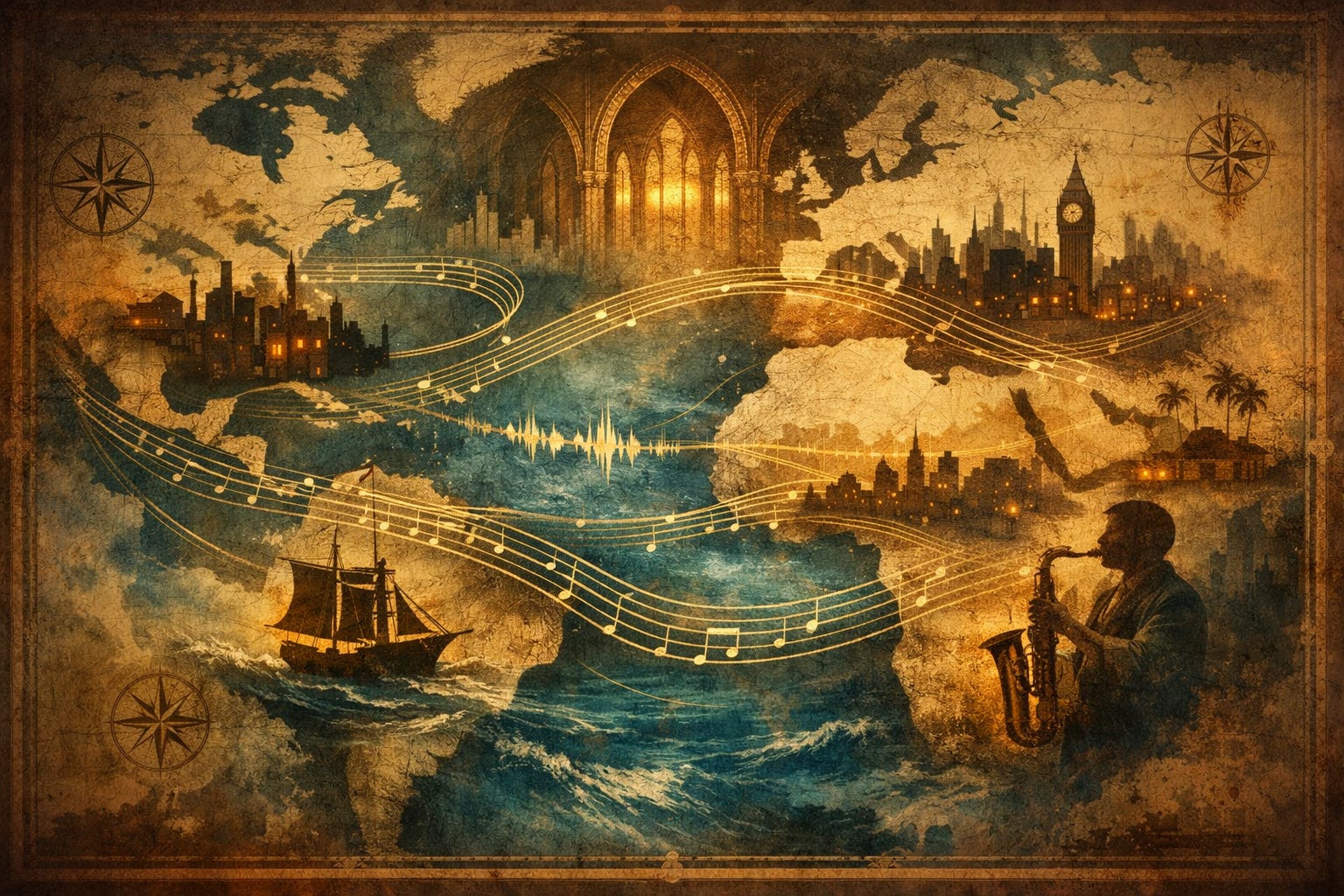
Sociologist Paul Gilroy’s Black Atlantic framework disrupts the idea of neat national or ethnic cultures. He argues that Blackness was forged at the intersection of transatlantic slavery, racial capitalism, Christianity, and Enlightenment thought. This Atlantic world linked Africa, the Caribbean, the Americas, and Europe. Therefore, “Black” identity is not African per se; it is a product of Western racial taxonomy, a response to European colonial categorisation within modernity.
Blackness became both a designation of oppression and a banner of resistance within the West. Crucially, Black intellectuals and artists were not marginal observers of Western civilisation. They were active and critical participants in shaping it.
For instance, Olaudah Equiano, a formerly enslaved African, was a writer and abolitionist in eighteenth-century Britain. His autobiography helped galvanise public opinion and contributed to the passage of the British Slave Trade Act of 1807, which abolished the slave trade within the British Empire.
Frederick Douglass came to see the U.S. Constitution not as a dead compromise with slavery, but as a moral promise whose meaning could only be fully realised when interpreted through the lived reality of Black Americans. Formed by slavery, Douglass exposed the contradiction between America’s professed ideals of liberty and its actual practices, forcing those ideals to be tested rather than merely proclaimed.
Black experience did not negate the Constitution’s universal claims. It clarified and completed them, revealing whether liberty was a tribal privilege or a genuinely moral value. In this sense, Black presence in America was not external to the constitutional project but essential to its maturation, acting as both its most searching critic and its most faithful interpreter.
The Black Atlantic, then, is the ghost in the machine of modernity: ever present, yet rarely credited.
The traces of this inheritance can even be found in entertainment. For instance, zombies, mythological figures ever present in some of the most iconic horror genres from Night of the Living Dead to 28 Days Later, are best understood as a Black Atlantic inheritance rather than a purely Western fantasy.
Emerging from Haitian Vodou and the brutal realities of plantation slavery, the zombie originally symbolised a person stripped of will, kinship, and moral agency: a living death produced by modern systems of domination. When this figure crossed the Atlantic into Europe and North America, it was secularised and commercialised. Yet it retained its original charge, a critique of modernity’s tendency to reduce human beings to labour, bodies, or appetites.
Today, it has been fully absorbed into Western popular culture as a universal metaphor for alienation, consumption, and dehumanisation.
Music is another site where this inheritance becomes visible. Consider the lineage of rock and roll. Its origins lie in the blending of Black musical genres, drawing on electric blues, jazz, swing, folk, and gospel, among others.
Beyond surface-level aesthetics, we see the Black Atlantic journey at work: music as a mode of survival, protest, and identity. From Negro Spirituals, sung on plantations and encoded with theology and resistance, to jazz born in the segregated American South and emerging as modernity’s most avant-garde form before eventually finding its way into rock and roll. These forms shaped Western musical modernism. They are not apart from it.
Elvis Presley best captures this lived reality. Growing up in Memphis, close to Black churches and Beale Street, Elvis absorbed a musical grammar forged within Black Atlantic modernity: call-and-response, embodied rhythm, vocal improvisation, and the fusion of the sacred and the secular.
What made Elvis transformative was not originality, but translation. He acted as a cultural conduit through which Black Atlantic sound crossed racial boundaries and entered white mainstream America.
Pentecostalism is often mislabelled an “immigrant Christianity,” but this framing misses its true genealogy. Pentecostalism did not arrive in the West from the Global South. It was born within Western modernity, shaped by Afro-diasporic experience.
Its theology, worship, and moral imagination crystallised in early twentieth-century Atlantic cities, most famously through the Azusa Street Revival. There, Black Christians drew on spirituals, Holiness movements, revivalism, and embodied Black worship to articulate a radically democratic vision of the Spirit. Pentecostalism reflects Black Atlantic conditions of displacement, hope, suffering, and a demand for divine immediacy.
Its later global spread to Africa and the Caribbean was not a foreign import back into the West. It was the outward diffusion of a Western-born Black religious form, one that exposes how deeply Black Atlantic Christianity has shaped the spiritual architecture of the modern world.
Today, we see Pentecostal expressions of the Christian faith across several denominations, my local Anglican church in southeast London being one such example. Yet few are aware that a black man, William J. Seymour, led the foundational event of modern Pentecostal history.
Blackness is not a foreign presence in the West. It is one of its deepest inheritances.
If the Black Atlantic is to be considered foreign, then the same logic must apply to Christianity itself, which would have to be treated as an “import” from the Middle East into the West. Yet this raises an obvious tension. How does one reconcile such a thinking with Augustine of Hippo, a North African of Berber origin born in what is now modern-day Algeria, who is widely affirmed as one of the founding fathers of Western philosophy and theology?
This all highlights a category error that many engage in when we talk about “the West.” The West is not, historically, a biological or ancestral category, but a moral-cultural civilisation. It is a tradition constituted by ideas, arguments, and moral claims that are received, contested, and developed over time.
From Augustine of Hippo through John Locke to Martin Luther King Jr., the Western tradition has been shaped by theological reflection, moral reasoning, and appeals to universal human dignity, not shared bloodlines.
Yet modern discourse increasingly collapses civilisation into ancestry, treating the West as an ethnic possession rather than an intellectual inheritance.
Framing Western civilisation by participation in ideas does not deny ethnicity as a real and meaningful dimension of identity; it simply refuses to absolutise it. Moral-cultural civilisations are often carried, enriched, and inflected by particular peoples without being reducible to them. English traditions of liberty, the Italian Renaissance, Jewish intellectual life, and the Black Atlantic all represent distinctive historical contributions shaped by concrete communities, memories, and practices. Ethnicity supplies texture and depth. Civilisation provides the shared grammar through which those inheritances can be received beyond their point of origin.
To mistake Black inheritance as foreign is not merely a historical error, but a failure to understand how Western civilisation has always been formed.
No posts
Comments
Nothing yet. Say the first thing.
Sign in to join the conversation.