
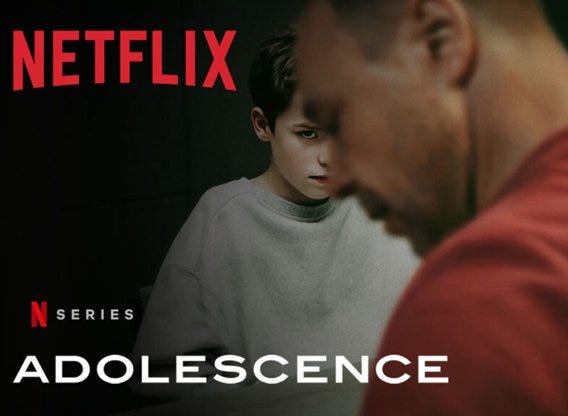
But what stood out for me is how much was said in the silences—the sighs, gestures and facial expressions. This is a story that rests heavily on body language.
Spoiler Alert
Adolescence is everything I expected it to be—chilling, intense and unsettling. The four-part series leans heavily on the dramatic and spectacular individual performances. The cast’s interpretation of their roles is impressive. I knew what to expect from Stephen Graham and Ashley Walters, but the performance of the teenage actor, Owen Cooper, as one of the main characters, left me astounded. He delivered a stellar act.
The most beautiful thing about this Netflix mini-series is that it defies classification. It has a bit of everything from crime to police procedural, mystery, psychological drama, and documentary. It is a social commentary as much as it is fiction.
The show starts with an early morning raid on the Miller’s home. Their thirteen-year-old son is arrested on the suspicion of murder to the surprise and chagrin of his parents and sister. Jamie repeatedly expresses his innocence as he’s being led out of the house. The mother is screaming. The sister is crying. The father is trying to manage everything and everyone—put emotions in check and keep a clear head. The series starts with an intensity that doesn’t loosen its grip through its entire four episodes. I was scared to keep watching yet couldn’t afford to stop.
The one-shot photography and the anthology-styled episodes give a unique real time feel to the story, revving up the tension. It gives you little room to analyse or ponder, you’re just overwhelmed by emotions. It gives you no space to breathe. You’re perpetually at the edge of your seat. This strength, I would later realise, is also the show’s weakness.
That stretch prior interrogation, where the boy is processed for detention, in the presence of his father, was harrowing to watch. Eddie stumbles through a range of feelings without railings—having to process things as they unfold yet prioritizing his son’s legal rights and mental health while his own sanity grows thin. Jamie continues to deny the crime, even after the detectives show the CCTV footage of his fatal act. The revelation leaves the father shattered. What starts as a mystery quickly morphs into a nameless beast at the end of the first episode.
The dialogue is brilliant. But what stood out for me is how much was said in the silences—the sighs, gestures and facial expressions. This is a story that rests heavily on body language. Its storytelling method seeks to explore the complexity of human nature without trying to establish a rigid distinction between right or wrong. It places the audience in the heartbeat of its characters—through each throbbing nerve, and each fear struggling to find voice. Through the vein of laughter and the gravity of tears.
Episode two takes a detour into the world of social media and its impact on parenting, and teenage interaction. Here, coloured emojis take on new meanings with such frequency that adults can’t keep up. We see a spectrum of adolescent relationship scenarios—with teachers, parents and peers. It would be naïve to use social media behaviour to assess humans because online personas largely stay put there.
This episode is the weakest of the series. It struggles to be coherent. Perhaps it mirrors the chaos of the medium it seeks to interrogate. Where it asks questions, the show does well, but where it aims at subtle affirmation of social tropes, it strays from being the open book it poses as. The writers try to nudge us towards their idea of bad parenting while failing to acknowledge that adolescence is that period where rebels are made. Adolescence isn’t so much about the shortcomings of parents as much as that phase when we become our own person—that point when we decide to discard our parents’ counsels and experiment, dig into ourselves to find identity.
Also, in their bid to move the story along the gender path, they threw in a weak motive for the murder in the most unconvincing manner. Suddenly, DI Bascombe’s son decides to save his father from further embarrassment by having the most uncomfortable conversation, trying to make him understand online communication. Then his partner goes into a weird, unrelated rant of how the focus has been on the perpetrator rather than the victim. They lost me there—I thought they were trying to establish an air-tight case against the culprit!
After reading some of Jack Thorne’s comments about the show, it became apparent that the writer himself has tapped into the secret of social media engagement in trying to steer the conversation in a direction he wants. Again, the series that initially felt open to different interpretations based on personal perception and experience becomes contextual and sentimental. He stylishly curates the discourse and drives engagement.
The following episodes continue down the narrow corridor, amplifying the trope of male ego or fragility and an absent or abusive father. This is also where the story falters. Where the gaps in plot become more pronounced. The decision to focus on the accounts of different characters in each episode left some creases in the narrative. For example, Jamie’s persona becomes complicated—how do you marry the timid teenager who peed himself in the first episode with the one who engages the psychologist in your head? His session with Briony gives the vibe of a bipolar kid, which would be hard to sell because his character at home was consistent—it’s also in agreement with the personality struggling with the definition of masculinity, rejected and bullied by a girl he admires.
Could we argue that Eddie, who seemed more rational, got worn-out and lost control over time while his wife, Manda, somehow regains composure and becomes the family’s emotional rudder? Suddenly, a working father who does everything to provide for the family becomes the absent father the society desperately needs as scapegoat—what a stretch!
In retrospect, the detective sergeant’s rant about ignoring the victim is like four fingers pointing inwards at the show itself. In the bid to tell an urgent tale of flawed males, or avoid victim-blaming, Katie story was avoided. This makes light of the cyber or non-physical kind of bullying. It makes light of the very important Newton’s Third Law of motion—for every action, there is an equal and opposite reaction. It would have been nice to have a glimpse into the victim’s life or at least the people in her life.
Adolescence addressed difficult and sensitive societal issues. And while you can’t prescribe a story for a writer or question what perspective an artist puts out, you expect some level of honesty and balance in the conversations it seeks to generate.
We’re a generation who lives in denial, like a dog trying to escape its own tail. We are big on empathy but don’t seem to understand the concept of cause. No problem is solved whose root isn’t investigated. The subtle truth of this TV series is that most times we don’t have answers to human (mis)behaviour. The motive of a killer is hardly ever a simple thing to pin down. Two children under the same parental grooming can turn out differently irrespective of their gender. But, yes, let’s keep skirting the issues—we’re not ready for this conversation.
No posts
Comments
Nothing yet. Say the first thing.
Sign in to join the conversation.