
It’s April, folks, and that means it’s time to celebrate your mother. Not the lovely lady that birthed you (although, please do send her my regards). I’m talking about Mother Earth. Earth Day is April 22nd this year, but Earth Month is already happening all around us. It’s a time for planting trees, cleaning up, and sowing hope.
No matter where you live, there’s probably an Earth Day event for you. If you live in Chicago, consider joining Citizens’ Climate Lobby as we clean up Northerly Island tomorrow (Saturday, April 18th). You can even sign up at this fancy link. Will it rain? Probably. But just consider those tears of joy from your grateful Mother.
Earth Day is, ultimately, an act of hope. Even with the environmental degradation taking place all around us, we rally together to try and do something. And while it may seem like our planet ought to be celebrated every day, Earth Day is only the beginning. Just take CCL’s event I linked to above. Of the 47 people signed up, 17 have never been to one of our events before. Even I got my start at an Earth Day event. After picking up beach trash on Earth Day 2020, I became the obnoxious, ultra-volunteering creature you see before you.
Earth Day, then, is really an expression of all the planetary work already going on inside us, those tectonic shifts urging us to act and change. Like a hundred flowers blooming[1], environmentalism is a blossoming of the seeds already putting roots down in our lives. And for me, while I try to incorporate sustainability into what I eat, buy, electrify, and wear, those roots come from somewhere deeper. They come from philosophy. They come from faith.
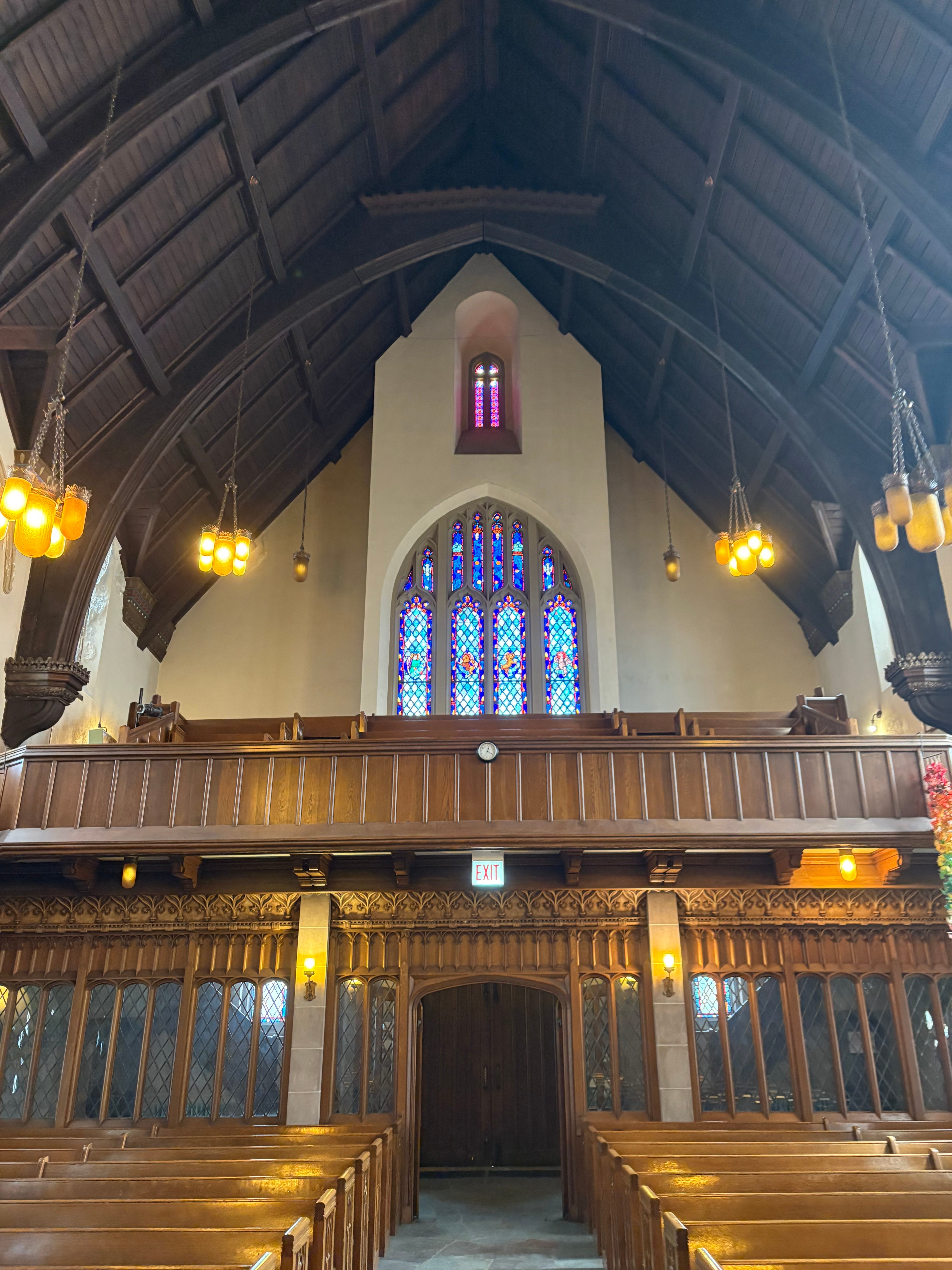
For anyone just joining us, I’ll do my requisite TLDR: my progressive, rainbow flag church is fighting the good fight on climate change and attempting to upgrade our exquisitely ancient infrastructure. You can read about that particularly journey in Taking Solace in Slowness and Unreasonably Excited about Lightbulbs.
Today, though, I don’t want to talk about the building. I want to talk about the people. At my church, we’re celebrating the Earth all month long. And last weekend, we had a service dedicated to environmental storytelling. With the members of our church’s Green Team (associated with Faith in Place, a great environmental justice org that helps churches become more sustainable), we walked through not only what we’ve done as a church, but why.
But what does that have to do with you? There is some phenomenal environmental work going on in faith communities. But, by and large, the enviro movement is a secular atheist one. And, at least in America, I’d hazard a guess that the majority of churches, which lean right-to-far-right, espouse beliefs of dominion that are antithetical to environmental stewardship (more on that later).
However, during this year’s Earth Day sermon — given by one of our pastors, Rebecca, who is an amazing speaker with a background as a playwrite, Moth storyteller, and more — I had a realization. The philosophy she discussed — non-dualistic thinking at the intersection of the environment and faith — is exactly what the enviro movement has been grappling with the past few years. They just don’t call it that…
Yours truly — bold in the pen but shy behind the mic — actually did the readings. In front of everyone. Even though I was told that the schedule was very tight, I got nervous and started riffing. I think I got some laughs? I don’t know, I blacked out.
But I do remember the readings (the ones I was actually meant to do). At my church, we always do one Bible reading and one secular poem. And after stumbling through Psalm 8 (When I look up at your skies, at what your fingers made — the moon and the stars), I read from Carl Sagan’s “The Pale Blue Dot”:
Look again at that dot. That’s here. That’s home. That’s us. On it everyone you love, everyone you know, everyone you ever heard of, every human being who ever was, lived out their lives. The aggregate of our joy and suffering, thousands of confident religions, ideologies, and economic doctrines, every hunter and forager, every hero and coward, every creator and destroyer of civilization, every king and peasant, every young couple in love, every mother and father, hopeful child, inventor and explorer, every teacher of morals, every corrupt politician, every “superstar,” every “supreme leader,” every saint and sinner in the history of our species lived there – on a mote of dust suspended in a sunbeam.
Stirring stuff. And I think I only messed up a couple times (a minor miracle). But let’s get back to the sermon and the philosophy of environmentalism in the church. After all, what does the environment have to do with faith?
The most common belief you’ll see from Christians on the environment is Dominion. In a purely environmental context (there are political contexts too), it’s the belief that humans are meant to have total control over the Earth. Stemming from interpretations of Genesis 1:28, it’s like Manifest Destiny for every land and creature:
And God blessed them, and God said unto them, “Be fruitful, and multiply, and replenish the earth, and subdue it: and have dominion over the fish of the sea, and over the fowl of the air, and over every living thing that moveth upon the earth.
And, if you take a look around, it’s not like there’s zero logic to it. Humans have made a massive impact on this planet. It’s the reason we’re living in the Anthropocene, a literal geologic age marked by our presence. Ignoring the fire tortoise memes I’ve been seeing lately (You think God loves you? Tortoises live 100 years and are covered in armor…), we squishy apes have already taken over our world.
However, as a philosophy, dominion is fatally flawed. For one thing, the Earth is an intricate system we’re woven into. As the planet warms up, and our lives are beset by storms, heatwaves, and wildfire smoke, we’re reminded that we can’t live without Mother Earth. And it’s not just religion. Just as Aristotelian philosophy urges Western culture to separate the mind from the body, dominion tempts us to think we can somehow be separate from the air and water we need to live.
The flaws, though, go deeper than that. At its darkest, dominion can merge with millenarianism, the belief that nothing here matters because it’s all a preview to the second coming. Why should you care about the Earth when it’s going to be remade? In fact, some fundamentalist sects go so far as to say environmentalism is akin to idolatry. Every tool and resource on the planet should be used for Christian conquest and the domination of non-believers.
If that were actually the case, though, what then, would be the point of living? Why help the poor, the hungry, and the sick (all things Jesus urged us to do)? Why care about anything at all?
In the end, caring for the Earth is not only about caring for the beautiful flora and fauna we call home. It’s about caring for each other. It’s about trying to limit our mutual suffering and take responsibility for our interwoven impact. If that’s not goodness, I don’t know what is.
But if we’re meant to care about the environment, how should we go about doing so? Should we emphasize “right-thinking” and, as good post-modernists, focus solely on systems of inequity and the corporations who lead emissions? (Even if they’re generating those emissions making stuff for us.) Or should we take the route of the self-flagellating saints and seek perfect behavior for ourselves? (Even though our behavior is only part of a broader socioeconomic and industrial context.)
If you, like me, were traumatized by Catholic school, you may be realizing two things: 1) personal perfection is impossible, but 2) washing our hands of all responsibility simply because the world isn’t black and white is unsatisfying and morally unfulfilling. But what is an environmentalist to do? Thankfully, in between bouts of cruelty, crusades, and bloodshed, the church has spent two millennia thinking about this very thing. The paradox of faith and works. The tension between grace and free will. *#Christianity re-enters the chat*
In the Old Testament, there was only one way to save yourself — the capital “L” Law. You had to abide by the commandments (among other rules). And if you failed to do so, you’d better sacrifice a meaty ram at the temple. Jesus, however, flipped that on its head. Not only did he see greater value in the rejected and forgotten, but he offered salvation to literally everyone regardless of what they’ve done. This, in essence, is the new covenant. Salvation merely by the grace of God.
What, then, of our lives? What are they for? Clearly, even if our actions don’t save and redeem us, they’re still important. After all, my many atheist friends are the kindest and most moral people I know. If you’re only behaving well because you’re afraid of hell (which is a weird mix of Dante and Greek mythology, anyway), you have a huge problem. Kindness matters. And the only true commandment we get under this new covenant is the golden rule, an exhortation to love.
But what of sin? Even if you don’t believe in hell (and again, I personally don’t), there’s something important in the Christian concept of sin and redemption. We’ve all done wrong. We’ve all caused damage, both personally, socially, and environmentally.
In the developed world, our environmental “original sin” is part of our very being. We can’t avoid the fact that what brought us to today — industrialization, technology, development — also came at the cost of environmental degradation.
If love is the command, then hate and hurt are its opposite. And when we do wrong, we’re asked to repent. But what does that mean? Translated literally, it simply means to “turn around,” to decide we want to stop causing hurt. That’s the essence of restorative justice. Through our innate empathy for each other, we can want to change.
So, it’s incumbent on us to try. And yet, just like salvation, our individual actions alone aren’t enough. It’s the great irony of human existence. We’re given free will, but, alone, we’re all so very small. My composting won’t force aluminum companies to switch to electric arc furnaces. Even worse, many of the things we do try, like recycling, are lies sold to us by the plastics industry. This tension is precisely why Paul had to write so many letters in the New Testament. From Romans 3:
23 For everyone has sinned; we all fall short of God’s glorious standard. 24 Yet God, in his grace, freely makes us right in his sight… 27 Can we boast, then, that we have done anything to be accepted by God? No, because our acquittal is not based on obeying the law. It is based on faith… 31 Well then, if we emphasize faith, does this mean that we can forget about the law? Of course not! In fact, only when we have faith do we truly fulfill the law.
We must, then, have both faith and works. Works without faith is meaningless. Yet faith without works is dead. And yet, fundamentalism teaches that salvation is an individual project. Either you’re good or bad, right or wrong, perfect or doomed. In reality, the good news is both far more complicated and uncomfortable: It’s both out of our hands, and it will all, somehow, be fine.
You can’t only electric car your way out of the climate crisis. And yet, as we change ourselves, as our “environmental faith,” molds us, we see what we’re capable of collectively. If we change our furnaces, our grid, our homes, and our industries, we will slowly see the world change with us.
And that’s the other side of the coin: universal salvation — or, in the case of the environment, climate salvation — also isn’t “fair.” Our solar punk future will save both you and the people you dislike. The oil executives and the climate deniers. All of us are inching toward a future when energy will be free and abundant, CO2 levels will be falling, and the biodiversity of our ecosystems will be allowed to heal.
My challenge to you is this: realize that whatever you do in your life, the environment is a part of it. Realize that whatever you care about — poverty, inequity, justice — climate is the “Ur-challenge,” threatening the less fortunate across every intersectionality. What we do matters.
However, that also doesn’t mean self-loathing and an obsession with environmental purity is a short-cut to environmental salvation. This new covenant of environmental stewardship is not about condemnation but invitation. It is about, as best we can, bringing the future we’ve been promised to fruition.
It is about more rest, more connectedness, and more balance. It is about knowing, even when we’re privileged enough to be comfortable or spared the worst of climate change, that it’s all connected. The hyper-capitalism leeching the Earth is the same hyper-capitalism that asks you to work without rest, without healthcare, without hope.
This, friends, is non-dualistic thinking. We don’t have to do a thing. Our salvation, environmental or otherwise, is assured. And yet, we are invited to act with love, for each other and the world. Right here. Right now.
One day, we will reach the promised land. In fact, we’re building clean energy so quickly, it might be here before we know it. Scientists like Mark Lynas, who once thought we could warm the world by four degrees Celsius and beyond, now think two or three is more likely. We have already begun the journey.
And yet, the suffering from even that much warming is real. So, if you care for your neighbor, you will try. Maybe you’ll only do the things that truly bring you joy. Maybe you’ll compost. Maybe you’ll ride your bike. Maybe you’ll ride the train. Maybe you’ll lobby the government and the companies of your country to make systemic changes. But whatever you do for the planet, it will be an act of love.
Happy Earth Month.

*Saint Peter as Founder of the Church, Woodcut German 15th Century, courtesy National Gallery of Art
**Email header art by Karl Nilsson (sigvardnilsson on instagram), includes portions of Beck’s Castle Ruins by László Mednyánszky Denbigh Castle, W he ales by Edward Dayes & Paysage de la Grand Chartreuse attributed to Jean Lubin Vauzelle
[1] I don’t suggest accidentally referencing Mao Zedong in your Substack like I just did
No posts
Comments
Nothing yet. Say the first thing.
Sign in to join the conversation.