
Originally published March 2025
Hey Jack,
I'm a parent of a female hockey player (2013) and wanted to reach out to you with a couple of questions as I potentially move into the coaching side.
I grew up around hockey but played baseball in college and continued with coaching baseball. I got into the whole Driveline, Constraint Led Approach, Skill Acquisition side of things in baseball and have found that development model to be largely ignored in hockey.
Long story short, I can't watch another season of practice where the girls skate around cones and take uncontested breakaways for 90 minutes. I feel confident in my abilities to design a practice plan that incorporates more decision making and less cones but I feel like my knowledge of tactics is lacking.
You have coached women’s hockey at a high level and I'm curious if you would agree or disagree that I think we need to teach the game a little bit differently to our female population because a large percentage of them do not consume much hockey outside of their own team.
Where would you have me start in your own literature to prepare to coach 13U female hockey?
Thanks very much for your time and the content you have already put out.
Sincerely,
R.B.
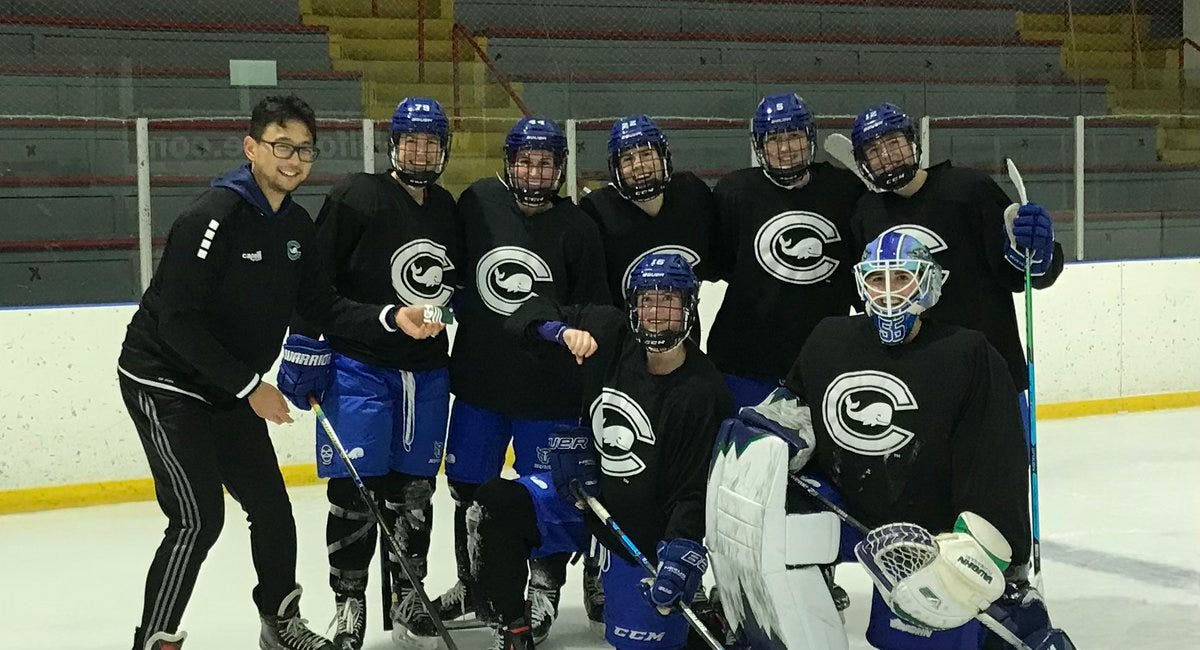
Over the years’ I’ve worked with female minor hockey players, college players (at McGill University) and professionals (with the Connecticut Whale).
Some were huge hockey nerds. Some relished dominating physically. Others simply enjoyed the camaraderie that a team sport provided. Not all of my players were keen to watch hockey on TV, play NHL video games or even talk shop after they got off the ice.
I didn’t really care about my players’ motivations or whether they enjoyed our sport for its own sake. I certainly shared more information with the ones who were more keen on learning, but ultimately I don’t believe that one needs to spend a whole lot of time thinking about hockey off the ice to be effective on the ice.
The real issue facing female players is that many grow up with an incorrect idea of what their sport is really about.
I call it being right for the wrong reasons vs. being wrong for the right reasons.
Here’s a tennis-related anecdote I heard today from a Jonathan Stokke, a former professional player-turned high-level coach.
“(During a tournament leading up to the U.S. Open), I played a match and double-faulted probably 45 times in three sets.
Afterwards I was just lying to people. I was like, ‘oh, I have a shoulder injury.’
I just was making stuff up because it was so embarrassing to be double-faulting so often.
I went home to the Vandermeer Tennis Academy after the tournament.
Dennis Vandermeer said, ‘hey, can you hit a serve and have it hit the baseline?’
I was like, okay. And I did that.
He's like, ‘that's awesome. Now can you hit a serve and hit the bottom of the net? So I did that.
He said, ‘now can you just hit one on the service line, please?
And I hit it right on the service line.
I just looked at him. I was like, ‘this is stupid.’
But he realized that I was in my head. He said, ‘you can hit deeper or shorter on command when you want. You can make these small adjustments.’
That was very helpful. He made me go to the extremes, and so that really helped me rediscover my serve.”
From Doubles Only Tennis Podcast: #1 Episode of 2024 (Rebroadcast): Jonathan Stokke on the 6 Most Common Errors Doubles Players Make, Jan 8, 2025
Stokke’s coach Dennis Vandermeer taught him how to be wrong for the right reasons: hitting inaccurate serves on purpose to find his range.
Meanwhile, many up-and-coming tennis juniors (especially girls) are taught to be right for the wrong reasons: hitting the ball hard from the baseline in the same textbook way, over and over again.
Having a technically sound, well-rounded game is a must for a pro tennis player, but only a handful truly understand the nuances of spin (topspin & underspin), pace (hard & soft) and court positioning (baseline, at the net and in-between). On the women’s tour, Iga Swiatek, Karolina Muchova, Ons Jabeur, Leylah Fernandez and Su-Wei Hsieh are the exceptions who prove the rule.
Many players (and their parents/coaches) chase the right answer in the form of an optimal swing technique, repeated ad infinitum. And then these girls grow up and we dismiss them for being one-dimensional or lacking decision-making abilities.
One-dimensional and lacking decision-making abilities are also terms that can be applied to many hockey players who over-practice the wrong things (“skating around cones and taking breakaways for 90 minutes,” to paraphrase R.B.)
The challenge is that hockey is much more open-ended than tennis or baseball.
Hockey is made up of 1v1s, 1v2s and 2v1s that players must identify and then problem-solve. It’s a choose-your-own-adventure in a way that many other sports aren’t.
Below are four frequently occurring rush play situations, as illustrated in the newly-released Hockey Tactics 2025 ebook.

3v3 rushes typically don’t lead to scoring chances since it’s relatively easy for a trio of defenders to break the situation down into three 1v1s. An attacking team that settles for 1v1s is one that struggles to score.
The secret to creating offense on a consistent basis, then, is to give players plenty of opportunities to make incorrect offensive decisions until they develop an internal compass for how to turn these dead-end 3v3s into 2v1s or 1v2s.

The even-strength game comes alive when teams create and capitalize on odd-player situations.
For coaches like R.B., building drills that foster these situations is a step toward helping players be wrong for the right reasons.
Click below for a few of the drills I used with the Connecticut Whale:
Steal My Drills
·
February 21, 2022
Recently, The Athletic’s Arpon Basu and Marc-Antoine Godin shared an in-depth conversation with new Montreal Canadiens head coach Martin St. Louis about his tactical philosophy.
Comments
Nothing yet. Say the first thing.
Sign in to join the conversation.