
This week we started our effort to listen to the newly released Assassination Records Review Board recordings from 1995 through 1998, which capture deliberations over JFK assassination-related topics ranging from Operation Northwoods to redaction requests to names of CIA officials. The series begins with the March 6, 1995, meeting and concludes with the Board’s final meeting on Sept. 29, 1998, one day before its congressional authorization expired.
The release of the meeting recordings is a vindication for assassination researchers Mark Adamczyk, Paul Bleau and Andrew Iler, who have been seeking them for several years as part of a larger effort related the JFK Records Act. They have been pursuing the AARB’s Final Determination Notifications — decisions on what documents should or should not be released.
In our preliminary review, Jack Reid and I found that audio files have not been posted for numerous ARRB closed meetings. While the collection explicitly does not include recordings from meetings before March 6, 1995, it is unclear whether the missing audio files that are in the collection will be posted at a subsequent time, or if all the missing recordings have been redacted in full.
Still, there is much in these recordings for the research community to digest. For example, the recording from the July 17-18, 1995, meeting features a detailed discussion of the validity of CIA redaction requests.
You can listen to and download the audio files here.
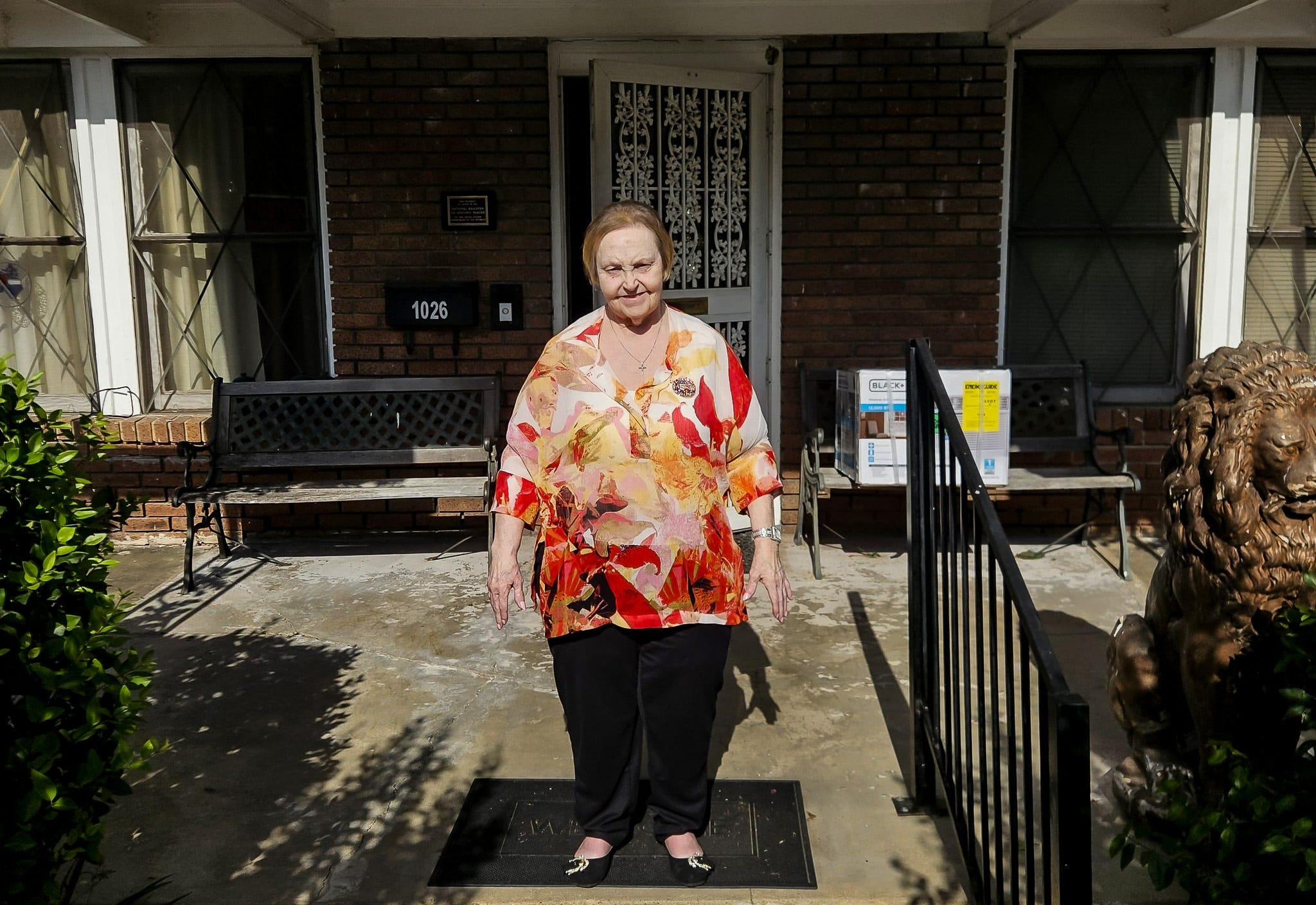
Guest contributor Mark Bujdos visited the woman who runs the Oswald Rooming House Museum in Dallas. Patricia “Pat” Puckett Hall knew the ex-Marine when she was 11 years old — and she remembers him as kind and thoughtful.
On Oct. 14, 1963, Oswald registered at her grandmother Gladys Johnson’s rooming house under the alias “O.H. Lee.” The tiny cubbyhole once rented to him remains essentially as it was. It operates now as a museum, run solely by Hall.
It is available for visits by appointment.
During the time Oswald lived there, Hall and her brothers interacted on a daily basis — and not in any small manner — with the man who would be accused of murdering President Kennedy. Oswald helped sixth-grader Pat repeatedly with her reading and math homework at the dining room table.
Hall described to Bujdos the events of Nov. 22, 1963 in her household. She recalled how her mother reacted to the assassination — and the children watching the TV as their tenant and friend was shot and killed on the Sunday after JFK’s death.
What of Pat’s life after the events of 1963?
“My life just went on like any normal little girl’s life. But because Mr. Lee helped me with my homework and was so encouraging me in school, I do credit him with the reason why I finished high school. Because it was very difficult for me. I still struggle with dyslexia, and so, if it wasn’t for him, I probably wouldn’t have gotten the education I have because I have my high school diploma, and I have been in college.“
A reminder that on Thursdays, JFK Facts subscribers join Larry Schnapf for a discussion of the latest news and information related to America’s greatest cold case, the assassination of President Kennedy. This is a genuinely freewheeling and fact-based discussion of all things JFK. Write your questions in the chat thread during the big Zoom call, open to all.
This week the guest was Greg Doudna, a researcher who studied the Ancient Near East at Cornell University and worked on the Dead Sea Scrolls at the University of Copenhagen. Since 2017, Greg has been researching areas of the JFK assassination, and JFK Facts has featured articles about his impressive research on the Gen. Edwin Walker shooting in a two-part series.
Login to the JFK Facts Live discussions at 8 p.m. EST Thursdays. We’ll send a reminder with news about next week’s guest.
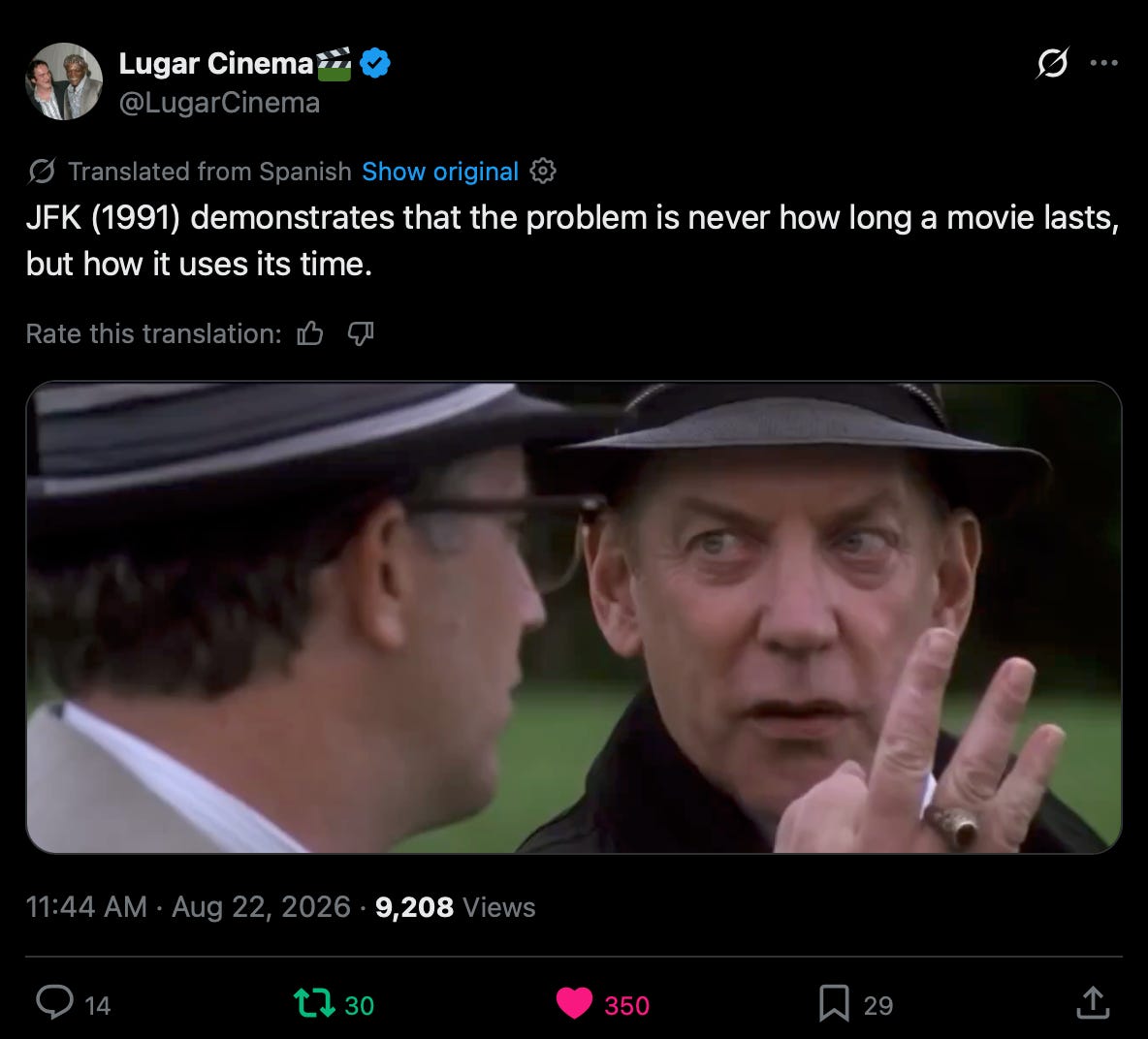
Slim pickings on X again this week, but we give first prize to “X” — the character played by Donald Sutherland in Oliver Stone’s monumental “JFK” (1991) — in a tweet from the Italian movie buff account Lugar Cinema. The post, as translated to English, reads: “JFK (1991) demonstrates that the problem is never how long a movie lasts, but how it uses its time.”
Sutherland’s image and voice are onscreen for just under 17 minutes of the over-three-hour theatrical release before his character finally tells Jim Garrison (Kevin Costner): “I just hope you get a break.” But the segment forms the unforgettable “fulcrum” of the film.
The X post features the chilling exchange:
Garrison: I never realized Kennedy was so dangerous to the establishment. Is that why?
X: Well, that’s a real question, isn’t it? Why? The “how” and the “who” is just scenery for the public — Oswald, Ruby, Cuba, the Mafia — keeps ‘em guessing like some kind of parlor game, prevents them from asking the most important question: Why? Why was Kennedy killed? Who benefited? Who has the power to cover it up? Who?
Comments
Nothing yet. Say the first thing.
Sign in to join the conversation.