
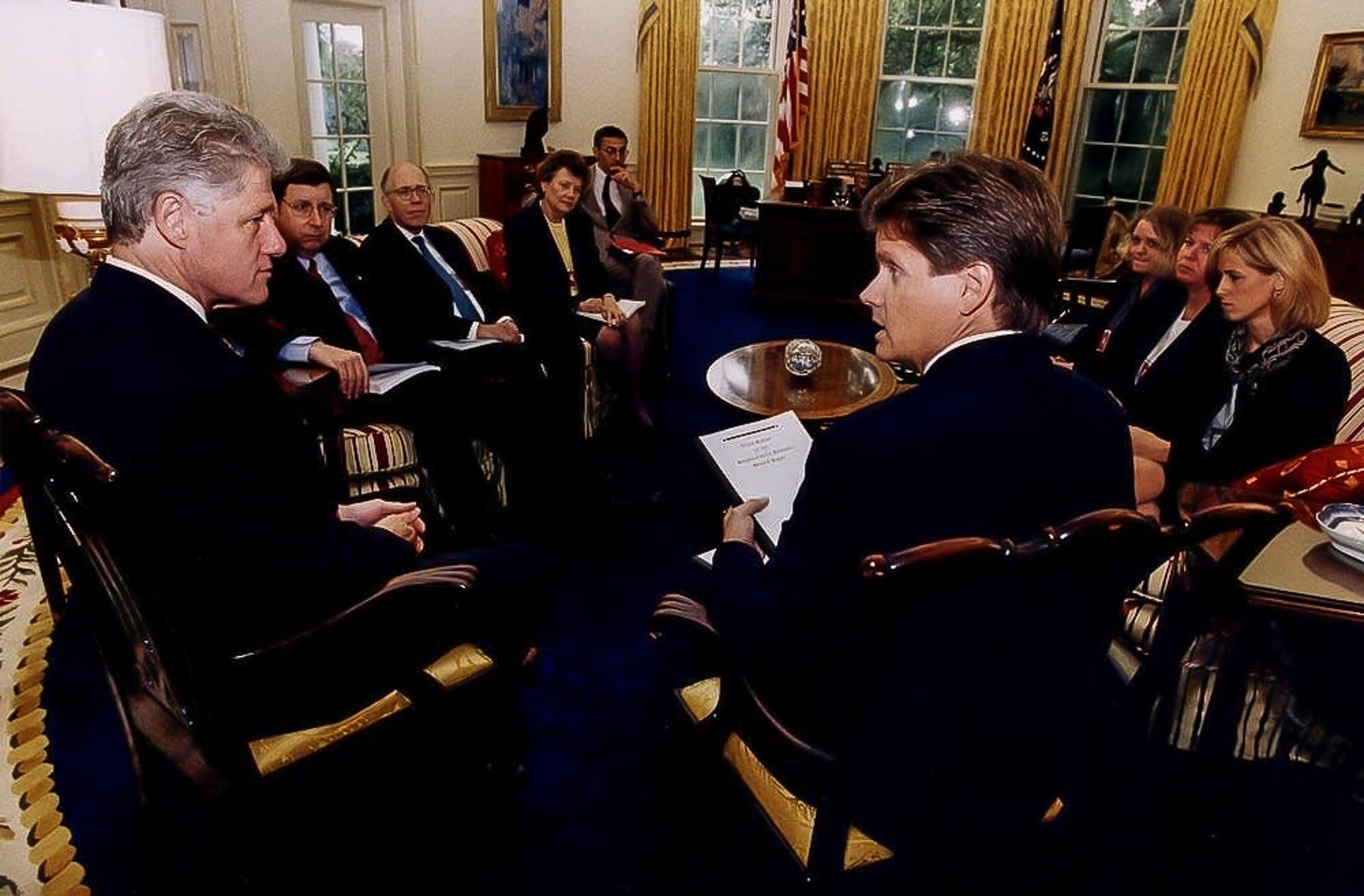
In a classic Washington, D.C., Friday afternoon news dump, the National Archives published 47 audio files of JFK Assassination Records Review Board (ARRB) deliberations from closed-door meetings held in the 1990s.
The series begins with the March 6, 1995, meeting and concludes with the Board’s final meeting on Sept. 29, 1998, one day before its congressional authorization expired.
The AARB was created by Congress in 1994 to work through the release of documents being made public as part of the JFK Records Act, which was passed in the wake of the uproar over Oliver Stone’s 1991 movie “JFK.”
While assassination researchers are just beginning to explore the recordings, the meetings are certain to provide insight into the thinking and workings of the five-member panel, which not only examined documents for release but also interviewed many key witnesses. Among the topics discussed and debated in the meeting recordings include the Zapruder film, Lee Harvey Oswald’s visit to Mexico City shortly before the assassination, the proposed false-flag operation known as Operation Northwoods, and the CIA’s unwillingness to release certain records.
The release of the meeting recordings is a vindication for assassination researchers Mark Adamczyk, Paul Bleau and Andrew Iler, who have been seeking them for several years as part of a larger effort related the JFK Records Act. They have been pursuing the AARB’s Final Determination Notifications — decisions on what documents should or should not be released.
The Final Determination Notifications are not publicly available, and the team has been trying to figure out a way to secure them. They were told the meeting records could provide insight into that question.
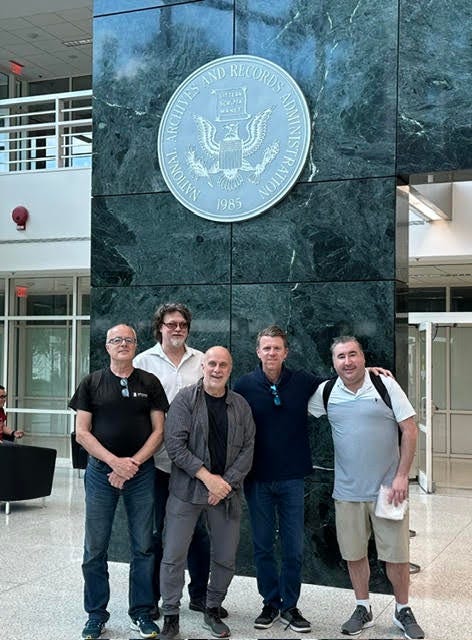
“In May of this year, Mark Adamczyk and I, along with Paul Bleau, Joe Borelli and John Bleau, spent three days at NARA’s College Park campus with a primary focus of locating and obtaining copies of the audio of the ARRB closed session board meetings,” Iler told JFK Facts by email. “On the final day of our visit we were advised by NARA staff that they had located the tapes. … NARA committed to digitizing the tapes and putting them up on their website.”
In Iler’s estimation, the recording of the meetings not only provide new understanding into decisions regarding the release — or withholding — of documents, but also “a wealth of otherwise unknown information about the functioning of the ARRB.”
An immediate concern with the 2026 release is the appearance of numerous redactions, despite President Donald Trump’s 2025 executive order mandating the release of all JFK documents.
Specifically, the NARA web page dedicated to this release features the following notice [bold added for emphasis]:
Access to some of these archival materials is restricted for the following reasons:
FOIA (b)(1) National Security
Secret
FOIA (b)(3) Statute
FOIA (b)(6) Personal Information
FOIA (b)(7) Law Enforcement
These records are partially restricted under 50 U.S.C. § 3024(i)(1) Intelligence Sources and Methods.
A JFK Facts review of ARRB meetings revealed that audio files have not been posted for numerous ARRB closed meetings. While the collection explicitly does not include recordings from meetings before March 6, 1995 — the AARB first convened in October 1994 — it is unclear whether the missing audio files that are in the collection will be posted at a subsequent time, or if all the missing recordings have been redacted in full.
Still, there is much in these recordings for the research community to digest. For example, the recording from the July 17-18, 1995, meeting features a detailed discussion of the validity of CIA redaction requests.
Just months into their respective appointments, ARRB members can be heard sympathizing with the need to maintain some secrets about alleged assassin Lee Harvey Oswald’s foray into Mexico in order to protect government officials there.
However, the ARRB found it unacceptable to redact all mentions of the true name of the CIA asset codenamed LIENVOY just because the Agency feared “the possible mosaic of the John Newmans of the world putting things together.” (LIENVOY was the cryptonym for a CIA wiretapping operation targeting the Soviet and Cuban embassies in Mexico City; John Newman is a JFK assassination researcher known for his work exploring Oswald’s connections to the CIA.)
Redacting names was an ongoing point of contention throughout the life of the ARRB. During the July 9, 1997 meeting, one name the Board discussed was Daniel Stanley Watson, Chief of Covert Action (propaganda) in the Mexico City station from 1965-67.
The House Select Committee on Assassinations interviewed him regarding his claim to have requested and received Oswald’s 201 file, which he described as very thin — well short of the 43 documents that would ultimately be released.
The Agency argued that Watson’s name should be redacted because his widow, who lived in Mexico, should be protected. Of course, the flip side of that argument is that by setting a precedent to protect widows, the CIA would also prevent journalists and researchers from contacting them.
Attorney and assassination researcher Lawrence Schnapf, a regular contributor to JFK Facts, has just started listening to some of the recordings. He was intrigued by a discussion of the Zapruder film, including ownership questions around the home movie that captured the assassination.
“The board was not only struggling with the copyright issue but also surprisingly unaware of the importance of having the best available copy available for the public,” Schnapf said. “Some board members seemed to think any copy would be enough without understanding the quality issues.”
There is much more for researchers to listen to — and to put into historical context. But Schnapf said the release of the recordings has already made a broader point about transparency.
“These limited releases illustrate the importance of having all the ARRB materials made available online,” he said. “There are still entire files of people who served as executive directors and general counsel that are unavailable unless a researcher goes to NARA.”
This is a developing story, and JFK Facts will have further updates about the content of these recordings in coming days.
Comments
Nothing yet. Say the first thing.
Sign in to join the conversation.