
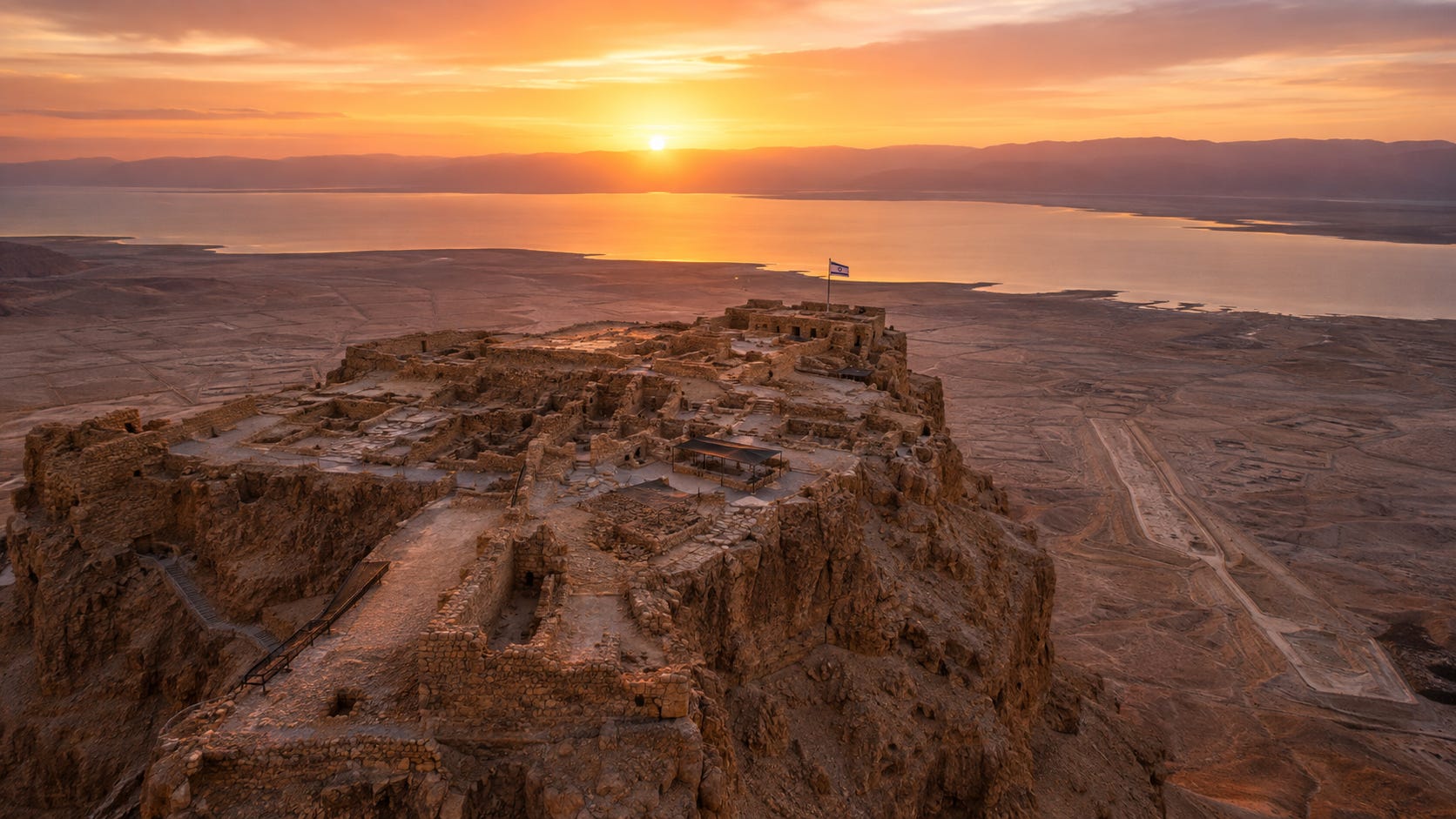
Before dawn, the Judean Desert is almost unnaturally silent. The Dead Sea lies below like a sheet of dark metal, the mountains of Moab form a black wall across the water, and a thin procession of hikers zigzags upward along the Snake Path. Headlamps flicker. Shoes scrape against stone. Nobody has enough coffee.
Then the sun rises.
Light spills across the Jordanian mountains, strikes the Dead Sea and climbs the cliffs of Masada. The Roman camps become visible on the desert floor. So does the enormous siege ramp constructed to destroy the Jewish resistance nearly 2,000 years ago.
The Romans are gone.
The Jews are standing on top of the mountain again, speaking Hebrew.
That is Masada.
Masada itself is not named explicitly in the Tanakh, and there is no need to manufacture a connection when the real one is already powerful. The mountain rises within the biblical wilderness of Judah, overlooking the landscape where Jewish history was born, tested and repeatedly rescued from disaster.
Its Hebrew name, מצדה, Metzada, comes from the word for a fortress or stronghold. The Tanakh uses the same linguistic root when describing the desert refuges where David hid while King Saul hunted him. David moved through the strongholds of the Judean wilderness and the crags of Ein Gedi, just north of Masada. Psalm 63 is introduced as a psalm of David “when he was in the wilderness of Judah.”
It is tempting to place David on this exact summit, staring across the Dead Sea with a harp tucked under his arm. It would also be historically dishonest. The Bible does not say that. What it does give us is the landscape: Ein Gedi, the wilderness of Judah, the Dead Sea, the cliffs, caves, wadis and fortresses that shaped the life of Israel’s future king.
Stand on Masada and that geography stops being a collection of names in a book. You can see why David survived here, why armies feared this desert and why a fortress on this isolated rock could appear almost unconquerable.
Masada entered recorded Jewish history during the Second Temple period. Josephus attributes its first fortification to “Jonathan the High Priest,” although scholars debate whether he meant Jonathan the Maccabee or the Hasmonean king Alexander Jannaeus, whose Hebrew name was also Jonathan.
Either way, Masada’s emergence as a fortress belongs to the age of the Hasmoneans, the Jewish dynasty created by the Maccabean revolt. These were not wandering visitors borrowing somebody else’s land. They were Jewish rulers governing a Jewish kingdom in Judea, maintaining fortresses, minting coins and defending the country surrounding Jerusalem.
Then came Herod.
Herod the Great ruled Judea from 37 to 4 BCE. He was ruthless, paranoid and politically dependent on Rome—but he was also one of the ancient world’s most ambitious builders. Caesarea, Herodium, the expansion of the Temple Mount and the palaces of Jericho all carried his architectural fingerprints.
At Masada, Herod’s fear and genius met on top of a desert mountain.
He transformed the plateau into an almost self-contained royal refuge. He built a casemate wall around the summit, guard towers, enormous storerooms, barracks, bathhouses, administrative buildings and two major palaces. The Western Palace covered roughly 3,700 square meters. The Northern Palace descended dramatically across three terraces cut into the cliff, complete with columns, reception rooms, mosaics and frescoes.
This was not a miserable military bunker. Herod apparently wanted to survive the apocalypse with a Roman bath, imported wine and a dining room overlooking the Dead Sea. Paranoia, certainly—but paranoia with excellent flooring.
The greatest achievement was water. Masada stands in one of the driest environments on earth, yet engineers built channels that captured flash-flood runoff and carried it into vast cisterns carved into the rock. Its sophisticated system could store enough water to sustain a large population for years. As UNESCO notes, this engineering transformed a barren, isolated summit into a lavish royal retreat.
In 66 CE, Judea exploded in revolt against Roman rule. A Jewish group known as the Sicarii seized Masada from its Roman garrison. Their leader was Eleazar ben Yair.
Four years later, Roman forces destroyed Jerusalem and burned the Second Temple. Other Jewish strongholds fell. Masada remained.
The people living there were not a simple cast of flawless movie heroes. Josephus describes the Sicarii as a violent faction that fought other Jews and carried out a murderous raid against the Jewish community of Ein Gedi. Zionism does not require us to turn every ancient rebel into a plaster saint. Jewish history is strong enough to be told honestly.
But whatever we think of the Sicarii, the larger historical reality is unmistakable. After Jerusalem fell, Jewish men, women and children were still holding a fortress in Judea and refusing to submit to the empire that had destroyed their capital and Temple.
Rome could not tolerate that.
Around 73 or 74 CE, the Roman governor Lucius Flavius Silva marched against Masada with Legio X Fretensis and supporting forces. The Romans built eight military camps around the mountain and connected them with a siege wall, sealing the inhabitants inside. Much of that system remains visible today and constitutes what UNESCO calls the most complete surviving Roman siege works in the world.
Then the Romans began building the ramp.
They hauled earth and stone against Masada’s western face until their troops could push a siege tower and battering ram toward the wall. Think about the scale of that obsession. Rome committed a legion, engineers, laborers, camps, fortifications and months of work to crush a final group of Jews on a desert mountain.
Apparently, the Roman army failed to receive the modern memo explaining that Jews had no history in this country.
Our only detailed account of Masada’s final hours comes from Josephus, who was not present at the siege. According to him, when Eleazar ben Yair realized the Romans would break through, he urged the inhabitants to die free rather than be captured, enslaved and abused.
Josephus wrote that 960 people died, with only two women and five children surviving after hiding in a cistern. Potsherds bearing names were later discovered, including one inscribed “Ben Yair.” They may have been the lots described by Josephus, although they may also have served an ordinary administrative purpose.
The mass-death narrative remains debated. Archaeology verifies the Roman siege, camps, wall, ramp, destruction and Jewish occupation, but it cannot prove every detail of Josephus’s dramatic account. Jewish law places extraordinary value on preserving life, making the story morally painful rather than romantically simple.
Masada should not be reduced to a slogan celebrating death. Its deeper Jewish meaning is the refusal to disappear.
Rome breached the wall and ended the revolt. Yet it failed in its larger objective. The Jewish people survived the destruction of Jerusalem, survived exile, preserved the Hebrew language, prayed toward this land for centuries and eventually returned to rebuild sovereignty.
Rome won the mountain for a night. The Jews won history.
Masada is not merely a legend. It is physical evidence.
On its summit archaeologists uncovered a synagogue used during the final years of the Second Temple period. Stone benches lined its walls. Biblical parchment fragments were found in pits believed to have served as a genizah. Elsewhere on the mountain were portions of Psalms and other biblical texts, ritual baths, Hebrew and Aramaic writings, Jewish coins, domestic objects and the rooms where Jewish families lived.
Walk a little farther and look down. You can still see the camps of the Roman army, the siege wall and the ramp built to reach the Jewish defenders.
A synagogue above. A Roman legion below.
It is difficult to invent a clearer archaeological summary of Jewish history in Judea.
Masada cannot determine every modern boundary or private property dispute; archaeology is not a land registry. But it utterly demolishes the lie that Jews are recent foreign trespassers with no national history here. The fortress documents Jewish government, Jewish worship, Jewish resistance and Roman efforts to destroy them centuries before Islam existed and nearly two millennia before the State of Israel was reborn.
When activists call Jews “colonizers” in Judea, they are asking the world to ignore a mountain covered with Hebrew texts while surrounded by the camps of the foreign empire that came to suppress them. That is not scholarship. It is historical taxidermy—gutting the past and stuffing it into whatever political costume is fashionable this week.
After the revolt, Roman troops occupied Masada. Centuries later, Byzantine monks established a small community on the summit and built a church whose mosaic floor can still be seen. When they departed in the sixth century, the mountain fell silent for more than 1,300 years.
Western explorers identified and surveyed the site during the nineteenth century, but its modern transformation began with the Zionist return. Yitzhak Lamdan’s 1927 Hebrew poem Masada turned the mountain into a symbol of Jewish survival. Youth movements began making difficult desert pilgrimages to the summit. Long before cable cars and air-conditioned visitor centers, young Jews climbed with packs, water and a stubbornness that probably alarmed their mothers.
Between 1963 and 1965, archaeologist and former IDF Chief of Staff Yigael Yadin led the great excavations of Masada. Thousands of volunteers from Israel and abroad participated. Archaeology became a national encounter: a generation rebuilding the Jewish state was uncovering the lives of the final generation that had lost it.
Masada became a national park in 1966. The first cable car opened in 1971, making the summit accessible to visitors who could not climb. It was replaced in 1998 by the current system, which reaches the summit in about three minutes and is wheelchair accessible. Masada was inscribed as a UNESCO World Heritage Site in 2001. Its development into a major attraction did not happen because somebody added a gift shop. It happened because the site combines staggering scenery, world-class archaeology and a story that reaches directly into the identity of modern Israel. The official park history traces that transformation in detail.
The cable car leaves from the eastern visitor center and rises almost vertically toward the Snake Path Gate. As the cabin climbs, the Dead Sea expands behind you and the desert floor falls away beneath your feet.
Taking it is not cheating. The Romans needed an entire legion and a gigantic ramp to reach the summit. You are allowed three minutes of Swiss engineering.
For hikers, the Snake Path is the classic ascent. It twists up the eastern face, gaining roughly 350 meters through exposed desert terrain. The climb usually takes about an hour and is demanding, particularly in the heat. Every turn reveals more of the Dead Sea until, near the summit, the water and mountains seem to fill the horizon.
The shorter option is the Roman Ramp trail from Masada’s western entrance, reached through Arad. It takes roughly half an hour and follows the route of the ancient Roman assault. The eastern and western entrances are not connected by a road around the mountain, so decide which side you want before blindly obeying your navigation app into the Judean Desert.
Sunrise is Masada’s legendary experience. The Snake Path normally opens about an hour before sunrise, while the Roman Ramp opens about thirty minutes before it. Climbing through darkness and reaching the plateau as the sun clears the mountains of Moab is unforgettable.
The desert changes color by the minute—black to violet, violet to copper, copper to blazing gold. The Dead Sea catches the light below, while the Roman camps slowly appear out of the shadows. It feels less like watching a sunrise than watching history return to the land.
Sunset is different. The western cliffs burn orange and red, the air begins to cool and the desert stretches toward Arad in enormous folds of stone. Ordinary park and cable-car hours often end before actual sunset, so plan for the western campground, the night show or special extended-hour events rather than assuming you can remain on the summit. Current trail closures and schedules should always be checked with the Israel Nature and Parks Authority.
And take the heat seriously. In summer, the Snake Path may close early—sometimes very early—because the Judean Desert does not care about your vacation schedule, your fitness tracker or the fact that you once walked uphill in New Jersey. Bring water, cover your head and start before the sun begins behaving like a weapon.
Visit Masada because the view is magnificent. Visit for Herod’s palaces, the mosaics, the cisterns, the synagogue and the astonishing Roman siege works. Visit because the hike will humble you and the cable car will delight your children.
But above all, visit because Masada exposes the absurdity of separating the Jewish people from the Land of Israel.
The mountain remembers the Hasmoneans. It remembers Herod, King of Judea. It remembers Jewish prayer, Hebrew scripture and families resisting Rome. It remembers the destruction of Jewish sovereignty—and it now overlooks a reborn Jewish state.
Below the summit sit the remains of the empire that tried to erase us. Above them fly Israeli flags.
The empire is an archaeological layer.
The Jews are home.
No posts
Comments
Nothing yet. Say the first thing.
Sign in to join the conversation.