
My first column-writing guide has been read over 20,000 times. I published it in January 2026. Over the past few months, I’ve developed new strategies and gathered ideas that I’d like to share with you in this updated article. Enjoy!
I am not a literary scholar, but my column is occasionally described as quite entertaining. And even though my parents might see that differently; just as I am not a literary scholar, I am also not a prodigy. So I am pretty sure you, too, can write texts that excite you—and, ideally, real readers. But for that, you need to understand the craft.
This is a guide for everyone whose fingers start itching at the thought of writing their own column and essays. And it is an attempt to convince those who believe their lives are too boring to write about that they are oh so wrong.
A quick refresher:
A personal column is a short, narrative-style piece of writing that focuses on one specific topic. It takes personal experiences, thoughts, or observations and turns them into a story.
In the following, I distinguish between plot-driven and character-driven texts. The latter are what we encounter most often here on Substack: texts in which personal reflections, internal struggles, personality, relationships, personal growth, and emotional arcs take center stage in form of a personal essays.
Plot-driven texts, on the other hand—like the ones you may know from my column—focus on what happened: external conflicts, sequences of events, action, mystery, and suspense.
My guide works for both plot-driven and character-driven texts and offers useful tools for each.
Let’s go a bit deeper and break down the substance of a personal column. This makes it easier to understand the concept—and to find your own way into it.
One thing I’ve learned: having an overarching theme makes it much easier to write new issues on a regular basis. If one week you write about your first kindergarten argument and the next about ten things you learned in your career, that’s certainly versatile—but it will be harder to consistently generate new ideas.
If, on the other hand, you (at least for now) commit to one or two overarching themes, you’ll quickly notice how much faster ideas come to you.
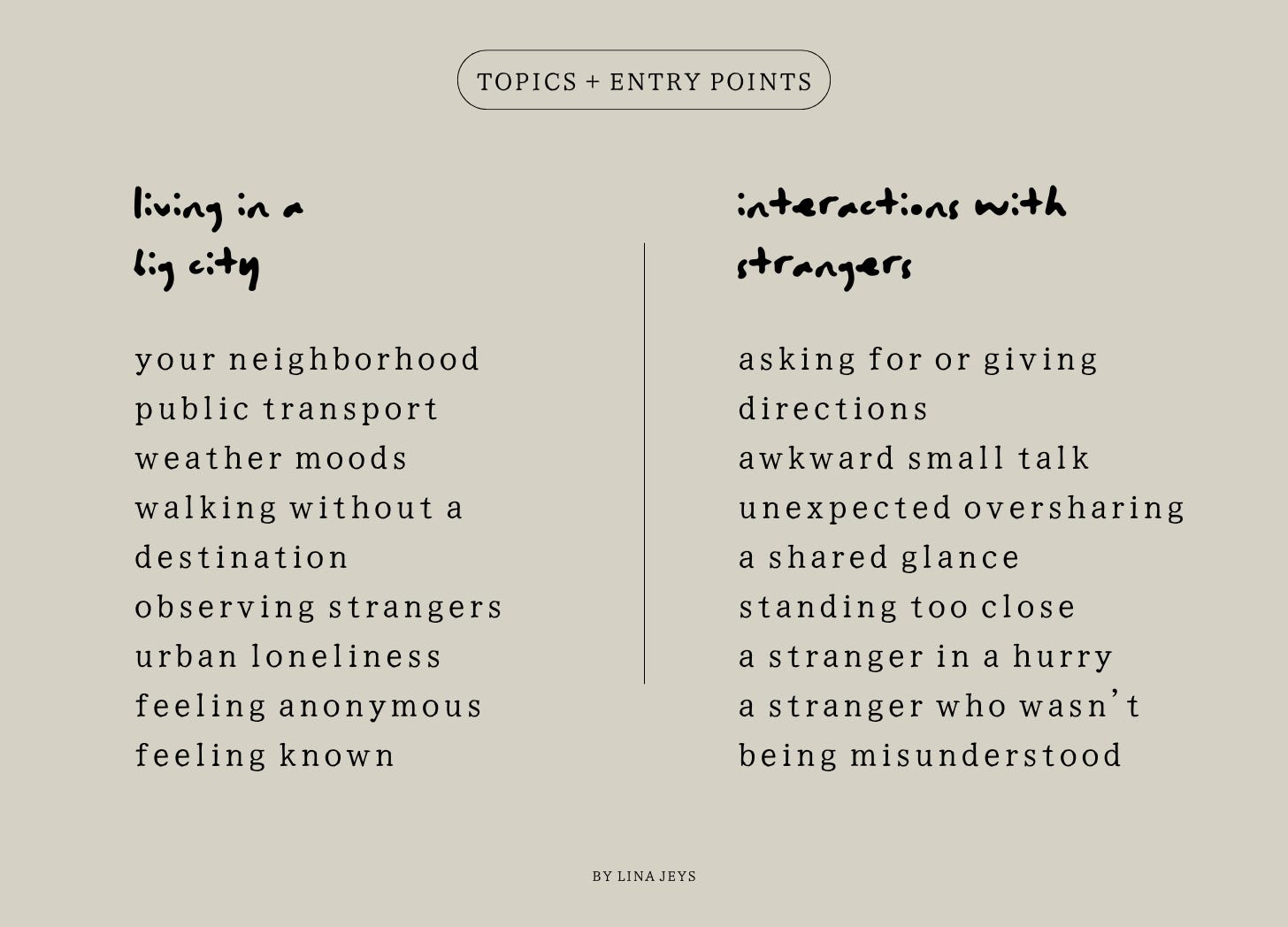
In my column, for example, almost every text falls into one of these two categories:
Life in a big city
Interpersonal encounters with strangers
This developed very naturally, and every text can be assigned to at least one of these themes.
Your themes may look completely different. An overarching theme should be neither too narrow nor too broad. Here are a few examples:
Dating life in your twenties
Experiences from your corporate job
Conversations with friends
Your life as a mother
Memories from your childhood
Stories about aging
Cooking and food
As mentioned above: once you’ve defined an overarching theme, it becomes much easier to find weekly ideas to write about.
In my case, these are often very ordinary experiences or encounters—nothing remotely cinematic.
A mantra that helps me a lot is this: Stop looking for events. Start looking for thoughts.
This means that, for my column, it’s usually not that important what exactly happened—but rather what I thought about it. In this column, for example, nothing exciting happened at all from an outside perspective. I simply went to a café and ate a pistachio croissant. That’s it. And yet it’s one of my most-read columns, because my thoughts about the experience made up the entire story.
What helps me is keeping a list of thoughts and interesting fragments of phrases that might eventually make their way into a column. You’ll notice that this exercise changes how you perceive your life—you become much more aware. Because every thought, every encounter, is potential material for a new story.
Examples:
“felt weird after that dinner”
“why i hate buying socks”
“the way the barista said my name”
“that one sentence my friend said”
You don’t need to know yet what a note will turn into. Maybe it turns into nothing. Better to have it than to need it.
I could give you a long list of possible column topics—but please believe me when I say this wouldn’t actually help you. The best texts come from your own head, and you will know when an idea is worth turning into a story. That tingling feeling in your stomach will tell you.
Here’s a prompt to help you find ideas for your column:
What happened today that would have felt insignificant to anyone else — but lingered in my thoughts? What moment from today keeps popping back up?
Then keep writing with these follow-ups (don’t overthink, just answer):
Where was I?
Who else was there?
What did I notice that others probably didn’t?
What did I think but didn’t say?
What emotion did this moment trigger? (Be specific.)
What did this moment remind me of?
Why am I still thinking about it now?
End with this:
If I were to write a column about this, it would really be about ___.
By now, you should have one or two overarching themes as well as your first entry points. Write this list into your notebook so you can return to it whenever the muse decides to abandon you.
The defining feature of your column is you. That’s why you need to think about how to bring your personal touch into it—your writing style. The topic of style alone fills entire textbooks, so here’s a condensed look at it.
The personal touch gives your column its recognizability. The goal here is that someone could steal an unpublished text of yours, publish it on their blog as their own—and your loyal readers would still immediately sense that something is off.
Admittedly, that’s a rather egocentric goal and somewhat exaggerated. But it illustrates how important it is to integrate your own touch into your writing.
William Zinsser put it perfectly in On Writing Well:
“Don’t alter your voice to fit your subject. Develop one voice that readers will recognize when they hear it on the page (…)”.
To understand what shapes our writing, it helps to look at how we actually write.
Let’s take Stephen King as an example:
Simple language over complex terminology: King admires The Elements of Style by Strunk and White (which, in my opinion too, is required reading for writers). His style is often described as clear, precise, vivid, and concise. He favors direct language.
Focus on characters and emotion: He emphasizes that horror should come from the psychological situation of the characters — not just from violence. His stories are rooted in the fears and thoughts of ordinary people.
Realistic language and setting: He writes in a simple, everyday tone about “normal” people in familiar environments, which I feel makes the horror seem much closer.
Let’s take a look at what defines my writing:
Analytical overthinking: I tend to overanalyze even the smallest interactions with strangers. I’m less interested in what was said and more in what it could have meant — the subtext, the “what if” scenarios that spiral in my head.
Humor through exaggeration: I love exaggeration — not subtly, but deliberately over the top. Hyperbole is my way of creating a very specific kind of sarcasm that sits somewhere between sincerity and absurdity.
Everyday life as a stage: Nothing particularly dramatic happens in my texts. I write about ordinary situations that might seem trivial at first — but through internal overthinking, they turn into small parallel worlds. What defines my column is not what happens, but how I think about it.
Personal vulnerability: Because I focus on small moments, my texts inevitably reveal a lot about me. Each column becomes a small window into how I think, what I find funny, and how I see the world.
So; what defines my column is how I think about everyday life and how I put those thoughts into words. As mentioned before, nothing dramatically exciting usually happens in my texts. And yet—or precisely because of that—each one reveals a lot about me as a person.
Here’s an example from the sixth issue of my column. I’m alone on the bus when I see thirty uniformed police officers waiting at the final stop.
“With every meter the bus rolled closer, I saw my carefully built life flashing before my eyes. I said goodbye to my apartment and wondered if I could sublet it while serving my sentence. I imagined my parents’ prison visits — maybe they’d bring me rehabilitation literature with titles like “Life After Prison: A Ten-Step Action Plan.””
Spoiler: in the end, it was just a regular ticket inspection.
This example clearly shows the writing style of my texts.
Your own writing style doesn’t emerge from rules or clever adjectives—it emerges from recurring patterns of thought and narration. The good news: you already have these patterns. You just need to make them visible.
The assignment is simple and yet, I think, brilliant.
Write the same story in three different ways.
It doesn’t matter what you write about. For all I care, you can write about your last trip to the supermarket.
The first version could be a neutral, almost report-like description of what happened.
The next version could be a completely exaggerated, almost absurd take on the situation, filled with hyperbole and internal monologues.
The final version of the story could then explore, with emotional depth, what it did to you when you discovered that your favorite cereal had been discontinued.
I don’t want to tell you what style to write in. After all, the whole point is to experiment with different styles that you could imagine yourself writing in.
As you write, you will almost certainly notice which of the versions comes most naturally to you. Where the sentences seem to flow effortlessly and you feel that little spark after putting a particularly good sentence on the page.
And when one of the styles gives you that feeling, analyze the patterns behind it.
What exactly makes this style yours?
Do you often think in worst-case scenarios?
Do you mentally jump into the future?
Do you observe yourself from the outside?
Do you work with exaggeration, understatement, or dry humor?
These patterns are not mistakes. They are your style.
Allow yourself to stay the same. Many writers believe they need to reinvent themselves with every text. The opposite is true. Recognition comes from repetition.
Readers return precisely because of this.
Don’t be too hard on yourself if your voice doesn’t reveal itself immediately. When I first started writing, I wrote very emotional texts. Then I realized how much it annoyed me to pull at the heartstrings in every piece—and that I’d rather make others (and myself) smile.
Your writer’s voice will develop over time.
It’s not something you add. It’s something you stop hiding.
The structure of compelling stories is a science of its own.
I’m a big fan of keep it simple and stupid, so here’s a short excursion into possible structures for a personal column—especially looking at plot-driven vs. character-driven texts.
What fascinates me about short stories and columns is how extremely limited we are. Where digressions and detours are welcome in a novel, there’s simply no room for them in a column. We have to captivate readers in just a few hundred words. That’s an art in itself.
The structure of a personal column closely resembles flash fiction:
Typically under 1,000 words
Option A: Plot-driven — the plot happens to the character, forcing them to act; despite its brevity, it needs a narrative arc with character, conflict, and some form of resolution (or implication)
Option B: Character-driven — focuses on internal motivations, choices, and emotional growth
Strong impact: aims to leave a lingering impression, like an afterimage
Implication: often hints at a larger story the reader completes themselves
What does this mean for us as writers of such short texts? As writers, how can we create a text that captivates readers?
This part is reserved for paid subscribers. Here’s what you’ll find in the rest of the post:
Two essential aspects of your column structure
Structure of plot-driven vs. character-driven columns
Two of the most important writing tips for captivating texts
A practical ten-step guide to get you writing
A simple writing exercise that truly helps anyone finish a story
Whether plot-driven or character-driven, you always start in medias res. In a column, there’s no room for long introductions or backstories.
A quick entry doesn’t mean something spectacular has to happen immediately. It’s enough to land in the middle of a concrete situation.
Here are a few opening lines from my texts:
I had lived in Hamburg for one year and seven months when, one ordinary Tuesday, I found myself face to face with my first brush with the law.
When I moved in, I had neglected the small civic duty of introducing myself to the neighbours — a lapse that would soon prove more consequential than expected.
My day had been an absolute disaster.
After three days of house-sitting in my tiny hometown, far removed from anything that could reasonably be described as civilization, I had to admit that I was slowly losing my mind.
The first sentence has to land. If the reader isn’t hooked by the first sentence, they likely won’t read another.
Comments
Nothing yet. Say the first thing.
Sign in to join the conversation.