
Reader, do you know that feeling when the Spirit nudges or presses inside you to do something and you look back to see if there’s someone else behind you? This was my experience with the “Jesus was Forgiving” chapter of Jesus Was. I waited to see if someone else would sign up for it. But the column remained white like it was blinking, waiting for me to add my name.
My hesitancy didn’t come from not wanting to be faithful in my calling as a writer. I try to practice listening to what needs to be penned before rushing it onto paper. Don’t get me wrong, I’ve gone through lots of journals with unfiltered rants and letters to people I’ll never send. But this mulling came from a desire to not harm others.
Forgiveness is such an important part of how we follow Jesus. Even when he was nailed on the cross, when each breath was excruciating, with lacerations throbbing and raw, he said “Father, forgive them.” He embodied forgiveness, not vengeance. Mercy, not revenge. I struggled to say yes to this chapter because it’s so important to understand—and there are many misunderstandings of what forgiveness is and is not. And I am still learning.
Reader, maybe you’ve experienced this as well. Perhaps you recoil when you hear “Forgive and forget.” Maybe you’ve offered this saying when you were uncomfortable with what someone shared with you, passing along what you heard growing up. Or you’ve experienced the weaponization of forgiveness to control a certain image, a storyline that wasn’t true, a narrative that didn’t bring the help and healing you longed for.
Maybe you, like me, were offered fragments of what forgiveness means but as we pieced it together it doesn’t look like Jesus, the God-Man who came to show us how to be truly human, how to be one of God’s image bearers. How to be live a life worthy of our humanity, as Miroslav Volf puts it. How do we do this in an age of dehumanization, where powers lurk around the corner and take up soundbites ready to pounce on us, ready to kill, steal, and destroy?
We need to pay close attention to Jesus, to walk so closely that we focus on his footsteps, so we don’t lose our footing.
I used to think it was something I would reach when I was spiritually mature, like a goal or a box next to each fruit I could check off. But I’ve come to see forgiveness as a practice, a way of becoming. Desmond Tutu once said that “forgiveness is not just an occasional act; it is a constant attitude.”1 He lived through the brutality of apartheid, he discerned that to break the cycle of retaliation, forgiveness was the key to enlarge the Christian imagination of what could be, how we can forge a way together. It wasn’t cliche, but a necessary path as oppressors listened and victims told the stories of rape, beatings, and murder. Forgiveness did not come at the expense of truth.
Nelson Mandela, after 27 years in prison, didn’t walk out with clenched fists but with resolve. “Resentment is like drinking poison and then hoping it will kill your enemies,”2 he reminds us. Mandela challenges any easy notions of forgiveness. It wasn’t not the erasure of pain or injustice, but the embracing that his oppressors would not have the final say in shaping his humanity.
Here’s the thing with forgiveness. It expands our humanity where a lack of forgiveness distorts and diminishes our humanity because it fosters a power over or under others. It grows a fruit, but it’s not a good one.
Forgiveness is both beautiful and scandalous, almost offensive, until I saw my own sins for the bowls of soup they were. Miroslav Volf stated, “Forgiveness flounders because I exclude the enemy from the community of humans even as I exclude myself from the community of sinners.”3 To live as followers of Jesus is to keep both truths alive: I have been wronged, and that I, too, am capable of wounding others.
Forgiveness is both beautiful and scandalous.
Does this mean we let go of justice?
You may recall the families of the Emmanuel AME Church victims in Charleston. They extended words of forgiveness days after a young white supremacist murdered nine people gathered for a Wednesday night Bible study. Nadine Collier, daughter of Ethel Lance, stood in the courtroom and said, “You took something very precious from me. I will never talk to her ever again. I will never be able to hold her again. But I forgive you. And may God have mercy on your soul.”4 This was not a “cheap grace” that Dietrich Bonhoeffer discussed. It didn’t erase the grief, pain, rage, and lament. It did not dismiss the charges against the shooter. It was anchored in the love of God and a faithfulness to follow Jesus. It was a resolution that revealed how revenge would not define the identity of the victims. Does this mean their lives were not forever changed? Of course not. Is this a one-time act? For me, no. It’s a posture and an ongoing process where we grow in Christlikeness as we abide in the Spirit. It is the deep work of becoming the people of God. It’s so vital to participate in that Jesus taught it to his disciples.
These stories reveal how we can resist our culture’s temptation to seek vengeance. Listen to the narratives of our headline news. Do you see Jesus’s teaching? Did he say, “Blessed are those who get even?” Does forgiveness mean we avoid seeking justice? We must remember that God’s justice comes from salvific purposes. Jesus didn’t restore law and order under rule of the Roman Empire. His forgiveness breaks the cycle of fracturing that diminishes our view of each other. God desires that we live as a community of people who work toward the well-being and flourishing of all people.
From my experience, forgiveness invites a letting go of the person who caused great harm. It keeps the oppressors, the abusers, the perpetrators from holding power over you. When we forgive those who deeply and intimately betrayed us, we become more tethered to Jesus than to the past. Forgiveness is a deep work and wrestling in the heart of the one harmed. It liberates us to become the image bearers and shalom bringers God created us to be.
When we forgive those who deeply and intimately betrayed us, we become more tethered to Jesus than to the past.
Forgiveness, though, does not excuse evil nor the consequences that come in a just society.
Let’s look at Rachel Denhollander during the trial with offender Larry Nassar. Her 36-minute victim-impact statement called for just consequences—and offered forgiveness. She declared in the courtroom:
“These victims are worth everything … I plead with you to impose the maximum sentence under the plea agreement because everything is what these survivors are worth.” This plea emphasized that the restoration of dignity of the survivors mattered and deserved acknowledgement through justice (Rachel Denhollander, Victim Impact Statement, January 24, 2018).5
She extended mercy but refused to cheapen grace as she addressed Nassar directly:
“These victims’ Bible you carry says it is better for a stone to be thrown around your neck and you to be cast into a lake than for you to make even one child stumble. And you have damaged hundreds…Should you ever reach the point of truly facing what you have done, you will experience true repentance and true forgiveness from God, which you need four more than forgiveness from me—though I extend that to you as well” (Rachel Denhollander, Victim Impact Statement, January 24, 2018).
She challenged the court to hold accountability for the evil acts perpetrated by Nassar.
The voices we’ve listened to don’t offer a “forgive and forget” mantra which trivializes and dismisses the people who have been deeply traumatized. There are deep wounds of betrayal that do not close with a tidy ending like a 30-second commercial.
When we practice forgiving others it builds muscle memory, a way we learn to inhabit the kingdom of God. It invites us to look at how, though we may not have had any control over the circumstances at the time, we do have a choice and responsibility in how we respond now. It asks us to trust God. It’s a way we live out a cruciform faith that is costly. Smedes captures this when he said, “Forgiving is love’s toughest work, and love’s biggest risk.”
But not to forgive is costly as well. A lack of forgiveness allows bitterness to grow, to see people as “the other”. It leads to generational and systemic sin, retaliation and vengeance.
Forgiveness expands our view of humanity and dismantles the us versus them lens. We will experience a healing that is more than we can imagine. It liberates us to envision and live out a story bigger than our wounds.
By Terri Fullerton
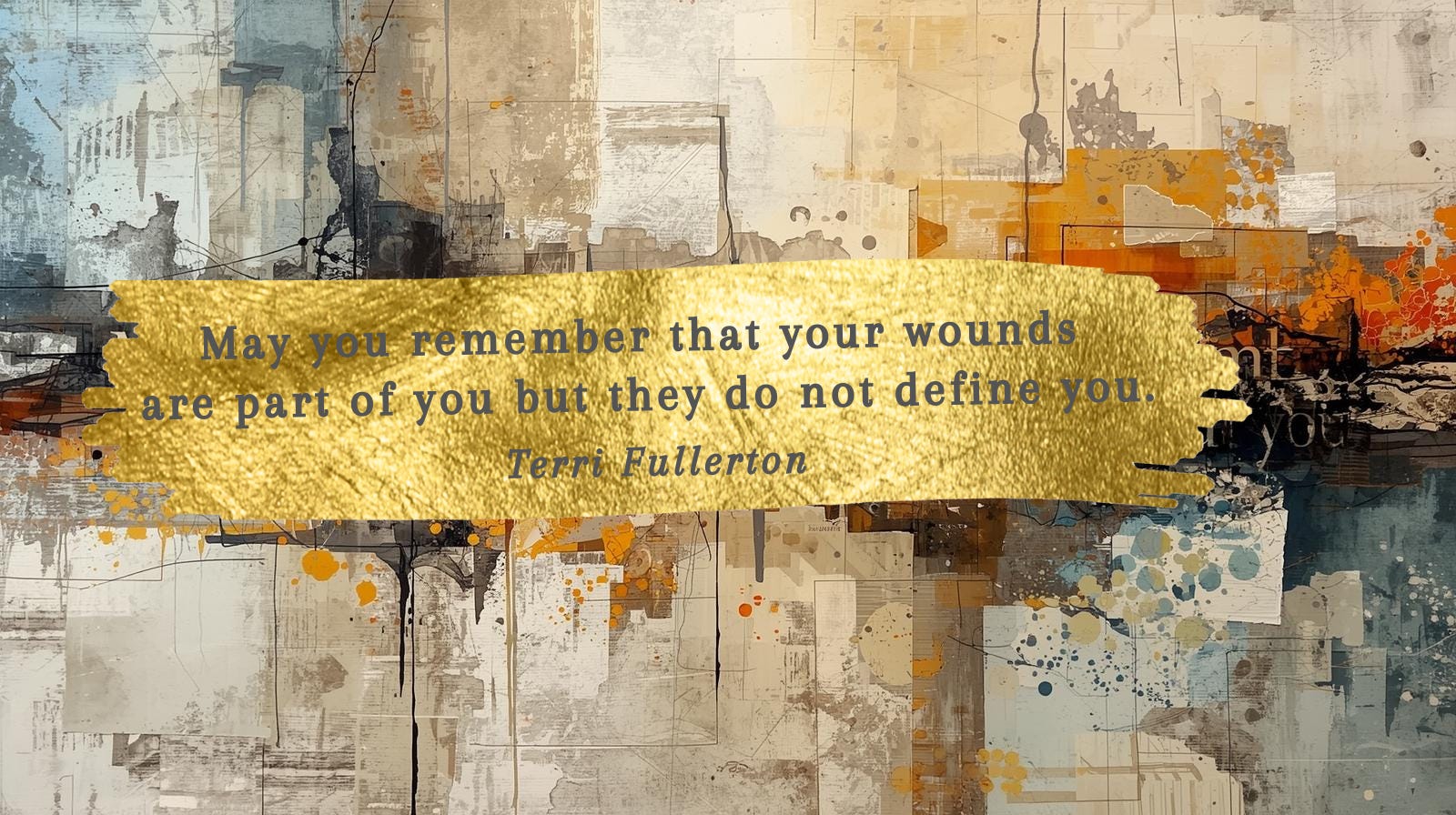
May you remember that your wounds are part of you
but they do not define you.
May you see how you are part of a larger Story.
May you tend the scars with gentleness,
as you come to feel love and belonging—
as you are,
hemorrhaging with pain
from someone else’s gain
or just numb
or weary.
You are more than
entombed proof
of what happened,
You are more than the sum
of all the betrayals.
May forgiveness invite you
to unexpected places—
soft spaces, in the dark,
the quiet breaking open,
grieve what was lost.
I pray that as you bear truth
with the openness of God’s invitation,
you learn to become
more fully human
in a culture that has been
and is dehumanizing.
May all of our wounds, individual and collective,
become seeds of resurrection hope
that bears fruit of the Spirit and not of the world.
May you feel the palpable presence of Jesus
who doesn’t lead us where he hasn’t been.
May you feel his tender hand
in all the hard places you’ve had to bear.

"This is a book that brings Jesus out of the headlines and back into our hearts."
—Pastor Josh Burtram and Will Wright, hosts of the Faithful Politics podcast
—> Pre-order your copy of Jesus Was today: https://a.co/d/2eUBPZF
—> Apply to join the Launch Team here: https://forms.gle/nwdTHWKMLuDsxNnK9
Thanks for reading Jesus Was! This post is public so feel free to share it.
Desmond Tutu, No Future Without Forgiveness (New York: Doubleday, 1999), 85.
Nelson Mandela, quoted in Richard Stengel, Mandela’s Way: Lessons on Life, Love, and Courage (New York: Crown, 2009), 164.
Miroslav Volf, Exclusion and Embrace: A Theological Exploration of Identity, Otherness, and Reconciliation (Nashville: Abingdon Press, 1996), 24.
Nadine Collier, statement at bond hearing of Dylan Roof, June 19, 2015, quoted in Frances Robles and Nikita Stewart, “Church Massacre Suspect Held as Charleston Grieves,” New York Times, June 19, 2015.
Rachel Denhollander, “Read Rachel Denhollander’s Full Victim Impact Statement About Larry Nassar, “CNN, January 25, 2018 (updated January 30, 2018), https: //www.cnn.com/2018/01/24/us/Rachel-denhollander-full-statement/index.html.
No posts
Comments
Nothing yet. Say the first thing.
Sign in to join the conversation.