
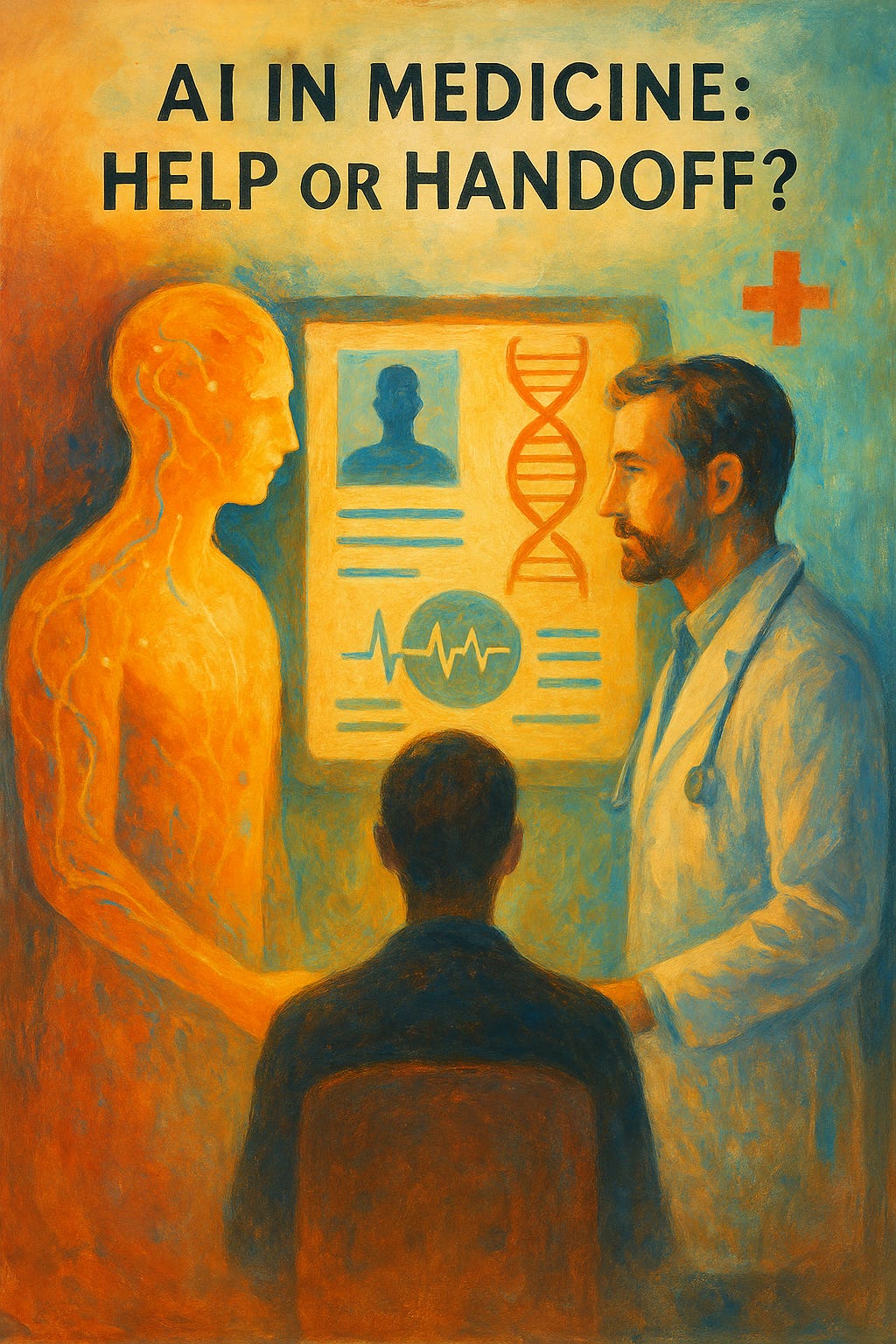
Recently, Microsoft claimed that its artificial intelligence system can diagnose medical conditions more accurately than human doctors1. That announcement prompted me to think about the increasing role of AI in medicine. I don’t object to AI being used in research. That’s precisely where we want it: analyzing vast datasets, discovering patterns, accelerating the search for cures. The concern begins when AI moves out of the lab and into the exam room, or worse, into the insurance industry.
Even in those areas, I’m not entirely opposed. I see the potential. But I also see the privacy pitfalls. I once watched a speculative documentary set in the year 20572. The opening scene featured a man who avoided brushing his teeth after a night of partying because his AI-connected toothbrush would report it to his insurance company. It was fiction, of course, but it hit close to home. My toothbrush already connects to my phone. Currently, the data remains there. Still, it is not much of a leap for that data to be uploaded to a health provider or insurer.
We are moving quickly toward a future where everything is connected, and that future comes with trade-offs. I’ve used ChatGPT to help understand blood test results. After redacting my personal information, I asked what the numbers meant. The insights were helpful. It made me wonder why services like Quest Diagnostics don’t offer AI-powered tools to help patients interpret years of their data. But here’s the concern: who else sees that analysis? Does the AI’s insight go to me alone? Or is it also sent to my doctor or my insurance company? At what point does helpful information become a risk to privacy?
Let’s imagine that privacy concerns are fully addressed and AI is securely contained. We’re then left with a new set of questions. If AI can diagnose and explain lab results, do I still need to see a doctor? Should AI be allowed to prescribe medication? I would say absolutely not. I would never accept a prescription written solely by an algorithm. I also would not want to visit a medical office only to be seen by a machine. The role of a physician goes far beyond interpreting test results. We risk forgetting the human element of care. I was reminded of this while watching the medical drama Pulse3 on Netflix. In one episode, a 9-year-old girl presents with flu-like symptoms. The data—the fever, the labs—suggest it’s the flu. But the doctor isn’t convinced. “She doesn’t look right,” he says, and he orders more tests. That insight didn’t come from a chart. It stemmed from years of experience, intuition, and being fully present with the patient. An AI would never catch that.
That is why I believe the best future is one where doctors use AI as a tool, not a replacement. The doctor can input symptoms, test results, and observations into an AI that offers diagnostic suggestions. Then, the physician, with training and compassion, makes the final call. That could lead to better outcomes than we have now. However, the human doctor must stay informed. It is similar to education, where AI can be a valuable assistant, but it cannot replace a real teacher. It would be amazing if, before my appointment, an AI could analyze my long-term health data and offer insights to my physician. I would even be open to choosing which data I want the AI to send. But the control over that data—who sees it, when, and why—must always lie with me.
To reject AI entirely is to close ourselves off to something that may be a gift. As Timothy Dalrymple said:
“AI is a reflection of God’s creativity in us that can lead to both extraordinary destruction and extraordinary good. And we should get about the business of making sure it’s the latter.”4
We cannot ask God for healing and then refuse the tools He gives us. That would be like the man who prays to win the lottery but never buys a ticket.
AI in medicine holds great promise, but only if it remains a servant to the human person. It must never become a replacement.
https://microsoft.ai/new/the-path-to-medical-superintelligence/
https://youtube.com/clip/UgkxkVwQWNU0IAbUR-TbaeW9IBq-9MpMdJwF?si=4Js3Z6UJEd0SCiUy
https://youtube.com/shorts/iyAtTJu2dSA?si=EX8C-W9KCeDTHDxJ
https://www.christianitytoday.com/2025/07/artificial-intelligence-creation-mandate-technology-bible-in-our-image/
No posts
Comments
Nothing yet. Say the first thing.
Sign in to join the conversation.