
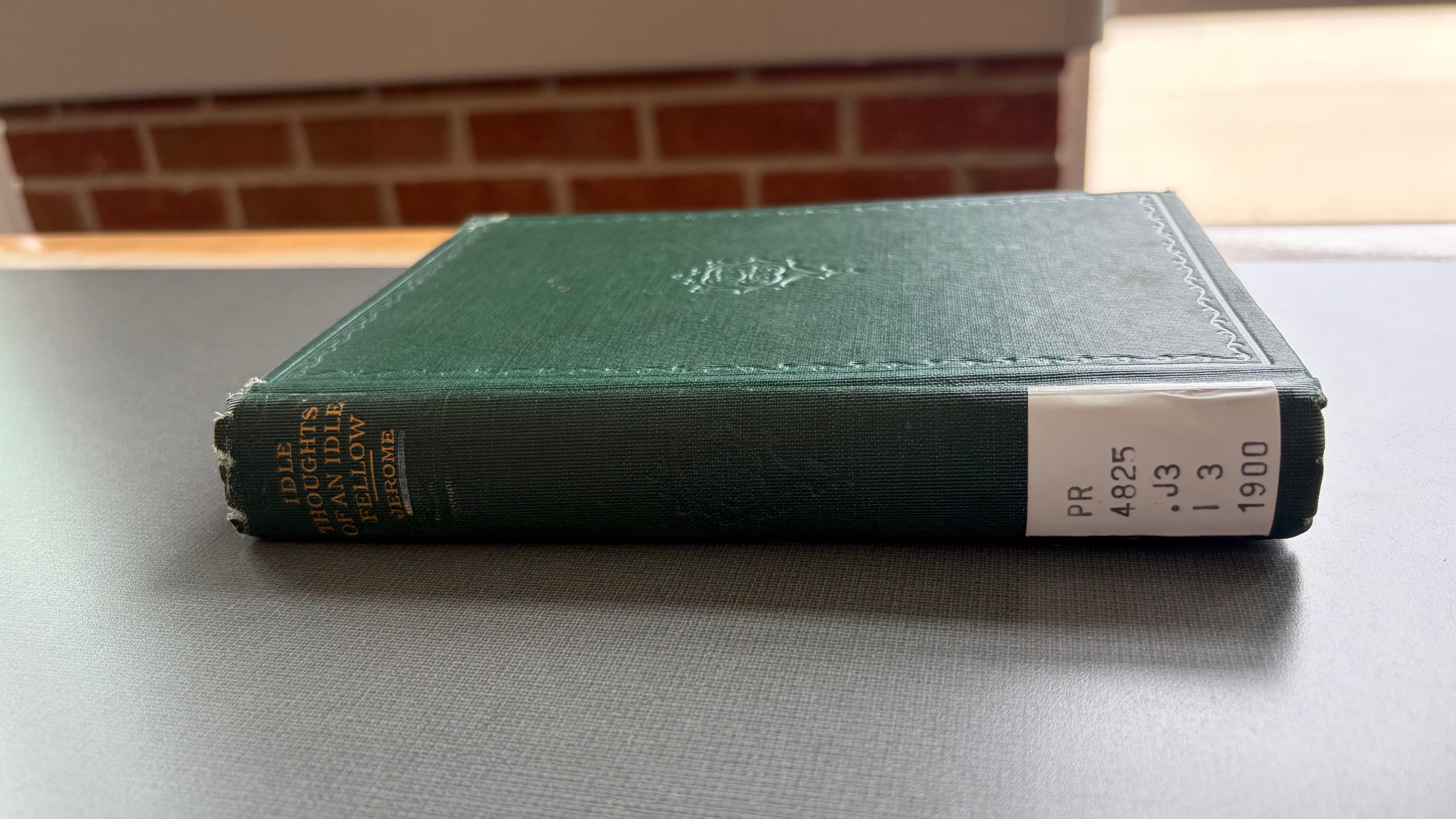
I found a wonderful book in a university library while walking the stacks, The Idle Thoughts of An Idle Fellow, by Jerome K. Jerome, 1886. Please allow me to reminisce about my find in the spirit of Jerome’s witty prose and how wit benefits thinking. This article will not be as humorous as Jerome, but maybe an unexpected discovery in the library will loosen up how I write today.
Not many people understand what walking the stacks is, much less what can be found there. The library stacks are the rows upon rows of book shelves at a university library or public library. Idle walking inspired idle thinking for me today and a much needed reprieve from hard thinking.
I generally find no use in public libraries these days. Good books there have been replaced with movie rentals (yes you can still check out VHS tapes and DVDs at some public libraries), but I will often find treasures in a university library.
Google searches are now for old people. I am told that the kids use Chat GPT or CLAUDE for their questions now. Yet the art of walking the stacks in a library leads to unexpected treasures. Maybe this will become a new trend for the kids who want to rebel from technology. Let’s only hope.
Thanks for reading Jesus Mind! This post is public so feel free to share it.
Today, I settled in at my local university library to focus on grading student assignments. I join a men’s prayer meeting at my church on the first Tuesday of the month. Men pray at 6:30 am before heading off to work. Since I work from home, I find praying with other men a grand change of routine. Today I decided to work from a local university library instead of going back to my home office. This is a public university and the public has free access to the library. My tax dollars are paying off.
In between sprints of reading student work and grading, I walked around the library, mostly stretching my aging body, but also to take in all the knowledge before me in print form. The experience involved sight, smell, and touch. Even hearing played into this discovery of knowledge because silence in a library does tend to focus the mind.
One of my walkabouts brought me to a stack of poetry by John Keats. Beside the dozens of editions of collections of poetry by Keats was a book by Jerome K. Jerome. [ … h, i, j, k, l, m, n, o, p …]. I was intrigued by the title of the little book, The Idle Thoughts of An Idle Fellow. Random walking through the stacks allowed me the joy of finding new treasure.
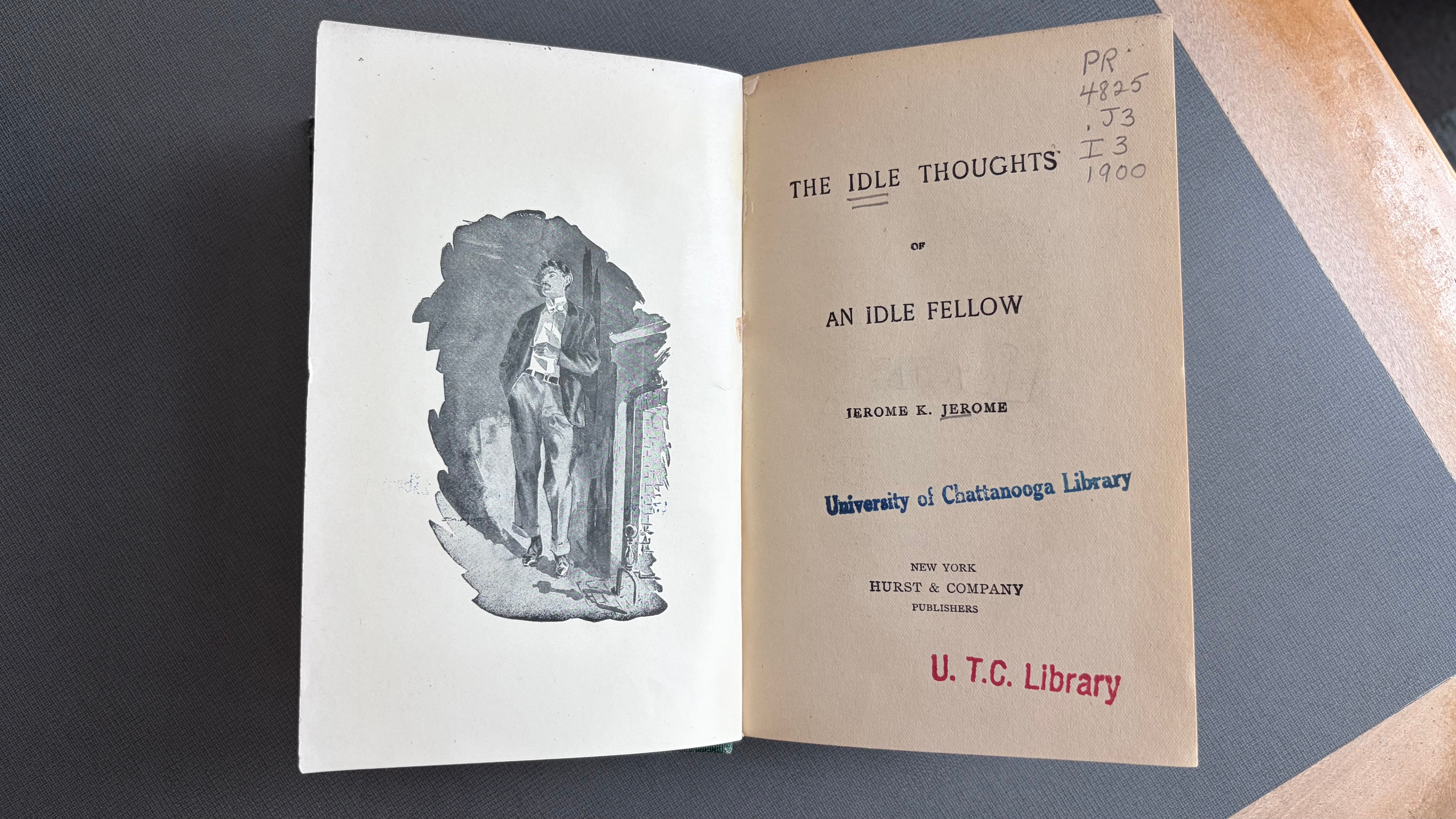
The preface to this book summarizes the content. It is a series of ‘papers’ or idle thoughts from an author (a British humorist in the tradition of American Mark Twain) who exercised his imagination through idle thinking, a prerequisite for wit.
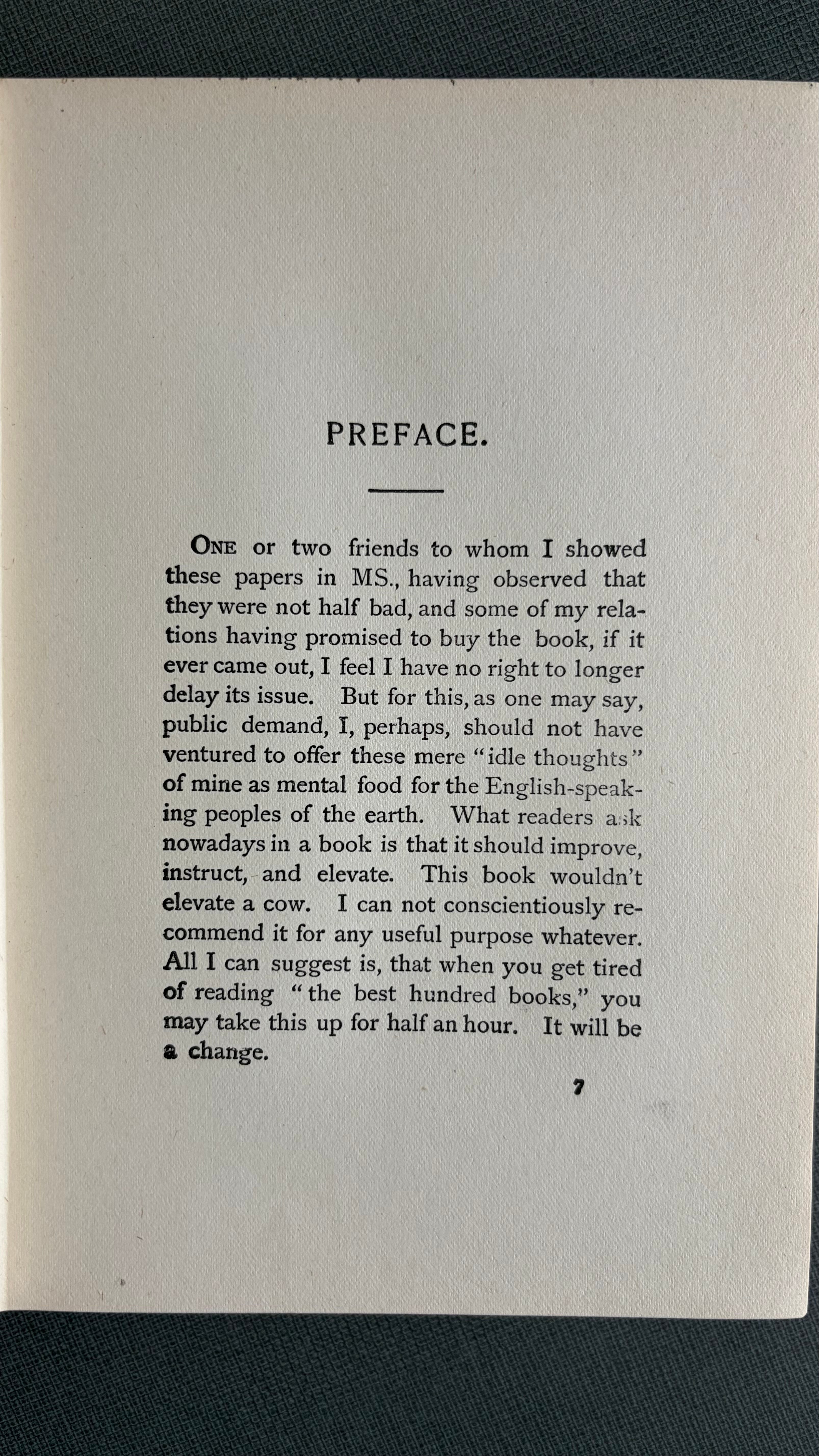
Preface
One or two friends to whom I showed these papers in MS., having observed that they were not half bad, and some of my relations having promised to buy the book, if it ever came out, I feel I have no right to longer delay its issue. But for this, as one may say, public demand, I, perhaps, should not have ventured to offer these mere “idle thoughts” of mine as mental food for the English-speaking peoples of the earth. What readers ask nowadays in a book is that it should improve, instruct, and elevate. This book wouldn’t elevate a cow. I can not conscientiously recommend it for any useful purpose whatever. All I can suggest is, that when you get tired of reading “the best hundred books,” you may take this up for half an hour. It will be a change.
[p. 7]
Maybe divine providence brought me to this little book. Teaching moral philosophy to students online (asynchronous instead of synchronous) can have moments of drudgery mixed in with the joy of thinking deeply about fundamental questions of the human condition.
But does the systematic study of theology and philosophy sometimes need a reprieve into the wit of humor? I found Jerome K. Jerome’s witty observations in this little book very philosophical.
Perhaps God’s providential hand directed my gaze to this little book of humor for a reason. I learned today that the mind needs to be lightened from time to time. The heavy task of thinking does affect the body too. No one can carry heavy things far for long. Wit seems to be the rest that a hard pressed mind needs.
Therefore, I needed these words from Jerome K. Jerome today.
This book wouldn’t elevate a cow. I can not conscientiously recommend it for any useful purpose whatever. All I can suggest is, that when you get tired of reading “the best hundred books,” you may take this up for half an hour. It will be a change.
There is wisdom in idle thinking. Perhaps idle thinking is the much needed sabbath for the mind. If wisdom is found in the Mind of Christ, then the rhythm of creation might be a much needed aspect of thinking.
Wit and wisdom may be siblings of the mind that balance the task of thinking.
Wit and wisdom may be siblings of the mind that balance the task of thinking.
Too much reasoning can lead to mundane boredom. After all how many student discussion posts can one consider at one time?
Too much wit and one’s mind may become numb. Mindless entertainment (even humor) may lead to slothfulness. We called the television the “boob tube” for a reason. We call endless engagement with social media “doom scrolling.”
I found this quote from Justin Huffman at the TGC website helpful.
“No amount of vacationing, streaming entertainment, or social-media escapism will give us true rest. Running to Christ, submitting to his provision and direction, is the only real and lasting sabbath for the soul.”
Yet the serious thinker can also be a dull thinker. “Too much work makes Jack a dull boy” they say.
I do not want to equate the 19th century British humor of Jerome K. Jerome with the Sabbath rest of Christ. But I do believe that the break I found through Jerome K. Jerome provided a much needed rest from the mental and spiritual drain of endless grading and staring at a computer screen .
I did not mindlessly walk the stacks of the library today. My mind shifted attention to the joy of reading and knowledge that surrounded me in the library stacks. My mind rested in those moments. My soul was refreshed. I pondered the meaning of the work that I was doing, and I do believe that God’s providential hand directed me to the book by Jerome K. Jerome. In reading the one page preface I found that it was good for the mind to step away from “reading the best hundred books” as an intellectual bucket list. Finding humor in thinking about every day living is a grand exercise of simply thinking about our surroundings. Applying what we read deeply to the everyday is necessary to thinking with the Mind of Christ as doing so requires practical application of the biblical wisdom that shapes our thinking.
So maybe regular sabbath rest in mental idleness is the requisite state of mind for the mind to think well. It seems that Jesus modeled this balance in his teaching. His was a school of learning to love God the Father while even here and now in this fallen and broken world.
Jesus saw confrontation from the serious thinking religious leaders of Judaism in his time. His response was sometimes gentle, sometimes harsh, but always with rhetorical wit.
Jesus’s wit served a deeper purpose: redirecting attention from the mundane legalism of the Mosaic Law toward the greater truth of the Kingdom of God. The spirit of the law always superseded the letter of the law.
So, in conclusion, I am grateful for my little discovery today of Jerome K. Jerome’s wit and wisdom. Humorous observations of deep philosophical and theological questions do indeed redirect our mental focus.
I will remember Jerome K. Jerome’s witty advice to not take oneself too seriously when thinking about weighty questions. A little bit of humor can be just as philosophical as the most serious ideas of great thinkers.
Comments
Nothing yet. Say the first thing.
Sign in to join the conversation.