
We eat clams for dinner. My uncle adds garlic, lemon, and a bottle of Budweiser, then steams them open on the grill. It’s hot, but not heat wave hot, and the clams taste like summer. We dip chunks of bread into broth that tastes faintly of beer.
If it were last year, I’d think of that time, when I was seventeen, and my mama made a sex joke about clams to my high school boyfriend. We had spent the day digging for clams and mussels in the shallow part of the bay. We were standing in the kitchen, steaming our shellfish open, shoulders sunburnt and salty. My mama’s joke was too raunchy to write here, but unoriginal enough that I’m sure you could guess it.
If it were last year, I’d tell this story to the table. To my mom, sister, aunts, uncles, cousins, all of us sucking clam meat, filling silver bowls with our empty shells. I’d tell the story and we’d laugh as we remembered my mama, the way she couldn’t resist an obvious sex joke, especially one directed at a captive and inappropriate audience. If it were last year, we’d look out at the flowers surrounding our table in the garden, the foxgloves and echinacea and hydrangea, and we’d remember the way my mama walked through her own garden, her hand in her brothers’ hand, her blue eyes wide and peaceful, on the morning that she died.
June 30th.
It’s been two years.
I spent a lot of time braced against the inevitability of this second anniversary, a lot of energy clinging to the specific way that I felt it should be.
Last year we drove out to the bay. In the laundry room of an Airbnb, we spooned my mama’s ashes into snack-sized Ziplocs, laughed at this absurdity, then carried our snack bags to the bay. In salt rich air, we stood in shallow water. Clouds of bone and dust formed in the wind and the waves. I had this urge to place my mama’s ashes on my tongue to see if I could taste her. It felt like I could taste her, that’s how close I felt she was. We played Patti Smith songs, my mama’s favorite. We danced and blew bubbles and watched the sun shift position, break the cloud cover, hot and whole. I remember feeling sure, in that moment, that it was the sun that was moving. That it seemed impossible to believe that the clouds were.
I spent a lot of time and energy gripping onto this version of June 30th. I loudly insisted to my family that I wanted this year to look like last year, that I wanted us to return to the bay. I wanted this year to look like last year because maybe if it looked the same it would feel the same and maybe it felt the same it would be the same. Maybe we could be at one year instead of two years, which will turn to three years, and then four. How far until you can’t imagine tasting someone? How far until the idea of placing ashes on your tongue is just weird? I wanted this year to look like last year because I wanted to control this relentless march of temporal distance, to resist the dogged inevitability of change.
I booked the same Airbnb and texted it to my family group chat. I imagined we’d cook dinner and serve it on that same lazy Susan, that on the anniversary of the day my mama died we’d go back to that same spot on the bay. I imagined we’d go to the cemetery where my mama is buried and bring bouquets of her favorite flowers, all of this predicated on the notion that the recreation of an experience that had once made me feel close to her would succeed in making me feel close to her again. I imagined this experience would bring others close too. That this is what we all wanted, to stop moving, to stop leaving her, to stand still, to stay the same.
I was wrong, of course. It was the clouds that were moving. And the rest of my family didn’t want to go back to the bay.
***
A few days before the anniversary, and on a leave from work, I spend the heat wave outside. I meet a poet friend for lunch and instead of sitting in his air-conditioned apartment like we planned, I ask him to walk with me. We never get to do this, I say to him, be outside on a Tuesday, sweating in 102 degrees.
My friend and I walk through Madison Square Park and talk. Beneath us the grass is patched and thirsty, hot like the top of a stove. My friend tells me about his recent trip to London, the novel he just finished, the competitive swimming he did when he was a kid. We agree that competitive sports, swimming for him, gymnastics for me, were the first time we each felt the dual effect of identity, the comfort of definition and its constraints. I was a swimmer, he said to me, it’s just what I did. When he decided to stop swimming, it wasn’t the not swimming that hurt, but having to tell everyone about it, having to admit to having changed.
My friend and I talk about the malleability of self, the fallibility of static identity. He tells me that he is afraid of loving someone who loves a specific version of him, of hurting them with his propensity for change. We are sitting on the lip of a water fountain, the heat static in the air. In this moment, I do not draw the connection between change and grief, the futile grip on past selves and past certainties that I seem to have tightened over the past two years. I don’t draw the explicit connection, but I do feel myself drawn in. I feel the gravity of the word, change.
My friend and I talk about writing. How for each of us, writing has been the longest lasting of our interests, the one that seems to persist across versions of self. Writing, we agree, persists in the face of otherwise inevitable change because it is not an identity but a vehicle towards identity, a vehicle towards the next self. In this way, writing is a mechanism of change, more concerned with the process of transition than what that transition is to.
I tell my friend that I think love is like writing in this way. That deep love resists the notion of a final form. I am thinking of Loren when I say this. How I was twenty-three when I met him, when I fell in love with the smell of his neck and texture of his palms. Loren and I were not the people we are now when we met, not the people we’ll one day be, so what is it that allows our love to sustain? It feels like love must rest on capaciousness. That to love someone is to love their capacity to uncover, discover, and reveal new parts of themselves and, crucially, to respect them enough to allow them to uncover, discover, and reveal new parts of you. In other words, love persists in the face of otherwise inevitable change because it is not predicated on a static identity but is a vehicle towards the next self.
We rise from our seat on the fountain. My phone says it is 103 degrees. We say what does it take to write and we wonder what this means about what it takes to love.
Ever since, I’ve been making a list: Devotion, persistence, a belief in the uncanny, a willingness to question, a relentless pursuit of that which feels true, a desire to change and be changed.
***
We eat clams for dinner. We are tucked between flower gardens, at a long wooden table in the backyard of my aunt and uncle’s home. The heat wave just ended. 85 almost feels cool.
If it were last year, these clams would make me think of my mama. I’d think of her sex jokes, her big toothed grin. For so many years my mama, her illness, and then her gone-ness, were the centripetal force of my family’s love. It’s been so hard for me to fathom a different center, a gravity that is anything but her.
This year, I dip my clams into broth and pass the breadbasket to my cousin. Her and her boyfriend just moved to New York from Chicago and now they live across the hall from a group of my closest friends. It’s the first time we’ve been adults in the same city and having her here changes something, New York feels fuller, more like home. This past fall my cousin rescued a mutt named Kirby, who has sandy hair, a human-like grin, and a love for licking toes. Kirby rests his head on my foot under the table. He chases me through the yard and eats the zipper out of pair of my cousin’s shorts when no one’s home. We sit in the living room and wonder if we should take him to the vet for an x-ray, and I have this feeling, as we’re all sitting there googling what might happen to a dog that eats a zipper, this feeling that my mama is there with us, that she’s shifted position, that she might not be at the center, but that this shift doesn’t mean that she’s any less close.
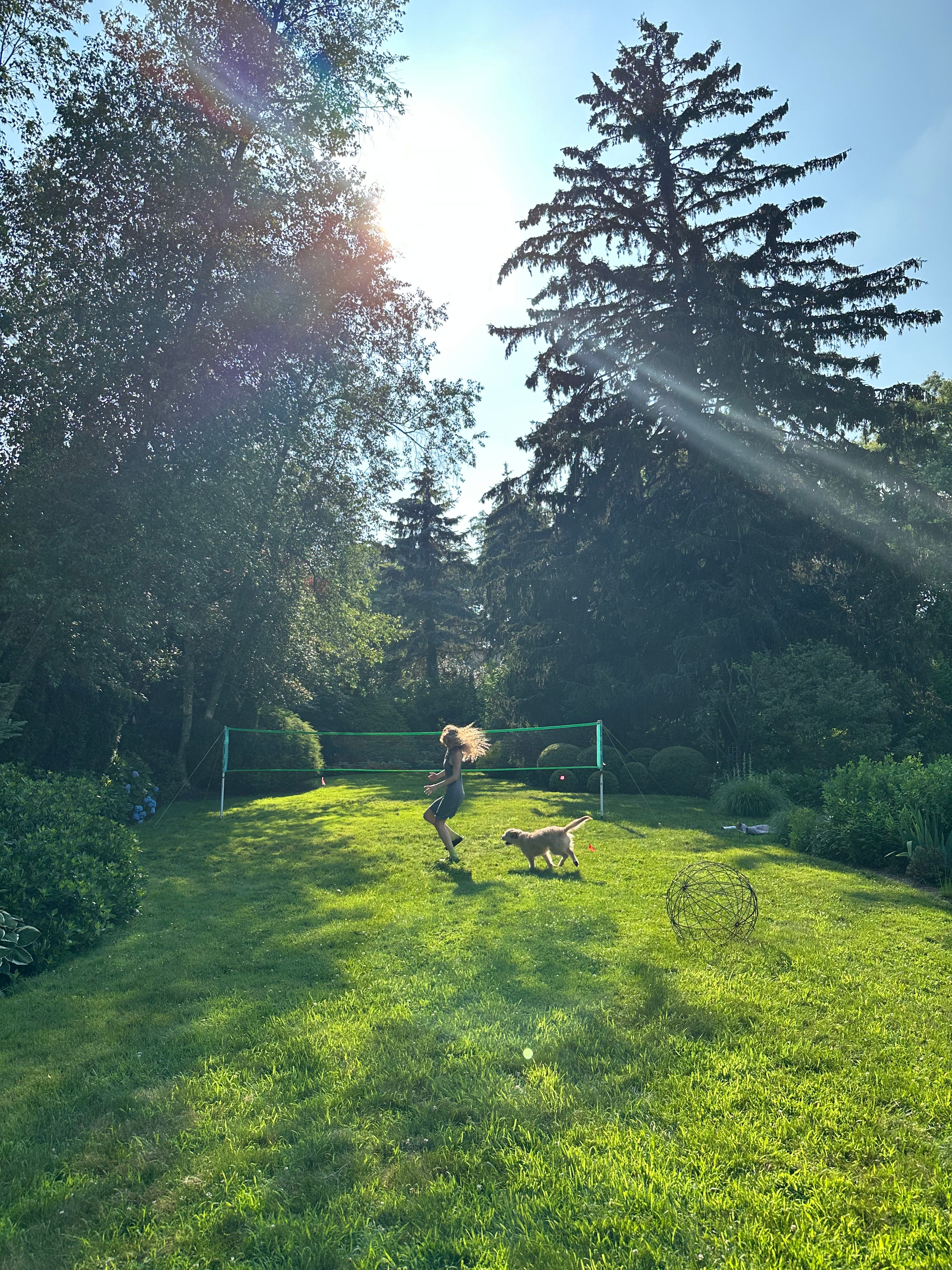
This year, I don’t think about the time that my mama told my high school boyfriend a clam-related sex joke until I sit down to write about the weekend. I write about the Tom Petty cover band concert, about my uncle’s dance moves, which remind me of my mama as I write about them but in the moment just reminded me of him. I write about our cold cut sandwiches, our badminton tournaments, our walks through the garden, my sister’s new girlfriend who we all really love. I write about the sense that this weekend, something was different. Or a lot of things were different. That always, in perpetuity, difference occurs. I write about the fact that different is just another way of saying changed. I write that change is inevitable and that somehow, this year, this weekend, change was beautiful. That in this change, my mama felt just as close, just differently. She felt as close she’s ever been.
I write about the heat wave. The fountain. This idea of writing and love as vehicles of change. Like a math equation, I find myself writing:
I know that I need to feel close to my mama.
I know that I feel the closest to my mama when I feel the most ok.
I know that to be ok, I need to write and love.
I know that to write and to love is to change.
What I’m saying is, I think I can change without leaving her. What I’m saying is, it’s all moving, it’s always moving, the clouds, the sky, the sun.
No posts
Comments
Nothing yet. Say the first thing.
Sign in to join the conversation.