
Years ago, for her birthday in June, a friend of mine asked several people in her life to write an answer to this question and send it to her: What is the good life?
I remember a few answers I came up with; some were hyper-specific to what I was experiencing at the time, others concepts and ideals I stand by now. I have turned it over many times since, almost always around this time of the year, when the heat blanches any thought of productivity or a bottom line from my mind.
What is the good life?
I recently saw the movie Materialists, which is chiefly preoccupied with the question of whether romantic relationships are better sustained in the long run by financial security or being genuinely in love with someone. For its purposes, you can only have one or the other. It asks whether the good life is better served by being able to go to an expensive restaurant on your 5 year anniversary, or enjoying the person you are spending it with.
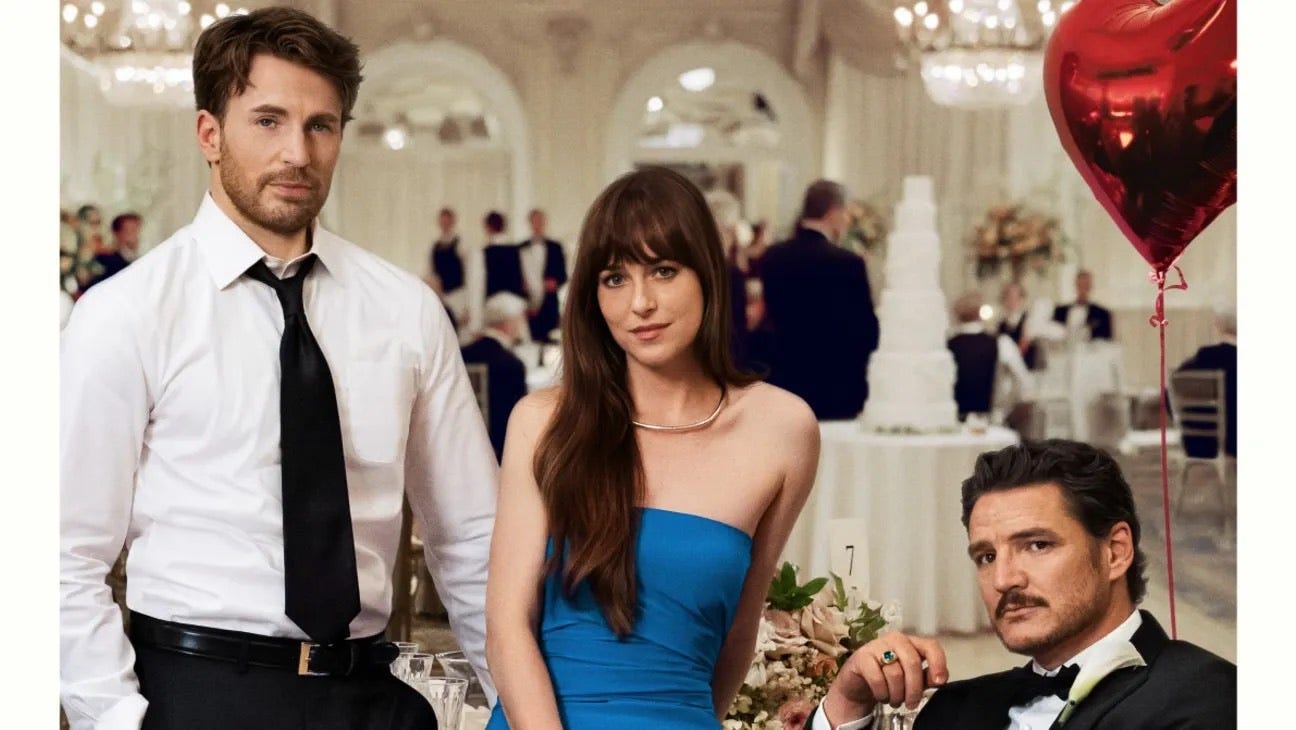
The main character, Lucy, is a matchmaker for wealthy New Yorkers, and there are several sequences in which her clients describe exactly what they are looking for in a partner — down to BMI and salary numbers (and a very clever take on the much-debated female fixation on male height). They describe their ideal mate in the same way you would describe a car you are looking to buy. The underlying anxiety in each of these sequences is that if each client can just find the person who checks all of their (literal) boxes, The Good Life will be unlocked for them, and thus their own lives — the lives they long and are waiting for — will begin. They just need to find the right person.
It’s dealing with concepts that have been around as long as people have been marrying each other, but with a distinctly modern issue at its core: self-image. Towards the beginning of the movie, one of Lucy’s clients calls her in a panic on her wedding day. She is draped artfully across a queen size bed in the bridal suite, clad in a gown that easily cost thousands of dollars, and begins to weep about why she is getting married at all when modern women can financially provide for themselves and have had to endure millennia of being traded as collateral in marriage deals. Lucy looks intently into her eyes, and asks her, “Why do you want to get married?” She assures her there’s nothing she hasn’t heard before; there are no wrong answers. The bride tearfully, quietly confesses that she wants to marry this particular man because he makes her sister jealous: he’s taller than her sister’s husband, richer than her sister’s husband, and quantifiably more attractive. Lucy translates: “He makes you feel valuable.”
The two women proceed to the lavishly expensive wedding, where Lucy catches the eye of the groom’s equally high-status brother, who immediately makes her feel valuable. Within minutes of meeting him, she runs into her cater waiter ex, who it’s instantly clear makes her feel seen. The rest of the movie is spent with Lucy deciding which is more important to her. Which items on her checklist is she alright leaving blank?
I left the theater feeling profoundly sad and somewhat empty, and I’ve been turning over why in the week that’s passed since. There is one deeply romantic monologue that made me cry (spoken by the distractingly gorgeous Chris Evans, whose very casting implies that if you do choose to be with someone broke, the sting of poverty is softened if that person is at least someone enviably attractive), but other than that, the movie itself didn’t elicit much of an emotional response from me. I did not feel one way or the other about any of the characters, and felt that the movie was more interested in love as a sterile intellectual concept than as a magnetic force capable of changing a life for the better. The movie has a “happy” ending, but it’s tinged with a sort of deflated sigh. A decision has been made, but you get the sense that just as much has been lost as gained. It’s all a very detached approach to love, treating it as something that either happens to you or doesn’t.
The day after I saw it, without knowing that I was thinking about these things, another friend sent me this quote from The Art of Loving by Erich Fromm: “Most people see the problem of life primarily as that of being loved, rather than that of loving, of one’s capacity to love. Hence the problem to them is how to be loved, how to be lovable.”
And after several days of chewing on both, I realize that’s what made me sad: So often, when we talk about love (be it romantic or otherwise), the focus is on being loved rather than being loving. Preparing ourselves to get something rather than to give it. This entire movie, despite what is arguably a romantic ending, is reflecting the very real state of modern love: people walking around with subconscious and conscious checklists of what they want in every type of relationship, what they feel they deserve, without the least concern for what they themselves might do to increase their capacity to be loving. Not a single character asks what they can do to love better — they are only concerned with being loved. For all its talk about material versus immaterial assets, it doesn’t quite know which line to put love on in its ledger.
The “problem” underlying all of these increasingly caricatured prerequisites to love is the reciprocal fear from each person that they themselves are not lovable. They want to be loved — “to feel valuable” — yet they go about it by listing their own material assets as the justification as to why they do or don’t deserve it. Each of the three main characters, at one point or another, lists their material value. It’s a zero-sum game. You are worthy of love (i.e., a mate of reciprocal value) only inasmuch as you are lovable (i.e., your own material assets). When a semi-compromise is reached towards the end of the movie, you’re not quite sure who has given up what, who has gained, and to what end.
Materialists barely scratches at the surface of one’s capacity to love. It’s not at all interested in asking what each of these people might do to be more loving, to see love as something that’s grown with care, not grabbed from a shelf or stumbled upon. It’s understandable, of course. It’s much easier to wait for someone to do something good than to do it yourself. It’s much more attractive to think of life “starting” when someone loves you, as opposed to starting to make life more beautiful by being loving.
At the risk of sounding corny, I have lately been listening to 1 Corinthians 13 while I make my coffee in the morning. Even if you are not a person to whom faith is of interest, it’s fascinating on a strictly philosophical level. When you really take into account what it says love is, it’s completely counterintuitive, especially all of these things it says love is at once: patient, kind, unenvying, not boasting, not proud, not rude, not seeking to build itself up. Not making checklists, not requiring a minimum income, not waiting for someone to be perfect before embracing them. It describes love as something to aspire to, not something you earn. It requests something of you; it’s a checklist, but one where you have to do inventory on yourself.
I think that love, real love, is muscular, and somewhat difficult. Love is not some passive thing to be waited on, but a skill that is slowly but actively cultivated so that it can be given freely. And I wonder how much our lives might change for the better were we to really take seriously the posture of being as actively loving as possible, as opposed to passively waiting for love of any form to simply happen to us. What would it look like, truly, to be more concerned with loving than being loved?
If love is muscular, then it requires daily effort to become more loving — to increase one’s capacity to love. It takes practice. What would it look like if each day, in each interaction, my goal was simply to be kind? To be patient? If I looked for opportunities to exercise these traits, instead of hoping for them from others? My mind immediately plays devil’s advocate. What about when someone interrupts me? What about when someone is rude? What about when someone is impatient with me? It strikes me that each of those questions is about how someone else is behaving towards me, not the other way around. Passive, not active.
Nothing changes if nothing changes. You do not wake up one day being the person you want to be, in the life you dream of living, by having a rigorous checklist of the type of life you want to have (or creating one for some faceless person to theoretically fulfill but realistically never live up to). I don’t know that any of us can become more lovable, per se; I do know it doesn’t happen by making more money or assessing other people by the same metric. And I know that a life spent in the pursuit of being loving cannot be anything but a good and hopeful idea.
No posts
Comments
Nothing yet. Say the first thing.
Sign in to join the conversation.