
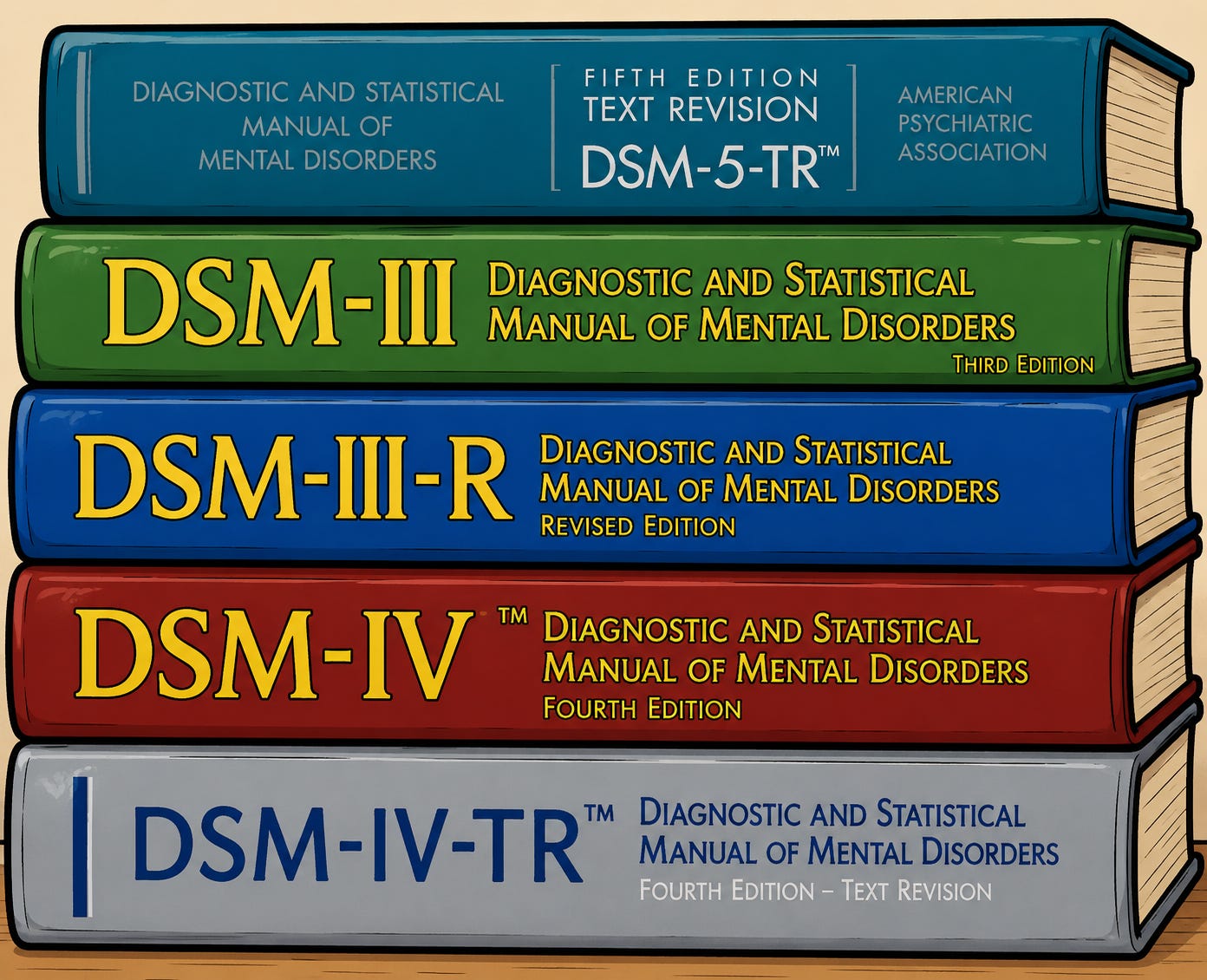
About this time last year, I caught word of a new DSM in the works — the DSM-6. The DSM is the Diagnostic and Statistical Manual of Mental Disorders, and sometimes regarded as the Psychiatrist’s Bible.
We need a broader debate about this culturally, politically, and economically significant document whose creators work very much behind closed doors.1
Critiques of the DSM are legion from author COI to incoherence to the pathologizing of the human condition. Still, it persists as an important manual. The DSM is used by a wide range of stakeholders: researchers, clinicians and hospitals, insurers, courts, educators, policymakers, patients and families.
DSM revisions, which have occurred about about once a decade, occur within a professional society, the American Psychiatric Association, with final approval from the organization’s trustees. The DSM-6 is expected to usher in an era of diagnostic updates on a rolling basis.
This post kicks off a new project, Real In Its Consequences. The project is an open notebook of my exploration of mental health governance originating at the point of the DSM and its creators.
The title of the project comes from the Thomas Theorem (1928) named for American sociologist husband and wife pair, William Isaac Thomas and Dorothy Swaine Thomas:
“If men define situations as real, they are real in their consequences.”
How experts define mental illness has real world consequences — children are given pharmaceuticals, law students receive extra exam time, defendants face sentencing options, policymakers work to address the “mental health crisis.”
I spun the project off as its own section. So, if you’re into this sort of thing please subscribe to Conflicted and opt in for receiving notifications for Real in its Consequences.
Diagnosis— the labeling of human kinds— has cultural and policy significance because of the way individuals and communities come to understand themselves and each other. The late philosopher Ian Hacking called this the “looping effect” in which experts ‘make up people’ who in turn create groups and make demands, such as to be recognized as experts on behalf of their own kind.
Diagnoses work at the boundary of psychiatric/scientific expertise and society. Resource distribution is made contingent on the expert diagnosis. As such, diagnosis becomes a means to access resources such as more time to take a law school exam.
Meanwhile, expanding diagnostic categories is a way to argue for policy urgency, using diagnosis rates as a measure of harm to or need for some slice of the population. “Concept creep” denotes psychology’s ever expanding notion of harm to mental health and mental disorder.
Related is the cultural shift in the way we speak and think about our moods. More people are open to using a popular vernacular of depression and anxiety, which can muddle self reporting rates. This is the looping effect.
Without transparency in the process of making a diagnostic handbook there is ample opportunity for politicization of mental health, which is real in its consequences for resource distribution, policy, politics, and our shared sense of well-being.
With this new project, we’ll unpack the decision making process that characterizes so much of individual and public mental health, highlight the work of leading experts and their thinking, and take a look at data in select controversies.
In the next post, I’ll share some of the intro material the DSM-6 committee has released.
Some early reflections on this topic are below:
Some of what I’m reading on the web:
Manhattan Institute’s, Carolyn Gorman, is a leading voice on the issue of mental health screening in schools and the problem of overshadowing serious mental illness with a hyper-focus on wellness.
Awais Aftab, Psychiatry at the Margins, advocate for a different approach to psychiatric nosology, known as HiTOP, than what dominates in the DSM. It is notable thought that there is an equally credentialed faction arguing for something totally different than the dominant framework.
Jonathan Shedler, newsletter by the same name, has a list of reasons for the “slow decline of psychotherapy” that includes: “Conflation of mental and emotional distress with DSM diagnostic categories by both health insurers and researchers.”
Nassir Ghaemi, The Psychiatry Letter, has a good overview on the distortions of the DSM in Why DSM is Mostly False. Similar to any other unrealistically exalted expert consensus document, Ghaemi notes, “The problem is that DSM can’t be a Bible and science at the same time.”
Thomas Easley, The Path Between, has a historical and philosophical look at the meaning of constructing illness in current headlining debates about mental health diagnoses.
I’m drawn to this topic from multiple fronts:
As an observer of the climate anxiety literature, I noticed that some had begun advocating for climate anxiety and its broader family of eco-strife to be included as part of the new nosology.
As a mom and a college professor, I am an observer of the frequency at which children and young people are stamped with mental disorder.
As an analyst attuned to issues in science and technology, I have noticed the political narratives arising around trends in different diagnoses, notably, ADHD and autism.
No posts
Comments
Nothing yet. Say the first thing.
Sign in to join the conversation.