
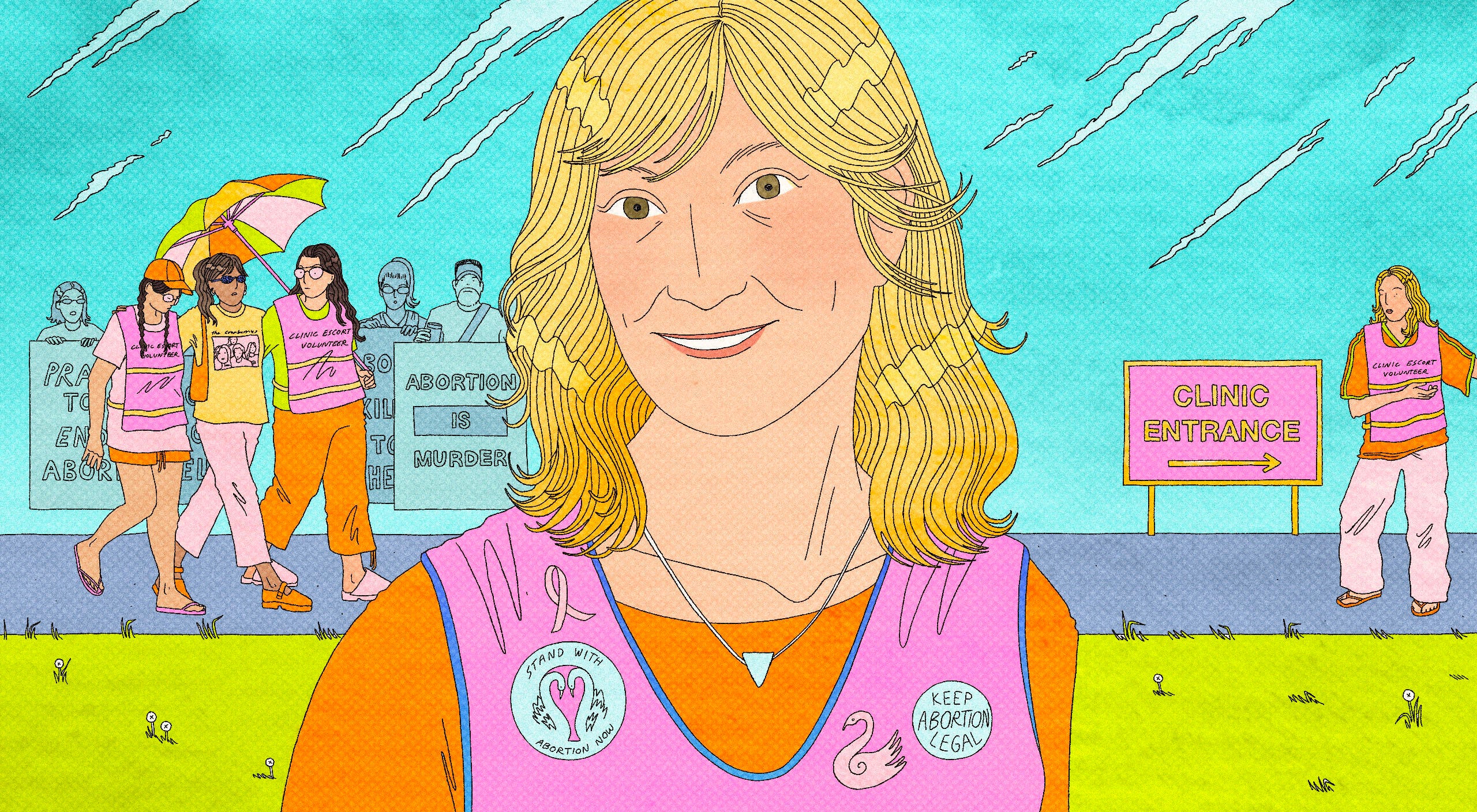
In 1972, Dusty Swan, nee Debbie Frare, supported a friend who had to leave Florida to access abortion. The following year, the Supreme Court issued Roe v. Wade, legalizing abortion and allowing clinics to open in Dusty’s community. She inquired about volunteer opportunities at her local clinic in Orlando, and the rest is history.
Today, Dusty is a swan—that is, a volunteer clinic escort with Stand with Abortion Now (SWAN), which officially formed in 2022. As an escort, she walks patients from the parking lot to the clinic, providing them the support they need as they’re often confronted by a gauntlet of anti-abortion protesters.
Other roles the SWANs have taken on: they operate a table outside the clinic to distribute food and water to unhoused community members, along with a free period product pantry. The group also runs a popular TikTok account, where they mock clinic harassers to the delight of over 300,000 followers.
The levity is necessary: with the Trump administration openly backing extremist protesters—refusing to prosecute them even for criminal behavior at clinics—Dusty says anti-abortion activists have only been emboldened.
That said, it’s not as if protesters weren’t bold before: a few years ago, Dusty was stalked by one extremist from the clinic to her car, where they took photos of her license plate to identify and dox her. This, Dusty says, is pretty standard behavior directed at patients, clinic staff, and volunteers.
Just like Dusty’s friend had to leave the state for care 54 years ago, today, too many patients have to leave Florida for abortion after six weeks. “I don’t know why there aren’t more women from my generation [volunteering with SWAN], because we know what it was like when there was no legal abortion—it’s hell,” she says.
Dusty spoke to Abortion, Every Day about how volunteering at abortion clinics has changed and stayed the same through the decades; what surging anti-abortion harassment looks like on the ground; the stories she hears from patients and clinic staff; and more.
AED: What does an ordinary day entail for you volunteering at the clinic?
DS: Typically we get there, get set up outside, put out water and snacks for unhoused people who walk by. Now we have a free period product pantry now at our clinic, so I usually check to make sure that’s stocked up. I’ll just be outside meeting the patients, getting them to the parking lot, walking them up to the clinic, and trying to basically drown out our protesters as much as I can.
AED: What does anti-abortion harassment outside your clinic often look like? Have there been any particularly memorable moments?
DS: They’re all really just bullies, and all bullies are cowards. There’s never been violence, but sometimes pushing and shoving. The worst incident is that a guy spit on one of our swans, but she was recording, and we called the police and they arrested him. They found he had a gun in an ankle holster.
We get mostly middle-aged white men for protesters—which is what happens at most clinics—and we get a few white women. They’re mostly barred from trespassing on the property, they stay on the sidewalk or driveway and yell at the patients. They’re disgusting. They’ll tell patients they’re going to hell or what they’re doing is murder. I try to talk over them as I’m escorting the patient until the patient gets inside. Then I refuse to speak to the protesters, which really pisses them off because they want you to engage. Sometimes they get a little pushy, shove-y, and aggressive, especially the men. They want to push you out of the way so they can get to a car to hand out their propaganda to patients.
But generally, they know where they’re allowed to be, and how much they’re allowed to get physical, which is not very much—especially with me, because I’m over 65, so if they touch me, it’s a felony in Florida. I personally have no fear of them.
AED: You’ve been volunteering at abortion clinics in your community for decades. How has your work changed and stayed the same over the years?
DS: It’s absolutely changed through the years. When I graduated from high school in 1972, I was 17, and I had a friend who had to leave the state to get an abortion. So, when Roe came in 1973, they started opening clinics, and I went down and asked if they needed a volunteer. They said sure. At that time, the way we advocated for our patients was to be inside the clinic, where we’d have three or four patients with a counselor going through a counseling session.
As a volunteer, I went with them through the session, held their hand, sat with them in recovery, got them anything they needed, and would be that familiar face as they went through the whole process.
Now it’s quite different. We don’t really do any work inside the clinic, we’re generally outside protecting the patients by walking them into the clinic, trying to protect their identities as we carry big umbrellas and things like that. The protesters often wear body cameras to film our patients and can be very intrusive, try to intimidate them by taking photos and videos. We get very creative to try to stop that.
When I was sitting through those counseling sessions as a volunteer, that was incredibly valuable. I know this is hard to believe, but we didn’t have Google back then, we had to go to the library for information, so not many people knew much about abortion or the mechanics of it. Then a few years after I became a volunteer, I went to the same clinic and had my abortion, and I already knew everything that was going to happen.
AED: What is the impact of anti-abortion rhetoric portraying abortion patients and providers as murderers at a time of increasing harassment and violence?
DS: It’s all disgusting, from people who are supposed to be Christians and quote the Bible but don’t even know what they’re talking about. None of them want to help women or children—their only interest is in controlling and coercing women.
AED: We know that anti-abortion harassment and violence have been on the rise in recent years and that the Trump administration has directly egged this on. How has that affected your work and patients and providers’ safety?
DS: It’s affected us a lot, since Trump helped the Supreme Court overturn Roe and the dominoes started falling. Mostly our protesters don’t talk about the political scene so much and stick to abortion. But this rhetoric coming out of Washington has had a very negative effect and emboldened a lot of the protesters. They dox us.
This man once followed me several blocks to my car, took photos of my car and license plate, ran my plate, told all the protesters my real name. When I showed up to the clinic, they started calling me my real name. We all go by pseudonyms because of the doxxing.

But for me, I don’t care. I basically told them to take out a billboard of me, I don’t care who knows that I advocate for women at an abortion clinic. They could take out a front-page in the newspaper saying that for all I care—I’d be proud.
AED: Do you often hear stories from the patients or providers at your clinic, and if so, what are you hearing?
DS: I hear more from the patients. They’re often waiting for some time before the appointment. They’ll tell me why they’re seeking abortion—they might be young, or have a six-month-old, or have five kids already. It could be any number of things they’re telling me is their reason, but I say the same thing to all of them: the only reason you need to be here today is because it’s Thursday. You need no other reason, you need no reason, there’s no explanation necessary. This is what you chose to do today, and it’s your right to do it.
AED: What do you want people to know about the patients and clinic staff you support, in a country that so often demonizes them?
DS: They’re heroes. Our nurses are heroes. Some of them have been at that clinic for 20 years. They could make so much more money and not face this harassment somewhere else, but they stay here. All the staff are so incredibly dedicated.
AED: What drew you to volunteer your time this way, and to the reproductive justice movement broadly?
DS: I grew up as a young teenager in the ‘60s and the ‘70s, and feminism was at the forefront then. I was radicalized early, and I’ve always been a feminist. I don’t think there’s anything wrong with that word. I’m sure I’m a product of my generation and the things that were happening as I was growing up. And then with Roe, we finally started to really see some progress for women in so many areas.
But now we’ve gone so far backwards. It’ll take us decades to get back what we’ve lost, us, LGBTQ people, immigrants, all of us. It’ll be decades before we are in the position that we were in before all this bullshit started.
AED: What do you do to unwind and take care of yourself?
DS: I actually work out with a trainer three times a week. I lift weights and do strength training and stuff like that, and I do it for a lot of reasons. But one of those reasons is so I can go down to the clinic and run up and down the driveway helping people. It’s funny because I’m the oldest in the organization by decades, and I don’t know why there aren’t more women from my generation there, because we know what it was like when there was no legal abortion—it’s hell.
It really bothers the protesters that I’m older for some reason—they think I’m their mama or something. So, I exercise and do what I can to just be able to get out there and do this work.
Comments
Nothing yet. Say the first thing.
Sign in to join the conversation.