
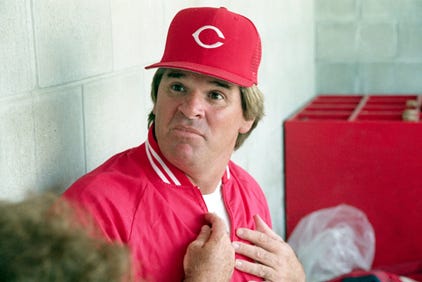
In recent years, the most famous or infamous sports bettor seems to have been baseball’s Pete Rose. When questioned about his betting, Rose reluctantly admitted to betting on baseball, including games where he had been either a player or manager. But as he “unequivocally” stated, he only bet on himself or his teams to win. He allegedly never placed a bet on one of his teams to lose, even though he had often been in situations in which he could have shaved points or made managerial decisions that would have caused his team to win by a reduced margin, netting himself huge financial gains. Instead, he argued, he regularly bet on his teams to win. “Everybody did it,” he insisted. “And so what?”
Those admissions led to Rose being banned from the game for life. It’s sad, especially considering the current state of sports betting, which almost makes what Rose did look innocent. Since sports betting was generally legalized in 2018 by a Supreme Court ruling that made individual states responsible for the legality and conduct of sports betting, annual “official” betting revenues have increased from $400 million to more than $25 billion, making it one of the fastest growing businesses in the world. Sports betting organizations are projected to spend more than $600 million next year on television advertising alone.
Unlike casino gambling, which usually requires that people travel to select locations to become physically involved, sports betting (and some new forms of casino gambling) follow participants into their private lives, via smartphones. Psychologists tell us that sports gambling, particularly in its smartphone iterations, is extraordinarily addictive, triggering cerebral pathways in the brain. The speed at which transactions occur adds to the addictive nature of the activity. Data suggest that by the time betting entrepreneurs take their “cut,” approximately 98% of sports bettors lose. Those are frightening odds that are well hidden from bettors. Also, 70% of sports betting profits come from less than 2% of bettors. This form of addictive betting is a particular threat for teenaged boys who often imagine that they are supremely knowledgeable about sports.
Perhaps the most disturbing aspect of contemporary sports betting is the evolving trend toward micro-betting. Betters can now place wagers on increasingly small aspects of an athletic contest. What will the first pitch of the second inning be: a fastball, curve, or slider? How many hits or stolen bases will there be in a particular inning? Will a college-level basketball player make his next free throw? This growing phenomenon presents countless opportunities for “fixing” individual micro bets without actually “throwing” games, helping to tempt some athletes down a troubling pathway. Several have been “caught” in recent years.
For 1950s’ kids, sports betting was a common activity. And the most pervasive of our betting activities was penny pitching. Naturally, we approached this “sport” like Pete Rose, only betting to win. “Pitching” had been popular for decades in America and Europe, and it was a popular “sport” in my bayfront neighborhood. The playing field was any curb or straight edge, and for us, it was most commonly played on the concrete edge of Bello’s (now the Bayview) Tavern. Rules were simple. During any round, participants lined up holding their coins and took turns tossing (pitching) them against the straight edge or wall. The player whose coin ended up closest to the wall won all the coins that had been tossed. When there was a tie, which always seemed to be determined amicably, two or three co-winners split the coins that had been tossed.
Penny pitching was not limited to pennies. Some high-stakes games involved pitching nickels or quarters, but most of the kids were put off by the more expensive games. Of course, there were preferred techniques, and some of the kids always seemed to be better than most of the others. Some of us would practice, finding isolated cement curbs or other “edges,” where we would spend hours trying to perfect techniques.

Given the current state of sports betting, Rose and his dalliances seem almost silly. Not only is modern sports betting becoming endemic to society but also increasing numbers of young men are finding themselves in serious trouble after being lured into the “web” of deceit created by sophisticated advertising. One of the world’s largest betting organizations, DraftKings, currently features a promotion that promises that a $5 bet by a “first timer” will net $300. What could possibly go wrong with that? And recently, DraftKings announced a partnership with ESPN, making betting seem all the more innocent. Almost all-American.
The eventual result of these seemingly foolproof “odds” is often a young man (females are far less likely to get involved) who must seek help from parents after finding himself thousands of dollars behind.
There were similarly tempting but far less onerous opportunities for us kids to get into trouble with our seemingly innocent coin pitching during the 1950s. One of the transitions from grade school to high school was a daily, high-stakes game at Cathedral Prep. High school games were much more serious, involving quarters and half-dollars. Most days there was a game going on when we arrived for school, and regular gamers arrived more than a half-hour early each day to play. It was possible for skillful boys to net $10 or more each day. Some contests featured sets of boys, including one high-skill player and a second financial backer. It was an early lesson in economics.

Historian and author David Frew, Ph.D., is a Scholar-in-Residence at the JES. An emeritus professor at Gannon University, he held a variety of administrative positions during a 33-year career. He is also emeritus director of the Erie County Historical Society/Hagen History Center and is president of his own management consulting business. Frew has written or cowritten 35 books and more than 100 articles, cases, and papers.
No posts
Comments
Nothing yet. Say the first thing.
Sign in to join the conversation.