
There is an ongoing debate among historians and philosophers about whether history repeats itself or if history rhymes with itself. This debate is an intellectual luxury afforded to the powerful and privileged. For those who must endure the pain of tyranny, discrimination, and oppression, for marginalized communities that live without safe drinking water, adequate housing, and affordable healthcare, history is not an abstract intellectual discussion about the societal determinants of health and demography. For many, history is not the past but a present, lived reality whose wounds continue to shape future experiences.
Bernard Lonergan, a prominent 20th-century Canadian Jesuit philosopher, theologian, and economist, argued that present history is actively shaped by human choices and intelligence. He maintained that individual and collective bias, together with what he termed a “flight from understanding,” distorts common sense and contributes to social and institutional decline [1]. For Lonergan, this pattern can be overcome only through critical self-appropriation, authentic insight, and moral responsibility (Lonergan, 1957, 1972). The systemic decline is caused by individual and group biases that blind communities to wider truths.
Margurite Ann Johnson, better known as Maya Angelou, once declared, “History, despite its wrenching pain cannot be unlived, but if faced with courage need not be lived again.” [2] Dr. Angelou’s aphorism is not simply a statement about history. Seemingly timeless, her words remain relevant, issuing a clarion call for moral courage and an insightful challenge, predicated on the belief that courage, truth-telling, and moral responsibility will determine whether the next generation inherits the wounds of the past or the wisdom gained from confronting them.
Whether history is repeating or rhyming, it has been said that a society that refuses to confront its past risks repeating it because human beings often fail to learn from previous experiences. Political tyranny and oppression, economic corruption and inequality, wars of choice and necessary wars, and the abuses of position and power can reappear when similar human immorality and ecological conditions exist. Both Lonergan and Angelou warn that forgetting history or refusing to confront it is dangerous and can enable threats that are familiar, new, or sometimes repeat offenses in unprecedented forms.
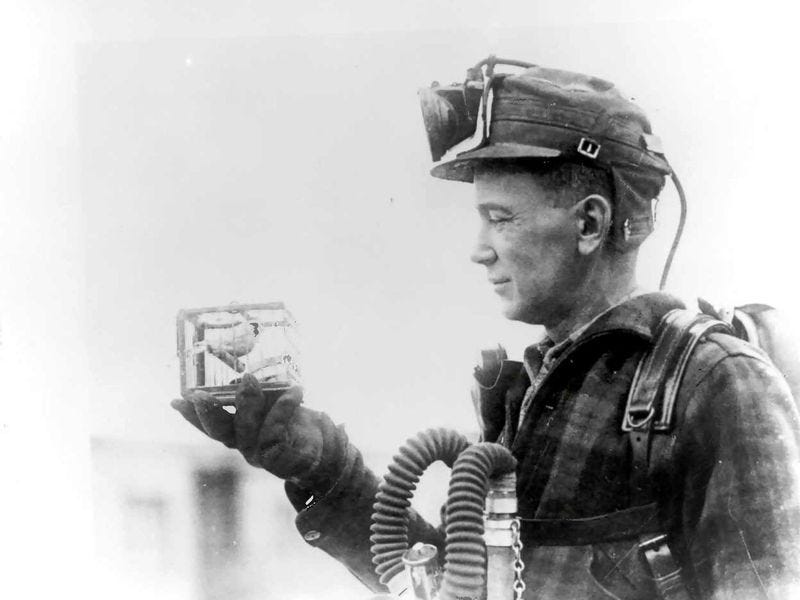
For generations, coal miners carried canaries into underground mines because canaries have a highly efficient, delicate respiratory system featuring a unique two-cycle breathing mechanism and extra air sacs that process large volumes of air rapidly. This design makes them extremely sensitive to airborne toxins, which is why they were historically used in coal mines to detect dangerous gases. When a canary became distressed or died, though the danger was unseen, miners understood that the environment had become unsafe and that immediate action was necessary. The canary functioned as an early warning system, providing an objective biological signal that danger existed before humans could detect it themselves.
In The Miner’s Canary: Enlisting Race, Resisting Power, Transforming Democracy (2002), Lani Guinier and Gerald Torres [3] use the analogy of the canary being carried into coal mines to argue that the experiences of racially marginalized communities serve as early warning indicators of broader systemic failures in American democracy. Just as canaries were more sensitive than miners to toxic gases, vulnerable populations are often the first to experience the harmful effects of economic inequality, environmental injustice, political exclusion, failing schools, discriminatory policing, and other structural inequities. Rather than viewing these communities as isolated exceptions, Guinier and Torres contend that their experiences reveal deeper problems that eventually threaten society as a whole.
The authors argue that the canary’s true purpose was never to simply suffer and die. The bird’s distress was intended to alert miners to the invisible toxins in the environment so they could leave the mine or eliminate the source of the toxic gases. Likewise, the suffering of marginalized communities should prompt society’s purveyors of democracy and justice to identify and transform the structural conditions that produce inequality, oppression, and discrimination.
However, public health officials, and social and political scientists, rather than designing research methods to better understand, identify, and ameliorate the social and ecological determinants of health, poverty, and education, focused their attention analogously on the canary. In doing so, they devoted considerable effort to documenting the symptoms, behaviors, and outcomes of those most affected by toxic social conditions while giving comparatively less attention to the structural environments that produced those conditions. Their research emphasized the individuals and communities experiencing the greatest distress while often neglecting the human decisions; their political interference, economic inputs, societal interpretations, and institutional practices and policy choices that created and sustained those conditions.
In effect, the canary became the object of scientific inquiry rather than the mine or the environment itself. Humans design institutions, allocate resources, interpret evidence, and possess the capacity to alter the social and political environments. Meaningful social change requires shifting the focus from documenting the suffering of vulnerable populations to transforming the human systems that produce vulnerability in the first place. The canary is studied with increasing precision, but the poisoned mine, the institutions, policies, and power structures that endangered both the canary and the miners remained largely unchanged.
This insight presents an important challenge to those of us who live and work in social and political sciences. Much social science research has traditionally focused on studying the “dead or dying canary.” We design research methods to measure disparities, document traumas, catalog poverty, analyze crime, or explain poor health outcomes after harm has already occurred. Researchers have generated extensive data and offer evidence-based research that describe the effects of racism, economic deprivation, educational inequities, and community disinvestment. While this work is invaluable for understanding social problems, greater emphasis must be directed at reducing or eliminating the toxicity within the environments that create them. In this sense, the “toxic mine,” the interconnected structures of power, position, and resource allocation, remains inadequately addressed.
Guinier and Torres challenge scholars to reorient research toward systemic transformation. Rather than asking why vulnerable populations experience disproportionate harm, they encourage researchers to investigate how institutions, policies, and power structures create those conditions and what changes would improve the environment for everyone. Echoing the central metaphor advanced by Guinier and Torres (2002), Rev. Jeremiah Wright argued that “Ain’t nothing wrong with the canary. Fix the toxic system you have trapped the canary in, tied the canary to, and then told the canary to sing” (Wright, 2025). Wright’s observation shifts attention away from blaming individuals for their suffering and toward transforming the social, political, and institutional environments that produce inequity. [4]
When the toxic conditions are eliminated, the canary survives and so do the miners. This reframing shifts the focus from treating marginalized communities as objects of study to recognizing them as human beings whose lived experiences can guide institutional reform and strengthen democracy for the benefit of all. However, the critical independent variable in this analysis is neither the miner nor the mine. Electronic gas detectors and digital air-quality sensors have replaced living miner canaries. These modern tools use continuous monitoring to track toxic and explosive gases safely.
While a digital sensor can perfectly replicate and improve upon a canary’s lung capacity, technology designed to help the marginalized often accidentally replicates and scales the very oppression it aims to fix. Unlike the canary, which responds instinctively and without bias, people exercise discretion at every stage of the information process. Humans determine which variables to measure, what data to collect, how information is categorized, which findings are emphasized or ignored, and how results are communicated to stakeholders. These decisions are shaped by values, assumptions, organizational incentives, cognitive biases, political interests, and personal motivations.
Consequently, humans become the critical variable in any assessment or decision-making process. While data can reveal important patterns and serve as an early warning indicator, the integrity of those findings ultimately depend on the people who design the system, manage the inputs, interpret the evidence, and implement the outcomes. Human intervention can improve understanding through expertise and contextual knowledge, but it can also distort reality by manipulating inputs, selectively interpreting evidence, suppressing unfavorable findings, or framing conclusions to support predetermined objectives. Therefore, the quality and trustworthiness of organizational decisions depend not only on the accuracy of the data but also on the ethical judgment, transparency, and accountability of the humans responsible for transforming information into action.
While the mine provides the physical environment and the miner faces the immediate hazards, neither function in a vacuum; both are governed by the upstream choices of organizational leaders. The structural integrity of a tunnel, the reliability of ventilation systems, and the quality of safety gear are not random variables, but the direct results of executive budgeting and resource allocation. When analysis focuses solely on the physical site, it misidentifies a symptom as the root cause. It is the administrative decisions, setting aggressive production quotas, delaying equipment upgrades, or underfunding maintenance, that actively shape the risk profile of the workplace.
This systemic dynamic extends far beyond the confines of industrial safety; it reflects a broader societal pattern in which institutional architects orchestrate conditions while the public bears the consequences. Just as frontline miners are constrained by executive quotas, marginalized communities navigate a landscape heavily restricted by targeted administrative maneuvers. The enforcement paradigms of immigration and Immigration and Customs Enforcement serve as a primary example, in which executive policy directives dictate the daily vulnerabilities of undocumented populations. Similarly, legislative measures that induce voter suppression deliberately reshape the democratic environment, altering who can participate before a single ballot has been cast. In both arenas, the outcomes are not organic products of public behavior, but the calculated results of upstream institutional design.
This exercise of top-down control manifests even more acutely in areas of national security and high-level accountability. Geopolitical escalations, such as ongoing military conflicts with Iran, are driven by executive decisions made in closed rooms, yet the direct physical and economic costs associated with these decisions are passed on to our military service members and the citizens of the United States. Further, the systematic concealment of critical information, such as the suppression of the Epstein files, highlights how powerful actors manipulate institutional transparency to shield themselves from accountability. Across all these domains; from the depths of a Charleston, West Virginia, coal mine to the highest corridors of congressional and presidential powers, the analytical lens must remain fixed on the same truth: the actions and hardships observed at the surface are merely the downstream effects of human choices made by those who engineer the system itself.
JES Publications Reader's Guide

Angelou, M. (1993). On the pulse of morning. New York: Random House.
Guinier, L., & Torres, G. (2002). The miner’s canary: Enlisting race, resisting power, transforming democracy. Boston, MA: Harvard University Press
Lonergan, B. J. F. (1992). Insight: A study of human understanding (Collected Works of Bernard Lonergan, Vol. 3, F. E. Crowe & R. M. Doran, Eds.). University of Toronto Press.
Wright, J. A., Jr. (2025). Keynote address at the Equity Action Summit [Video]. Michigan Roundtable for Diversity and Inclusion.
No posts
Comments
Nothing yet. Say the first thing.
Sign in to join the conversation.