
As a quick catch-up (more about this challenge in this video or blog post), the first phase of this challenge asks you to choose a prompt and sprint five times. Not writing five complete stories, but getting five different ideas on the page.
You can find my sprints and immediate thoughts in the YouTube video, but my overall experience of this phase is below.
This is my Phase One.
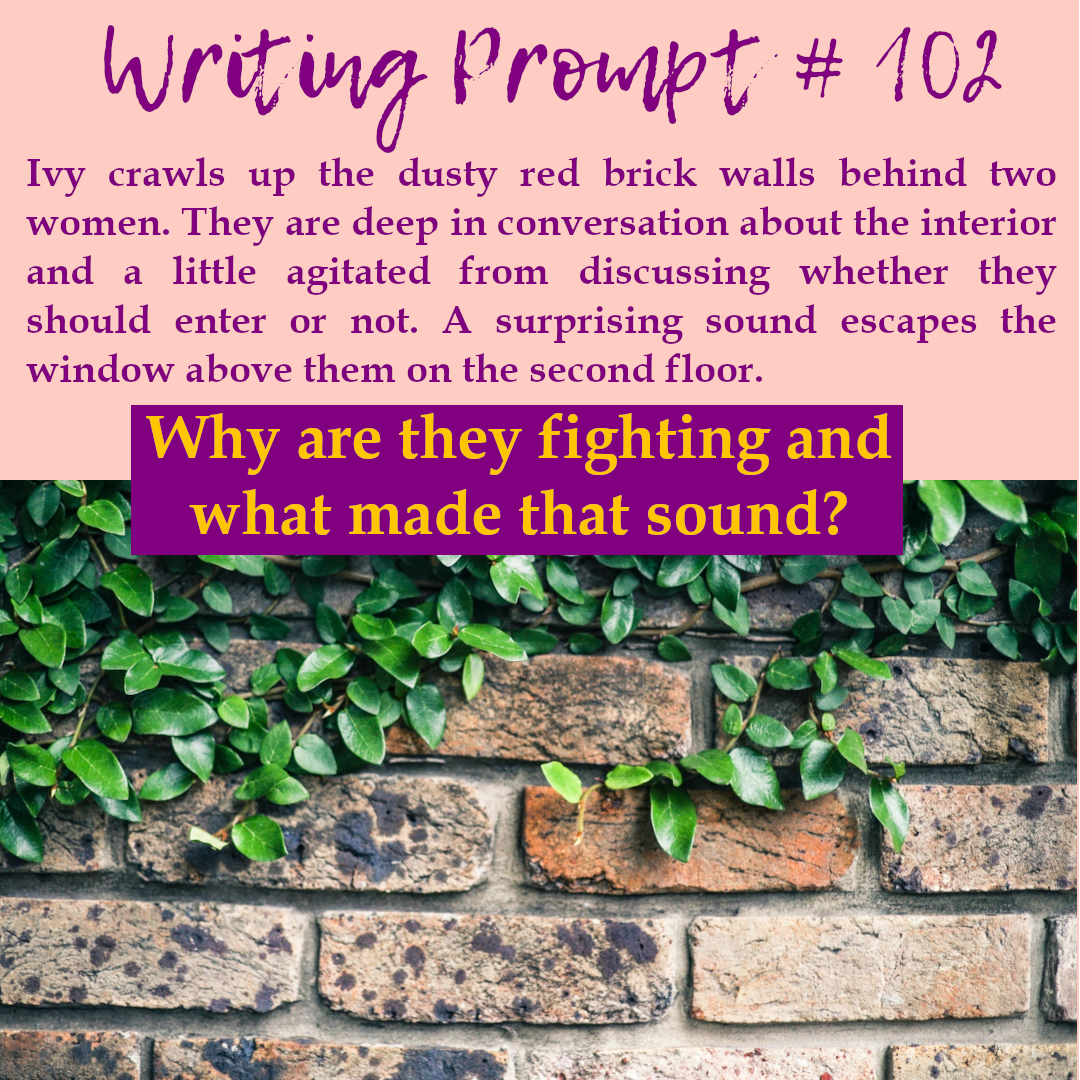
Ivy crawls up the dusty red brick walls behind two women. They are deep in conversation about the interior and a little agitated from discussing whether they should enter or not. A surprising sound escapes the window above them on the second floor. Why are they fighting and what made that sound?
I shared my favourite lines on Instagram, but here I think I will share my first lines. The first thing I wrote in each sprint, no matter how awful.
The two women are exploring trails and happen upon a building. One wants to enter; the other thinks they should stick to exploring nature. The sound from inside is a bell.
The ivy on the bricks behind them crawls the way the shiver does down Jenny’s spine. “I don’t think we should go in there.”
Two women are walking up to their friend’s house and hear a possible fight happening. They’re unsure if they should interfere or not. The sound is plates breaking.
“Did you hear that?” Julia whispered.
“I don’t know.”
Two women are looking for shelter for the night. One has seen this building before and believes it’s safe. The other is not so certain especially when they hear chains rattling inside.
“Hurry up, it’s getting dark.”
Pam waded through the thick grass, eyes on the horizon.
One woman is taking the other to the building. The one being taken is cautious and uncomfortable. As they get closer, she is certain it is a witch’s house and they should not enter.
“Why are we here?”
“I just want to show you something.”
“What kind of something could you possibly want to show me out in the middle of a field.
Two cops are arguing over whether they should wait for backup or not. After a loud metal on tile sound, the argument is over, and the one cop is going in whether her partner follows or not.
“We should wait for back up.”
“No we shouldn’t, they’ll take too long and we don’t know what will happen in that time.”
Or at least I assume it does. This prompt is very specific. It gives me characters and location, an immediate sign of conflict, and an interruption/disturbance. Really it’s perfect for the beginning of a story, but it also doesn’t leave much room for imagination.
I am certainly going to attempt phase one a few more times after the challenge is over with different types of prompts. I want to see the wider creative depth of “three things” or “start with this sentence” style prompts. Two of my favorites to create.
Because of this, creating five different stories was more of a challenge than I expected.
Was this prompt too specific to allow for what I was considering “different enough”? The characters had to be women, they had to be arguing, they had to be outside a brick building with ivy, and there needed to be a surprising sound. Only small details can be changed and still fulfill writing from the prompt. (Though at the same time I encourage people to run any way they want even if the inspiration starts defying the prompt.)
The thing that I was hung up on the entire time was that the tone felt very similar. None of these stories could be considered light, happy, or whimsical; they are all on the darker side of things: survival, horror, and violence. Is this because there was the word argument in the prompt and that set off negativity? Is it that this house felt unsafe because of the unknown noise?
Something more structural that was similar in all of these sprints was that they started dialogue heavy. I think this was, again, by nature of the type of prompt. The prompt includes two women arguing, and so I felt the need to have the argument. In theory this could be executed with indirect dialogue.
In fact, I’ve just had the realization that the POV didn’t have to be following the two women. I could definitely have had someone watching the two women. Dammit. That certainly would have helped me tell a different enough story.
A tip to anyone undertaking this challenge after me: consider your POV as a way to change things up. Which brings me to…
I kept worrying my stories weren’t different enough, but when I tried to talk about it I would come to the conclusion that they were. So what constitutes different enough for this challenge? What are the elements to look at? Does a sprint allow for enough development to see differences in some of these elements?
First, let’s take a look at the big three elements: character, setting, and plot.
With such a restriction on character, I don’t know if we get to see a lot of difference here in such a small amount of writing. (Although, sitting and thinking about these things is helping me see where I could have gone differently.)
All of my stories have two women that clearly have some sort of relationship. (Why no strangers!? Strangers can argue!) It’s not really the characters that make them different people but their circumstances. Is that enough? Is it okay because it’s this one element?
Sprint #1 - Friends? Lovers? Ghost believers?
Sprint #2 - Friends? Lovers? Cowards in the face of conflict?
Sprint #3 - Friends? Lovers? Survivors.
Sprint #4 - Lovers. One is a cultist or worshipper. One is observant.
Sprint #5 - Cops. One is stubborn and fearless. One is logical, but also maybe fearless.
Oof… that doesn’t look great. I’m not even positive (from the writing) about the relationships between these women. Only that they know each other. In my mind I know the answer to friends or lovers, but it’s not really evident in the writing (yet).
This prompt has part of the setting clearly staked out. There’s a brick wall with ivy growing on it. However, I think there is definitely some wiggle room here because where this building exists and in what kind of world are still very up for imagination.
Did I do a good job of making interesting settings though? In the immediate vicinity, not so much, but in the grander sense of setting, I think I did.
Sprint #1 - surrounded by tall grass, in sight of a trail. Possibly a world where ghosts exist.
Sprint #2 - Urban/suburban and contemporary/realistic.
Sprint #3 - Surrounded by tall grass. In a world that has ended/is ending.
Sprint #4 - Surrounded by tall grass surrounded by a forest. Cultists/witches/magic might exist.
Sprint #5 - Urban/suburban and contemporary/realistic.
A lot of grass. For some reason I got really stuck on this being some abandoned, overgrown, ruined building. I obviously pulled myself out of that for the two “in town” stories, but there are definitely other ways to take this. Secluded just feels right? I’m clearly primed for horror.
I do think this is where my stories become different enough. The women are faced with different conflicts and dangers.
Sprint #1 - Two women exploring nature start exploring a building. The immediate conflict is whether they should even be there and the long term conflict is whatever danger lurks within (it’s ghosts).
Sprint #2 - Two women observe a domestic dispute and aren’t sure if, when, or how to intervene. They’re now possibly in danger of the same man.
Sprint #3 - Two women facing end-of-the-world peril. Immediately they are seeking shelter but people, zombies, and other basic necessities will prove a problem.
Sprint #4 - One woman means to sacrifice the other. The sacrifice can tell something is up.
Sprint #5 - Two cops are at the site of an abduction/hostage situation. They enter and are now in imminent danger, hopefully with back up on the way.
There’s definitely some big stakes going on in most, if not all, of these stories. (I don’t know if sprint one is that deadly yet.) But even with life and limb being the thing at stake, the ways in which they can be lost are quite different. If I were to bring these plots down to a single idea each they’d be: haunting, domestic violence, zombies, cultists, rescue.
There’s a different level of agency for our characters in these circumstances which I think makes a big difference in the vibe of the plot. Our characters are seeking adventure, searching for safety or shelter, fighting against being taken somewhere, or charging ahead into obvious danger. This is where the difference really hits for me. Which is weird because I said character was the least different, but agency is character.
Well, I’m going to say I fulfilled Phase One with five “different enough” stories. But the next phase asks me to choose only three to move on and create an outline for them. How do I choose? I know the challenge says to choose your favourite, but I can’t help but think about whether these stories are short story narratives or not. I’m not supposed to worry about that until the next knock-out phase but… I might have to take it into account.
However, if we are looking at favourites, I almost want to use word count to cut out my stories. I feel like the more I wrote the more into the idea I was. I was never far off from others, but the two that landed on 321 versus the two that were over 370 feels like it should make a difference. I won’t be making a decision in today’s post, but I’m curious what criteria you might look at (or are looking at) for Phase Two. Should I be basing it on vibes and excitement or should I be more technical in my choices?
Jerrica Black is an editor, writer, and content creator with a variety of passions including but not limited to literature, cooking, crafting, hiking, and gaming. She graduated in May 2025 from Professional Writing at Algonquin, is the author of “Flames to Remember” in Shattered Reflections, and creates educational and conversational blog posts and videos about reading, writing, and editing while encouraging (and editing for) aspiring writers and assisting small businesses with copy & content.
No posts
Comments
Nothing yet. Say the first thing.
Sign in to join the conversation.