
Following Hamas’ Al Aqsa Flood operation into southern Israel on October 7th, 2023, and the subsequent bombardment of the Gaza Strip, I began making month-long reporting trips to Israel-Palestine to cover different aspects of the war.
In October and November 2023, I documented the wave of settler and military violence across rural villages in the southern West Bank, resulting in the complete ethnic cleansing of more than 20 communities in less than 40 days—a campaign of violence and displacement that continues to this day.
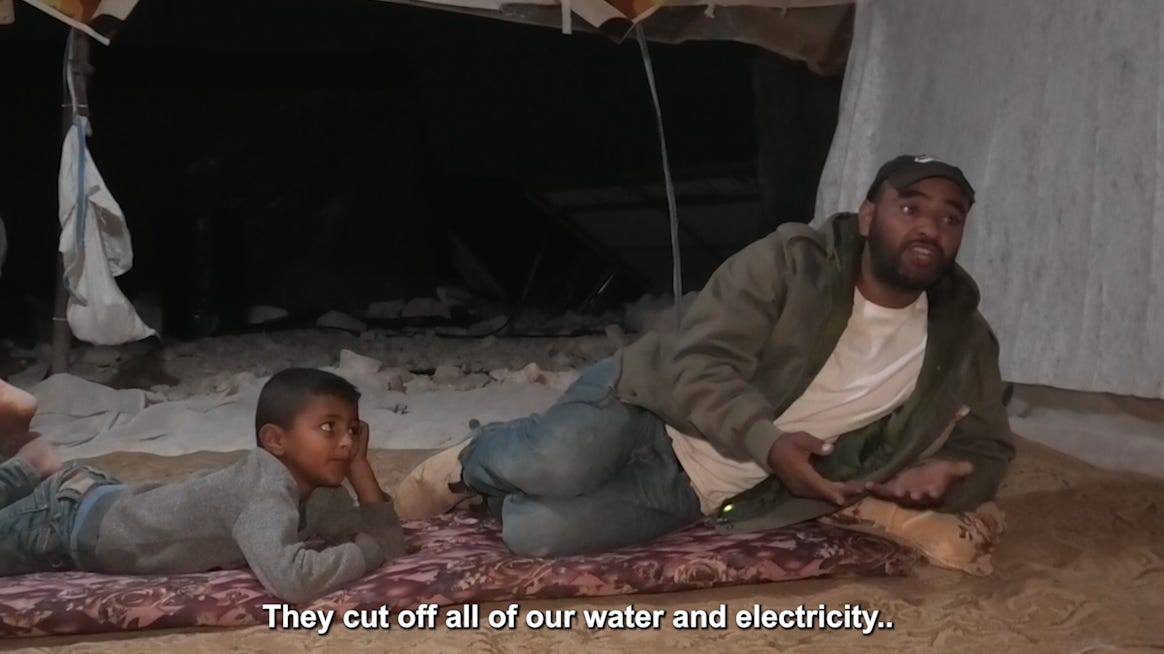
In March 2024, I embedded myself with Jewish Israeli nationalists who saw it as their civic and religious duty to travel south to the Nitzana and Karem Shalom border crossings, where they worked to block humanitarian aid from reaching Gaza’s starving population. I accompanied them, documenting their collaboration with the Israeli military, which—despite both Israeli and international law—allowed these civilians into closed military zones to obstruct aid shipments. I conducted interviews with civilians who openly expressed their genocidal ambitions, while military reservists spoke candidly about war crimes they had committed while deployed in Gaza.
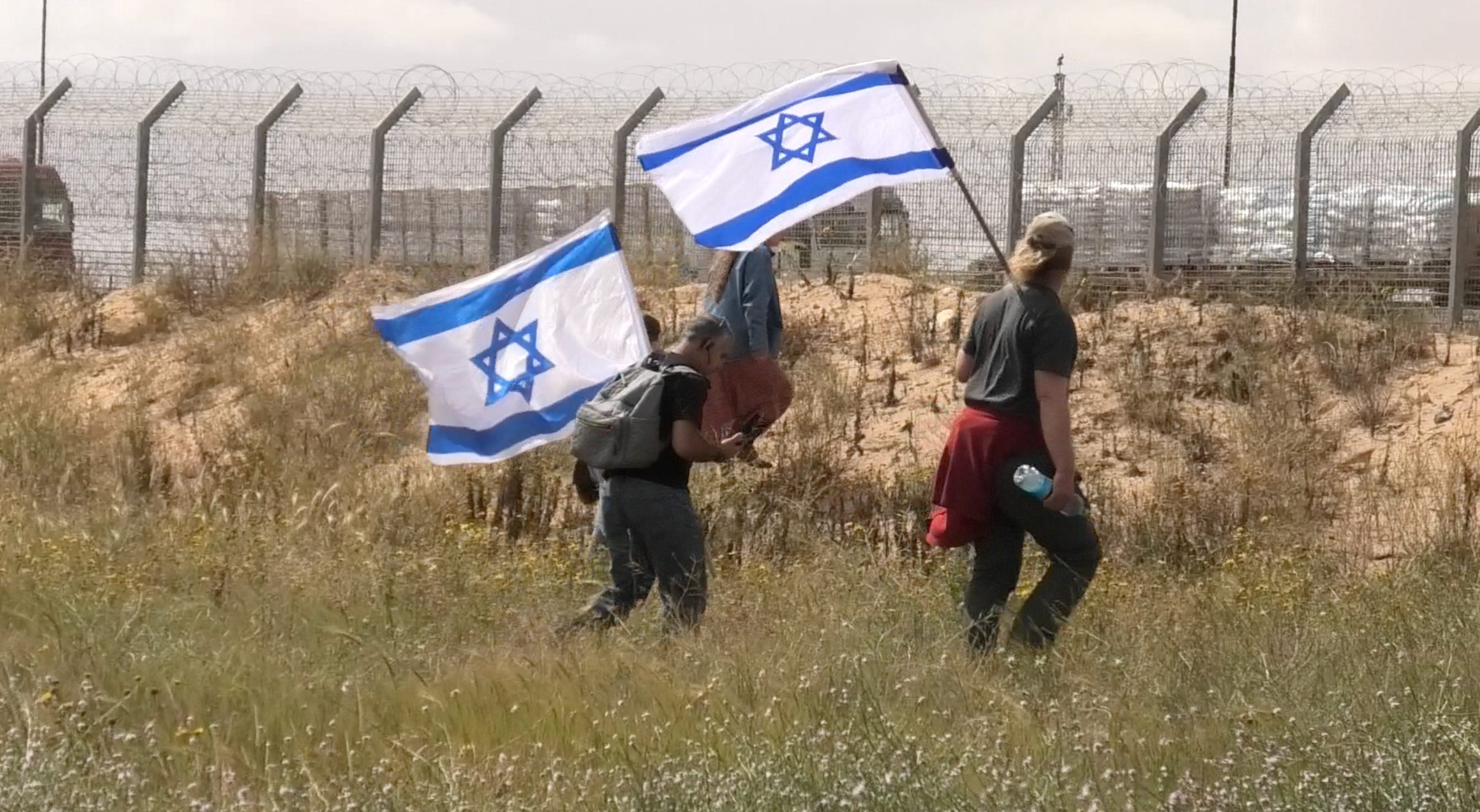
In April 2024, I accompanied Israeli settlers from Sderot into the northern Gaza Strip via the Erez checkpoint, where they established “symbolic outposts” and called for the full Judaization and resettlement of the territory.
In Ramallah, Bethlehem and East Jerusalem, I documented the ever more frequent late-night military raids. I interviewed recently released Palestinian detainees and reported on the worsening conditions inside Israeli military prisons—both of which the Israeli government has justified by referencing the events of October 7th.
These reporting trips ended in October 2024 when I was arrested by the Israeli military and incarcerated as an “enemy of the state” for factual reporting.
LOCKED IN THE LEVANT
I had two primary objectives for my trip back to Israel-Palestine in October 2024. During my time away, the conversation within Israel about resettling and Judaizing Gaza had shifted dramatically. Initially, this movement—led by settlers and right-wing civilians—had been dismissed by the Israeli government as a fringe effort. But by the time I returned, that pretense had disappeared. The same protests that had once been downplayed as marginal were now being held at the Gaza border with open support from members of the Israeli Knesset. The idea of resettling Gaza was no longer a radical position. It had become mainstream.
Previously, Israeli politicians and Knesset members weren’t able to openly advocate for turning the Gaza Strip into an exclusively Jewish Israeli enclave while still maintaining their international image as victims and framing their military actions as purely defensive. But that was changing.
My goal was to document how the resettlement movement had evolved. Tracking its shift from a fringe effort to a mainstream Israeli political cause. I planned to follow and embed with these groups, from their settlements to their demonstrations at various border checkpoints into Gaza.
The other item on my reporting agenda was the situation in the northern West Bank, specifically the Jenin Refugee Camp. This camp is home to Palestinians who were displaced in 1948, when they were forced to flee their homes in areas that are now part of Israel, such as Haifa. The IDF was currently in the process of raiding the camp. They had put the camp under a full siege for 10 days, shutting off all water, not allowing the delivery of food, destroying and digging up the roads, and even carrying out several airstrikes. To the Palestinians and reporters in the northern West Bank, it looked like Israel was opening up another front in their war.
The evening I arrived in Jerusalem to report on the resettlement movement and the violence in northern Gaza, I went to Ben Sira Cafe, a popular spot in West Jerusalem. Known as one of the more youthful and “liberal” cafes in the area, Ben Sira stands out for continuing to serve beer from Taybeh, a Christian Palestinian town in the occupied West Bank—even during wartime. In Israel, the bar for being considered liberal is remarkably low.
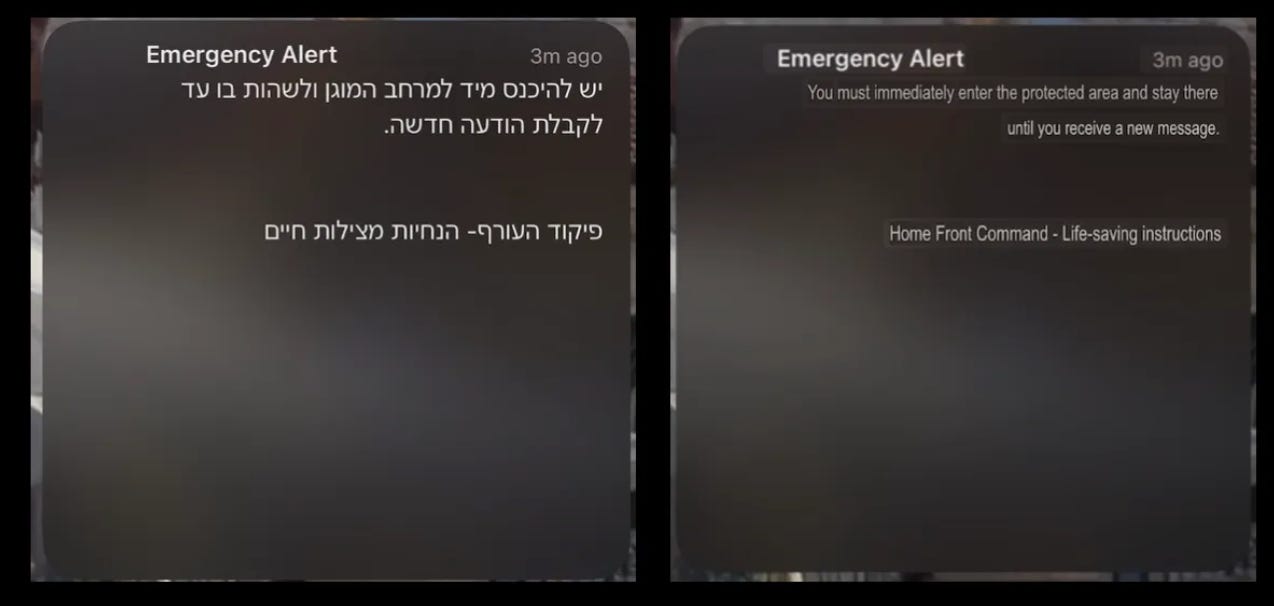
As I sat at the bar, everyone’s phones suddenly blared with the same urgent alarm—the kind you’d hear for an Amber Alert or a flash flood warning. A few seconds later, the outdoor missile sirens followed, a routine occurrence in Israel, sometimes going off multiple times a day. In Jerusalem, however, they’re less frequent due to the city’s proximity to one of the most holy sites in all of Islam, Al Aqsa Mosque.
The alert came to my iPhone at 7:30 PM and in Hebrew, it read: “You must immediately enter a protected area and stay there until you receive a new message - Home Front Command Life saving instructions.”
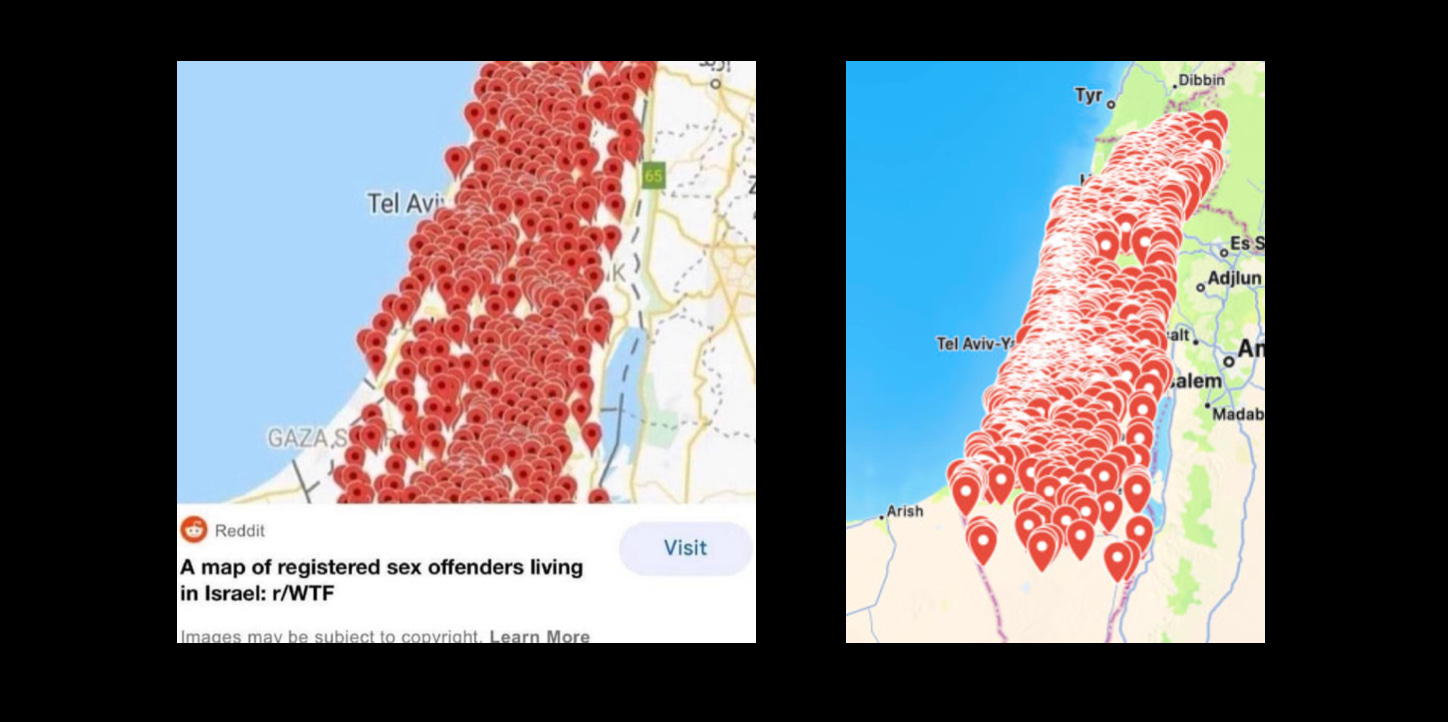
The young Israelis who were at the pub began passing around their phones and showing each other a smart phone app designed for Israelis to track where missile sirens inside of the country are activated. It puts the location pins on a map of the country. The map was entirely covered. The missile siren map looked similar to the viral meme photo that shows all of the registered sexual predators in Israel.
The barrage of ballistic missiles came in groups of 10 or 20, and made it look as though the sky was filled with massive fireworks, stretching from Jerusalem to Ramallah to Jordan. Videos from Gaza and the West Bank showed Palestinians celebrating the sight in the streets.
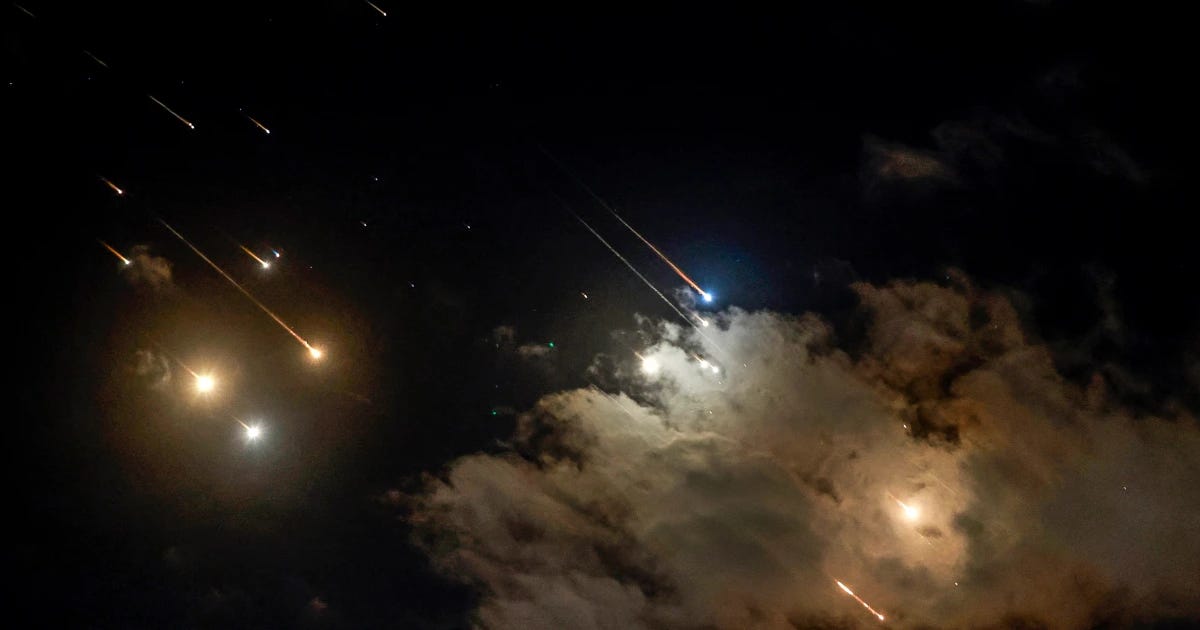
After about 15 minutes, the sirens began to quiet, and the intervals between the booming rocket sounds grew longer and longer. Once the missiles had stopped entirely, the IRGC (Iranian Revolutionary Guard Corps) released a statement claiming responsibility for the attack, offering their justification and assuring that the assault was over. Still at the pub, I saw the statement on Twitter immediately after it was published and went back to my hotel reassured that I wouldn’t be hit with any type of missile or shrapnel.
IRGC statement:
“Your sons in the Islamic Revolutionary Guard Corps, in accordance with the promises made by the officials of the Islamic Republic and military commanders, with the help of other armed forces, carried out the ‘Truthful Promise-2’ operation.
In this operation, several air & radar bases, as well as centers for plotting and planning assassinations against the leaders of the resistance, particularly martyr Ismail Haniyeh, martyr Sayyed Hassan Nasrallah, and the military commanders of Hezbollah, the Palestinian Islamic resistance, and IRGC commanders, were struck.
Despite this region being protected by the most advanced and dense defense systems, 90% of the strikes successfully hit their targets, causing the Zionist regime to be terrified of the Islamic Republic’s intelligence and operational dominance.
This operation was carried out within the framework of the right to legitimate self-defense and in accordance with international law, and any further foolishness by the enemy will be met with a destructive and regret-inducing response.”
The next morning, on October 2nd, I woke up and began reaching out to my contacts in Nablus, a city in the northern West Bank. Overnight, following the Iranian missile strikes, the Israeli army had launched a raid on the Balata refugee camp, located just outside the city. Soldiers stormed dozens of Palestinian homes, detaining ten young men and taking them to undisclosed locations. A firefight erupted between the military and Palestinian resistance fighters trying to defend the camp. According to the Jerusalem Post, four Israeli soldiers were injured in the clashes.
The drive from Jerusalem to Jenin (my planned final destination in the West Bank and then, the epicenter of Israeli military activity) was 96 miles. However, due to Israeli army checkpoints and arbitrary roadblocks, the journey would take over six hours for my Palestinian driver. Nablus is located roughly halfway between Jerusalem and Jenin, making it an ideal place to stay and work for a few days covering the occupation raids on Balata camp before continuing on further north to Jenin.
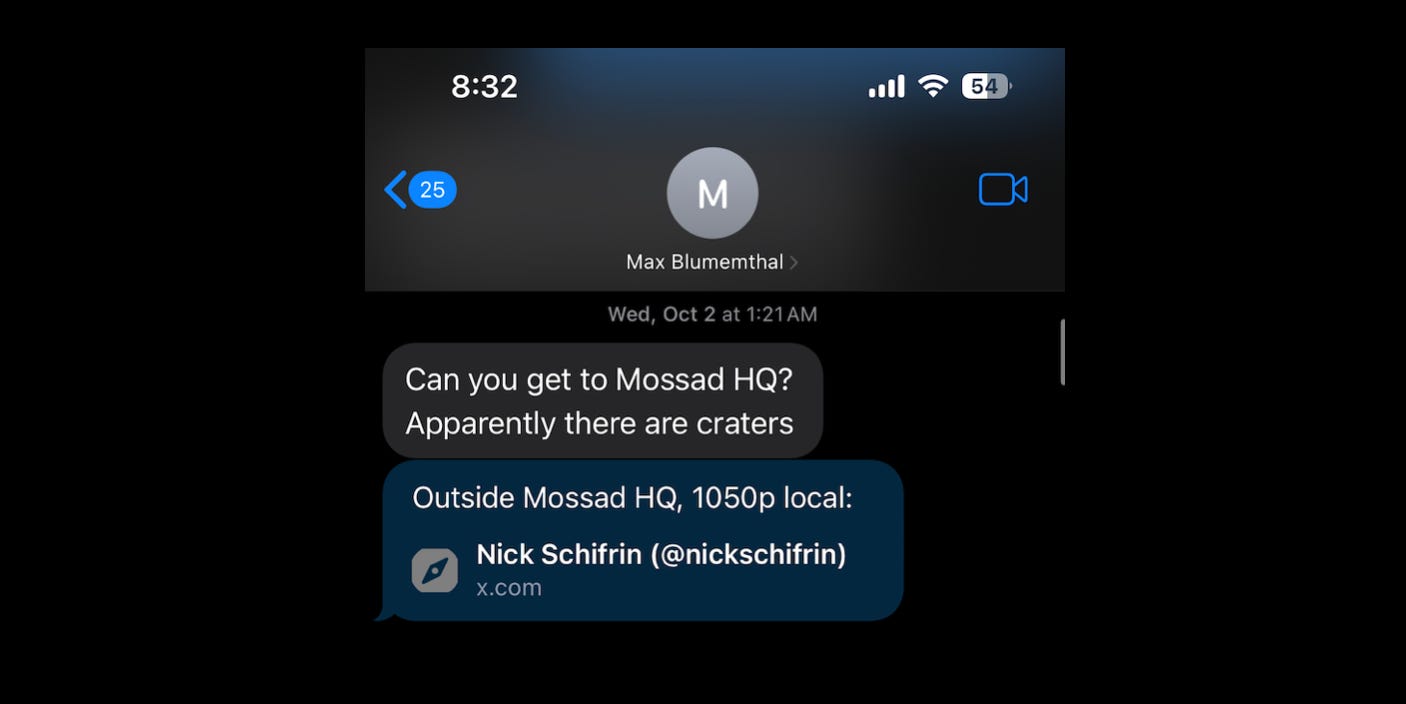
While in my hotel room organizing my journey, I received a text message from Max Blumenthal, the editor of The Grayzone, the publication I was on assignment for at the time. The message read: “Can you get to Mossad HQ? Apparently, there are craters,” along with a link to a PBS video report by journalist Nick Schifrin. After some research, it became clear that the Iranian missile strike had been more successful than originally reported. Not only had a rocket apparently landed in the center of Tel Aviv, but videos were also emerging online showing rockets making impact all over the Negev Desert in southern Israel, particularly near Nevatim airbase. Nevatim is Israel’s largest and most critical airbase, home to three squadrons of U.S.-supplied F-35 stealth fighter jets. These jets played a central role in Israel’s 16-month bombardment of the besieged Gaza Strip, as well as strikes against southern Lebanon, both of which were still ongoing at the time of my assignment.
The mission to document what appeared to be a new front in the war opening up in the West Bank was put on hold for a few days. A friend and colleague of mine, Jess Buaxbaum, a journalist in Jerusalem, connected me with a driver named Nab, who was willing to travel deep into the Negev Desert to search for missile impact sites. Nab was a Christian Jerusalemite who made his living as a tourist guide in the West Bank before the October 7th war began. Now there are no tourists, and so he’s making his living as a fixer of sorts, assisting and helping foreign journalists.
It was the morning of October 2nd, the day after the Iranian missile strike. It wouldn’t be for several more days until the U.S. and Israeli media would cover what had taken place in the Negev. In other words, the story was still fresh. Nab picked me up in a red Mercedes Sprinter van in Jerusalem and we began our two hour journey south in search of any destruction caused by Iranian missiles
We stopped for gas and bottled water in a small town outside Be’er Sheva, the largest city in the Negev Desert. Outside a grocery store, a group of Palestinian workers stood scratching off lottery tickets. In Arabic, Nab asked if they had heard anything about where the missiles had landed. They stopped talking amongst themselves, eyed us suspiciously and denied knowing anything.
It was unlikely that they hadn’t at least heard rumors, but for Palestinians, even casually sharing information—especially about something as sensitive as missile strikes—could be dangerous. If we were undercover police or informants, a simple comment could be seen as revealing intelligence. In a time of war and heightened suspicion, for Palestinians, staying silent is often the safest option. We got back in the car and continued south.
Eventually, we started seeing highway signs for Nevatim Airbase, and the road changed from being guardrail-free to a road lined with guardrails and a 15-foot-tall steel fence topped with barbed wire. The military base, which videos online showed being hit by rockets, was probably over a mile away from the highway, making it impossible to see any actual damage to the base itself. We spotted a few fighter jets landing almost entirely vertical prompting us to theorize wether or not the missile damage was forcing jets to land a way in which they don’t need to use the entire runway.
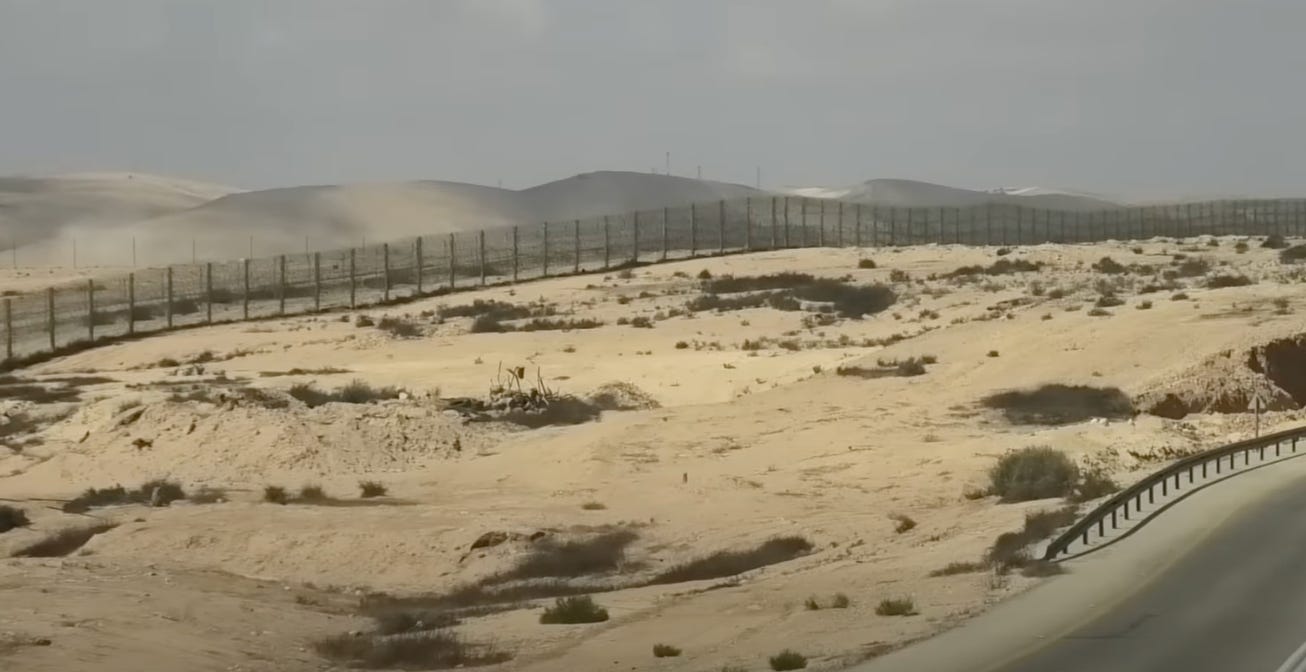
We made a U-turn and searched for any type of destruction that wasn’t inside inaccessible sensitive military zones. As we drove, we passed by small Palestinian Bedouin villages. Despite these Palestinians having Israeli citizenship, they’re forbidden from building permanent structures in their villages and face almost constant displacement and demolition orders from the Israeli authorities. Once the demolitions or displacements are successful, Jewish neighborhoods or apartment complexes are built.
We drove into a village and interviewed two Palestinian men. I asked if they heard the missiles, if they were scared during the strikes, if they felt safe — and lastly, if they happened to know where any of the missiles fell. At this point, after traveling so far, I selfishly just wanted to see a missile with my own eyes.
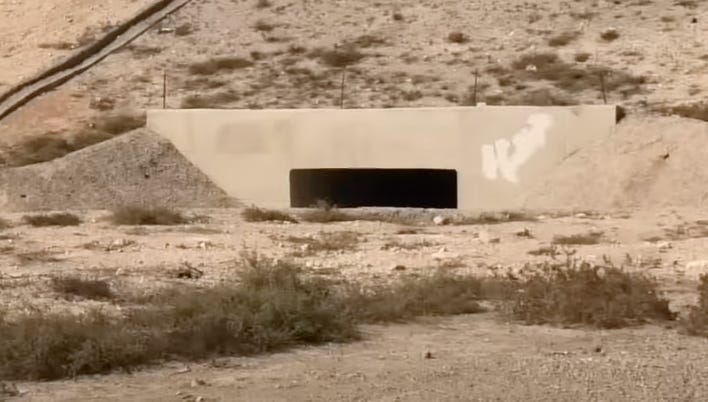
The Palestinian men explained that the missile impacts were like an earthquake — they didn’t just hear the missiles, they felt them too. Because the Bedouin village is “unrecognized” by Israel, they don’t have bomb shelters or secured rooms like those you’d find in every other Israeli development, apartment complex, hotel or shopping center. Instead, they took me to the places where the women and children from their village took cover: an overpass on a nearby highway and the entrance to flood water drain, about 5 feet in width and 2 feet in height.
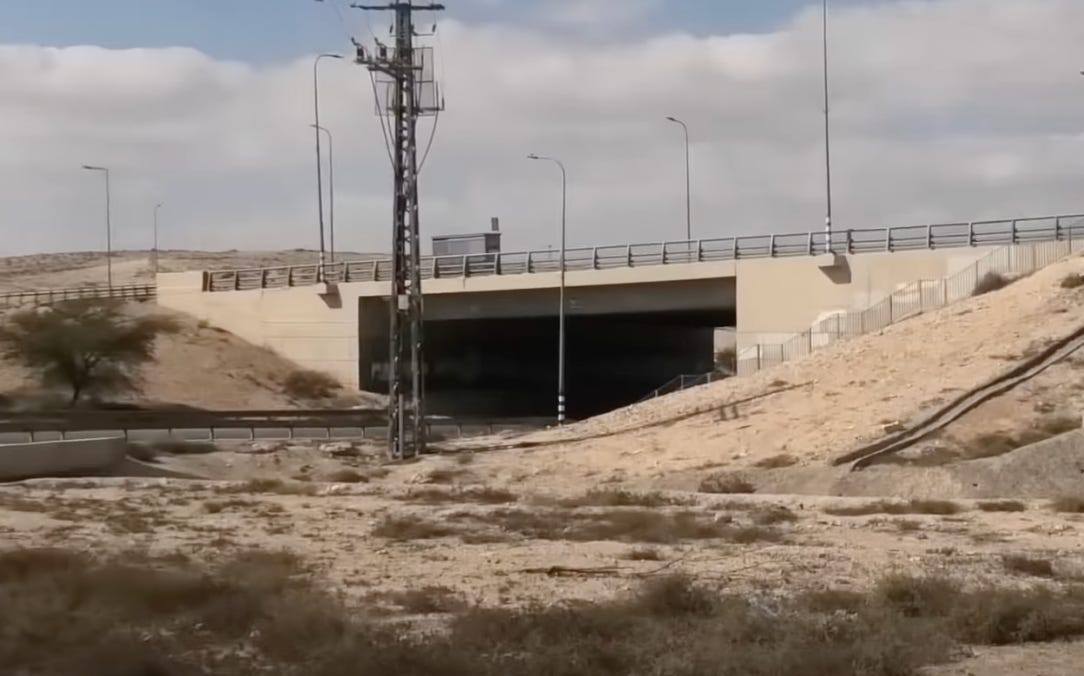
After some convincing, the two men agreed to take us where a missile made impact. We followed their car for about 5 minutes to a location about half a mile behind their village and a half mile from Nevatim Airbase. Only the bottom portion of the missile was still in tact. The rest of the missile was in shrapnel inside of a crater a few meters to its left.
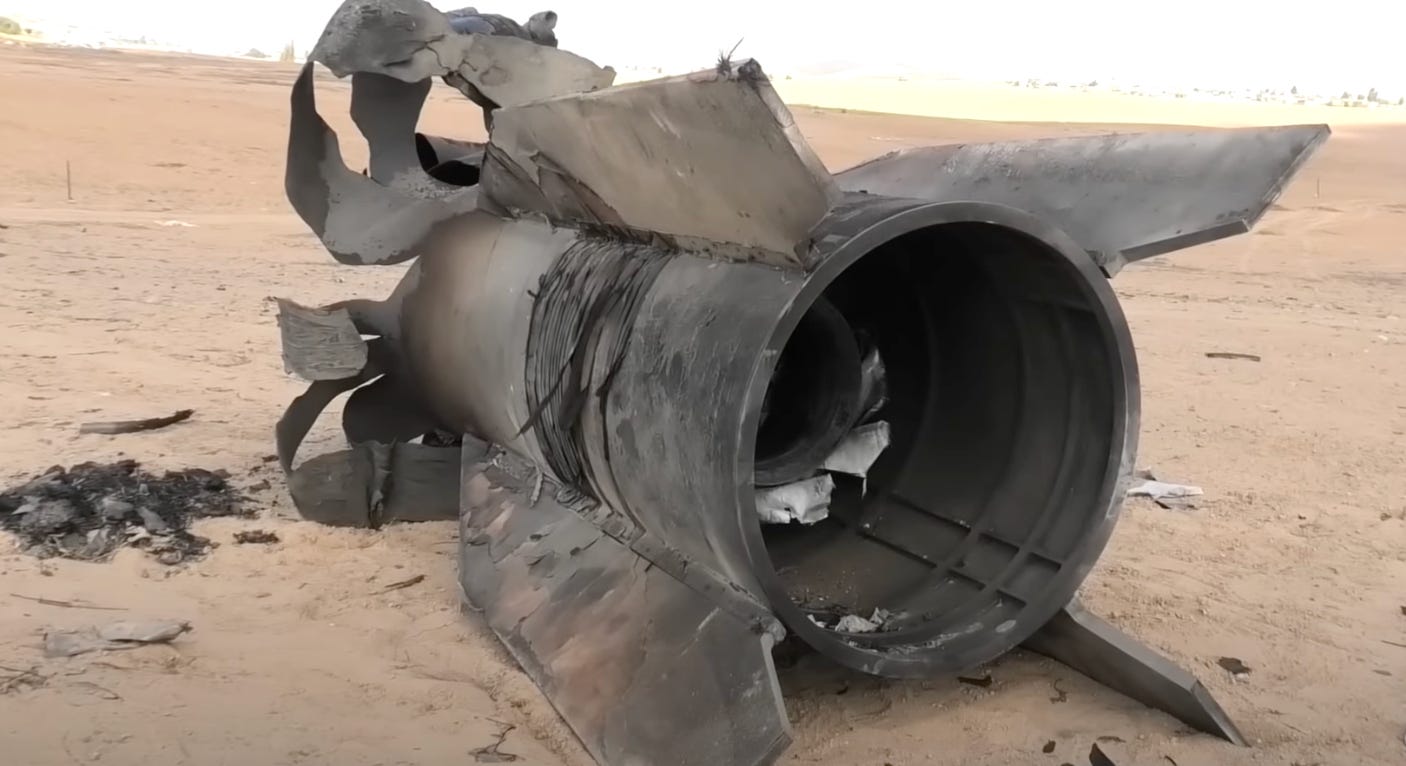
Although I wasn’t able to document any deliberately hidden destruction of Israeli civilian or military infrastructure, I did manage interview Palestinians about one of the most serious attacks against Israel since the war began. And I documented how Palestinians in the Negev, despite being Israeli citizens, are not protected by the state [because they’re not Jewish] and face active discrimination, forcing them to take cover from life-threatening ballistic missile attacks in places like sewers and underpasses.
To get to the Negev, Nab avoided driving through the West Bank as it would have taken much longer. On the way, Nab took me though the entire bottom half of the West Bank straight up to Jerusalem. He said that he wanted me “to see how bad the situation had become.”
The week before, a Palestinian from Hebron shot several people at a train station in Jaffa, an area just south of Tel Aviv. In retaliation, the Israeli military had placed all of Hebron under strict lockdown. Concrete road blocks and army trucks were blocking off the entrances to entire neighborhoods and villages, forcing Palestinian men, women and children to walk instead of drive. Soldiers shut down cafes and shopping centers and were patrolling with full military garb and rifles in hand, patting down and asking for the identification card of anyone and everyone. I witnessed this collective punishment military lockdown through the window of the Nab’s car.
When I returned to Jerusalem, I reviewed the footage and interviews. While it was good, I felt it wasn’t quite enough to complete a report about the Iranian missile strike.
A PBS Newshour report by journalist Nick Schifrin showed a massive crater just a few thousand feet from the headquarters of Israel’s spy agency, Mossad. Israeli media wasn’t covering any missile impacts in Tel Aviv, but this video clearly showed that missiles had, in fact, hit Tel Aviv. I thought there might be more to than that single impact in Tel Aviv to uncover. Even if there wasn’t, documenting the single missile impact in Tel Aviv firsthand could be enough to complete my Iranian missile report. And then I could move on to what I had originally come to Israel to report on: Jenin and the push for resettlement in the Gaza Strip.
Nab had dropped me off at my hotel just 30 minutes ago but I called him again and asked if he would drive to Tel Aviv. He reminded me that Tel Aviv is a giant city, he didn’t know where the Mossad building was and that going to Tel Aviv to look for missile impact sites without an specific destination could take an entire night or even several days.
I hung up the phone and Googled “Where is the Mossad HQ?” At first, the search results only told me Tel Aviv, which I already knew. After some more clicking around, I got the name of a neighborhood: Herzliya. I told Nab that we’d start there. He gave me a price and came back to my hotel to pick me up. As we neared that area in Tel Aviv where the internet had told me the Mossad building was located, I realized that it was just another part of a vast city, and a specific building could be anywhere.
In the passenger seat of Nab’s car, I rewatched a few videos that had surfaced online showing someone in Tel Aviv recording a missile in the air before it made impact. As I watched, I noticed large, illuminated unmistakable numbers on a skyscraper. Looking up the road, I saw the same building in the distance. We drove towards it and spotted an entirely destroyed Toyota SUV covered in concrete dust and rubble. Not long after that, the scene began to come together.

The road didn’t appear to be closed, but curiously, it was completely empty. Perhaps other entrances to the road were blocked off elsewhere. The massive 30 by 30 foot crater had been filled in with dirt, but large slabs of concrete, which had once made up the street, were scattered on top of the bus stops and windshields of vehicles up to 50 feet away. My first impression was that it was strange the site hadn’t been fully cleaned up yet, especially since it had been over 24 hours. There was a sort of haunting feeling being the only person at this site, despite being in the middle of a city.
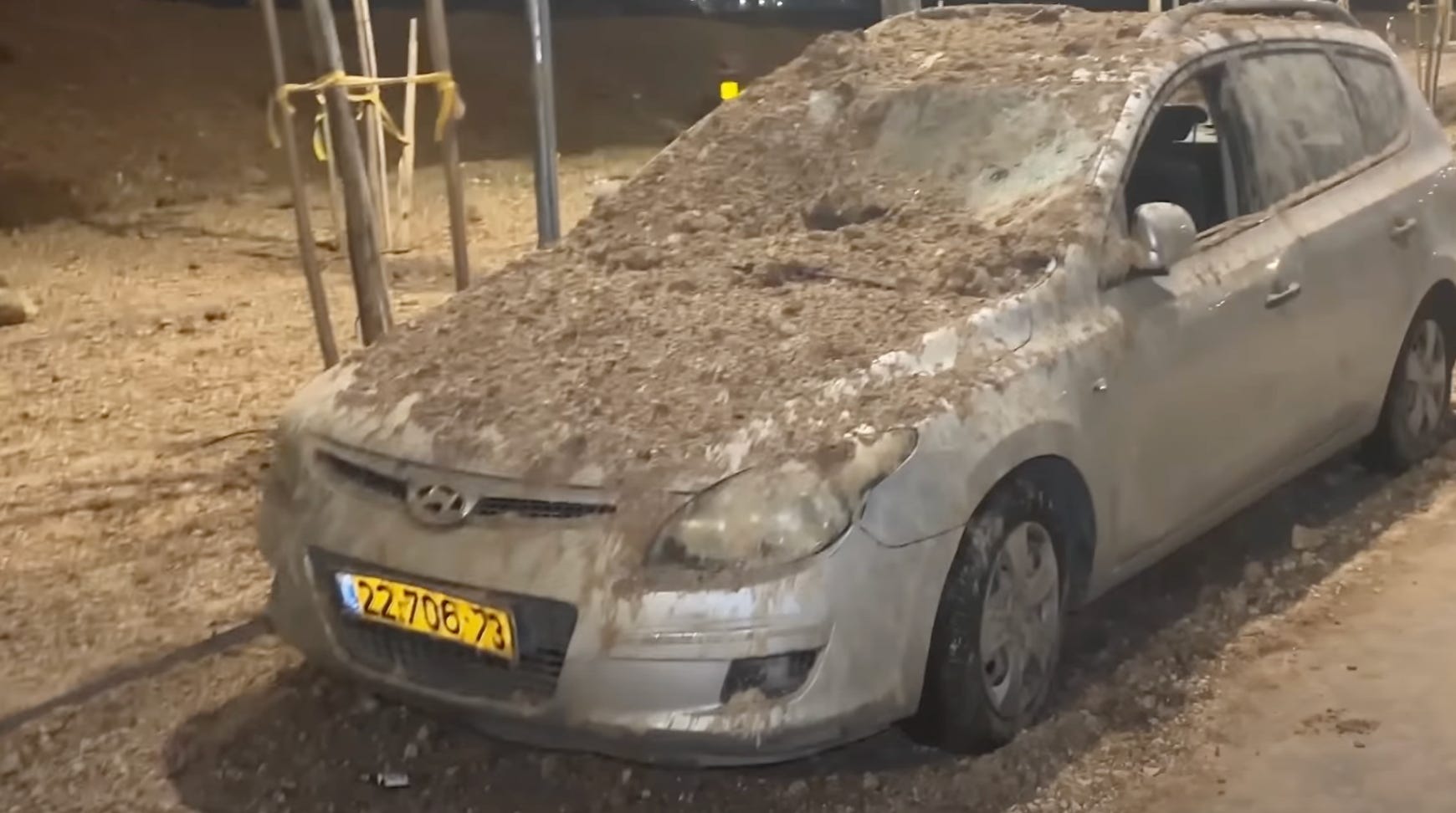
A white, ominous-looking building with frosted glass windows stood about a thousand feet behind the impact site. “That’s the Mossad headquarters,” Nab told me. I took a screenshot of my location on the map as I stood next to the missile crater, saving the coordinates, which hadn’t been published by the media yet. The only information about the missile impact and its proximity to the Mossad building had been information in Nick Shifrin video. But curiously, his video never aired on TV or even the PBS website. The video could only found on his Twitter account with all PBS branding, lower thirds and bugs entirely absent.
On the drive back to Jerusalem, both Google Maps and Apple Maps malfunctioned, showing my location as being at Queen Alia International Airport, more than 100 miles east. This glitch was also affecting Nab’s phone, also showing him inside the Jordanian airport. Thankfully, as a former tour guide, Nab knew the route between Israel’s two largest and most important cities. Nonetheless, the fact that our cell phones were both affected in the same exact way directly after being near the Israeli intelligence building was unsettling.
Despite not locating, or even attempting to find other Tel Aviv missile impact sites that evening, I had gathered original documentation of not only one but two locations inside of Israel where Iranian missiles had made direct impact in close proximity to vital military and intelligence centers Nevatim airbase and the Mossad HQ. It was enough for a report.
The next day, I stayed in my hotel, writing and editing the videos and interviews I had gathered. The report was uploaded to YouTube a few days later, on October 5th. By then, both Israeli and international media had been reporting on the destruction caused by the attack at the Nevatim Airbase, with real-time satellite images showing the damage. This made that part of my report less exclusive, especially considering I hadn’t documented any actual destruction of the base and only located a single missile that missed its target. However, even days later, the PBS Newshour report was still the only report besides mine that documented any missile impacts in Tel Aviv.
With the missile report completed, filed and published, I could finally focus on the reporting I had originally come to do. First, in order to spend time in the northern West Bank camps that were actively being raided and attacked by the military, I needed to get my hands on a bulletproof press vest. A journalist I had met a few months earlier in Bethlehem gave me the number of a man in Jerusalem who rents out press vests. With all the military activity in the West Bank, his business was likely one of the few in the country thriving, as journalists were practically the only tourists. The vest renter told me he wouldn’t have any available vests for me for another two weeks.
Theia Chatelle, an American journalist with The Intercept, connected me with a reporter based in the Tulkarm refugee camp in the northern West Bank. The reporter agreed to lend me a bulletproof press vest. Since Tulkarm was only 15 miles from Nablus and the Balata refugee camp—my intended first stop before heading to Jenin—I planned to pick the vest up along the way.
I had been in contact with about a dozen Palestinian reporters based in Nablus and Jenin. Many of them extraordinarily generous with their time, offering to take me around the refugee camps where I could document the destruction caused by recent Israeli military activity and interview the besieged residents.
One of my goals was to interview resistance fighters in the camps, and it was becoming increasingly likely that I would have the opportunity to do so. A colleague of mine, based in Ramallah—the de facto Palestinian capital—was running a small but highly informative Twitter account that posts updates and videos about fighting and Israeli military activity in the West Bank. They were in the process of connecting me with young Palestinian men involved in armed resistance in Jenin Camp, known as the Jenin Brigade. These fighters are known to be extremely secretive and cautious. Gaining access to them would be a huge achievement for an American journalist, but it also carried significant risks, especially since many of the recent airstrikes in the northern West Bank had been aimed at “eliminating” members of these armed resistance groups. The frequently used Israeli military tactic of blocking all water and food from entering the camp was a sort of punishment for the fighters and those who aided and supported them.
I had my bulletproof vest reserved and several important connections in Nablus and Jenin. The only thing left to figure out was how to get up there. The vest was in Tulkarm, I had reporting to carry out in Nablus and the nearby refugee camps and then I needed to make my way up to Jenin. One of the journalists I was in touch with in Nablus offered to travel with me to Jenin once I reached Nablus. So now, all I had to do was get to Tulkarm for the vest and then get to Nablus.
Andrey Khrzhanovskiy, who on the internet goes by the name AndreyX, is an Israeli activist and journalist who normally travels around the West Bank and posts TikTok’s about state-backed settler violence against rural Palestinian villages. On Twitter, I had seen a video posted from AndreyX inside a cafe in the north that had been targeted in an airstrike. We had a few mutuals and I asked if I could tag along with him next time he went up there. He enthusiastically agreed and told me to meet him and his two friends at the central bus station in Jerusalem and we’d head north. A WhatsApp group chat “Journey to the North” was created for all of us to communicate.

My plan was to travel with the group to Tulkarm to retrieve my press vest and then to Nablus, where I would meet my Palestinian contacts before continuing my work and journey on my own.
I preferred to do most of my reporting independently because I didn’t feel comfortable navigating these exclusively Palestinian cities and refugee camps alongside a group of Israelis. Regardless of their political beliefs.
Our first destination was Tuwani, a Palestinian village located about an hour from Jerusalem. Once we arrived, we planned to spend the night in a nearby village and then travel north early the following morning.
We met at the Jerusalem bus stop around 1PM on October 7th. As we boarded, there was plenty to talk about, but they advised me to stay quiet for safety reasons. The bus we were taking was a settler bus—an express route that goes directly to a West Bank settlement. In this case, it was heading to Kiryat Arba, one of the most extreme and violent settlements in the West Bank. Its most notorious resident is Itamar Ben-Gvir, the messianic far-right politician who serves as Israel’s national security minister. He resigned from the government in protest of the January 2024 Gaza ceasefire—only to rejoin the government once the war resumed.
Kiryat Arba’s entrance was guarded by civilian soldiers with rifles. Our quartet was able to walk right pass them because the soldiers were only there to “secure” the settlement from Palestinians whose land they stole in order to build their homes. Everyone in our group of four besides me was Israeli. We stood around the entrance and began to discuss our plan as we waited for a friend to pick us up in his car and take us to Tuwani.
The drive from the settlement to Tuwani took about 15 minutes. When we arrived, a few Palestinian women, whom I had met a few months earlier while reporting on settler violence in nearby Hebron, warmly greeted us. One of the women had recently had a baby. We all greeted the baby, sat down, and enjoyed some tea.
About an hour before dark, the four of us split into two groups. Andrey and Sofia went to one village for the night, while Meir (the other Israeli) and I went to a different village. The village we visited was in an incredibly difficult situation. Originally home to a few dozen Palestinians, many of the villagers had gradually moved away over the years, relocating to larger Palestinian cities for work. Now, only two people remain: an elderly married couple who survive by breeding, selling and eating chickens and goats.
Violent Israeli settlers nearby are fully aware that this elderly couple is the only thing standing between the land and a complete takeover. Once the village is abandoned, the settlers will move in, demolish the village, and build another Jews-only settlement.
Settlers often come to the village late at night, sometimes killing a goat or a few chickens, setting fires, and threatening the elderly couple, demanding that they leave the land. To help provide security, young Israeli leftists sleep at these villages overnight. This form of activism is known as “protective presence,” as Israeli settlers are less likely to attack Palestinians when Israelis or internationals are present.
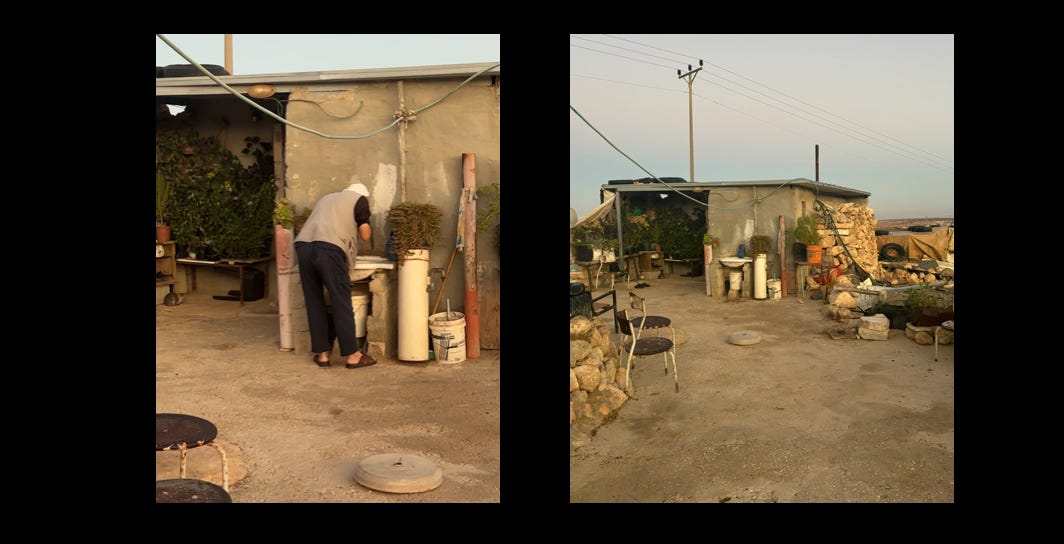
Meir and I spent the night in the village, and in the morning we were kindly offered bread, olives, hummus, and coffee for breakfast. As we ate, Andrey and Sofia arrived to pick us up.
In the driver’s seat of the car that would take us to Tulkarm and Nablus was Hussein Hureini, a 35-year-old Palestinian activist who agreed to drive us. He told us we needed to leave as soon as possible because the drive north would take the whole day. Hussein estimated the trip would take about five hours, not including any unexpected roadblocks or long delays at military checkpoints. I sat in the front passenger seat.
The first couple of hours of the drive were on roads that could barely be considered roads. They were winding and unpaved. At one point, the only route open to Palestinian cars was a path over mountains of sand. Cars took turns attempting to climb the hills to reach the road. Some slid back and failed, forcing them to turn around and abandon their trip north.
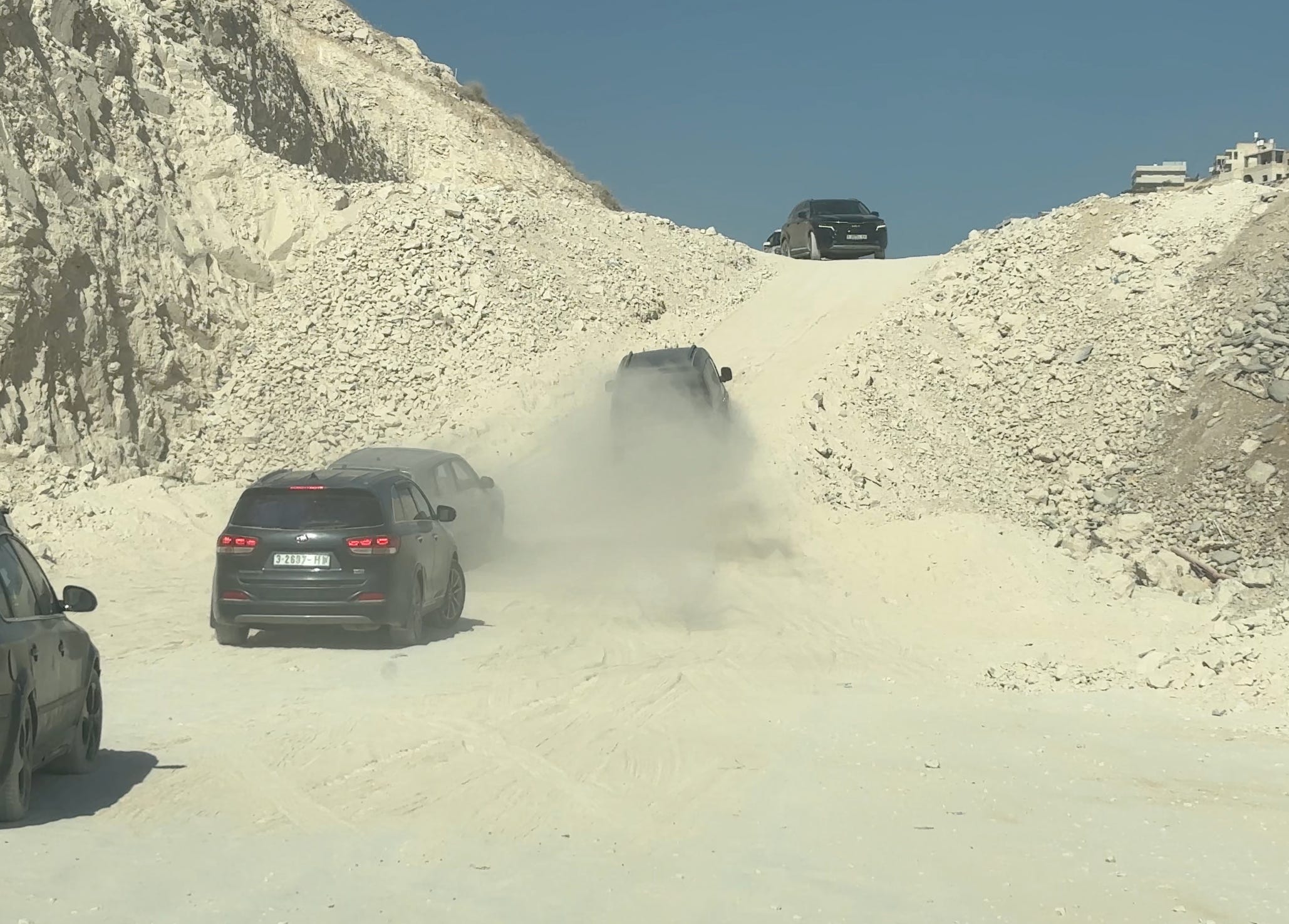
As the sound of Palestinian dance music played on Hussein’s radio and we sipped our gas station coffees, Andrey, Sofia, and Meir were behind me in the car discussing the potential problems they [but not me] could face.
Of course, there were the obvious risks of being in what some consider an active war zone, where airstrikes are regularly carried out against the very same civilian population we planned to engage with and stay among. But the more immediate concern for them was the possibility of encountering or being questioned by the military on our way north.
Our destinations were in a region of the West Bank where Israeli authorities have strictly prohibited Israelis from entering. If an Israeli is caught, they can be arrested or, at the very least, ordered to return to Israel. Fortunately for Andrey and Meir, they both hold dual citizenship, which could help if we were stopped by the military. They would just show their other passport. Andrey is a Russian citizen (having moved to Israel to escape political persecution against “anti-Putin/ pro-democracy” activists), and Meir, besides being an Israeli citizen, also holds a Canadian passport.
It wasn’t as simple for Sofia. She didn’t have citizenship in any country other than Israel. She had purposely left her passport behind to avoid being caught with it. Since she spoke perfect English, her plan, if questioned, was to claim she was an American citizen and present her student ID from Cooper Union, an expensive university in New York where she was currently enrolled. The only risk for me came from being with the Israelis. If we were stopped and asked to turn around, it would mean I wasted two entire days. Inconvenient but not the end of the world.
As we drove, we were stopped at a number of informal military checkpoints — just an army truck or two in the middle of the road. Considering we weren’t in a prohibited area yet, the Israelis [two of which were young women] were able to use their “Israeliness” to pacify the soldiers.
The drive was taking much longer than we had planned. The others convinced me that there were people in Nablus who could lend me a bulletproof press vest, and that stopping in Tulkarm to get my vest would add several hours or more to our trip, not just the 45 minutes we had originally thought. I messaged some contacts in Nablus, and they were confident I could get a vest from someone there. So, we decided to head straight to Nablus, where I planned to meet a Palestinian journalist contact who would take me to the Balata refugee camp.
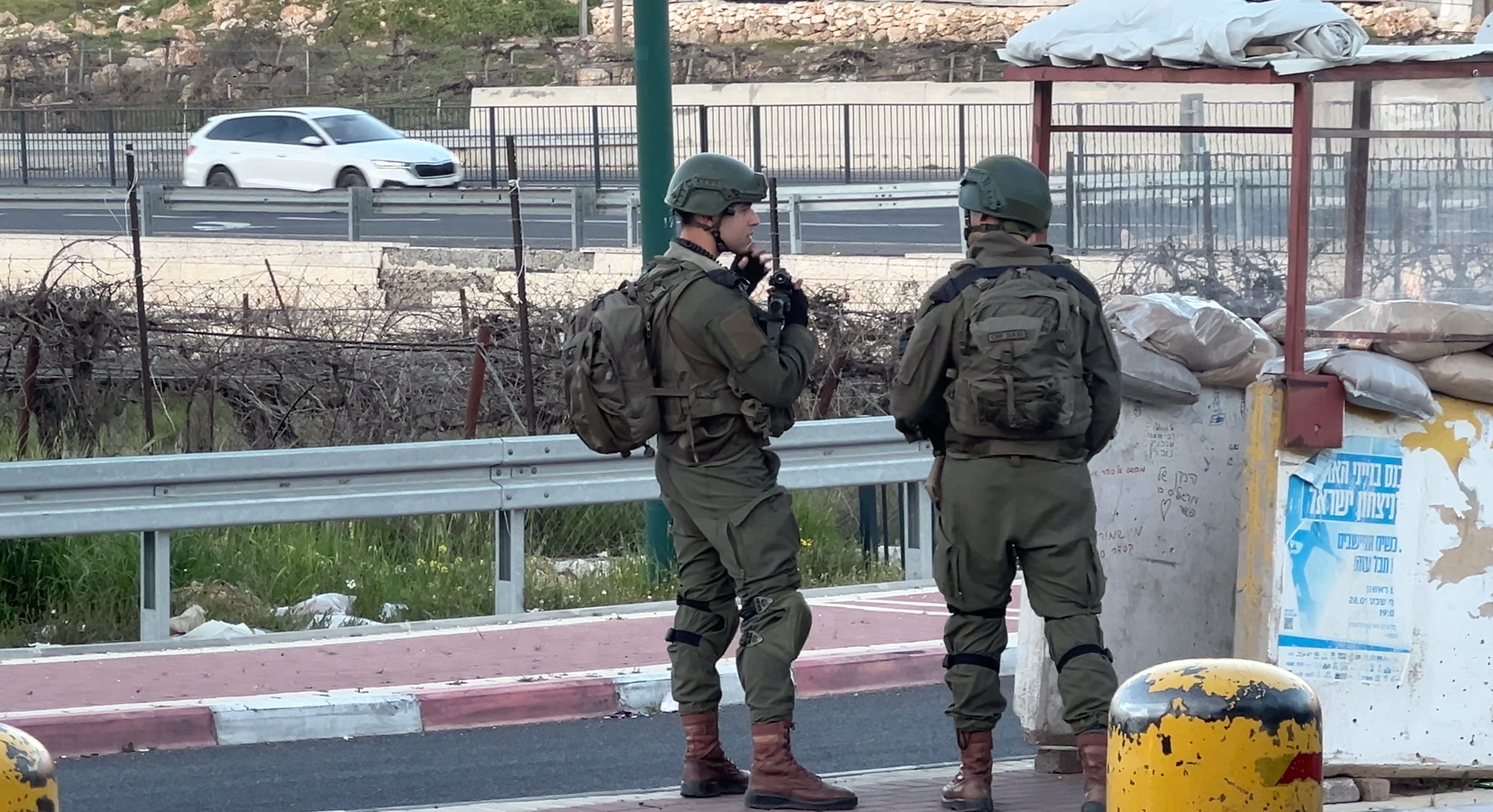
We arrived at a more formal military checkpoint, marked by concrete barriers and manned by about seven or eight fully armed Israeli soldiers. By this point, we were far enough north where the only cars passing through the checkpoint were Palestinian. The soldiers had their rifles aimed at the section of the road where cars were required to stop — or in other words, the rifles were pointed directly at the Palestinians as soon as they stopped at the checkpoint.
The line to get through the checkpoint was a couple dozen cars in length, moving so slowly that at one point, Meir and Sofia got out of the car and picked a few figs from a nearby fig-tree. As I observed how the checkpoint operated, it was clear that the soldiers dealt with the Palestinians in a few distinct ways. The most common interaction was for the soldiers manning the checkpoint to aim their guns at a car and tell the driver to pull over. They ask the driver a few questions, check his ID, and then let the car pass. The second approach was to stop the car, check the driver’s ID, and then force the driver to turn around, not allowing them to proceed through the checkpoint. The third, rarest outcome, was when the soldiers would simply wave the car through without stopping or checking any papers. Cars with younger to middle aged men were almost always stopped for longer periods of time or turned around completely.
When it was our turn to pass through the checkpoint, the soldier immediately ordered Hussein to pull over to the side. Hussein complied, and the soldier then instructed us to roll down all the windows and then told Hussien to remove the key from the ignition. The soldier’s English was just as good as mine — he was certainly American.
The soldier asked Hussein where we were going, and he replied, “Nablus.” The soldier then asked where we were all from. Hussein told him he was from Yatta, a rural area in the South Hebron Hills. I said I was from New York, Sofia said the same, and Andrey and Meir each told the soldiers what they had originally planned: Russia and Canada, respectively. The soldier walked away with Hussien’s Palestinian ID card.
We were pulled over to the side for about 20 minutes until the soldier returned and asked for all of our passports. He already had Hussein’s, and since I was sitting in the passenger seat, he asked for mine next. “American? What are you doing here?” he asked. I told him I was a journalist, and he asked which publication I worked for. I explained that I was independent and handed him my press card along with my passport. He took everyone’s passport except Sofia’s, as she was only carrying her New York student ID — and walked back to where the other soldiers were stationed.
The atmosphere in the car shifted from calm to tense, but not for me. Among the four journalists in the car, I was the only one being completely honest about my identity and nationality. I was also the only one, besides our Palestinian driver, who was allowed to enter Nablus.
The soldier was gone for another 30 or 40 minutes, which we all thought was curiously long. Through the back windshield, we could see the soldiers examining our IDs and making phone calls, likely to their superiors. Seeing this, I immediately made my social media accounts private. I also deleted the WhatsApp and Telegram apps from my phone, as that was how I had been communicating with my Palestinian contacts about meeting with resistance fighters.
The soldier made his way back to the car. “Okay, I’m going to need everyone’s phone,” he said, directing his attention first to Hussein. He handed over his phone without hesitation. Then, he turned to the girls, who also complied. When he asked Andrey for his phone, Andrey refused.
The soldier reached into the car to take it from him, but Andrey extended his arms away from the window, out of the soldier’s reach. The soldier struggled with Andrey for a few seconds, trying to wrestle the phone from him through the open window. Then, in a swift move, he pointed his rifle directly at Andrey’s face, opened the car door from the inside, and forcibly dragged Andrey out of the car, throwing him onto the ground and taking the phone from him. The soldier handed the phone to another solider who took it back to the opposite side of the street where the checkpoint outpost was situated.
Then the soldier came up to my window. “Phone?” he asked. I asked why he was taking my phone, considering Americans are fully allowed to travel to Nablus and I had already provided all of my legitimate papers and ID. “You’re right. You’ve given me all the right stuff…” He paused for dramatic effect. “But I’m still going to need your phone.” I handed it to him.
About 20 minutes later, the soldiers called out from across the street, asking each of us for the passcodes to our locked phones. We all refused. Shortly after, we were ordered to get out of the car and sit on the side of the checkpoint road so the soldiers could search the vehicle. As we sat there, several soldiers aimed their rifles at us. While we were on the ground I wasn’t very nervous. I knew I hadn’t done anything wrong. I watched as the soldiers harassed Palestinians trying to drive out of Nablus. They randomly checked their papers, checked their phones, patted them down, refused to let them leave their own city, shouted and laughed at them. It was a good representation of what Israeli occupation in the West Bank looks like.
While sitting on the ground in the sun, Hussein was sweating profusely and actually having trouble keeping his eyes open. The others called out to the soldiers and asked if Hussein could at least move to the shade. The soldiers refused to allow it. “Vitamin D is healthy for you!” They yelled while laughing from across the street.
The soldier with an American accent called out from across the street, “Loffredo, let’s go!” I stood up and slowly walked across the street with my hands half-raised, as some of the rifles were still pointed at our group. He told me to put my hands behind my back. I asked why, and he replied, “Because you’re under arrest.” I asked again, “Why?” He answered, “Intelligence.”
In a matter of a few seconds they had zip-tied my hands together, shackled my feet together and then wrapped at least twenty feet of white fabric around my head, blindfolding me and covering my ears. The cloth was tightly wound around my head at least 10 or 15 times.
They called out everyone else’s names and did the same to them. I had only ever seen this tactic of blindfolding before arrest used against Palestinians—not journalists, especially not Americans or Jewish Israelis.
While blindfolded, shackled, and handcuffed, we were guided into the back of an IDF Humvee, except for Hussein, who appeared to be dealt with separately. The steel door was shut, and we were driven for what felt like 5 or 10 minutes. When the Humvee stopped, we remained blindfolded in the back for another twenty minutes. Then, we were guided out, walked about fifteen feet, were guided up a few stairs, and were told to sit on another floor and not speak to each other.
After the soldiers left us, Sofia explained that we were in a small, makeshift room made of sheet metal—essentially a temporary military office somewhere in the West Bank, not far from where we had been taken from. These tiny outdoor military structures are known as “pill boxes.” We asked Sofia how she was able to see, and she quietly told us that she had cried and spoken to the soldiers in Hebrew, convincing them not to blindfold her.
I later learned that we had been taken to an Israeli outpost called “Hasela,” near the Israeli settlement of Yitzhar. The blindfold cloth wrapped tightly around my head was so constricting that the skin around my forehead, ears, and scalp began to go numb. I couldn’t even tell if my hat was still on, and since my hands were cuffed, I couldn’t touch my head to check. When I asked Sofia, she told me that my hat wasn’t there anymore. The triviality of my question prompted Andrey and Meir to let out nervous giggles.
We sat blindfolded and shackled on this floor for a good hour before Andrey and I were moved into the second row of seats in an SUV. Andre had the window, I was in the middle seat and next to me was an Israeli soldier. There were two soldiers in the front, one driving and one in the passenger seat. They told us in broken-English that no speaking was allowed. The soldiers turned a 3-hour drive into an 1.5 hour drive by speeding and taking roads the military could use.
Being blindfolded, with my ears obstructed and the constant movement of the truck, along with soldiers chatting in a language I didn’t understand, surprisingly made me sleepy. I drifted in and out of consciousness, occasionally leaning too much on Andrey, who was to my right, and at other times, leaning too much on the soldier to my left. Being forcibly rendered blind and partially deaf, then transferred by the military to an unknown location, is widely recognized by human rights experts as a form of detainee abuse.
The car slowed down for a few minutes and then eventually stopped. We got out of the car and the soldiers removed our handcuffs and told us that we could unwrap the blindfolds from around our heads. The shackles stayed on. It took a few seconds for my eyes to adjust to the light. It was now probably around 6pm. My ears were sore for the next hour or so. I looked around as much as I could, but it was only a second or two before we were taken inside. We were in the back parking lot of what seemed to be a highly secure military compound, situated on a hilltop in a remote area. The entrance road wound up the hills below and the entire compound was lined with concrete walls. In the distance, about a thousand feet away, I could make out what appeared to be an Israeli settlement perched on a neighboring hilltop.
Andrey and I were escorted through a door, down a long hallway, and into a holding cell. They took our belts, our shoelaces, and my necklace. Once the officers left us alone, Andrey and I were finally able to speak. He told me he believed we were about 30 minutes east of Jerusalem, near the Israeli settlement of Ma’ale Adumim.
Andrey turned out to be correct. The settlement on the neighboring hilltop was indeed Ma’ale Adumim, a large Israeli settlement in the Occupied West Bank founded in 1975 as a military outpost and then later developed into a civilian community. The settlement is surrounded by the Judean Desert and the foothills of Mt. Scopus. We were across the highway at the West Bank headquarters of the Israeli Police, also known as the “Shai Compound.”
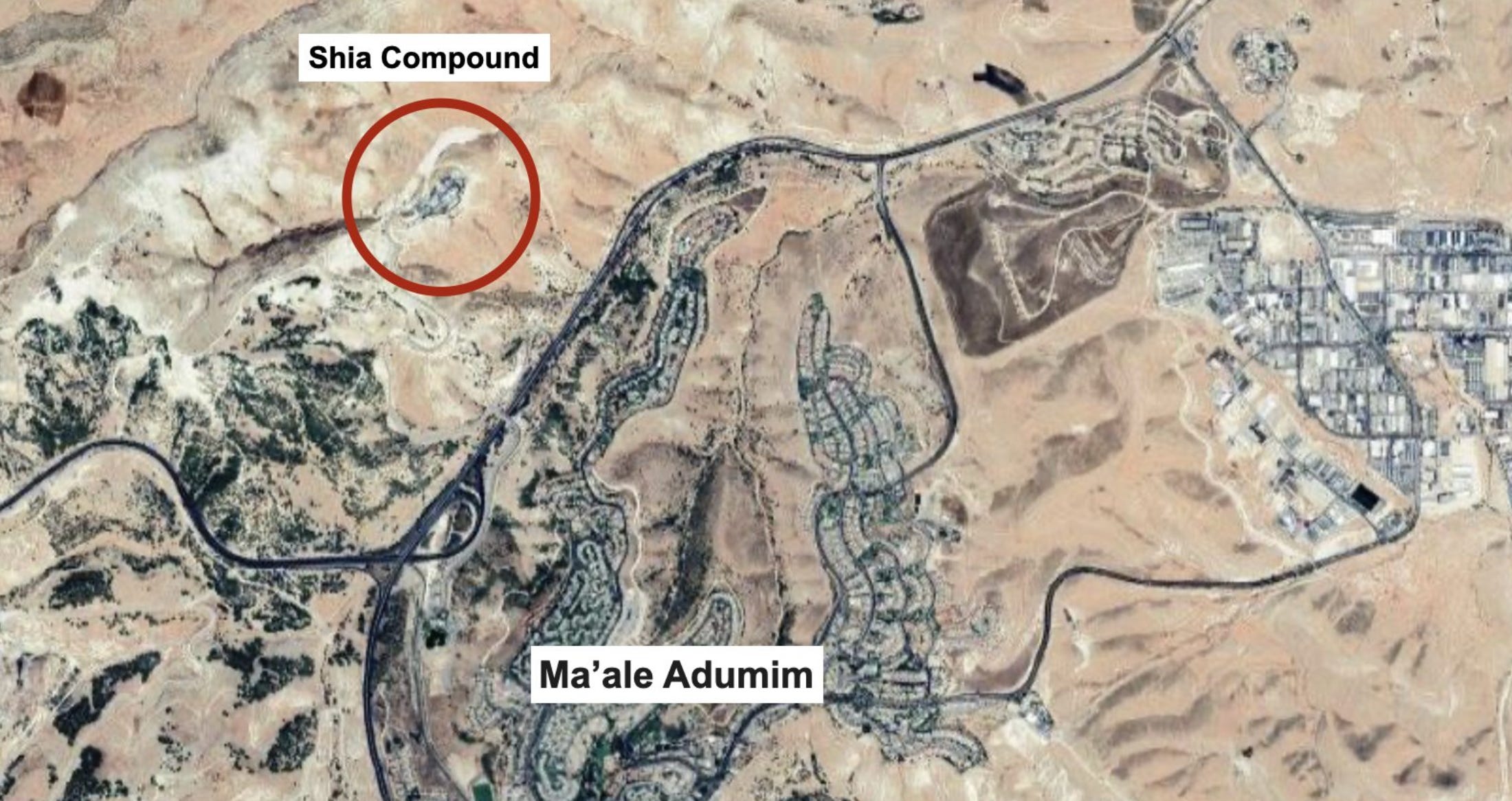
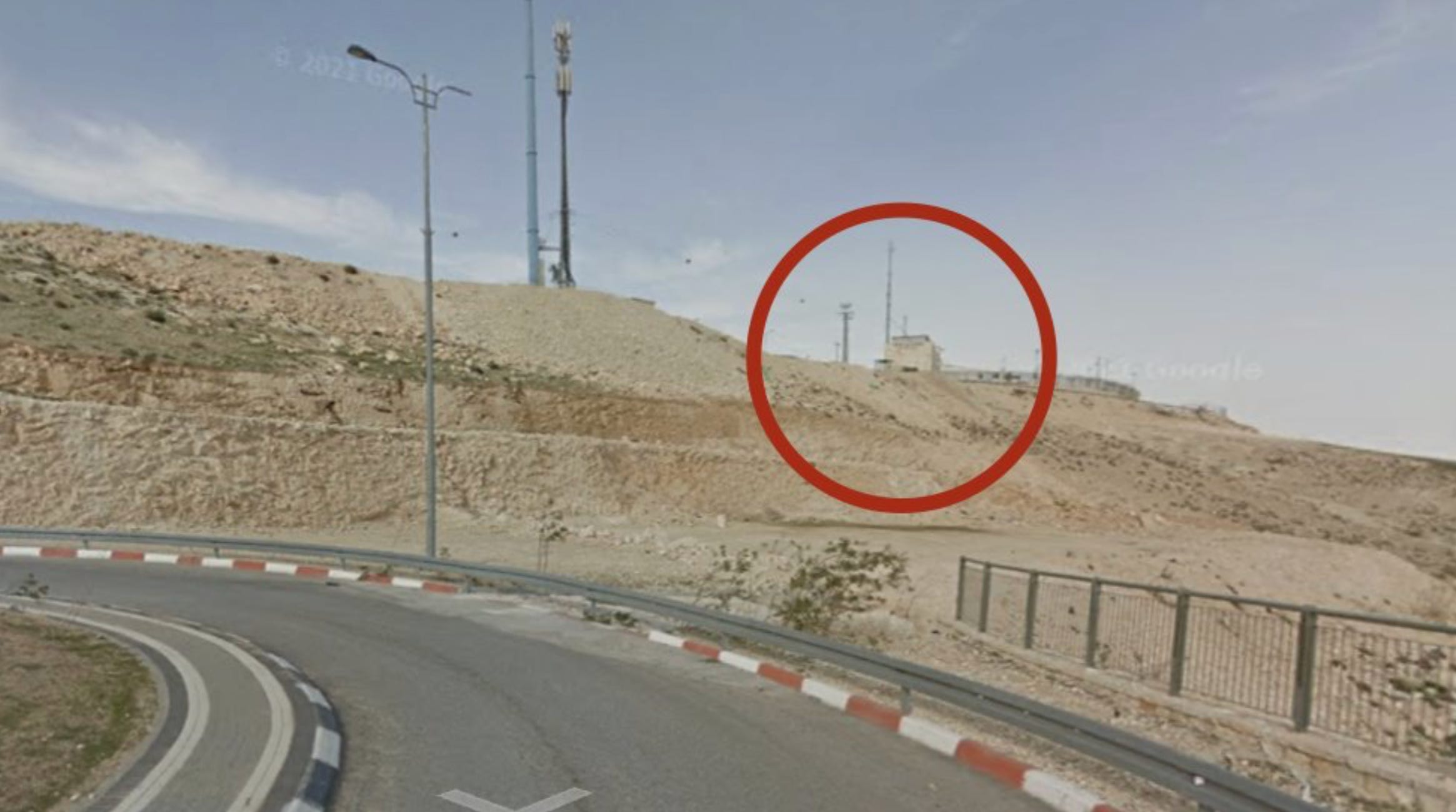
The Shai Compound, built in 2008, is shrouded in secrecy, with only a few photos available online. One of these was taken by the Israeli human rights organization B’Tselem. Both B’Tselem and other human rights organizations opposed the compound’s construction, as it further separated East Jerusalem from the West Bank by placing Israeli military and police infrastructure between them. Additionally, thousands of hectares of Palestinian land were confiscated to make way for the construction of the compound. For these reasons, when the Shai Compound was initially completed, Israeli settlers held a celebratory event at the nearly finished construction site.
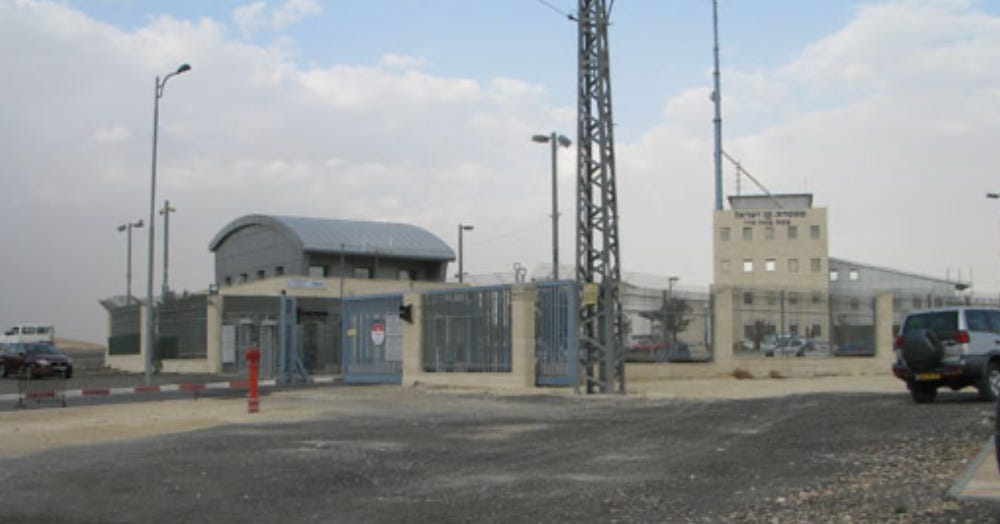
Back in the holding cell, Andrey and I spent about an hour discussing what had just happened. He explained that he had never seen the army treat Israeli or American journalists this way before. Despite the situation, he stayed optimistic, believing that the harsh treatment was likely an attempt to intimidate us and discourage us from returning to the north. He thought we’d most likely soon get released with a 15-day ban from the West Bank, which is a common consequence for the Israeli activists arrested in rural Palestinian villages protecting Palestinians from violent settlers. For me, any form of punishment would have been unjustified, as I was an American journalist operating in a part of the West Bank where my presence was entirely legal.
Andrey noted that when left-wing Israeli activists are arrested, they are not blindfolded or treated like terrorists like we had been. Instead, they’re treated like fellow Jewish Israelis—like a child who made a mistake. He emphasized that he wasn’t certain about anything and that this experience was unlike anything he had encountered or heard about before.
Two plainclothes officers came into our room and opened the cell, they told us to follow them. I thought we were being released. We followed them out of the cell and then up a flight of stairs to another floor that looked almost identical to the one below. Meir and Sofia were standing at the end of the hallway with terrified looks on their faces. They were standing in front of a banner that the officers had taken from an office and secured onto a wall in the hallway.
The blue and white banner featured two large Star of Davids with the Hebrew phrase ‘’יחד ננצח boldly displayed in the center. The officers ordered Andrey and I to join our two female colleagues against the wall in front of the banner. They yelled at us in Hebrew, laughed and took videos and photos with their cell phones. It was obvious that this wasn’t official business; it was a deliberate attempt to humiliate us and send these trophy photos into some type of IDF/ police group chats. After a few moments, Andrey and I were grabbed and escorted back downstairs to our holding cell.
Andrey later explained that the Hebrew phrase on the banner was a popular wartime slogan in Israel: “TOGETHER WE WILL WIN.” An Israeli agent popped his head into the room where we were being held and in broken English— so broken it was barely understandable—asked us “do you love Israel?” We didn’t respond and he laughed. That was the temperament of most of these agents. “Five years! You will be in jail for five years!” he said, still laughing. It was clear he was just trying to scare us, but it was still unsettling.
A couple of hours went by with little happening, aside from the occasional police officer entering the holding cell room to mock and tease us. Sometimes, officers would come in simply to look at us, as it was unusual to see an American and an Israeli behind bars, especially in the West Bank, where Palestinians are the only prisoners.
Our holding cell was locked but the door to the room was open. So Andrey and I could see anyone passing by outside the cell. An officer came in and told Andrey that his lawyer was on the phone. Andrey left to take the call and returned about 15 minutes later. He told me that back at the checkpoint, someone in the group had actually managed to contact a lawyer for us.
Andrey was ordered out of the cell again. By this point, he had been taken out several times and had spoken with a lawyer. I felt like I was being ignored despite my presence in Nablus being entirely legal. I was the only one who hadn’t broken any laws and the only one who hadn’t concealed parts of my identity or citizenship. I was a journalist from America, which is exactly what I told the soldiers.
A few minutes later, I heard footsteps approaching down the hallway and looked out of the cell. Andrey, Meir and Sofia were walking together toward the door we had originally entered but without their shackles and with their belongings in hand. “What’s happening?” I asked from my cell. “They’re letting us go,” Meir said without stopping or looking in my direction. It was around then that a sense of uneasiness came over me that I hadn’t experienced yet.
As I sat alone in my cell, a familiar sound drifted in from the office next door. It was my own voice. They were watching a documentary I had released just a few months earlier where I had covertly embedded myself among Israeli nationalists, documenting their collaboration with the IDF as they worked to block humanitarian aid from reaching Gaza at the Karem Shalom border crossing in southern Israel. Then, I heard segments from a more recent report—the one I had published just days before about the Iranian missile attack.
As an officer walked by, I asked what was going on and when I would be allowed to leave. He glanced at me, pretended not to understand me, and walked away. Soon after that, a female officer, who seemed to be of higher rank than the others, approached my cell. “Yes?” she said, sounding irritated and waiting for me to speak before offering any information. I asked her when I would be able to leave and she told me that she was waiting to hear from “intelligence” about what to do with me. As I took a few seconds to think about how to respond she walked away. I thought about saying something about being an American journalist but they knew this.
It was getting close to 11pm or midnight and I had been detained around 2pm. I still hadn’t been offered any food or water, and I had no idea whether I would be released in ten minutes, thirty minutes, three hours, or longer. It was difficult for me to believe Israel would keep an [ethnically Jewish] American citizen and journalist in prison overnight. I believed doing such a thing would create a huge diplomatic crisis and I couldn’t understand why they’d be willing to jeopardize their relationship with the U.S., their largest ally and military sponsor. But then again, they had already blindfolded me, shackled me, and thrown me into an army truck. So, at that point, I couldn’t be sure what they were willing or unwilling to do.
A group of officers came to my cell and without saying anything they unlocked it and guided me out and upstairs. “Lawyer,” one said as we walked down the hallway. They walked me into an office, pointed at the phone and walked out of the room. Below is how I recall the brief phone call going.
JEREMY: Hello?
LAWYER: Hi Jeremy, how are you doing? How are you being treated?
JEREMY: I’m fine.
LAWYER: That’s good. Listen carefully, they are accusing you of committing a very serious crime that carries a harsh penalty. 25 years minimum, maximum death penalty. This is very serious.
JEREMY: What?
LAWYER: Are the detectives in the room with you right now?
JEREMY: No
LAWYER: They are accusing you of giving information to the enemy during a time of war. Do you know what this is about?
JEREMY: No
JEREMY: They were watching my reports just now in an office.
LAWYER: Reports?
JEREMY: I published a video report a few days ago about the Iranian missile attack.
LAWYER: OK. I will watch that. This is what’s going to happen. They’re going to interrogate you now. You don’t have to say anything you don’t feel comfortable saying. You don’t need to unlock your cell phone. They will bring you to prison after. And you’ll go to court tomorrow and I’ll see you then.
JEREMY: They’re telling me to hang up the phone.
The detective had no problem telling me to get off the phone with my lawyer. Even going as far as putting his hand near the telephone as if to signal he’s going to hang the phone up for me whether I was ready or not.
As the interrogation began, the detective told me that, because it was so late, the translator would be on a phone call instead of in the room with us. He made a few calls [apparent attempts at reaching a translator] but none were successful probably because it was the middle of the night. He seemed both embarrassed and frustrated cursing in Hebrew to himself.
Finally, a woman with a strong Russian accent answered the phone. After a brief Hebrew language exchange with the detective, she began speaking to me in broken English. She told me that I’m suspected of “aiding enemy during wartime” which is a serious charge classified as an “enemy of the state” offense and I’d be treated accordingly. I didn’t say anything.
The detective and I struggled to communicate due to the translator’s poor grasp of both English, along with a weak cell phone signal. It was an archaic low-tech method for conducting an interrogation, especially for the world’s most advanced surveillance state. He asked if I had any family or friends in Hezbollah or the Iranian government. I said no.
The detective asked why I published the report on the Iranian missile strike. I explained that I’m a journalist, the missile strike was newsworthy and there was nothing in my report that wasn’t already publicly available online.
In other words, if I was guilty of publishing this report, so were other media outlets. And to go even further, theirs came out before mine. He tried to play semantics, asking the same questions in different ways, growing frustrated when my answers were more complex than simple yes or no, given that neither he nor the even translator could fully understand.
The detective then asked if I wanted to “hurt Israel,” to which I replied no. He placed an envelope with my phone inside it on the desk and asked if I would unlock it for him. I said no. He took the phone and put the screen toward my face, hoping the biometric “Face ID” feature would unlock the phone. I had never activated that feature for reasons just like this.
It was probably around one in the morning. “Okay, get up,” he said. He escorted me downstairs, where a younger officer re-handcuffed me [I already had shackles on.] They led me outside to an unmarked police car. One officer drove, while another joined me in the backseat. As we drove, the officers asked me about my political views. It seemed like simple curiosity at first, but looking back, it was probably a form of covert interrogation.
“So do you support BDS?” the detectives asked me, referring to the Palestinian-led, nonviolent movement promoting boycotts, divestments, and economic sanctions against Israel. “I don’t know,” I replied. “Well, you follow them,” the driver quickly retorted, likely referring to my Instagram account.
As we approached the Qalandia checkpoint—the main military checkpoint between the West Bank and Jerusalem—I couldn’t help but reflect. I had passed through this checkpoint at least a few dozen times, but never as a suspected “enemy of the state” shackled in the back of a car with Israeli intelligence agents. Normally, at Qalandia, the driver and I would be stopped and our IDs checked. But this time, because of my special chauffeurs, we passed right through.
“This is Sheikh Jarrah,” one of the officers said as we drove through the well-known Palestinian neighborhood in East Jerusalem. “I know,” I replied. “This one knows all about Sheikh Jarrah,” he said to the other officer, implying that I was some kind of Palestinian sympathizer.
About ten minutes later, the car started to slow down, and I immediately realized where we were. We had entered the heart of central Jerusalem, an area I had spent countless evenings over the past year. Just a few days before, I had been walking freely down this very street. We turned onto a road and passed through several security gates, entering what is known as the Russian Compound.
The Russian Compound is one of the oldest districts in central Jerusalem, not far from the dividing line that separated East Jerusalem from West Jerusalem from 1948 until 1967. It gets its name from the Russian Orthodox pilgrims who began flocking to the city’s holy sites in the mid-19th century. Their church still stands in the area, but the land is now owned by Israel. The compound is home to various government offices, a courthouse. And Moscobiyeh prison.
Moscobiyeh prison is in the heart of the Russian Compound, hidden from public view. It’s used as a facility to interrogate Palestinian detainees suspected of carrying out “security offenses.” The prison is notoriously known as “the slaughterhouse” due to the brutal torture techniques employed by Israel’s internal security services, known as the “Shabak” which translates to the “network” in English.
According to Addameer, a prisoner support NGO based in Ramallah: “mistreatment in Mascobiyeh is not only witnessed in the interrogation rooms, but rather is an integrated system operating to terrorize and break the detainees’ spirit.”
We were now parked in what I could only assume was the rear of the prison. The officer driving stopped the car, rolled down his window, lit a cigarette, and made a phone call—to whom I soon realized was a prison guard on the inside. He spoke briefly in Hebrew before hanging up. When he finished his cigarette, he stepped out of the car and walked toward the prison door, leaving me in the car but motioning for the other officer to bring me outside of the car.
For several minutes, I stood in the parking lot beside one of the officers, shackled and handcuffed, while the other filled out prisoner transport paperwork by the door. Once the paperwork was complete, around 1 or 2 a.m. on October 9, 2024, I had officially become a “security detainee” of the State of Israel.
The papers were signed, and I was led up the stairs into the custody of my new captors. One of the guards grabbed my arm tightly and guided me into a small vestibule. There, they removed my shackles and handcuffs and handed them back to the security agents who had driven me from the West Bank. They took my boots and, in exchange, gave me a pair of pink rubber sandals with penguins on them—at least 4 or 5 sizes too small, leaving half my foot hanging out the back. Clearly an attempt to humiliate or emasculate me.
Then, they instructed me to stand in front of a Star of David poster for my mugshot. The photo was printed onto an official government document, which also listed the “enemy of the state” charges against me and some other information in Hebrew. A clerk passed the document from the printer to the prison guard and then escorted me deeper into the prison.
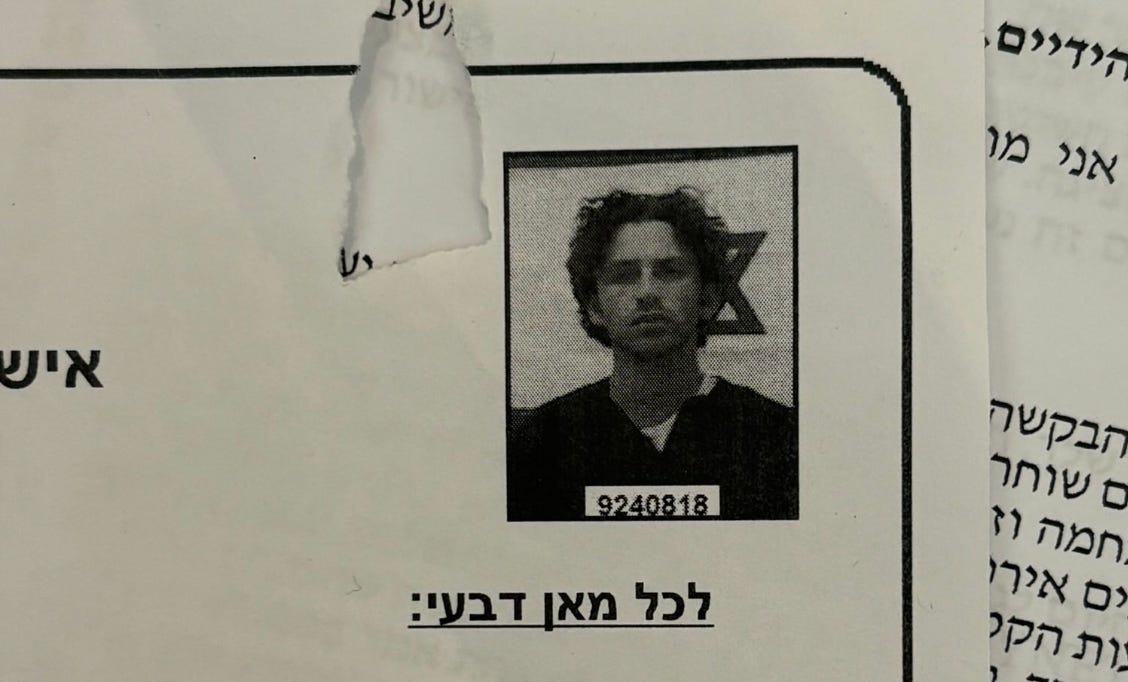
We stopped in front of a solid steel door, its blue paint flaking off to reveal metal that must have been there for a hundred years. My mugshot and the details of the accusations against me were taped to the outside of the door. The Shabak agent who had driven me from the West Bank was still with us. He told me I would appear in court the following morning, but when I asked him what time, he acted as if didn’t hear me. They opened the steel door and gave me a gentle shove from behind, guiding me toward the cell. I took a few steps forward, and the steel door slammed shut behind me.
I looked around. This wasn’t like the prison cells you see in the movies, with metal bars separating the prisoner from the rest of the prisoners — where the phrase “behind bars” comes from. There were no bars. It was just four concrete walls and a solid steel door, with a small steel slide at face level that guards could open to check on you. Near the bottom of the door was another small, mail-sized opening, also with a steel slide, which I assumed was used to pass food trays in and out.
The “mattress” was a 3-foot by 7-foot slab of concrete with a thin piece of fabric on top of it— so thin it could be used as either a mattress or blanket. Next to it was a dirty stainless steel toilet and a stainless steel sink. I was in solitary confinement. The floor was littered with cigarette butts, dead bugs in the corners, and dirt. I tried not to look around too much.
At first, I sat on the bed trying to make sense of everything. It’s hard to remember exactly what I was thinking. On one hand, because I was American, I wanted to believe this would all be over by morning. I tried to convince myself they were just “trying to teach me a lesson” but it was becoming harder and harder to believe that all of this it was just an exercise in scaring me due to the amount of resources being used on transporting me from the West Bank compound to the security prison, watching my reports, formally accusing me of a crime, putting me in solitary confinement, scheduling me a court date hearing etc.
I also told myself that they might believe the longer they held me—an American journalist as an “enemy of the state” in solitary confinement—the more likely it would become a diplomatic issue with Israel’s most important ally, my country, the United States.
By then, it was probably around three in the morning—about twelve hours since my arrest. I remembered that shortly before reaching the Nablus checkpoint, Meir had offered me a plain, whole tomato as a snack. At the time, I laughed and politely declined. Now, that odd snack sounded as satisfying as a full meal. My Israeli captors had yet to offer me any food or any water. I went from sitting up, to slouching, to adjusting myself and eventually laying front-side-up on the concert slab.
Every thirty minutes or so, the steel slide on the door would scrape open with a harsh, grating sound, and an Israeli prison guard would shine a flashlight directly at my face. They would hold it there just long enough to make me open my eyes before shutting the slide again. At first, I thought maybe they were”checking on me”, but it quickly became clear that this was a deliberate tactic—an effective attempt at sleep deprivation.
A few hours later, I heard noise outside the cell—people speaking in Hebrew, walking, yelling, and the crackle of walkie-talkies . The yellow tinted light in my cell suddenly turned on. The door slid open, and a few guards looked in at me. One said “good morning” in broken English and laughed. I asked them what time it was, one of the guards told me it was 6 o’clock in the morning before they closed the steel slide again.
I knew the time was 6am but I didn’t know what was happening and when it would happen. Would I be able to speak with a lawyer? What time? How long from now? What time is my court hearing? When would I be given water or food? Would this whole thing end before any of that even happened? Would I just be let out?
I became restless almost immediately. I paced back and forth across my cell—hundreds of times, for hours. Some of the guards seemed amused that an American was being held in Moscobiyeh. Every so often, a group of them would slide open the viewing hatch and the more curious ones would ask where I was from. “New York,” I’d say. Or just, “America.” They would then speak to each other in Hebrew, presumably about me, discuss the paper taped to my door that listed the charges against me, and slide the hatch shut again.
It was a few hours into the morning, and still, nothing had happened. I hadn’t been offered a phone call or had any contact with anyone. I kept on pacing and pacing into the afternoon, sometimes counting every time I did a “complete pace” meaning from one wall to the other and back. About 10 feet.
Finally, the steel slide opened. “Hands!” a voice commanded. At first, I didn’t understand, but then the guard opened the slide on the bottom of door, which I assumed was used for food trays. “Hands!” he said again. I put both my hands through the opening, and he handcuffed me through the rectangular hole and then opened the door.
When the door opened, it felt like I was finally getting fresh air, even though it just a poorly ventilated hallway inside of the prison. The guard slapped the wall a couple of times with his hands, then shoved me against it. Another guard crouched down and shackled my legs. “Lawyer” the guard said to me in broken English.
One of the guards grabbed my arm and began walking me down the hallway. Despite being shackled and handcuffed, with an Israeli prison guard gripping me tightly, I couldn’t help but feel a sense of freedom. Leaving the cell and walking down the hallway felt good. As I moved, I even felt a hint of “wind” on my face. As I passed other prison guards, Palestinian prisoners and Israeli security agents they all looked at me with a sort of puzzled look on their face wondering why someone who looks like me is handcuffed, shackled and being manhandled in Moscobiyeh. Maybe a twenty seconds later, we arrived at a small room, the guard opened the door, pushed me into the room and shut the door.
Sitting at a tiny table was my lawyer, 79-year-old Lea Tsemel. She skipped the small talk and went straight to the point. “We don’t have long,” she said. Lea explained that I was being accused of reporting on sensitive state secrets and asked how I thought we should argue against it. This was something I had been thinking about while pacing in the cell. I told her she needed to find Nick Shifrin’s PBS Newshour report, where he visited the same Tel Aviv missile site I did and disclosed its location several days before I did. As for anything related to Nevatim Airbase, I quickly pointed out that my report didn’t include any of the aerial satellite images that other news organizations had published, and I suggested she gather those reports for the court, as it demonstrates other publications included more sensitive information than I did.
She then explained that since I didn’t have a Government Press Office (GPO) card, we would also need to prove to the court that I was a journalist. I told her to simply Google my name—she would find plenty of “evidence”, including bylines in dozens of articles and credits as a producer on various news documentaries from both the U.S. and abroad. She was jotting down messy Hebrew notes on a legal pad. I also suggested she look up my appearance on Tucker Carlson Tonight on Fox News, where I had discussed the Russia-Ukraine war, aware that Israel’s government and courts were heavily influenced by the right-wing Likud Party. Sort of as an effort to show the court I’m not some anti-Israel propagandist and have previously appeared on “Republican” or right-wing “news” networks.
Lea was sharp, but also really old, and her English wasn’t great. I felt like we were barely understanding each other, which was frustrating given that I was facing a potential life sentence in prison or even the death penalty. To make matters worse, our time was already up. The Israeli authorities only allowed me about 1 or 2 minutes to speak with my lawyer. Lea shouted at them in Hebrew, and they reluctantly gave us another minute. As the prison guard grabbed me from my chair and the sound of my clinking shackles echoed, Lea scolded the guard in Hebrew and gathered her notes from our conversation. Our words might have been tangled, but I could see she was fighting for me. Whether that would be enough—I had no idea. She told me that she’ll see me in court. On my way out I asked her where the court was, she told me it was here, meaning within the Russian Compound somewhere.
Back in my cell, I knew it was afternoon —probably bright, beautiful and lively outside in central Jerusalem —but in there, it was dark, silent and still. I was aware that I had a court appearance coming up, but I had no idea when and there was no one to ask. Time in solitary confinement didn’t pass the way it passed outside. Minutes and hours blurred together. What felt like 10 minutes could have been an hour. What felt like 4 hours could have been 1 hour.
While in my cell, I remembered that I had actually been to the Russian Compound courthouse before. In October 2023, exactly one year prior, Meir Baruchin, a high-school civics teacher in Tel Aviv, was arrested for pro-Palestine Facebook posts. His electronics were seized, his home was turned upside down in a police raid, and he was brought before a judge in the Russian Compound’s court on charges of incitement. I had covered the protest outside the courthouse, where leftist Israelis gathered in solidarity with the arrested teacher. The protesters were brutally beaten and chased away by Yasam officers [a brigade of elite riot control and counterterrorism police frequently criticized for their aggressive tactics, particularly in Palestinian areas.] In this case, however, their force was directed at anti-war Jewish Israelis. Although the police sought to imprison Baruchin for 15 to 25 years, the judge let him go.
After some amount of hours, the small metal slot at the bottom of the steel door slid open. “Hands!” I knew the drill by now. I knelt, slid both wrists through the opening, and felt the cold steel of the handcuffs tighten. I pulled my hands back inside and stood, waiting for the door to open but it didn’t. I looked through the slot at the top of the door which was left slid open. The guards were walking away. Still cuffed, I started pacing back and forth with my hands cuffed.
The guards eventually came back, opened the door, put me against the wall and put the shackles back on my ankles. One of the guards told me I was going to court, which I had already assumed. They walked me down the same hallway and brought me into the vestibule that leads to the outside of the prison.
They opened the door to the outside and led me down a short flight of concrete stairs. It was bright and sunny outside, as I took the few-step walk down the stairs I contorted my neck in order to face the sun. My shackles rattled with each step and I kept tripping.
“Relax,” I told the guard, meaning slow down. He ignored me. The chains between my ankles kept my stride painfully short—walking was possible, but every step felt unstable, especially on stairs. The chain on prison “leg cuffs” is typically 13 to 16 inches long, according to Google, and that seems about right.
At the bottom of the stairs, a prisoner transport van waited. It was a white Sprinter van, marked with blue Israeli law enforcement insignias. No windows. Hard plastic seats. It had three rows, but a series of permanent, steel, built-in, floor to ceiling dividers separated each row. I couldn’t see if there were other prisoners in other sections of the van. Once I climbed in and the doors shut behind me, it was nearly pitch black with a tiny bit of outdoor light coming from a vent towards the top of the inside of the van. But it was too high up for me to look out of.
Every new situation was terrifying. If the authorities truly saw me as a threat to Israel’s national security—and by now, it was clear they did—I could easily imagine the van heading to a secret torture site instead of the court. And why was I being put in a van at all? I knew the courthouse was inside the same compound as the prison, barely a three-minute walk away.
The engine rumbled to life, and the van crawled forward, never actually picking up any speed. After a short, bumpy, and tense ride, the van stopped. The transport had driven me just a few hundred feet, winding through a maze of outdoor security roads. I was taken out of the van and with my shackles on led by the arm into the building.
Entering the courtroom was overwhelming and humiliating. I had come straight from solitary confinement, treated like an animal, hungry, led everywhere in chains, wearing dirty clothes and pink children’s sandals — and I was being brought into a formal government setting where everyone around me was well-groomed, clean, free, and only in the same room as me because I was accused of being an enemy of the state of Israel, facing life in prison or even the death penalty. In addition to being humiliated, my whole life on the line. To make matters worse, I quickly learned the entire proceedings were strictly in Hebrew, a language couldn’t understand.
I was seated on a bench at the side of the courtroom, behind a pane of plexiglass. Lea Tsemel, my lawyer, walked over, crouched down, and pointed to a middle-aged woman with blonde hair. “She’s from the American embassy,” Lea whispered. My eyes widened, as if I had just been given a lifeline. I immediately waved to the woman, signaling for her to come over to me. She hesitated, glancing around as though unsure if she was unable to approach me behind my plexiglass wall, but I kept signaling her until, finally, she reluctantly walked over. I thanked her for coming and asked if she could get me out. She gave me a disappointed look and explained that she couldn’t do anything—her role was strictly to observe, and they were not allowed to interfere with Israeli legal proceedings. “Observe?” I repeated, probably sounding more rude than I intended.
I don’t remember exactly how the conversation ended, but she returned to her seat. Although the dialogue was frustrating, it was the first sign that people in the outside world were aware of my situation. Which eased my nerves a bit.
I kept scanning the courtroom. Meir, who had been arrested with me the night before, was sitting in the way back of the courtroom. She gave me a broken smile. Seated next to her was someone I recognized from my earlier trips to Israel and the West Bank—her name was Yasmin. Yasmin is a 26-year-old Israeli activist. She organizes daily and overnight “protective presence” trips to the West Bank, where they work to shield Palestinian villagers from Israeli settlers. Through her WhatsApp, Yasmin managed dozens of activists, directing them to different Palestinian villages and towns every day of the week. She gave me the same type of broken smile that Meir gave me.
The court session began, and the prosecutor—which was just an agent from Israel’s Intelligence services—was the first to address the judge. I couldn’t understand the Hebrew, so I kept scanning the room, looking for changes in facial expressions. After a few minutes, Lea turned to me and quietly said that Israel was requesting a ten-day extension for my solitary confinement. Complete panic and dread washed over me. One day in solitary felt like a week. I was being deprived of food, sense of time, human interaction, fresh air, and was being moved from place to place in chains. It had already taken a heavy toll on me. Ten more days was unimaginable.
A woman sitting next to me, who I believed worked for the same human rights NGO funding my legal defense, leaned towards me and quietly explained that the authorities were requesting the ten-day extension because, in addition to allegedly publishing sensitive state information, they found it suspicious that I had refused to unlock my iPhone. She said they were requesting extra time in order to break into my passcode-protected phone and and also password-protected computer. The agent told the judge that they were confident once they accessed my electronics, they would find all the evidence needed to prosecute me as an enemy of the state.
Lea argued that the information I had published had already been publicly available, and named a few mainstream publications that published similar or even the same information as me. She mentioned PBS Newshour but struggled with the pronunciation and the details.
It was frustrating because at least in this instance, I believed I could defend myself perhaps better than Lea because I was very familiar with the information that could prove my innocence. I told Lea to gather and print these reports in order to hand to the judge. She didn’t have anything printed out. She told the judge that despite not being formally credentialed by the Israeli Government, I have been doing legitimate and professional reporting for years, for publications as well know [and pro-Israel] as Fox News and publications as large as the national public news broadcaster of Russia known as “RT.”
She also informed the judge that my mother was Jewish and so according to Judaism, I’m Jewish. I saw the judges shoulders relax immediately. Still, it seemed like the judge was more sympathetic to the intelligence services and police. I can’t understand Hebrew but the judge cut off and interrupted Lea multiple times which I took as a bad sign.
In a moment of desperation, I told Lea to tell the judge that I was willing to leave Israel, be deported, and never return. She refused. She said that no “good Jew” would willingly offer to stay away from Israel, and if the judge was to believe I was anything other than a “good Jew”, he would rule against me.
To me, any outcome that ended with guards yanking me off the bench, marching me back to the prisoner transport van in handcuffs and shackles, and throwing me back into solitary confinement was a very bad scenario. In the hours leading up to my court hearing, I was imagining the judge looking at me, telling me to go back to America, my handcuffs being removed, and that being the end of my incarceration experience.
The court session came to a conclusion. I couldn’t understand any of the dialogue so I waited with baited breathe for Lea to tell me what was happening. She told me the judge denied Israel’s request for a ten-day detention extension but unfortunately I am heading back to prison.
The judge ordered my detention be extended by 24 hours to give the security services a chance to further interrogate me and also time to break into my devices to extract information and gather intelligence against me. The possibility of 10 more days didn’t matter anymore. Another 24 hours in solitary confinement and the possibility of an interrogation session with Israeli intelligence, with years of prison looming over my head was enough for me to consider the ruling a defeat.
“This is a good outcome,” Lea insisted. “They wanted to hold you for ten days and we got it down to one.” As I was being pulled up and marched back to the prison transport van, she added, “Make sure you call me before they interrogate you. They have to let you call me.”
As I passed Meir and Yasmin, who seemed to be waiting to speak with Lea, I quickly thanked them for coming to support me. Before I could hear any response, I was shuffled away.
When I returned to my prison cell, it was probably around 3 o’clock in the afternoon. It wasn’t time to sleep—it was the middle of the day. I had nothing to occupy myself with. No books, no television, no one to talk to. I hadn’t been given any food yet. I just paced back and forth.
Sometimes, my thoughts were productive. I would plan out information or specific arguments to relay the next time I saw Lea. I’d try to convince myself that even if I received a drastically reduced sentence—say, 10 years—I would be released as a 38-year-old. That’s actually still pretty young.
The possibility of another interrogation loomed over me. After all, that was the entire reason the security services had extended my detention. It was a daunting thought, and I had no idea how to prepare for it. I reminded myself of the facts: I was an American journalist. I had nothing to hide. The entire premise of my arrest—that my reporting had exposed sensitive state secrets to “the enemy” was false. There were no secrets. The mainstream media had already reported on almost everything I covered, long before I did. But the security services and police had computers. They had the internet. They had to know this already. And yet, they were still pursuing “enemy of the state” charges against me. Was I being targeted for different political reasons? For my reporting over the past year that had actually exposed things the Israeli authorities had [until my reporting] had successfully kept hidden? Was I being targeted because I worked for The Grayzone, one of the most popular English language investigative reporting outfits — known for its opposition to Israeli occupation? Does my “innocence” even matter in this situation?
The guards would still occasionally slide open the viewing slot just to stare at me, as if I were some kind of strange phenomenon. Sometimes, they spoke to each other in Hebrew before walking away. Other times, they used broken English to tell me I was in serious trouble and would be in prison for a long time. I tried not to let it get to me because they weren’t the ones deciding my sentencing. They were just prison guards.
After what I could only guess was a few hours, an Israeli woman with a navy colored uniform and clipboard opened the steel slide on my prison cell door. “Jeremy…Loffredo?” she asked with the thickest of Israeli accents.
“Yes?” I called out, rushing to the door from the other side of my cell.
“This is a wellness visit. The embassy asked me to check on you,” she said. For a brief moment, I felt hopeful. Maybe I was about to get food, water, fresh air, or even be moved out of dark solitary confinement to a better cell. “How are you?” she asked. “I’m in prison. So not good,” I replied. “You know you really hurt Israel? Why did you do this?” she asked.
“You are in big trouble,” she stated flatly. I just stared at her through the small opening in the door. “OK. Goodbye, Jeremy,” she said before walking away.
I went back to pacing my cell, thinking about the American government. So far the U.S. had encountered an incarcerated and innocent journalist—Jeremy Loffredo twice. He had been taken from a car, shackled, blindfolded, handcuffed, put in solitary confinement and was facing life in prison. First, there was the embassy representative in the courtroom. She was hesitant to even acknowledge me, and when she finally did, she acted as if asking for help was an outrageous and inappropriate request. Then came this so-called “wellness check” the U.S. embassy had supposedly arranged. It was just an Israeli “social worker” who berated me for “hurting Israel,” and told me that I was in “big trouble” and then walked away.
The rest of the day or night, or whatever it was, went by painfully slow. At first, I couldn’t even bring myself to look at the stained, filthy piece of fabric they called a bed. But eventually, lying on it became normal. I crumpled my shirt into a pillow , put it behind my head and tried to rest. The guards kept sliding open the steel hatch, shining a light in my face. That, too, became routine—like being jolted awake by a cell phone alarm every 40 minutes. Unless the security services planned to drag me out of my cell for an interrogation in the middle of the night, it seemed they weren’t going to interrogate me at all. I wasn’t sure what to make of that., Because I was told that was the entire reason I my incarceration was extended: so I could be interrogated.
By the second morning, it almost felt like there was a routine. The guards made noise outside my cell, I paced for hours, talked to myself and wasn’t given any food—same as the day before. Eventually, the small hatch at the bottom of the door slid open.
“Hands!” a guard barked from the other side. I slid my hands through the opening to be cuffed, walked out, turned and faced the wall as they fastened shackles around my ankles. “Lawyer,” one of them said.
I was led into the same small room where Lea was already seated at the table. She got straight to the point. “Did they interrogate you? I told you to call me before the interrogation,” she said. I told her they hadn’t interrogated me. She looked surprised. Then she told me she had made contact with my girlfriend, my father, and my editor, The Grayzone’s Max Blumenthal. Until that moment, I hadn’t known if anyone in the U.S.—aside from the embassy worker I met the day before—was even aware of my situation.
Blumenthal had been gathering material and evidence to support my case. He was sending everything to Lea. Links, photos, excerpts and the dates of various reports, which were to serve as proof that my work hadn’t revealed any “sensitive state secrets.” And if it had, then by that same logic, journalists from NPR, The Washington Post, Haaretz, and other major international outlets should be shackled and starved right alongside me. Of course, this information only addressed the official justification for my detention—whether that was the real reason was another matter entirely.
Lea first asked me what they might find on my cellphone if they managed to bypass the passcode. I told her that anything of interest on my phone would be strictly related to legitimate journalistic work. She leaned forward and quietly probed, obviously suspicious that our conversation was being listened to. I told her that if anyone was to unlock my phone they’d find that I was in contact with people who live in the refugee camps in the northern West Bank, and that I was working to interview those in the resistance groups. She was taking notes. “Journalists interview those people. That should be OK. But you weren’t giving them any information or resources or anything, correct?” Definitely not, I told her.
And then I remembered something else on my phone. For the past few months I had been sending money to a friend in Gaza. A Palestinian guy about my age, Issa, had been taking care of his entire extended family while also fleeing constant Israeli shelling and airstrikes outside Khan Younis. His father, mother, grandmother and nephews had been moving tent to tent and sometimes living in the halls of what used to be schools when tents were too expensive. I would send Issa a few hundred dollars every week. Sometimes more, sometimes less. Of course this was purely humanitarian, but Issa was using someone else’s PayPal account and was “military age.”
Surely the Israeli authorities weren’t above categorizing innocent Palestinians in Gaza as “terrorists” and if they happened to label Issa or the owner of the PayPal account as a terrorist then it could easily be argued that I was giving financial support to Hamas or whoever. This is a stretch, but I was paranoid. I had to remind myself that none of the official suspicions had anything to do with money or Issa. Lea wrote this all down but reassured me that giving humanitarian money to people in Gaza is something that Israelis even do and it’s usually legal.
Lea told me it was interesting that they hadn’t interrogated me. Beyond that, she didn’t have much to discuss. This meeting with Lea—my only chance to leave my prison cell, even if just for a few minutes—was supposed to be an opportunity to review what information had been extracted from me during the interrogation or to analyze what I might have learned about the authorities’ motives. But since the interrogation never happened, there wasn’t much to say. Lea told me she’ll see me in court later in the day.
I was pulled from the small table and taken back to my prison cell. By now, I had gone nearly 48 hours without food. Before my meeting with Lea, a guard had given me a small cup of water—the only thing I’d received so far. I was completely at their mercy, taken and brought wherever they decided, when they decided, at whatever pace they chose. The only decisions left to me was whether to sit down inside my cell or pace back and forth.
Knowing my second court appearance was approaching, I tried to make myself look more presentable. I splashed water from the sink onto my face, and as I leaned toward the sink, I realized I could faintly see my reflection in the dirty chrome knobs. My hair was a mess. I stuck my head under the faucet and tried to slick it back. Then, I laid my shirt out on the “bed,” smoothing it with my hands trying to get rid of the wrinkles. This was all I could do.
A couple of guards slid open the steel hatch to check on me. I asked what time it was. One of them responded in broken English, “Two” he paused, “afternoon.” The guard clarifying it was afternoon meant that he thought it was possible that I had become so disoriented—after nearly 48 hours in isolation, that I might not know whether it was AM or PM. Because my hearing the day before had been around one in the afternoon, and I had been ordered to stay for another 24 hours I knew my court appearance had to be any minute.
After some time passed, I looked back into the faucet knob and checked my reflection, rewet my hair and tried to comb it with my hands. Not long after that, the bottom slide not door opened. “Hands!” I put my hands through to the other side, was handcuffed, took my hands back inside and stoop up, the door opened, and a group of 3 or 4 guards stood around me as I was put against the wall and shackled. Trying to gage the temperament of the guards, I told them one of the shackles were too tight and asked him to loosen it. “It’s short walk,” he said in broken English, laughing.
The guard was right—the walk to the prisoner transport van, followed by the walk to the courtroom, was a very short distance. But for me, considering I’ve pacing back and forth in a tiny prison cell for 24 hours, the trek to the court room was an incredibly long journey.
I was led outside and down the stairs. The sun was blinding—brighter than it had ever seemed before. I took the deepest breath of fresh air I could before stepping into the dark, isolated compartment of the prisoner transport van, shackled and handcuffed. In the van, I prayed that this would be the last time I would ever be shackled or handcuffed — that this would be my last court appearance and it would all be over very soon.
The courtroom was even more packed than the day before. Journalists, lawyers, police officers, and curious Israeli civilians filled every available space. Meir and Yasmin were in attendance again, seated in the back corner. As soon as I was escorted to my designated seat behind the plexiglass, Lea approached. She crouched beside me and pointed to a man sitting in the front row. A tall, slim Israeli in his mid-thirties with a buzzed head. “He’s here to testify for you,” she told me. “It’s very good.”
He was journalist for Ynet, the online platform of Yedioth Ahronoth, one of Israel’s major daily newspapers. He had written several Hebrew-language reports about the Iranian missile strike, publishing similar information that my report included. And more importantly, he also wrote an article about my arrest and detention, linking to my original video report on the missile attack. And because this Ynet journalist is a government-accredited reporter, all of his reporting must be sent to and cleared by Israel’s military censor. He came to my hearing to show the judge that his articles, which linked to my report, had been fully approved by the military censor office. He even had the communications from the censor’s office to prove it.
I looked at him and gave a thumbs up, and he nodded in response. The correspondence between this journalist and the Israeli military censor, where he was cleared to publish the same information as me and was later authorized to even publish my exact report, should prove that my report did not contain any sensitive information and that the targeting of me by the army and security services is unfair and political.
The court session had begun, and the authorities spoke to the judge first. A woman I didn’t know sat next to me and, with a strong Israeli accent, translated some of what the different parties were saying. After a few minutes, she quality explained that the security services were, again, requesting an additional 10-day extension for my detention. They claimed they were having trouble accessing my electronic devices but would soon break into them and begin searching for evidence to prove I was an enemy of the state, which they were confident they’d find.
The judge questioned why I needed to be detained to have my electronic devices searched, suggesting instead that I could be placed under a type of house arrest or banned from leaving the country while they conducted their search. The agent quickly responded, claiming that I posed a “threat to the security of Israel” if not kept in prison. The judge asked him to provide evidence that I was indeed a threat to Israel’s security. He told the judge that the information he’s asking for is unfortunately “secret” and could not be shared.
The authorities then attempted to pull on the nationalistic heartstrings of the judge and reiterated that my report could help Israel’s enemies by revealing the locations of military or intelligence centers. Their reasoning was that by publishing the locations where missiles had landed, Iran or Hezbollah could use the information to adjust and improve the accuracy of future attacks. That argument seemed to be the crux of their accusations against me — which could have been disproven from a simple Google search. But Lea’s witness, this Ynet journalist, was about to serve the same purpose in a way that neither the intelligence services or judge could refute.
Lea called the journalist to the stand. He introduced himself and explained everything to the judge. He then took out his phone and offered it to the judge so he could see the messages from the military censor for himself. The judge agreed, and the journalist walked up to him and handed over the phone. The judge, likely in his 60s, adjusted his eyeglasses and began reading the messages on the phone. He scrolled and carefully read the messages before handing the phone back to the journalist. The judge said something to the Israeli agents and the prosecution.
I looked in the direction of Meir and Yasmin until I made eye contact with one of them. Yasmin looked at me and nodded her head, knowing I couldn’t understand what was happening but as if to indicate that whatever was happening was working in my favor. The Israeli woman sitting next to me leaned in and quietly told me that the judge had just asked the agents why Ynet was allowed to publish something that “Mr. Loffredo” is strictly forbidden from. I looked back at Yasmin, and she nodded as if to say, “This is good.”
The agents reportedly argued that the key difference is that “Mr. Loffredo” was working for a news organization, The Grayzone, which they claimed aims to “hurt Israel.” The judge did not accept this explanation, and the agents leading the prosecution became visibly frustrated. They knew that without the journalist testifying on my behalf, they probably would have been able to convince the judge that I exposed state secrets. This was especially true since Lea had not yet printed out the dozens of mainstream news reports that would have further supported my innocence and shown that I wasn’t the only journalist to report on the locations of the Iranian missile sites.
Adding to our advantage, the judge questioned the agents about why they hadn’t interrogated me the day or night before, especially since one of the main reasons for the extension of my detention was to allow the authorities to conduct an interrogation. I don’t know what their exact response was, but it must not have been convincing. The judge ordered my release. But there was still a chance for Israel to appeal.
Lea explained that if the agents truly believed I was a “threat to the security of Israel,” they had the option to appeal the judge’s decision—but they only had 30 minutes to do so. Since the ruling was in my favor, the guards moved slower than they had the day before, taking their time before pulling me from my chair and escorting me back to the prisoner transfer van. While we waited out the 30 minutes, I stayed in the courtroom, discussing the case with Lea. The 30 minutes passed and no appeal was made.
The guards eventually led me back to the van, my shackles dragging against the floor. There was no feeling quite like knowing that, soon, the experience of being a prisoner would be nothing more than a memory. I was also painfully aware of my hunger—I still hadn’t been given any food and was starving, quite literally. I was thinking about one of my favorite shawarma spots in East Jerusalem, wondering if they would still be open by the time I was on the other side of the prison walls.
The engine roared to life, and a few minutes later, I was brought back to the holding area between the outside and the interior of the prison. There, I was shoulder to shoulder with several young Palestinian men, who were shackled and handcuffed like me, waiting to be processed and eventually placed in their cells.
Through a small viewing window in the door, a prison guard on the inside told the guard next to me to bring me inside. He grabbed my arm and we walked into the prison. One of the prison guards who had been especially harsh and aggressive toward me over the past couple of days reluctantly unshackled and uncuffed me. He was an Ethiopian Israeli Jew. I’ve been told that in law enforcement and military settings, Ethiopian Israelis [who are Black] can sometimes be the most brutal because they feel the need to prove their loyalty to Israel to their white Israeli colleagues in the police, military, or prison system.
I was instructed to sign some paperwork at a desk that looked like the reception area of a doctor’s office—except, instead of a receptionist, there was an Israeli prison guard, and instead of a doctors office, it was one of Israel’s most notorious detention centers. I signed some papers and then I was told I needed to pay 800 shekels, which is about 200 dollars. My wallet was still with all of my belongings presumably at the Israeli compound in the West Bank. They told me I could use the phone to call someone. I was going to call Lea, my lawyer.
Just as the receptionist-prison guard was about to hand me the phone, she hesitated and glanced at the guards behind me. They began speaking to each other in Hebrew. I turned around, hoping that watching their conversation might help me pick up on what they were saying. One of the guards looked directly at me and asked, “Loffredo?”
“Yes. I’m being released,” I tried to say in the most confident tone possible. “Come,” one of the guards said. They violently grabbed me by the arms and shoulders, causing me to drop the pen I was using to sign the release forms. Without explanation, they dragged me into a small, white concrete room—probably no more than six feet by six feet. I suspected this was where prisoners were ordered to change clothes or undergo strip searches. They left me inside while three or four guards stood outside, engaged in a discussion that I could only assume was about my situation and what to do with me next.
I remained in the small white concrete room for about ten minutes before they unlocked the door and without a word escorted me—not toward the vestibule that led outside, where I had expected to be released within minutes—but in the opposite direction, back toward the prison cell where I had spent the past two days. When we reached the cell, they opened the door and pushed me inside.
I paced back and forth, trying to make sense of what had just happened. I tried to stay calm, reminding myself of what I had just witnessed. I had been in court. I had seen and heard the judge explicitly order my release. Lea and the other woman—whose name I didn’t know—had even congratulated me. I had been signing the paperwork for my release. All of that was real. So why had I just been thrown back into my cell? No one was telling me anything.
Over the next several hours, guards periodically slid open the viewing slot on my prison door to check on me. With each glance, my frustration grew. I repeatedly asked them what was going on, reminding them that I was supposed to be released—but none of them gave me an answer. Most of them would act as if they didn’t understand my English. At one point, a guard told me he would get someone who could answer my simple, straightforward question: What is happening?
A few minutes later, another guard arrived. He seemed to be more senior. As I spoke, he just stared at me with a blank, almost lifeless expression. Then, without saying a word, he walked away. Was this some psychological torture tactic?
Some more time passed. I hadn’t been “checked on” by the guards in a long time. Then, I began to hear yelling—either from the hallway or from the cell next to mine. I coudln’t tell. At first, it wasn’t unusual, but as it continued, it started to make me feel increasingly uneasy. Once I noticed it continuing, it became impossible to ignore. It was definitely coming from the cell next to mine. The yelling escalated into the hysterical crying and screaming. The shrieking sounds were occasionally interrupted by the loud, Hebrew authoritative commands. The crying sounds were being followed by a banging-type noise. As if the banging noise was the cause of the shrieking and crying. Someone was being tortured.
The ear-piercing screams and cries entirely filled all of the space of my prison cell. I couldn’t think about anything else. All I could visualize was someone being brutally tortured just on the other side of the concrete wall. This lasted maybe an hour or two. Maybe 30 minutes.
Subjecting prisoners to the sounds of another prisoner being tortured is actually something that the Israeli security services are notorious for at Mascobiyeh prison. According to Addameer, a Palestinian prisoner rights NGO based in Ramallah that conducted interviews with hundreds of security detainees who were incarcerated at Mascobiyeh, 41% of the detainees were subjected to the screams and sound of torture from their cells.
According to 33 year old prisoner whose initials are E.D., one of the pressure methods used against him in his cell was listening to the sounds of a girl pleading for help as if she were being tortured. Dr. Pau Perez-Sales, who was interviewed by Addameer, noted that the anticipation of pain and envision of torture has more effect on the psychological state of the detainee than actual physical pain or actual torture. Former Israeli chief interrogator, noted that sometimes actors are actually hired to loudly mimic the sounds of a torture session or beatings in a neighboring room.
In that moment, my prison experience had never seemed further from over, despite my release being ordered a few hours earlier. The sounds of torture had finally stopped and I was able to go back to thinking about why I was put back into the prison cell in the first place. Still, the guards had not opened the steel slide on my door to “check” on me since before the torture sounds began.
Some amount of hours later, definitely well into the night, my prison door swung open. It wasn’t preceded by opening the viewing slide to “check” on me or even opening the bottom slide to handcuff me. The men who opened the door weren’t prison guards, they were plainclothes intelligence agents. Both wearing t-shirts, jeans and boots. They had guns and handcuffs on their waist. They skipped handcuffing me but still directed one of the guards to shackle my legs. The power dynamic was clear. The prison guards were taking orders from these agents.
They led me down the hallway toward a rear exit of the prison. I knew the hallway well, but I had only really seen it during the day. Now, walking with the intelligence agents, it was eerily empty. It felt like the middle of the night—no prison guards, no prisoners being moved and the office doors were shut.
The agents didn’t say anything to me, speaking only to each other in Hebrew. When we stepped outside, an unmarked police car was idling at the bottom of the stairs, its engine running and lights on. One agent got into the drivers seat, while the other opened the back door for me and told me to get in. I sat down, and he walked around to take the seat beside me in the back. The car began driving on empty late-night Jerusalem streets.
I asked them what was happening. “Interrogation,” one of the agents replied. “Are you taking me back to prison after?” I asked. The agent in the passenger seat, speaking with a thick Israeli accent, said, “We will see.” I had no idea what was going on.
Earlier that day, I thought I was being released. Now, I was handcuffed in the back of a car with two intelligence agents in the middle of the night, being driven to an unknown location. This is the part where I get tortured or go missing, I kept thinking.
Given the middle of the night pick-up from prison, I started to think they might have finally accessed my phone or laptop and wanted to interrogate me about it. I began running through potential answers in my head—justifications for why I wanted to interview resistance fighters in Jenin [who they’d label as terrorists] and why I had been sending someone in Gaza hundreds of dollars each week via PayPal, or perhaps they’d see on my phone that I had been inside of “closed military zones” during some of my prior reporting trips to Israel, which is technically illegal.
Also, a few months prior, I had went to the home of a Palestinian woman recently released from an Israeli prison, who had been accused of working with a group that Israel designates as a “terrorist group” — would they try to get me on that?
I noticed the car was heading toward the Qalandia military checkpoint—the entrance to the West Bank. We passed through Qalandia and drove deeper into the West Bank. Eventually, the car began ascending a heavily securitized mountain road. The landscape looked familiar—I had seen terrain like this only once before, on the night I was first taken to the Moscobiyeh prison from the West Bank “Shai” compound, where I was initially held after my arrest outside Nablus. Now, it seemed that I’m going back there with the authorities who were using a similarly abrupt and unpredictable approach. The first time, I was transferred from a checkpoint—blindfolded, shackled, and ordered to stay silent. This time, I was taken out of my prison cell by plainclothes security agents in the middle of the night. The method had changed, but the feeling was the same—sudden, unexplained, and completely out of my control.
Our car was waved through a couple of security gates before slowing down and coming to a stop. The 32 acre compound of Israeli police and military buildings and garages are spread across a rocky hilltop in the foothills of Mount Scopus, overlooking a pitch dark Judean desert.
As the “Judea and Samaria” headquarters, this compound is a center of constant activity during the day — a nerve center for the occupation of the West Bank. Meetings, militarized police units departing and returning from missions, training sessions, intelligence briefings, and critical support operations all happening simultaneously.
But at this moment, in the dead of night, the compound was practically asleep. The parking spots were empty, and no officers or soldiers were coming or going. No vehicles moved, and the windows of the most of the buildings had their lights off. The only signs of life were the Israeli agents who had brought me here—and me. They didn’t bother restraining me as we walked. They knew I had nowhere to run.
We walked into a building so empty that the motion-activated fluorescent lights were turning on as we made our way down the hallway. We reached a section where each of the agents had their own office. One of agents me offered me a cup of water from their office water jug. I took a plastic cup, filled it to the brim and drank it down in one go, refilling it several times.
I told who seemed to be the most senior of the agents, that the judge had ordered my release earlier but I ended up being forced back into my cell. I asked what was happening to me. In broken English, he explained that the judge had allowed them to appeal the court’s decision after the official appeal window had closed [which was entirely illegal.] And that’s why, just as I was signing my release papers, I was suddenly taken back to my cell— because the prison had received the appeal information. He told me that I’ll have court again in the morning and instructed me to sit in a chair in a nearby room.
The interrogation lasted two or three hours. He questioned me about my personal political views on Israel, Palestine, Lebanon, Iran and terrorism. The agent also asked about my work and why I report on the topics I do. He asked if I was aware that journalists in Israel are required to submit all their reporting to the government military censor. He asked personal questions, such as my address, my fathers address, and those of other family members. I was able to refuse to answer questions, as long as I understood that my refusals would be recorded and presented to the judge.
Similar to my previous interrogation, the agent became increasingly impatient, raising his voice whenever I gave answers more complex than a simple “yes” or “no” — it was clear that some of the questions were designed to trap me—leading questions that were meant to incriminate me if I gave any careless or inconsistent answers. I tried to be as vigilant and cautious as possible in all of my responses.
At one point during the interrogation, he said we’re going to take a break and asked me to come outside with him. I nervously followed him outside in my shackles and stood with him in the parking lot while he smoked a cigarette. He actually offered me a cigarette. We went back inside and continued the interrogation.
The agent, his last name Megiddo, eventually stood up from his desk sent a few messages on his phone and told me to follow him. We walked outside in the dark for maybe five minutes. I became more nervous with each step. We arrived to a back door of one of the larger buildings within the compound and agent Megiddo put in a passcode, the door unlocked, he opened it and I walked in first. The building wasn’t a cheap office building — it had marble floors, lots of glass and stainless steel, and plaques of decorated soldiers, intelligence officers and policemen. And just like the building before, it was dark and entirely empty, the motion activated lights were turned on as we walked down the hall.
I asked him what we were doing. “Taking pictures,” he replied. We stood in front of an elevator for a moment, but then he realized it was out of service until morning and told me we’d have to use the stairs. The whole situation was feeing increasingly eerie. The staircase was nearly pitch dark. “Are you going to torture me now?” I asked, “No,” he answered, though his tone wasn’t entirely reassuring. “So, you want to take photos of me at the top of this building?” I asked, still trying to understand. It seemed almost unbelievable. “Yes. Pictures.”
We reached the third or fourth floor and pushed open the door. The hallway beyond was just as dark as the staircase, except for a single room at the end where a light was on. We walked in. Inside, a younger agent sat in front of a computer, typing frantically. Beside him, to my surprise, was a massive camera—about the size of a basketball—mounted on a type of rig as larger than a bedroom dresser.
The two agents spoke to each other in Hebrew, pressed a few buttons on the contraption, and then instructed me to stand on a marked spot on the floor. Using a joystick connected to the computer, the younger agent adjusted the camera’s zoom and took pictures of my face—straight on, then from both the left and right side. Next, they did biometrics. Both of my iris’s were scanned, all ten of my fingers were fingerprinted, my palms, and then they swabbed the inside of my mouth for a DNA sample.
In that camera room, I realized the agents had never offered me a phone call to Lea before the interrogation—something I had been told was mandatory by law. But the same “law” also allowed Israeli security services to override my court ruling through an extrajudicial appeal, making it clear that “legal protections” were far from reliable.
Still, I wanted Lea to know what had happened. I wanted her to be aware that I had been interrogated in the middle of the night and that, as far as I could tell, they hadn’t managed to extract any incriminating information from me or pressure me into saying anything I shouldn’t have. They also hadn’t mentioned the contents of my cell phone—the thing I was most anxious about. It was crucial for Lea to know all of this before stepping into the courtroom, where she would be defending me—not just from the possibility of years in prison or even the death penalty, but at the very least, from another night of starvation in solitary confinement.
I stood still as the agents sealed the DNA sample in a bag and entered some information into the computer. Then, they led me back down the stairs and escorted me back to the office building where I had been interrogated. As we walked outside, I asked Agent Megiddo if I could use the phone to call Lea. “No,” he said. “You’ll see her in court tomorrow.”
We returned to the building where the agents had their offices and where I had been interrogated. They told me to stay in the hallway. I was in shackles but not handcuffs. The agents then stepped into an office, shut the door, and made a phone call. It was probably around two in the morning. A few minutes later, they emerged and walked me back outside. Megiddo and the younger agent stood nearby, speaking in Hebrew as they sipped coffee and smoked cigarettes. Then, an unmarked police car pulled up. The younger agent got into the back seat with me, and we drove out of the West Bank, back to Mascobiyeh.
As we arrived at Mascobiyeh, the agents walked me to the entrance. A prison guard was waiting to receive me. Noticing that I was in shackles but not handcuffs, he seized my arm tightly and angrily shouted at the agents—presumably reprimanding them for failing to properly restrain a potentially dangerous prisoner accused of high crimes against the Jewish state.
A couple of prison guards patted me down before escorting me back to my cell, where I’d be spending my third night. I laid down on the “bed,” crumpling my shirt into a ball to use as a pillow behind my head. It was probably a few hours before sunrise, though I wouldn’t be able to see the sunlight from inside of my solitary confinement cell anyway. As I laid there, my mind was in a much better place than it had been earlier that night when the screams of a prisoner being brutally tortured had filled the cell I was shoved into without explanation.
This interrogation felt like a final crescendo. The security services successfully managed to reverse the judge’s order for my release but in order to convince the next judge they’re serious about pursuing the charges against me they had to use this additional time to interrogate me. But during this interrogation, no new information was extracted from me, at least nothing serious. And it didn’t seem like they were able to get into my phone and if they had, it didn’t seem like they were interested in whatever they found.
But still, I felt both my mental and physical health deteriorating. The stress and starvation of the last few days had caused me to noticeably lose weight, and I found myself talking to myself aloud more often. It was becoming increasingly difficult to imagine ever walking freely again. I knew I had only been in solitary confinement for three days but it felt like at least three months. It was crucial for tomorrow’s hearing to conclude with my release.
Due to the appeal, my case had moved from the Jerusalem Magistrate’s Court, located in the Russian Compound, to the Jerusalem District Court in East Jerusalem. If it were appealed again, it could eventually move on to Israel’s Supreme Court.
Though it was almost morning, and the guards were aware that I had been in interrogation all night, they continued opening the steel slide on my prison door every 40 or so minutes to shine a flashlight at my face and wake me up. What felt like just a couple of hours later, it was morning—maybe six or seven o’clock. I could hear the chatter, walkie-talkies, and the shuffle of guards and prisoners moving around outside of my cell. Then, a prison worker—someone who wasn’t a guard—came to my cell door. Without saying a word, he crouched down and slid a tray through the door with a cup of chocolate pudding, a spoon, and a bottle of water. I raced to the door, crouched down and grabbed the tray. This pudding cup was the first food I had been given since I was locked up. I tried to take small spoonfuls to make it last longer, but it was gone in just a minute or so.

I paced back and forth, taking sips from the water bottle. After a couple of hours, I knew I’d be taken to court soon. I leaned in close to the faucet knob and looked at my reflection. My face was gaunt, and since I usually shave every day, I was starting to grow a beard and mustache. My hair was a mess, so I dipped my head into the sink and did my best to fix it. What felt like a few hours later, maybe around eleven in the morning, a guard opened the slide on my cell and told me to put my hands through the lower opening. I was cuffed, the door opened and then I was shackled, more guards than ever before were there to take me from my cell to the prisoner transport van, at least six or seven.
The van’s engine was already running when I stepped outside. The door was slid open, and I climbed inside. The transport vehicle was just like the ones I had been in for the previous court appearances—almost completely dark, smelt like sweat, with no air conditioning, and hard plastic and steel everywhere. However, this van’s air circulation vent was positioned slightly lower than the ones from the days before. If I twisted my neck and sat up as straight as far as I could, I could see outside. The view was warped through what I assumed was bulletproof glass or plexiglass, but I could make out passing trees, cars, buildings, and even the sky. The ride lasted about twenty minutes, so this was the longest I had been able to [vaguely] see the outside world in days.
When I was taken out of the van, I immediately noticed that this court was much more serious than the one I had been to the past two days. The building was massive, made of concrete, with the interior nearly all marble and stone. There were airport-like metal detectors at the entrance but I was brought inside through the back.
I was led into the courtroom, which had high ceilings, large windows, and a white marble floor. This court, The Jerusalem District Court in East Jerusalem is where infamous Nazi and one of major organizers of the Holocaust, Adolf Eichmann stood trial in 1961.
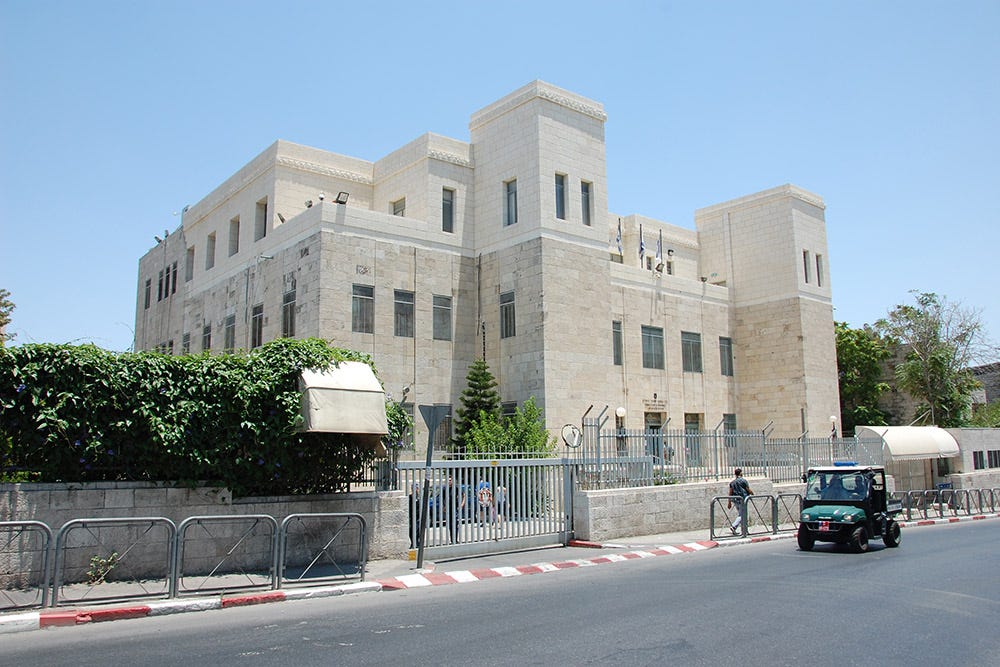
The prosecutor, who was an intelligence officer again, was dressed in a button-up shirt, unlike the previous days when the agent-prosecutors had worn less formal clothes. He was sorting through his papers. Behind him sat about ten people, who I later learned were regular Israeli civilians who believed I should be imprisoned and felt so strongly about it that they attended the hearing not only to observe, but also to show the judge that “the people” were paying attention.
Yasmin was there again, and I gave her a nod, as if to say thank you. Someone from the U.S. embassy was also present, though it was a different person from the first time. The U.S. embassy worker who came to the first hearing was a blonde woman, this time it was a fat guy. It wouldn’t have surprised me if the “embassy workers” only attended these hearings to gather intelligence on The Grayzone. They certainly made no effort to help me.
Lea walked up to me and crouched down. I told her I had been interrogated the night before. She asked what happened and why I hadn’t called her. I explained that it was the middle of the night, and they didn’t allow me to call anyone. I also mentioned that it didn’t seem like they had unlocked my phone. She asked what kind of questions they had asked, and I quietly listed as many as I could remember.
The prosecution was once again requesting a ten-day extension for my detention. The agent told the judge that I had been interrogated the night before, but lots of important questions remained unanswered. They also mentioned that they had spoken with the military censor about the Israeli journalist who was cleared to publish everything I had shared. According to the prosecution, the military censor’s office explained that the Ynet reporter was only allowed to publish his reports because “Mr. Loffredo” had already published the information—and if my reports hadn’t been published, the Ynet journalist would have been officially censored.
The judge asked for proof of this claim, either in the form of a letter from the censorship office or correspondence between the intelligence agent and the office. The agent conveniently didn’t have those documents with him but promised to send them to the judge at a later time. I looked at Yasmin, and she nodded, signaling that the judge didn’t seem persuaded. Which was good.
The agent explained to the judge that accessing my phone was proving more difficult than they had initially expected and argued that a reason for extending my detention was that the security services were confident the information on my phone would prove my guilt. Once again, the judge asked why they hadn’t considered alternatives, like house arrest or a ban on the accused of leaving the country, while they reviewed the laptop and phone. The prosecution responded by claiming, again, that I posed a threat to Israel’s security if not detained, but the information they used to reach that conclusion was secret and couldn’t be shared with the judge. Once again, the judge seemed frustrated by the lack of available evidence to support their claims.
Lea argued that even after an extrajudicial appeal and an extended interrogation, the only evidence the authorities have to justify an extension of my detention is not available for the judge to see. Lea also pointed out that I wasn’t given a phone call before or after my last interrogation, which is illegal. She presented the judge with documents that included other journalistic work I had done in different countries and publications, as well as evidence from several Israeli outlets that had reported the same information about the missile strikes as I had.
The judge mentioned a part of my report where I referred to Hassan Nasrallah as a “political leader” rather than a “terrorist.” She argued that describing Nasrallah as a political leader “undermined” my “journalistic integrity.” She then spoke for a few minutes but was actually interrupted several times by the intelligence agent prosecutor, which I understood as a positive sign.
The Israeli citizens attending the court hearing were visibly annoyed—whispering among themselves, some shaking their heads. That was my cue to feel the opposite. I glanced at Yasmin, and she gave me a thumbs-up. Then the judge looked directly at me and asked a question in Hebrew. The entire courtroom turned their eyes toward me. I looked at Lea for help. “The judge is asking if you’re willing to turn yourself in to the Shai compound in the West Bank for interrogation if the police request it,” she translated.
“Yes,” I replied. The prosecutor angrily said something in Hebrew.
The judge ordered the security services to release me from prison immediately but allowed them to keep my passport for ten days to prevent me from leaving the country. According to the judge’s ruling, if intelligence agents or police contacted my lawyer and requested my presence at the West Bank compound, I was required to go there immediately—failure to comply would result in evading arrest charges. The judge also permitted the security services to continue holding my phone and laptop in order to preform a digital strip search of sorts, which was admittedly unsettling. It was October 11th, meaning, if everything works out, I would be barred from leaving Israel until October 21st.
I was escorted back into the prisoner transport van. Just like the last time I was ordered to be released, a wave of relief crashed over me. But with it came an unexpected exhaustion—so deep it felt like my body was shutting down after running on fear for four days. The looming threats of years in prison, execution, and starvation had held me in a constant state of tension. The release from those fears triggered a powerful physical reaction that lingered throughout the week. It took different forms—brain fog, nausea and even a strange numbness spreading through my entire right leg.
As I sat in the van, waiting to be taken back to the prison for my formal release, the door opened, and Lea stepped inside the cramped and hot van cubby. She explained the conditions of my release and told me that Yasmin had paid the 1,000-shekel fee and listed her address as my official temporary residence—meaning if the security services decided to arrest me again, they’ll come looking at Yamin’s apartment.
Before Lea left the van she told me to call her from someones else’s phone when I was out of prison and safely with Yasmeen. I was reminded that I won’t have a phone when I’m released. A guard stood by the open door of the prisoner transport van. Curious to see how they would treat me now that I was being released, I decided to test the waters. “Do you like her?” I asked. “My lawyer, Lea?” He responded in a thick Israeli accent. “No, I do not like her. But she is very famous.”
“Famous?” I asked. He nodded but offered no further explanation. Before I could ask more, another guard appeared, and they slid the door shut beside me and moments later, the van rumbled to life, taking me back to the prison for my formal release.
When we reached the back door of Moscobiyeh, a familiar wave of anxiety hit me, fearing that something might go wrong again, like it had the day before. Every time a guard passed me on to another, I reminded them that I was being released. Inside the prison, where I would typically be returned to my cell, a guard unshackled my ankles, removed my handcuffs, and guided me to a side room. There, he rummaged through a large bin of shoes once worn by prisoners. “Point out yours,” he said. I took off the pink rubber flip-flops I had been wearing and put my feet back into my dirty black Timberlands. They couldn’t find the laces, so my boots stayed loose. They then escorted me to another part of the prison, where Meir and Yasmin were waiting to retrieve me. It was around 3 p.m.
To get to Yasmin’s car, we had to walk for a few minutes through the labyrinth of narrow streets that make up the Russian Compound. The sun was bright, and I didn’t know how to feel. Walking freely outside, without any shackles or anyone grabbing onto my arm, around the same prison where I had just been held as a high-security prisoner felt strange—almost wrong. As we walked, I passed a group of guards, likely on a lunch break, who had interacted with me inside the prison. I got into the front passenger seat of Yasmin’s SUV, which was covered in dirt and sand from driving around the West Bank.
It happened to be the evening of Yom Kippur, the holiest day in the Jewish faith, which begins at sundown and ends the following evening at sundown. In Yasmin’s car, she asked if I needed anything from the store because, once the holiday started, everything in Jerusalem—at least West Jerusalem—would be closed for 24 hours. We stopped at a convenience store to grab a few items, like toothpaste, a toothbrush, and some other things.
At the register, a military-aged Israeli man was working. Just hearing him speak in Hebrew made me uncomfortable, reminding me of prison guards. I couldn’t help but imagine how Palestinians living in Israel must feel all of the time. When we returned to Yasmin’s apartment, she gave me a tall glass of water and prepared a plate of hummus, pita, tahini, and sambousas—a sort of Middle Eastern version of Indian samosas.
Though Yasmin is incredibly hospitable and kind, she’s introverted and speaks very broken English. Meir, on the other hand, who I was originally arrested with in Nablus, is from Canada, is very sociable, and speaks perfect English. Meir told me she planned to take a bus from Jerusalem to Tel Aviv before Yom Kippur began, to have dinner at a friend’s house. Andrey and Sofia, who I had also been detained with, would be there. I thought being around people I know might be nice, so I decided to go with Meir. Yasmin told me that whenever I wanted to return to Jerusalem, she had spare room ready for me.
Before I left the house, I made a call to Lea Tsemel, my lawyer. I told her I was leaving Jerusalem with Meir and heading to Tel Aviv for a night or two. She said that was fine, especially because it’s the holiday. But she told me to try to keep my head down and that it would be smart to return to Jerusalem sooner than later — because her office was in Jerusalem.
The fact that I had been arrested and publicly accused of aiding Israel’s enemies during wartime—enemies many Israelis view as genocidal, Jew-hating terrorists—and that the Israeli media had been widely circulating my photo while covering my case, made walking around the Israel’s streets frightening. Israeli citizens were attending my court hearings, trying to pressure the judge into delivering a guilty verdict. Men of all ages, from eighteen-year-olds to seniors, were carrying automatic rifles slung across their chests, especially now, with wartime hysteria gripping the entire population. I listened to Lea and I tried my best to keep my head down. The dark green baseball cap that had fell off my head when I was originally blindfolded would have been perfect for this.
Meir and I got off the bus at the Tel Aviv Central Station and walked to her friend’s home. The walk was about 3 miles through South Tel Aviv, an area where many African asylum seekers live. As we walked, she did most of the talking. She shared insights into the local politics between neighborhoods that house asylum seekers from various countries and pointed out some of her favorite stores and restaurants.
I was only half-listening for the entire hour or so long walk, still overwhelmed by what had just happened to me and the uncertainty of what might come next. Would they call Lea to re-arrest me? If so, when? Would they interrogate me again? Would I end up back in handcuffs?
We arrived at Meir’s friend’s apartment, where Andrey—who I had been detained with—was already there, along with Sofia, who had also been detained with me, and another Israeli guy, also from Russia like Andrey, whose name I didn’t catch. They all greeted me warmly with hugs, offering me food and cigarettes. I ate a bit, then stepped out onto the balcony to join Andrey and his Russian friend. Andrey was staring intently at his phone. His Russian sidekick looking over his shoulder.
Andrey goes by the name AndreyX on social media, where he had 12,000 followers on Twitter and nearly 100,000 on Instagram and TikTok. He made a name for himself by being an activist in Russia, gaining recognition for opposing the Russian state. Over the years, he worked alongside various NGOs who received money from the U.S. or European governments. When the Russia-Ukraine war began, Andrey obtained Israeli citizenship through Israel’s Right of Return law, which grants Jews the right to relocate to Israel and gain citizenship.
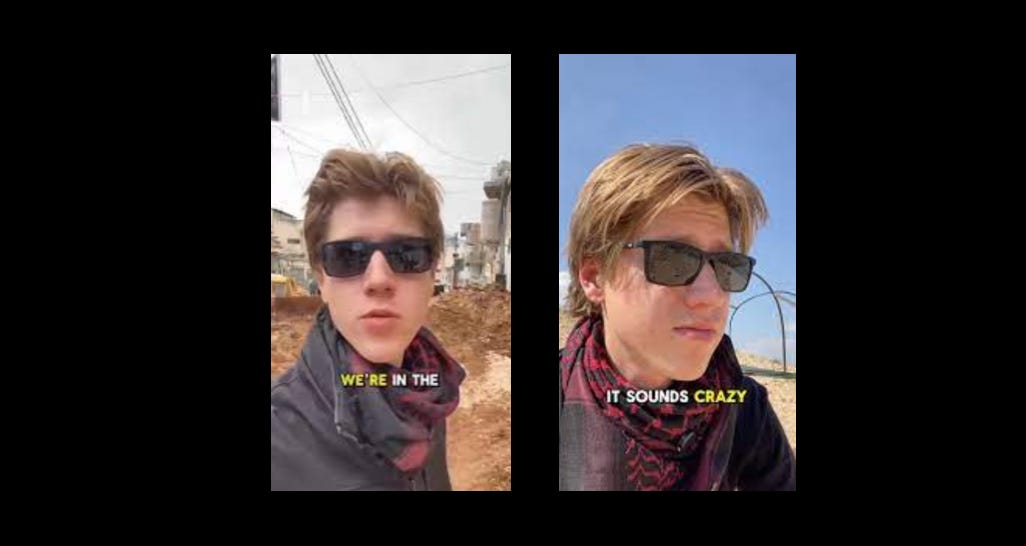
Today, he has a large following of pro-Palestine supporters. His leftist Israeli followers, along with his pro-Palestine Eastern European followers, view both Russia and Israel as sort of morally comparable regimes, believing both are waging unjust wars against much weaker states.
I asked what they were doing on the cell phone. “We’re trying to put out a fire,” Andrey said.
After being released from the Shai compound, Andrey tweeted about what had just happened to him. He mentioned that an American journalist he was with was still in detention, though he didn’t name me. After I had been out of contact for a while, my editor, Max Blumenthal, reached out and learned that I was the journalist in question. From there, the news spread quickly.
As news outlets began covering what was happening to me, interest and concern grew. Jill Stein, who was running for U.S. President at the time, publicly called for my release after my first court hearing.
However, Andrey’s followers on social media weren’t focused on the injustice of my arrest and ongoing detention. And neither was the media/ reporting collective that Andrey worked with. Instead of demanding updates on my conditions or calling for my release, they were calling for an apology and explanation from Andrey. They were upset that he had been in the same car as a journalist who worked with The Grayzone, a publication they saw as too critical of Ukraine, even going as far as labeling it “pro-Russia.”
He explained the situation to me. I had been released from solitary confinement just a couple hours earlier, and Israeli intelligence was still pursuing me as an enemy of the state. If convicted, I could face years in prison and even the death penalty. I tried to seem concerned about Andrey’s petty clout issue, but in reality I couldn’t care less.
Both Andrey and the other Russian guy, who presumably worked with him in this Pro-Palestine anti-Russia media space, told me they needed to make a video in the TikTok format Andrey typically uses—videos that often go semi-viral. The video would essentially be an apology to his followers for being caught in the same car as me. At first, I didn’t care if Andrey needed to “distance” himself from me. I figured the whole thing would come across as politically immature and silly to most people. If his NAFO-Ukraine-flag-in-bio followers needed him to denounce me, that was OK.
As they sat in the living room, planning what to say in their video, I stood in the kitchen, well within speaking distance, eating blueberries. Andrey was framing the entire apology as though he had made a huge mistake by not researching me before agreeing to let me join him on a trip to Nablus. He planned to claim that he hadn’t known about The Grayzone.
However, he admitted to me that this was a lie. He knew about The Grayzone and had even watched many of my previous reports for the publication. I believe he hadn’t expected our traveling together to become public, nor did he anticipate how fanatical some of his followers would be about us being in the same car. It’s absurd that being in a car together would imply a shared view of the war in Eastern Europe. Such a silly notion.
I wasn’t in the right mindset to argue about Russia and Ukraine. I watched as Andrey recorded his TikTok, lying through his teeth. It wasn’t until the end of the video that I felt I needed to tell him to stop. Andrey had accused The Grayzone, the publication I was reporting for, of producing “Iranian propaganda,” then added, “Opposing imperialism should mean opposing all imperialism—be it American, Russian, Iranian, or Israeli!”
I asked him what exactly he meant by that. I wanted to know when The Grayzone had mimicked “Iranian propaganda.” Also, what is Iranian imperialism?
Before he could respond, which I doubt he was prepared to do, I told him not to make the video at all, explaining that as a well-known pro-Palestine activist in Israel, publicly distancing himself from me or criticizing me would put me in a more precarious position with the authorities. They could easily get the impression that I had no public support, not even from communities that would typically be sympathetic to me. I also told him that I was being accused of “supporting the enemy”—specifically Iran—and if his video labeled me a supporter of Iran, it could place me in a very dangerous situation. I urged him to at least wait until I was out of the country before posting it.
His Russian friend pushed back, arguing that it was already several days too late and that they needed to respond to the “online criticisms” immediately. Sofia and Meir joined the conversation and quickly took my side. The girls convinced Andrey to issue a written statement instead of a video, since a video was far more likely to go viral. Andrey posted the “statement” on X:
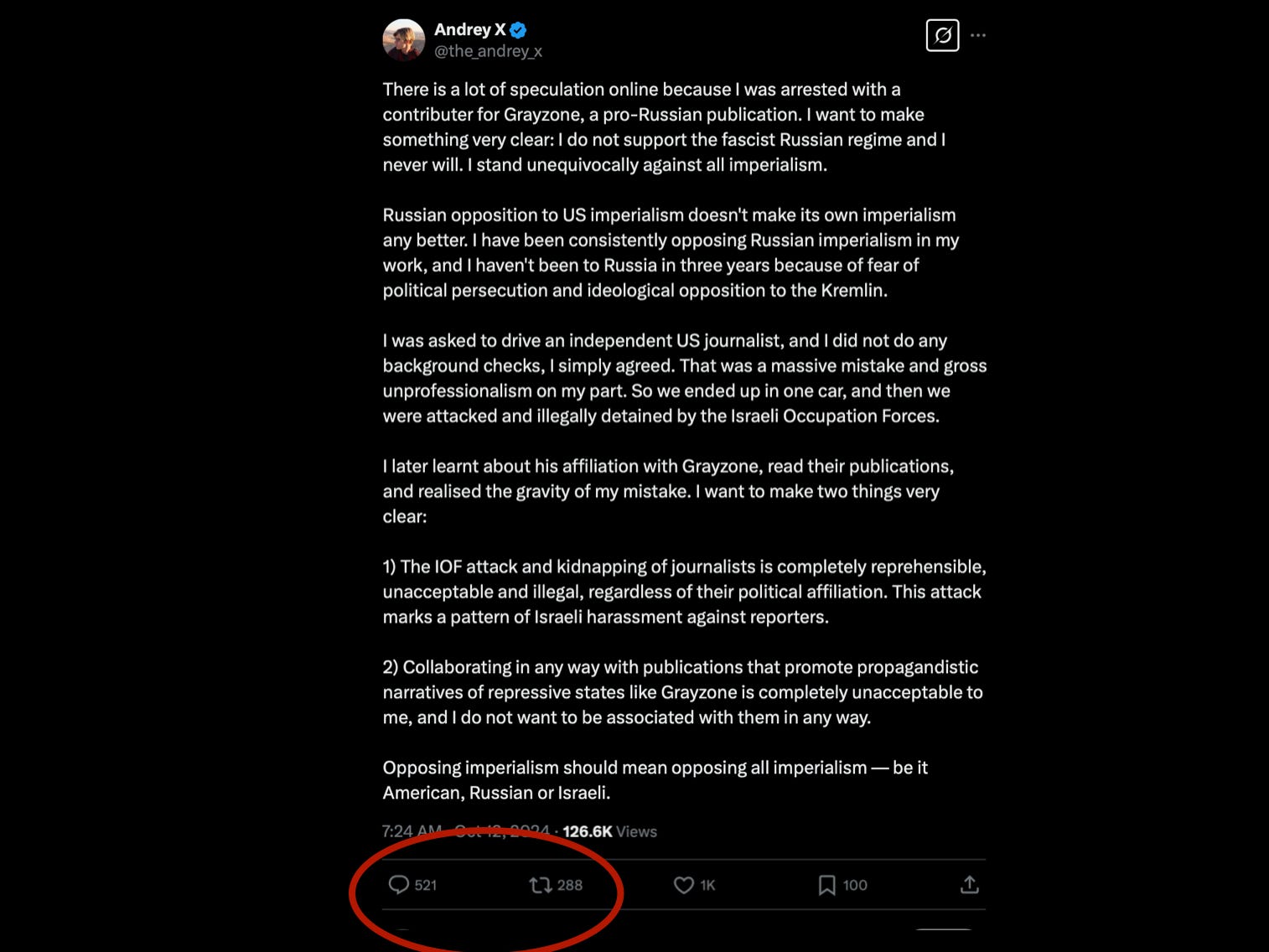
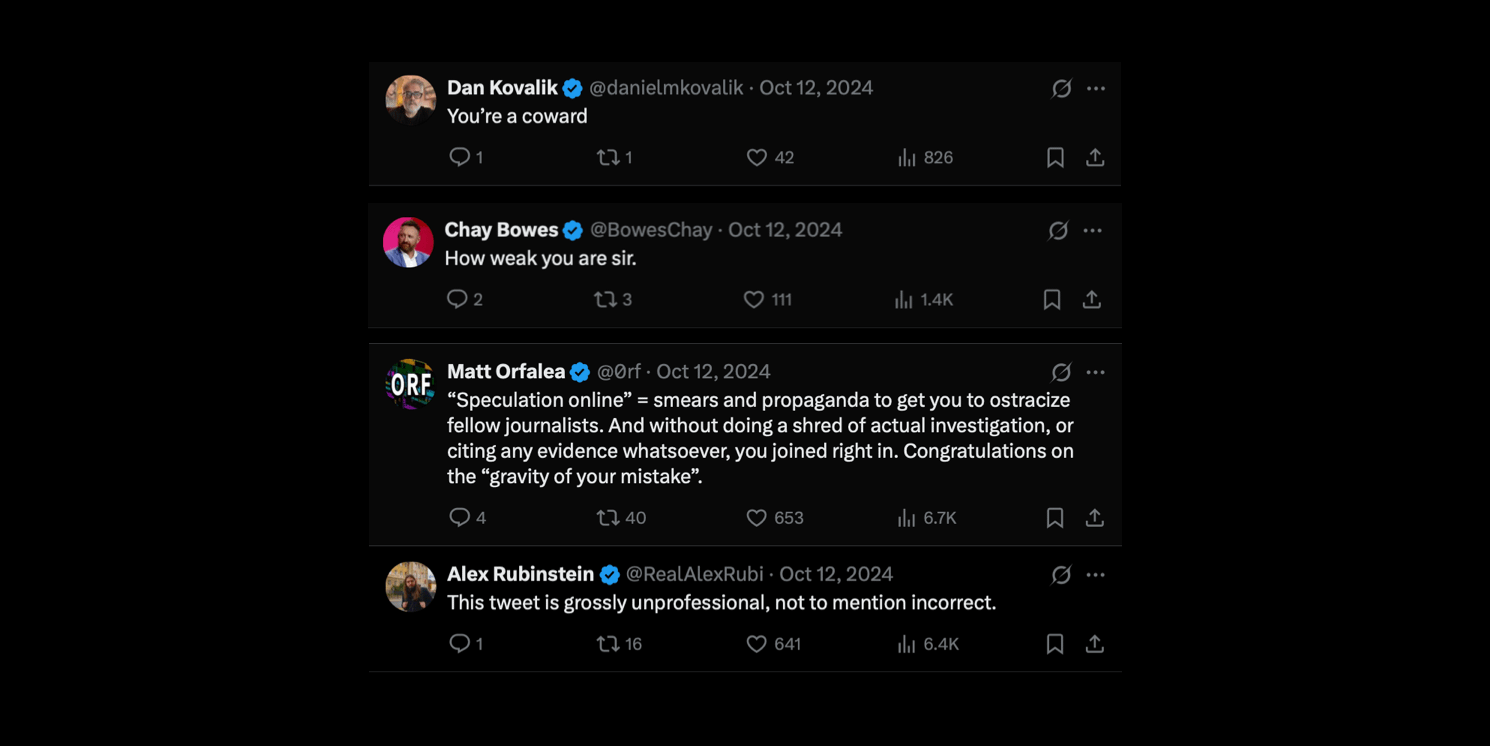
Later that night, everyone had either left the apartment or gone to sleep, I pulled a chair up to the desktop computer. I signed into my Gmail and Proton accounts and systematically deleted everything—emails, Google Docs, and then my entire PayPal history—knowing that Israeli authorities were combing through my phone and laptop, searching for anything they could twist into evidence of illegal speech or communications. Then, I Googled my name. Articles about my arrest had already been published by The Jerusalem Post, Haaretz, The Guardian, and The Intercept, among dozens of others. But none of them knew the full story. None mentioned the solitary confinement, the late-night interrogations in the West Bank or the starvation. I read a line in The Intercept that “Jeremy Loffredo” could be facing life in prison or even the death penalty. My stomach dropped and I got off the computer.
By then, the relief of being released from prison had worn off. My mind was now consumed by the possibility of being called in for another interrogation. If that happened, it would mean the authorities weren’t just trying to intimidate me into stopping my reporting or to discourage other independent journalists from working in Israel—they were actually trying to imprison me.
When I woke up the next morning, two things were urgent: getting a burner phone and securing money—both for obvious reasons. Using Meir’s WhatsApp, I contacted my brother in New Jersey and also Jess Buxbaum, the American journalist living in Jerusalem. Jess had previously connected me with Nab, the driver who helped me locate the Iranian missile sites just 12 days earlier— that felt like a lifetime ago.
I had my brother send money to Jess Buxbaum so she could buy me a burner phone and set aside extra cash for anything else I might need. My wallet was still in the custody of the authorities, and it would remain there for the foreseeable future.
I also called my lawyer, Lea, to discuss my case. She warned me that it wasn’t safe to speak on the phone and that I should assume all my conversations—especially those with her—were being monitored by the intelligence services. She told me to come to her house.
Both Jess, who was going to handle the phone and money, and Lea were in Jerusalem. Even though I had just arrived in Tel Aviv the day before, I now had urgent tasks to take care of back in Jerusalem. The only problem was that it was still Yom Kippur, and the roads wouldn’t reopen until sundown and the public transportation busses wouldn’t start running until a few hours after that. My only option was to take a sherut—a shared minibus where passengers pay a set fare, and the driver leaves once all the seats are filled. I walked to the area of Tel Aviv where I could find a sherut to Jerusalem.
It was in one of the busiest parts of Tel Aviv, and being surrounded by so many armed Israelis—many of whom had likely seen the news—was nerve-racking. I did my best to keep my head down.
While waiting for the sherut to fill up, I met a Palestinian restaurant worker still dressed in his kitchen whites. I told him I didn’t have a phone and explained which part of Jerusalem I needed to reach. He assured me that he’d let me know when it was time to get off the sherut.
The ride was about an hour long. I got off and walked to the Jerusalem Central Bus Station, where Jess was waiting for me. Everyone I had asked agreed that the best place to buy a phone especially this late into the evening and during a holiday would be one of the kiosks inside the bus station.
At the entrance to the but station, militarized Israeli police routinely checked IDs and searched bags. I didn’t have an ID. And while I had every legal right to be there, if they recognized me, I wouldn’t have been surprised if they used it as an excuse to harass me. Even if they didn’t harass me, I was doing everything possible to make contact with Israeli law enforcement as infrequently as possible. I waited outside while Jess went in and bought me an LG Android smartphone and a SIM card. She went to an ATM and gave me the cash that my brother had sent.
Jess and I walked around for a while as I shared my experiences from the past few days and speculated about what might come next. She then asked if I knew who Lea was. I told her I didn’t know anything about her, except that a prison guard had mentioned she was famous.
Lea Tsemel is one of the most well-known human rights lawyers in Israel. Born in Haifa, Palestine, in 1945—before the establishment of Israel—Lea has spent her entire 50-year legal career defending Palestinians in Israeli courts. Every year, she successfully defends hundreds of Palestinians against wrongful and illegal detentions. Tsemel is also known for her work defending Palestinian suicide bombers, often securing reduced sentences for them. Her career was the subject of the 2019 documentary The Advocate, which premiered at the Sundance Film Festival, received a 100% score on Rotten Tomatoes and was shortlisted for an Academy Award.
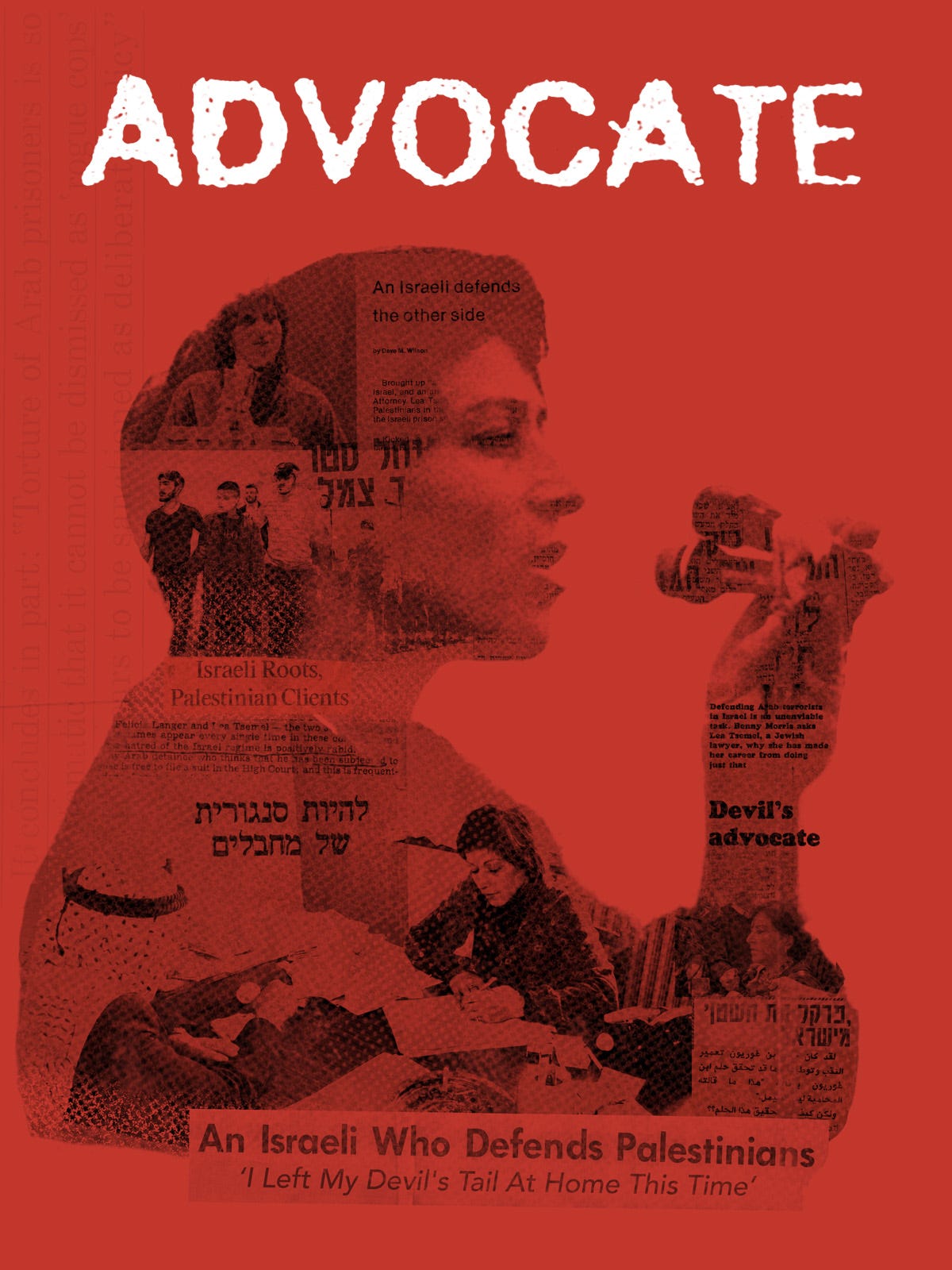
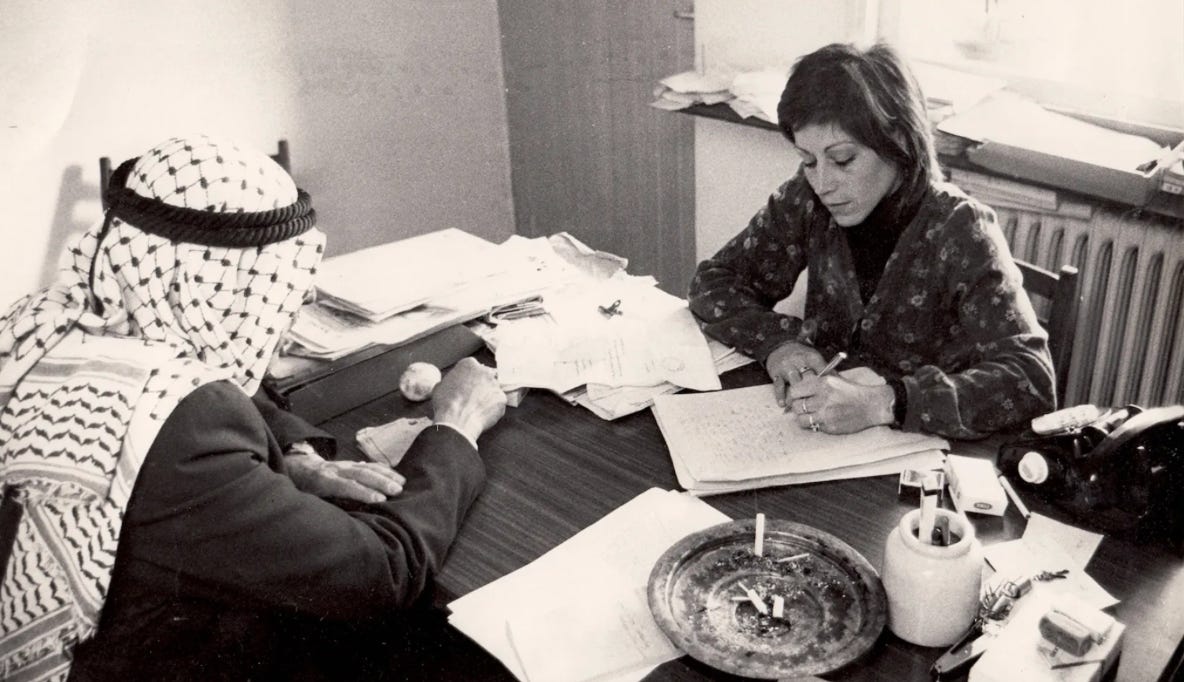
After learning all of this from Jess, I felt both concerned and relieved. I was concerned because I wondered if the trouble I was in really required one of Israel’s top lawyers. But I also felt relieved, knowing that my lawyer was highly experienced, with a deep understanding of the court system. She was no novice. When she tells me not to discuss my case on the phone and warns that there are likely others listening in on our calls, who better to trust than her?
It was probably around nine o’clock at night on October 12th by the time I had my burner phone. I had Lea’s address and phone number written on a piece of paper in my pocket. I took a cab to her house, which was in a beautiful neighborhood in Jerusalem. She welcomed me with coffee and cake. This was the first time Lea and I had a chance to sit down and discuss my case in detail. Until then, I had only spoken with her privately twice during my detention, both brief, prison-sanctioned conversations that lasted no more than a few minutes.
At the kitchen table, Lea pulled out her notepad and began asking me hundreds of questions. We discussed in surgical detail everything that was on my phone and computer. After about two hours, as she was walking me out of her house, she explained how crucial and helpful it had been to review everything in such detail.
“Just in case I get called back in for interrogation, right?” I asked, trying to gauge whether she thought it was likely that I’d be subjected to more interrogations. She didn’t give much away but replied, “Yes. Just in case.” I asked if she thought it was probable, and she said that I might get called back in but I might not.
That day and the day prior had been holidays, so it was very unlikely that I would get called in. But the next day, October 13th, was not a holiday, making it the first day when an interrogation at the West Bank police compound became a was a possibility. I took a cab back to Yasmin’s house, where a guest bedroom awaited me.
When I woke up in the morning, I sat on the second-floor balcony overlooking Yasmin and Itay’s quiet residential. The balcony was cluttered with various chairs, dead plants, living plants, cat toys, and ashtrays. I spent hours sitting in the sun, trying to relax. I was anxious, fearing that the police would show up any minute or that Lea would call to say I needed to go to the West Bank for interrogation, but the call didn’t come. Yasmin and Itay were at work all day, leaving me alone in the house.
Around six in the evening, I decided I needed to leave. I wanted to head back to Tel Aviv for some movement, and I knew Meir, Sofia, and even Andrey, despite my growing dislike for him, would be there. As I got ready to head to the bus, I received a call from Lea. I hesitated before answering, dreading what she might say. When I picked up, she told me that the security services had just contacted her and wanted me to appear at the West Bank Shai compound the next morning at 11am. She told me that she had to be in court and wouldn’t be able to drive me there. However, she offered to pick me up at seven in the morning as she drove to her office and would arrange a taxi for me from there.
I waited outside Yasmin’s home early the next morning. The sun hadn’t even fully risen yet. Lea pulled up and I got into her car. Her office was in East Jerusalem, which is the Palestinian side of the city. She’s probably the only Jewish Israeli with a business in East Jerusalem. She explained that this is her second, newer office. Right-wing Israelis had been targeting her office in West Jerusalem because of her work defending Palestinians and so she moved it to East Jerusalem. I asked how long she had been in this new office. “Almost 42 years,” she replied.
Lea parked the car and walked down the street, clearly the only Jew around. She was getting looks, but by now, most of the people in the neighborhood knew who she was. She was friends with the Palestinians who ran the bakery next to her office, and she bought us both pastries and coffee. We went upstairs to her office, which consisted of two rooms—one larger than the other—filled with giant file folders stacked on every wall, each organized by case. I sat with my coffee while Lea made phone calls and began sorting through documents, preparing for her court hearings the next day.
Eventually, it was around 10AM, and Lea’s Palestinian co-worker, Ahmed, called a taxi for me. He spoke in Arabic to the driver in order to give him the directions. It wasn’t just a simple address—it was a secretive Israeli compound in the West Bank. The directions could only be as specific as Ma’ale Adumim, the nearest nearby Israeli settlement. The rest of the route had to be navigated visually once we were in the area.
The driver made a few wrong turns but eventually found his way. As a Palestinian, he didn’t feel comfortable driving all the way to the entrance, so he dropped me off about 100 feet away, wished me luck, and drove off. I walked from there to the entrance gate and office. As a white person in casual clothes, with sort of weird hair and no payot or kippah, I felt completely out of place. I didn’t look like a soldier, and I certainly didn’t look like a Palestinian.
A female security officer at the front asked what I was doing there. I gave her my name, and after making a few calls, she led me from outside the gate inside the compound to an outdoor garage-like area just beyond the entrance and told me to wait. My primary concern at this point was that they must have gotten into my electronics.
After about fifteen minutes, an older, heavyset Israeli woman walked in and sat down next to me. She took a swig of Diet Coke, glanced at me, and casually said she that she thinks that she was here for me. I was confused. She explained that she had been called to the Shai compound to serve as a translator—her job was to interpret between English and Hebrew during my interrogation. It didn’t seem like she was government employee, a soldier or part of any sort of intelligence services. Although she very well could have been.
It seemed like she was just a civilian who was hired by the security services whenever they needed a translator for an American—a rare occurrence. Most of the officers and intelligence agents here spoke fluent or at least conversational Arabic since, being in the West Bank, Palestinians were exclusively who they dealt with.
She asked what I had done to end up there. I gave her a brief, simplified explanation: I told her I was a journalist and that the Israeli authorities claimed one of my reports contained secret information—but they were wrong. And that they had originally kept me in prison but I was released right before Yom Kippur. She asked if I was Jewish and I said yes.
A few agents escorted me inside and seated both me and the translator in an office. It was strange to be back in the same building where I had first been detained and then interrogated in the middle of the night as a prisoner, and now I was here again. But I was wearing clean[er] clothes—whether they were mine or Yasmin’s boyfriend’s is beside the point—and, unlike before, I didn’t have shackles on. Yet, any sense of relief that came with being unrestrained was quickly offset by the agents’ demeanor. They spoke to me almost exclusively in a harsh tone, and whenever I needed to move, they seized my arm in a tight grip.
The interrogation lasted more than seven hours without a single break. He asked me hundreds of questions, often repeating the same ones in slightly different ways, trying to trip me up or catch me in a lie.
The interrogator asked if I had included the location of the missile impacts in my report because I wanted Hezbollah or Iran to use that information to improve the accuracy of their next attack. I told them the truth: which was, as a journalist covering an international story of great significance, my job is to provide as much context and information as possible. We argued about the importance of a government censorship office at length. I wasn’t sure if the interrogation would end with my rearrest.
He pressed me about my funding—who pays me as an independent journalist, which bank I use to receive payments, and how much I received for this particular trip, as well how much money I received for my previous tips to Israel. Then, he pivoted to more personal questions: Was I a Zionist? Was I Jewish?
As I responded to the questions and accusations, he typed out the transcript of the interrogation, which would later be presented to the judge—an extraordinarily unfair system where my words could be easily altered by the interrogator. During certain parts of the questioning, he demanded that I only answer “yes” or “no.” When the question or accusation called for a more nuanced explanation, I could see him at the keyboard, deliberately recording only my “yes” or “no” response—completely distorting the conversation to serve the their narrative.
Towards the end of the interrogation, he started asking about specific conversations on my phone—what app I had used, the exact times I sent or received certain messages. I answered to the best of my memory, and each time, he would leave the room, as if he and the other agents listening in were cross-checking my responses against my phone to see if I was lying. The final twenty or so minutes were extremely chaotic and loud, visibly frightening the Israeli translator lady. Different agents kept entering the room, firing off questions about my phone—sometimes shouting. As if they didn’t get the answer soon, innocent people would die, just like the terrorist interrogations on television shows.
The agents seemed especially focused on how I learned about the location of the missile impact site in Tel Aviv. The answer was simple. I explained that I had seen a video on Twitter by PBS journalist Nick Shifrin, where he mentioned he was only a few hundred yards from the Mossad HQ. I then drove around and recognized a building in the distance that appeared in the video. From there, it didn’t take long to find the missile site—just follow the rubble. Anyone could have done it.
They asked how I found the video on X, and I told them it had millions of views, so anyone could have found it. But, I added, my editor, Max Blumenthal, had actually sent it to me. They then asked which messaging platform he used to send it. I told them it was October 2nd, and he had sent it via iMessage. They seemed visibly upset and frustrated. I didn’t understand why. How could they still be asking about this PBS report? We had brought it up multiple times in court. As far as the Tel Aviv part of my reporting, it was a key in my argument that other publications, namely PBS, had published the same things I had. Had they not seen it?
The tension kept escalating until, suddenly, it all just stopped. It felt as if they had either caught me in a significant lie or had pushed as hard as they could and came up empty-handed. By the time it was over, it was dark out and I hadn’t been offered any water or food. I had arrived at 10:45 in the morning. The translator lady told me that it had been the longest interrogation she’d even been a part of.
I returned to Yasmin’s house to find several missed calls from Lea—she was worried I had been arrested again because I had been out of contact for so long. When I called her back, I explained that the interrogation had lasted the entire time. She told me not to discuss it over the phone and said she would pick me up again at 7am so we could talk at her office.
Since the authorities had scheduled my interrogation for the first possible day after the holiday, I now spent every hour anxiously waiting for Lea to call and tell me I had to return to the West Bank. Sometimes, I even called Lea myself to ask if they had contacted her. She reassured me that they hadn’t and that she would certainly let me know if they did. Was I going to be subjected to a 7-hour interrogation every day?
The next morning was October 15th. The Jewish holiday of Sukkot was set to begin on the 16th and run through the 23rd, two days after the 21st, which is the day I was supposed to learn whether I would be re-arrested or not. The endless string of Jewish and Israeli holidays were working in my favor. Lea picked me up, and we had breakfast in her office while discussing the day-long draining interrogation.
Each time her phone rang—which was every few minutes—I tensed, fearing it was the authorities calling me back to the West Bank compound. Maybe they wanted to confront me over a lie or something they had finally found on my phone or laptop [real or planted] or simply to interrogate me again, this time with even more aggression and for a longer duration, hoping to pressure me into some type of false confession.
I hung around Lea’s office until late afternoon. By then, I felt more confident that I wouldn’t be called in that day. I left Lea’s office and walked through the Sheikh Jarrah neighborhood of East Jerusalem and went to Educational Bookshop, a bookstore and café that sells hundreds of English-language books on all things Palestine. Everything from cookbooks to music to the history to the Israeli occupation. Over the past year, I had become friends with one of the shop’s owners, Ahmed Muna, whose family had opened the store in 1984.
Through the grapevine of Israeli and Palestinian activists, social media, and by this point even Israeli and international news, the Muna family had heard about what was happening to me. Out front of the store on Salah Eddin Street, Ahmed and another member of the Muna family offered me coffee while we discussed my situation. They were sympathetic and couldn’t believe this was happening to an American journalist. As Palestinians, they actually found the whole situation somewhat amusing and even humorous, a response I hadn’t experienced yet and one that felt oddly comforting. I told Ahmed to take down the number of my new burner phone, but he laughed and politely refused, preferring to stay as far away from my legal troubles as possible.
Four months later, as I’m writing this, in February 2025, Educational Bookshop was raided by several undercover Israeli police officers. They entered the store in plainclothes, using Google Translate to scan books from English to Hebrew, and began confiscating those they considered “provocative.” Ahmed and his brother Mohammed were violently arrested and held overnight at Mascobiyeh under suspicion of “incitement” and “disturbing the public order.” The following day, they were brought before a judge in the same Russian Compound court where I had been in and out of. They were eventually released but banned from returning to work for 15 days.
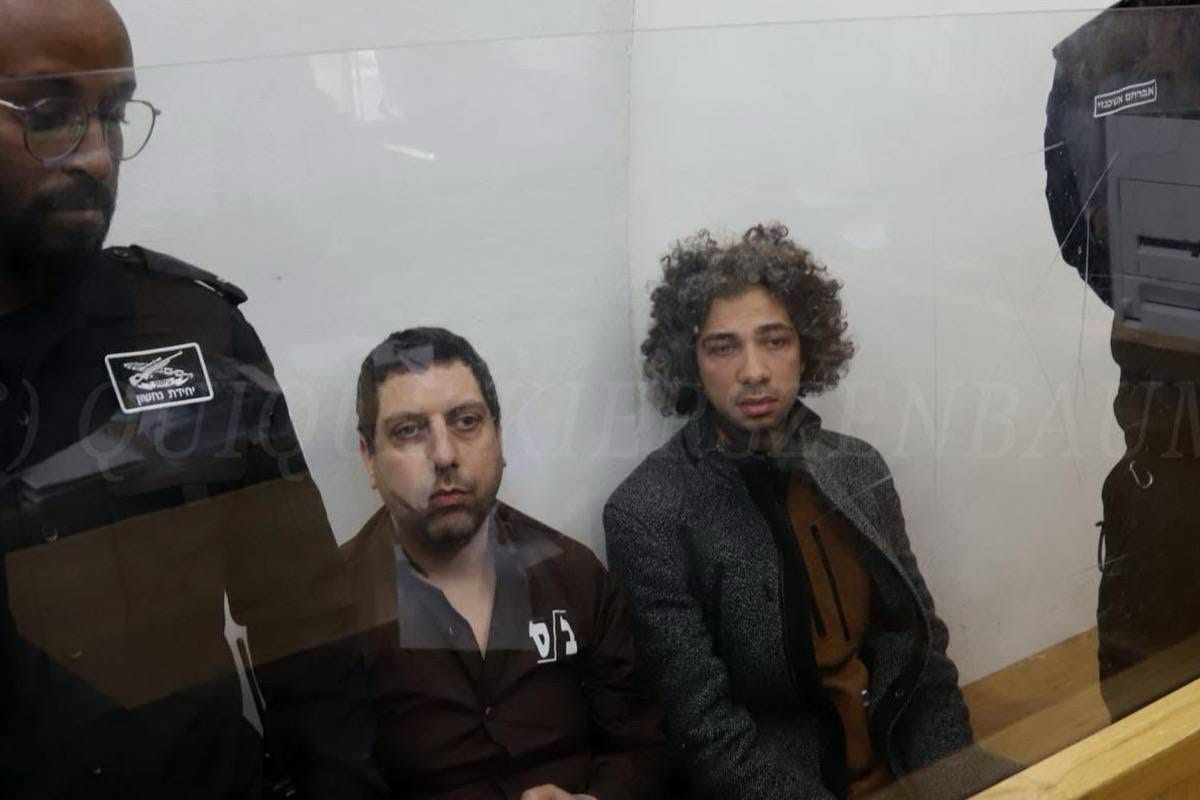
Back in East Jerusalem, I didn’t feel like I needed to keep a low profile or my head down because all of the residents were Palestinian and, I believed, would likely sympathize with my situation. In contrast, West Jerusalem was Jewish and very nationalist. Nearly everyone there had served, was serving, or would soon serve in the Israeli military. The men—and some women—carried rifles with them to cafes, restaurants and even doctors’ appointments. To them, anyone accused of being an enemy of the state was seen as an enemy of their own. Being in that environment made me anxious.
The next few days blurred together. I spent most of my time at Lea’s office, using her computer. Along with colleagues in the U.S. and some of the younger Palestinian lawyers in Lea’s firm, we compiled a comprehensive dossier for the security services or possibly a judge. It contained dates, quotes, screenshots, and photos from Israeli, American, and other international media, proving beyond any doubt that other outlets had reported the same information I had. The final document was 26 pages long. If the authorities were targeting me for another reason, they would have to come out and say it. We held off on sending it to the authorities because we expected to have more information to add to the package in the coming days.
My plan wasn’t just to rely on the 26-page dossier—I also wanted to leverage any politically influential contacts I had to pressure the authorities in Israel, since the U.S. government had failed to act on its own. The most significant name that came to mind was Robert F. Kennedy Jr., the son of Senator Robert Kennedy and the nephew of President John F. Kennedy, both of whom were assassinated. The Kennedy’s were considered American political royalty.
I had worked for Kennedy’s nonprofit five years earlier and had contributed research to his New York Times bestselling book about the career of Anthony Fauci. Under normal circumstances, getting Bobby to speak on my behalf would have been easy. But he was in the middle of a presidential campaign, had taken a fanatical pro-Israel stance, and was spending time with prominent Zionist political operator “Rabbi” Shmuley Boteach. Given the nature of the accusations against me—allegedly aiding Israel’s terrorist enemies—I wasn’t sure where he would stand.
Bobby’s phone number was in my confiscated phone, now in Israeli custody. A friend of mine gave me his number. As I paced back and forth in an alleyway in Central Jerusalem, I called him.
Kennedy answered immediately and had already heard about my situation. He told me he had spoken with a high-ranking Israeli official, who claimed that my reporting amounted to aiding the enemy during wartime—as if he were telling me something I didn’t already know. I told him I was well aware of the accusation and that it was completely false. He responded as if there was nothing else he could do. The call ended with him expressing sympathy but offering no real help.
I sent Bobby’s contact to Max Blumenthal and told him to take his best shot. Max managed to convince him to publish a public statement of support and concern, calling for the Israeli authorities to release me.
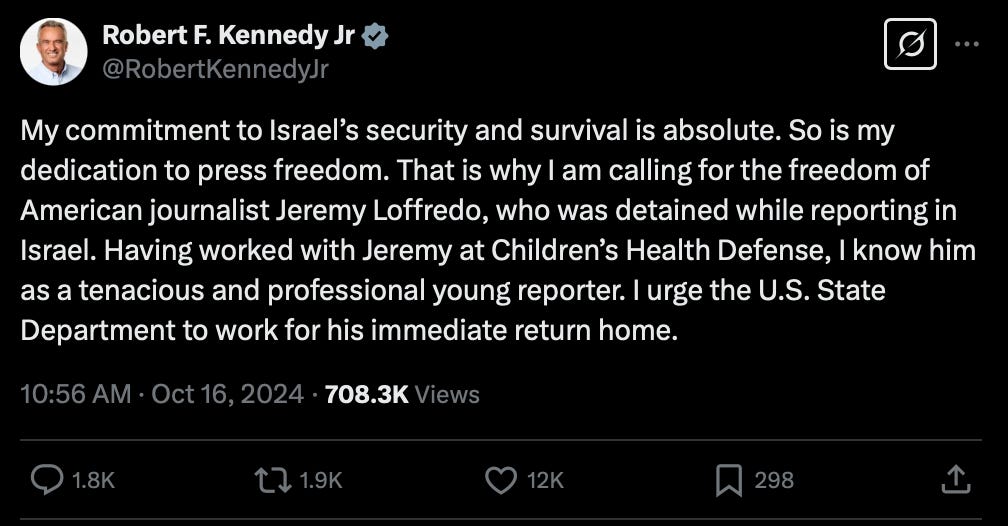
Kennedy opened his statement by reaffirming his support for Israel—a stance that undoubtably fails to align with my politics. But his statement wasn’t meant for me. It was directed at the Israeli authorities. If a well-known U.S. politician with pro-Palestinian views had called for my release, Israel would likely have ignored it. Instead, having a political figure who was actively running for president and had openly supported Israel’s ongoing bombardment of the besieged Gaza Strip made his call for my release far more effective. I added this statement to the document package I was preparing for the authorities.
It was now October 18th, three days until I was supposed to find out if I was being rearrested or given my passport, phone and laptop back. The mornings had become routine. For the entire week, I would go outside of Yasmin’s apartment at 7am, Lea would pick me up on her way to work, we would drive to East Jerusalem and I would pass the time in her office.
On the morning of the 18th, I was in Lea’s office, sipping coffee and on edge that at any time I’d be called in for another interrogation. I had finally managed to stop breaking a sweat every time her phone rang because it had been five days since my seven hour long interrogation. Maybe they gave up.
I planned to meet my friend Ben later that afternoon. He had moved from my neighborhood in New York City to Jerusalem to pursue some weird niche master’s degree in that had something to do with Arabic language. Since I still didn’t have access to my bank account, I had my brother send Ben money, which he would then give to me in cash. As a thank-you, I was going to buy him lunch. As I was messaging Ben figuring out when and where we would meet, Lea’s phone rang.
As she answered the phone, she widened her eyes at me—a silent signal that it was the intelligence agents handling my case. She spoke in Hebrew for a while before hanging up. The conversation was too stressful to watch without understanding, so I stepped into the other room. The fact that they were still investigating me, still discussing me, still trying to interrogate me—more than a week after my detention—made one thing clear: they were determined to find something. Anything.
When she finished, she told me the agents wanted me at the West Bank compound in one hour. They needed me to unlock my phone to see something. When I asked if they specified what exactly they needed to see, she said they wanted to see the October 2nd message from Max Blumenthal when he sent me the PBS video report of the Mossad HQ. I thought this was strange. How are they still asking questions about this viral video? I couldn’t refuse—doing so would mean immediate re-arrest. But voluntarily unlocking my phone for the very authorities who are trying to criminalize me felt like walking into a trap.
And who’s to say that once I unlock it, they won’t simply take my phone and go through everything? There are tons of messages between me and people connected to the Jenin Brigade—whom Israel classifies as terrorists—as well as clear evidence of my intent to meet with its fighters. Also, where are the cameras in the interrogation room? Could I enter my passcode in a way that blocks the ceiling cameras from seeing which numbers I press? Because what if this is all just a setup to trick me into revealing my passcode? Also, how did the Israeli security services not break into my phone yet? They told the judge they were actively trying and would succeed in a couple of days over a week ago.
I opened my burner phone and canceled my plans with Ben. Then, I sent a few messages to colleagues in New York, even though it was the middle of the night for them. After that, I placed the phone in a file cabinet in Lea’s office—I’d retrieve it when, and if, I made it back. I couldn’t risk the agents confiscating a second phone. Lea called me a taxi and I was on my way back to the compound.
When I arrived, the same Israeli woman was there to translate. We were both somewhat disappointed to see each other—I was unsettled that the interrogation was going to be long enough to justify hiring a translator — and she seemed to dread another exhausting session, remembering that the last one had dragged on for seven hours.
The same agent who had interrogated me before stepped into the garage-like waiting room where we were sitting. He was in plain clothes—jeans and a handgun tucked directly into the back of his waistband without a holster. The moment he saw me, he shouted with a thick Israeli accent for me to follow him, as if I had kept him waiting for hours. But I was actually fifteen minutes early. Whether he was genuinely angry or just putting on a show to intimidate me, I couldn’t tell.
Once inside the interrogation room, the agent reluctantly allowed me to call Lea but refused to leave. Sitting across from him, I told her outright that he was still in the room. He understood what I said and, visibly frustrated, insisted on speaking with her himself. I handed him the phone, and he spoke to her in Hebrew before giving it back to me. Lea then relayed his message: he wanted me to unlock my phone just to check the messages. She then told me to call her when I returned to Jerusalem. I handed the phone back to him, and he immediately hung up.
He opened a drawer, took out an white envelope containing my phone, and placed it on the desk in front of me. Then, he demanded that I unlock it. “I thought you had already unlocked it,” I said, without touching the envelope. As the conversation became more complicated, he turned to the translator and spoke to her in Hebrew. She then explained that, because I’m a journalist, I have different legal protections than ordinary people, which prevented them from forcibly accessing my phone.
Yet, during my court hearings, they had told each of the three judges that they had already started breaking through my phone’s passcode and would succeed soon. Not one of those judges had objected or stated that they weren’t allowed to do so.
I asked him what he wanted to see once I unlocked it. He wanted to see Max Blumenthal sending me the PBS NewsHour’s Nick Shifirin’s video on Twitter from outside the Mossad HQ. But he only referred to it as “the PBS video”.
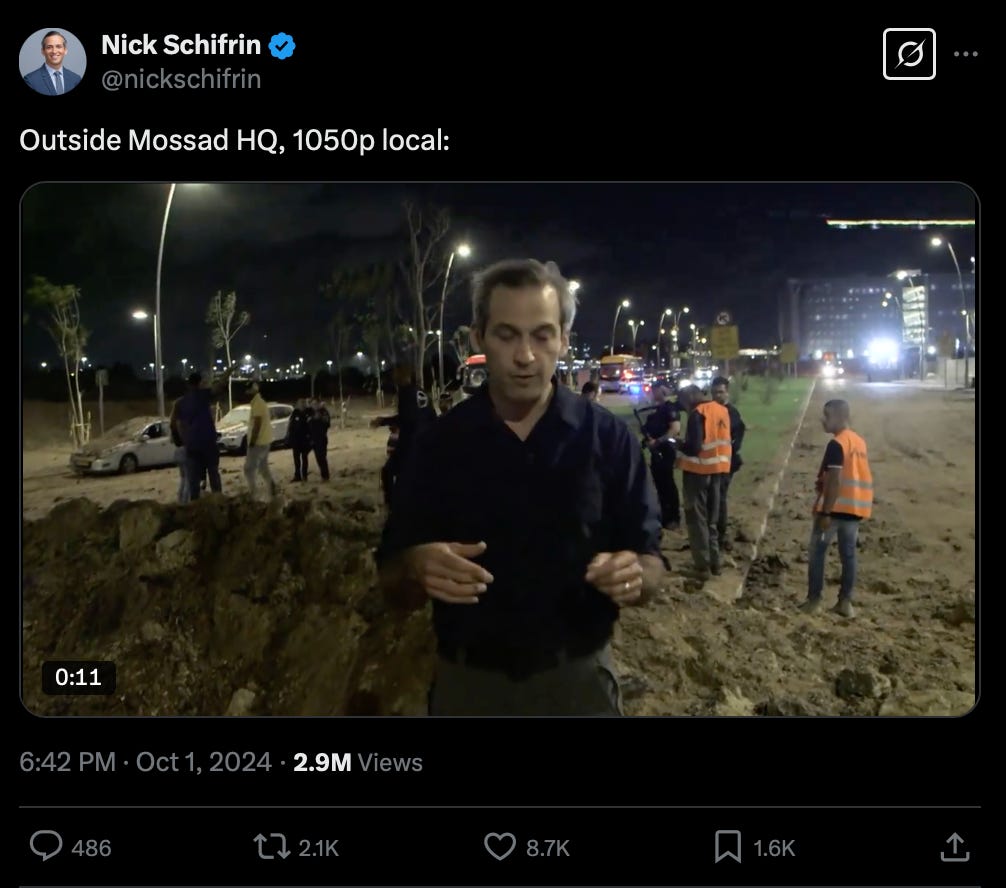
I took my phone out of the envelope and pressed the side button. The screen lit up—100% battery. It might seem minor, but this was the first personal item from before my arrest that I had seen or touched in nearly two weeks. My phone had been confiscated almost immediately, and now, after all that time, it was back in my hands. The agent ordered me to enter my passcode. I tried to use my upper body to shield the phone from any ceiling cameras—without contorting myself so much that I looked ridiculous.
I nervously typed in my passcode. I change it every few weeks, always using a slight variation of the previous one, but after so many days without unlocking my phone, it was no longer second nature. I accidentally entered the wrong code.
Normally, after entering the wrong passcode, you simply try again. However, iPhones, which is what I have, are designed to lock for increasing periods after multiple failed attempts: after six incorrect tries, the phone disables for one minute; after seven, for five minutes; after eight, for ten minutes; and after nine, for fifteen minutes.
When I entered the wrong passcode just once, my phone immediately disabled for fifteen minutes. That meant Israeli security services had already attempted to unlock it—guessing incorrectly eight times in a row.
I held up the phone and told the agent I had accidentally entered the wrong passcode, which had locked the device for fifteen minutes. For a brief moment, he looked embarrassed, but he quickly shifted to anger. I asked if they had been trying to unlock it. He flatly denied it. “That’s really interesting,” I said, knowing full well he was lying. I explained to him that this lockout only happens when the wrong passcode is entered multiple times in a row—yet I had only entered it incorrectly once. He didn’t respond. Instead, he left the room and didn’t return until the fifteen-minute lockout was nearly over.
When he returned, I entered the correct passcode, and my phone unlocked. It wasn’t connected to WiFi, but after I switched off airplane mode, it had cell service.
Almost instantly, a flood of notifications filled the screen—texts, Signal messages, WhatsApp messages, emails, and Twitter alerts from the past two weeks. I didn’t read them fully, just brief flashes as they rolled in. I didn’t want the agent to see anything—especially things I hadn’t even read yet, so I quickly put my phone back on airplane mode. After all, if he only wanted to check something in my messages, there was no need for an internet connection to access them.
He told me to show him, so I opened my messages with Blumenthal and scrolled back to October 2nd—as fast as I could—trying to bypass anything sensitive from the days leading up to my arrest on October 8th. I found the message he was looking for:
“Can you get to Mossad HQ? Apparently, there are craters.” The next message was a link to Nick Schifrin’s Twitter video. Then came another message: “Or better yet, Nevatim. I think the censors don’t want anyone to see the damage there.” That last message was an unfortunate one to have sitting right below the one the agent wanted to see—it could easily be interpreted as an attempt to evade Israeli censorship. And in fairness, that’s exactly what it was.
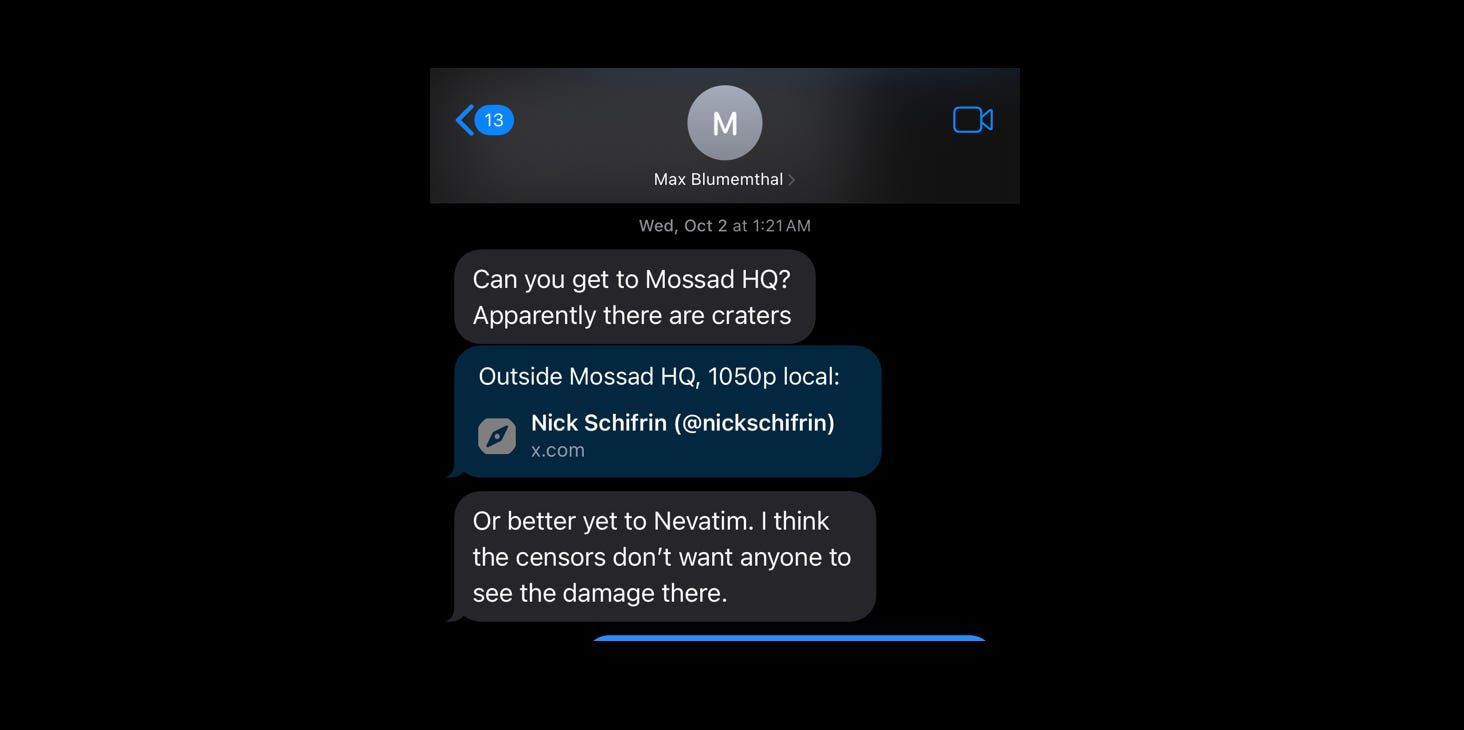
The agent told me to open the Twitter link to Nick Schifrin’s video. I turned off airplane mode and followed the link. The tweet partially loaded— we could see it had over 2 million views, thousands of likes and retweets, and the date and time it was posted, October 1st, 10:50PM which was three days before my report was published. The thumbnail showed Schifrin standing in front of a massive crater on the night of the missile attack. But when I clicked on the video for the agent to watch, it wouldn’t play. Instead, a pop-up appeared: “CONTENT UNAVAILABLE.”
Just two hours earlier in Lea’s office, I had rewatched the same video without any issues. Confused, I toggled airplane mode on and off, hoping it would reload. It didn’t. For a brief moment, the agent’s demeanor shifted—he seemed just as perplexed as I was. He took out his phone and snapped a video of the “CONTENT UNAVAILABLE” pop-up on my screen, touching the video over and over so he could document exactly what was happening.
He then turned his attention to the other message that Blumenthal had unfortunately sent me: “Or better yet, Nevatim. I think the censors don’t want anyone to see the damage there.”
The agent spoke in Hebrew to the translator, who then relayed the message to me. She told me that the message clearly showed intent to deliberately disobey censorship orders. I explained that “censors” means different things in the U.S. and Israel, and that the text didn’t demonstrate any such intent. To clarify, I gave an example involving U.S. President Joe Biden’s mental decline. I explained that in America, we might say “the censors” don’t want the public to notice the president’s cognitive issues. This doesn’t make it illegal or criminal to report on it; it just means it’s a topic that those in power prefer to avoid. The media might self-censor, not because it’s prohibited, but because it’s unpopular or discouraged. I was thinking on my feet.
After some intense back and forth, while maintaining my confidence, he seemed done with the conversation and told me to leave. I couldn’t believe I was actually leaving the compound while it was still light out. I had only been there for about an hour and a half.
I returned to Jerusalem and went straight to Lea’s office. She wasn’t there but Ahmed, her Palestinian colleague was at his desk and he let me use a computer. I couldn’t shake the agent’s intense curiosity about the PBS video. He had heard both me Lea mention it dozens of times and knew how much I was relying on it to prove my innocence, yet it seemed like the authorities had never actually seen it. Instead, it seemed, they were trying to verify its existence by checking the exact place I had told them I had watched it. The fact that the video wouldn’t load only made the situation more suspicious to me. The most logical explanation, I thought, was that the police or the security service network itself was being censored from viewing certain reports online. That would explain why they couldn’t find it on their own—and why, while my phone was inside the Shai compound, the content was suddenly “unavailable.”
I downloaded the Shifirin video at Lea’s office, so no online censors or network blocks could stop them from watching it. I also had the transcript translated to Hebrew. I put these files in the same folder as the dossier. I had Lea’s assistant send an email with all of this attached to one of the agents email address.
Around the same time, Max Blumenthal received an email from Nick Shifrin himself. A few days earlier, Max had reached out to Nick, asking if he had a Government Press Office (GPO) card and whether that particular video report on Twitter had been subject to government censorship or required approval. Nick took a while to respond, but when he did, he confirmed that did have a GPO card — meaning his report which showed the location of the missile strikes from outside the Mossad HQ—had been fully approved by the censor. That meant I had been thrown into solitary confinement, starved, and was now being threatened with life in prison for exposing information that had not only been published before me but was also officially sanctioned by the government
This part didn’t entirely make sense to me, and even now, I’m not sure if I’ll ever understand what exactly happened. The authorities I had been dealing with seemed to be censored from viewing a video report that was explicitly not censored according to a government approved reporter. It’s possible—likely, even—that Israel has different layers and types of digital censorship, restricting access in ways that aren’t always obvious. But this part of the story still doesn’t add up.
It was only a few days until October 21st—the day I would learn my fate. Would I be re-arrested and brought before a judge again, as authorities pursued their goal of imprisoning me? Would I be detained for a different reason, based on something they found in my phone? Or would I be released? And even then, Lea and I had no idea what “released” actually meant. Would I be deported? Or would I be allowed to stay in Israel and continue the reporting I had originally come to do?
Over the past week, I had spoken to my father several times on the phone. He had been trying to stay in contact with representatives and staff at the U.S. embassy in Jerusalem. Given the “special relationship” between the U.S. and Israel, I never expected the U.S. government to intervene on my behalf. But my father—an optimist who had never paid much attention to Israel until now—was forced to learn the reality of that relationship firsthand. Despite the fact that I was the only American journalist in Israel facing enemy-of-the-state charges for factual reporting, the U.S. embassy told my father four separate times that they would do nothing to help me. Instead, they sent that militant Israeli to my prison cell who chastised and threatened me.
The night before October 21st, I told Lea I would come to her office early the next morning, hoping we would hear from the authorities right away that I was free to go. Being at my lawyer’s office would make things easier if any action was required. However, she told me that unfortunately, she would be in court all day, as it was Monday and the first full session since the start of Sukkot.
Lea, at 79 years old, told me that on Mondays, instead of driving to the courthouse, she walks. She sets out at 6:45 AM, carrying a heavy bag full of casework over her shoulder. She suggested that I take a taxi to her house early in the morning, join her on the walk to court, and then wait around the outside of the court until she calls to tell me whether the security services had contacted her about my situation. I gladly accepted.
The next morning, I called a taxi to Lea’s home. When I arrived at 6:40 AM, she was already outside waiting for me. The walk to the courthouse was about two miles. As soon as we started, I asked when she thought she would hear from the agents. Her answer, which should have been obvious, was that she had no idea. Lea wasn’t one to make predictions.
We walked and she told me about the the different young Palestinian boys she’d be defending in court throughout the morning. We stopped for coffee and a breakfast pastry outside the Russian Compound, where I watched Lea exchange a few sharp words with a man who was sitting outside the café, smoking a cigarette and drinking coffee. After we went inside, she told me he was a well-known Jerusalem detective —one she often clashes with in court.
We walked through the section of the Russian Compound where guards from Moscobiyeh prison take their breaks. As I glanced at them, they looked back at me. I wasn’t sure what they were thinking, but I knew what I was hoping—that I would never again be shackled and dragged around by them. When we reached a certain point, Lea stopped and told me I couldn’t go any further. She told me to stay in the area and wait for her call.
It was still before 9 AM, and the streets were just beginning to shake off their early morning quiet. I wandered around, careful not to stray too far from the Russian Compound—but this was a part of Jerusalem I knew very well. I kept checking my phone for a message from Lea, even though there were no notifications indicating she had tried to reach me. After a couple of hours, Lea called only to say that the authorities still hadn’t contacted her. She told me that after her next court session, she would reach out to them herself to find out what was going on.
Around noon, as I sat sweating on a bench in the sun, Lea called again. She had spoken to the police, but they told her they still had no answers and would call her back. Even she couldn’t make sense of it. Were they still deciding what to do with me?How was that possible after ten whole days? According to the district court’s ruling, authorities could hold my passport and electronics for ten days. If they hadn’t found any incriminating evidence in that time, I was supposed to go free. So was it even legal for them to keep my passport beyond the deadline, effectively trapping me in the country?
By now, it was early morning in the U.S., and the few friends and colleagues who had my burner phone number started messaging me, eager for an update. They knew it was the long-awaited October 21st. But I had nothing to tell them.
In my bag, I had court documents and paperwork from the courts, the police, the security services. Out of sheer boredom, I pulled them out while sitting on a different bench and began flipping through them. They were exclusively in Hebrew so I couldn’t even read them.
The papers from the Russian Compound court bore the Lion of Judah, the official symbol of the Jerusalem municipality—expected. The district court and security services documents featured a menorah flanked by olive branches, Israel’s national emblem—also expected. But the paperwork from the secretive Shai compound, the Israeli police and intelligence headquarters for the West Bank (also known as the “Judea and Samaria Division”), carried a different insignia: a geographical outline of the entire West Bank interlocked with the Israeli Police’s Star of David. This symbol was striking—and nearly impossible to find online in the U.S.
Both Israel and the U.S. reject the claim that Israel occupies the West Bank, insisting instead that the territory is under Palestinian control. Having spent significant time there, I knew this wasn’t true. But what struck me was how blatant the reality was in the official insignia of the “Judea and Samaria” security services—a symbol featuring the entire West Bank interlocked with the Star of David and an Israeli security services badge. It was surprising to see such an open contradiction to the official narrative.
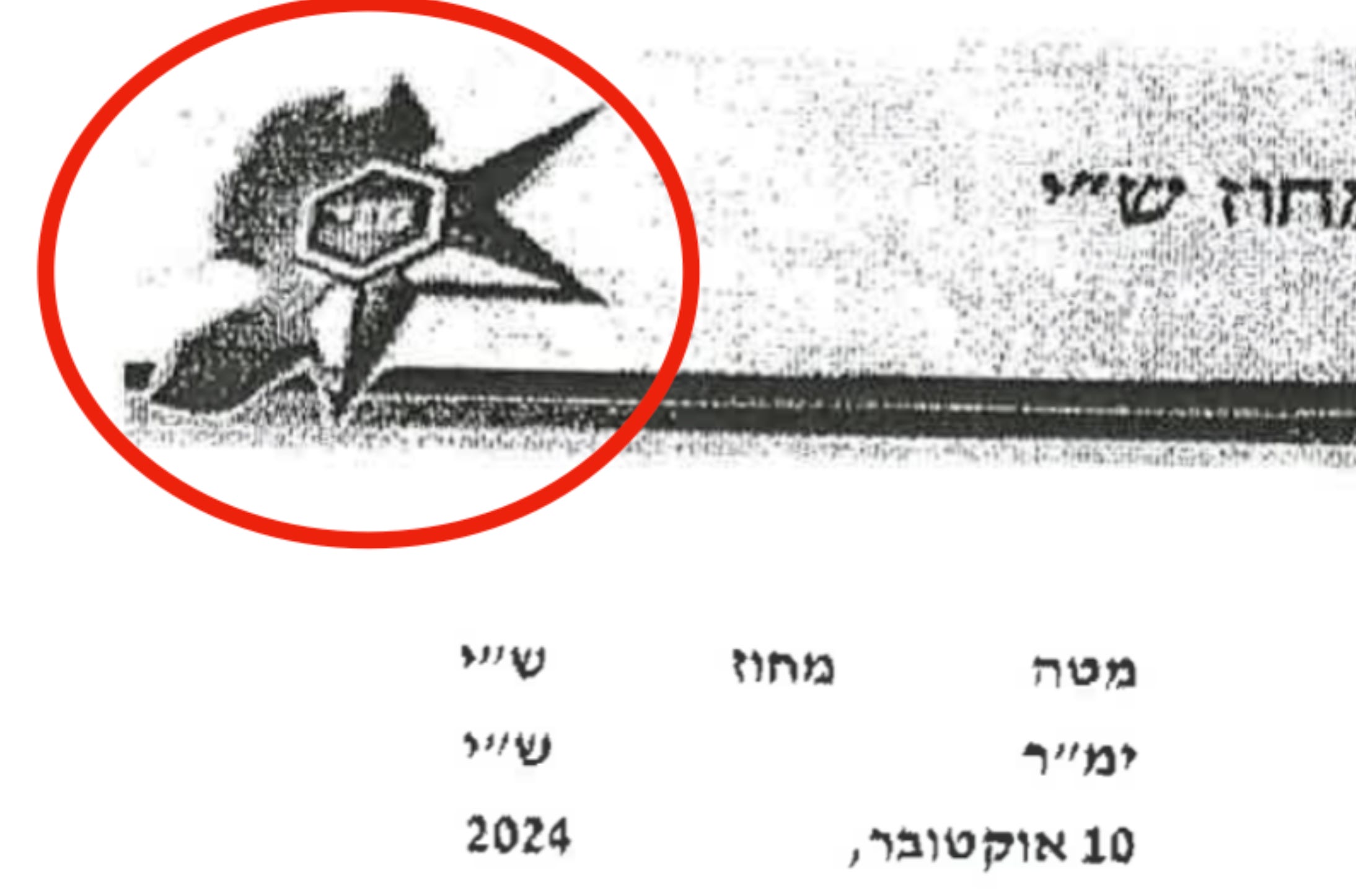
Lea called, and I answered faster than I ever had before. She asked if I could book a flight out of the country sooner than the one I already had, which was scheduled for October 23rd—just two days away. When I asked why, she said she didn’t know, only that it was what the authorities had asked when they called her just now. I told her yes. She told me to book it, send her the confirmation, and she would forward it to the security services.
Booking a flight on my burner phone would be nearly impossible. She told me to get to her office in East Jerusalem immediately—Ahmed, a lawyer in her office, would let me use a computer and help with everything. I didn’t waste a second. Half-walking, half-jogging, I made my way to the main street to flag down a taxi.
I told the taxi driver where I needed to go. “It’s dangerous there,” he said. “Lots of Arabs.” He was a Jewish and hesitant to even drive into East Jerusalem. In reality, East Jerusalem is just as developed, crowded, and livable as West Jerusalem—the only difference is that it’s mostly Palestinian. “I’m going to see my lawyer,” I told him. “Your lawyer is Arab?” he asked. “No, she’s Jewish.” He shook his head and told me that there’s no Jewish lawyers where we’re going. Conversations like this with Israelis happened more often than not. A grown man could spend his entire life in Jerusalem and never cross to the other side of town. He believed the people there were terrorists.
Because I was American and had told him that I was Jewish, the driver was actually very friendly—just curious and a bit puzzled about why I would willingly pay money to go somewhere filled with Palestinians. When we arrived on Lea’s street, he hesitated. He asked if I was sure this was the right place, if I wanted him to wait until I got inside safely, and reminded me to be careful. What he didn’t know was that I had spent nearly the entire week wandering around East Jerusalem, passing the time with no particular destination. In fact, I felt safer there than anywhere else in the city.
I walked up the stairs to Lea’s office and Ahmed was on the phone. I sat down and waiting for him to finish. He hung and had already heard from Lea and knew the plan. I sat in front of the computer and within one or two minutes I had already booked a flight for the 22nd of October, which was the next day. It departed from Tel Aviv in the afternoon and landed in Rome five hours later. From Rome, I’d go to New York. I just needed to get out of the country as soon as possible. Ahmed sent the flight confirmation to Lea. About an hour passed and I called Lea to ask what was happening. She told me they hadn’t responded.
We decided the best course of action was to give Itay, Yasmin’s boyfriend, who I had been staying with for over a week, power of attorney. This would allow him to go to the Shai Compound and attempt to retrieve my passport and electronics, even though they hadn’t shared any details about my legal situation—other than asking if I could book an earlier flight. We were testing the waters, in a sense, and pushing them to make a decision on whether they would allow me to leave or not. Lea said that sending Itay in my place was to minimize any chances of direct contact between me and the authorities.
I left Lea’s office with the power of attorney document and headed straight to Yasmin’s house. I handed it to Itay and told him he needed to request my passport, laptop, and phone. Yasmin decided to go with him, and they set off for the West Bank. Left alone in their apartment, I paced anxiously, waiting for news.
The compound was about a 30-minute drive east. After an hour and a half had passed, I estimated that Yasmin and Itay had been there for about an hour and figured it was reasonable to check in. Yasmin responded that they were still waiting.
I tried again 45 minutes later—same response: still waiting. By now, it was late afternoon, maybe early evening. They had been gone for nearly three hours. Just as I was about to call Lea to ask what it might mean for me that Itay and Yasmin had been left waiting for so long but then Yasmin sent me a photo on WhatsApp. No caption.
It was a photo taken from the passenger seat of Itay’s car—Yasmin holding my open passport, with my laptop and phone resting in her lap. I immediately called Lea to share the good news. It seemed like I had been given the green light to leave Israel. Lea contacted the police, requesting a formal letter confirming that I was free to leave—something I could show to airport security. They refused. When she called again, they stopped responding entirely.
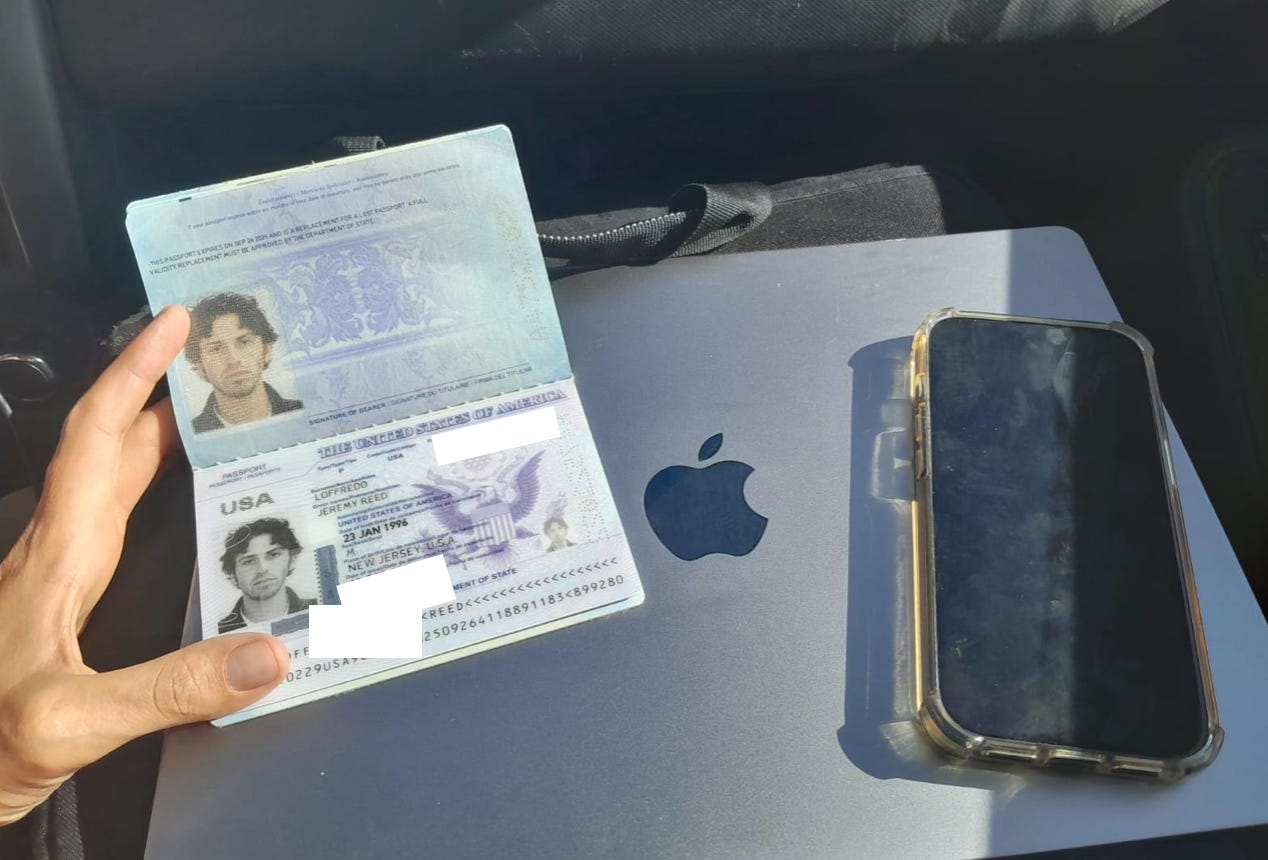
The security services who had been dealing with my case had gone completely silent. Technically, they weren’t forcing me to leave, which would amount to deporting an American journalist. But wouldn’t even put in writing that I was allowed to leave. Instead, they had demanded proof that I booked a departing flight within 24 hours, returned my passport, and then cut off all communication with both me and my lawyer.
According to Lea, this is a common tactic used when authorities want someone to leave but don’t want to face the political fallout of an official deportation. Instead, they make it unmistakably clear that leaving is in the person’s best interest. In my case, I had been imprisoned and was under investigation for charges that, if pursued, could have led to years in military prison or even my execution. Lea called this an “informal deportation.”
My entire ordeal—being treated as a potential terrorist despite being an American journalist—lasted 13 days. Between my time inside of prison and the subsequent and travel ban, I endured a total of 15 hours of interrogation. The relentless stress of knowing I could be picked up, re-imprisoned, and starved by the authorities at any moment made those thirteen days feel more like six months. Both in the little prison [Mascobiyeh] and the larger prison [Israel itself] time didn’t pass the way it normally did.
When Itay and Yasmin returned with my belongings, it was around five in the evening. I powered on my phone but kept using the burner, unsure of what, if anything, the intelligence services had done to it. Grateful for the space they had given me, I retreated to the room Yasmin and Itay had let me use, tidying up the bed and straightening the space.
Later that night, my friend Ben, who was living in the Old City, met me for beers. It was an odd mix of relief, celebration, melancholy, and reflection—trying to process everything that had just happened. For the first time since my arrest, I felt free to walk around West Jerusalem without constantly avoiding surveillance cameras or lowering my head when reservists carrying their M16s or M4 Carbines passed by or sat next to me.
In the early morning, I left a thousand shekels—about two hundred dollars—on Yasmin and Itay’s kitchen counter as a thank you for letting me stay in their home. Lea checked my case on some type of online portal for lawyers and told me that my case was still “open.” I made my way to the airport anyway. Since the authorities refused to provide anything official to show airport security or police proving that I was allowed to leave the country, Lea took matters into her own hands.
As my lawyer, she wrote a letter on my behalf, including the contact numbers of a couple of detectives and agents handling my case. But I didn’t know what to expect. The letter was legally meaningless, especially coming from a dissident, pro-Palestinian lawyer like Lea.
Normally, I would be questioned at Ben Gurion airport as part of routine procedures, but after my this recent run-in with the Israeli security services, the accusations of being an enemy of the state, and an open ongoing criminal investigation, I was expecting some sort of delay to my departure. But an airport interrogation by a couple security agents now seemed like child’s play compared to what I had just been subjected to.
I got to the airport at 7AM for a 1PM flight. Normally I’m late for flights and mock people who follow the “three-hour before” rule. One half of the reason I showed up seven hours early was simple: I was eager to leave Jerusalem and get to the airport, the final stop before leaving Israel altogether. The other half was uncertainty—I had no idea how long I might be interrogated, delayed, or held up.
I arrived so early that they wouldn’t even let me go through security yet. I had to sit and wait for three hours. I waited on a seat outside. Every time Israeli police or airport security walked towards me or pulled their car over I thought that it was time for my interrogation. It was a false alarm every time.
When I was finally allowed to begin making my way through the airport toward my gate, I handed my passport to a female Israeli security agent. She scanned it and, as expected, told me to wait as she walked over to a group of other agents and pointed at me.
A few moments later, she returned and asked what exactly I had been doing in Israel. I told her I was a journalist and launched into a brief but detailed rundown of my experience. For a couple of uninterrupted minutes, I explained everything that had happened—showing her articles from Haaretz that confirmed I was supposed to be held in the country for ten days after my release. I pointed to the date and essentially told her to do the math. I also presented the letter from my lawyer.
I had over-prepared, bombarding her with as much information as possible, hoping to avoid being brought to a secondary interrogation room. She flipped through the articles on my phone, skimmed the letter from Lea, and seemed to understand that whatever had happened to me was a matter for security services and intelligence agencies—likely above her pay grade. Finally, she looked up and told me to proceed through security.
Although I had been indirectly told to leave the country, I knew that anything could still happen. After everything that had unfolded over the past two weeks, I had no choice but to remain alert and cautious. Every time I looked up, I spotted at least five cameras directed at me. I couldn’t shake the feeling that somewhere in some back room, they were watching me, tracking my every move to ensure I boarded my flight. It didn’t feel unreasonable, considering I was still under investigation as an enemy of the state.
I sat down in the food court and had a Kosher Burger King meal. I couldn’t bare anymore hummus or tahini. Kosher Burger King is like normal Burger King but there’s no cheese. As I ate, I counted all of the cameras pointed right at me. I stayed ready, almost expecting to be pulled aside and questioned at any moment. But, fortunately, it didn’t happened.
At the gate, the flight was delayed first by thirty minutes, then another hour, and finally by another thirty minutes. In my justifiably paranoid state, I couldn’t help but think the delays were all because of my presence on the flight.
I boarded the flight and landed in Rome five hours later. I was supposed to get on a connection to New York but because of my flight delay in Tel Aviv, I had missed it. Normally, missing a flight is a giant inconvenience, but for me, after safely escaping Israel, being in a free man in Rome for an evening wasn’t that bad. I got dinner, walked around and finally returned to social media where I had been MIA since my detainment.
I received a Twitter message from Ryan Grim, formerly of The Intercept and currently of Drop Site News. He told me that I had been brought up in the State Department press briefing earlier that day. A journalist from the Epoch Times asked Vedant Patel, the Deputy Spokesperson for the State Department about my situation. The reporter told Patel that American journalist Jeremy Loffredo was arrested, detained and then ordered to remain in the country for ten days or until October 21st. Patel responded: “My understanding is that Mr. Loffredo has um…left Israel.”
I looked at the time the briefing took place and saw it had actually taken place 45 minutes after my plane took off — meaning the U.S. authorities were receiving updates and intel regarding my situation so often that they were able to publicly say I left Israel within an hour of the wheels going up on my plane. During my thirteen-day ordeal, the U.S. State Department held seven press conferences, each lasting about an hour. Not once did they mention my case.
When I was arrested by the Israeli army at a military checkpoint as an American journalist, the U.S. government was undoubtedly aware of the situation but chose to remain silent. Then, when Israel held me in solitary confinement for 85 hours, starving me while trying to charge me with enemy-of-the-state crimes for reporting facts, the U.S. stayed quiet—despite embassy staff attending my court appearances. After I was interrogated for hours in the West Bank—once in the middle of the night and again for an entire day, as they tried to criminalize my factual reporting and seized my passport—the U.S. government still failed to respond.
When they finally spoke up, it wasn’t until after I had already left, and they used incredibly passive language. They said nothing about the harsh conditions I was imprisoned under, the way I was treated, or the bogus charges leveled against me.
Compare this with Evan Gershkovich, the Wall Street Journal reporter arrested in Russia on March 30, 2023. Within 24 hours of his detention, Secretary of State Antony Blinken publicly called for his immediate release. The next day, President Joe Biden did the same.
The U.S. government presumably remained silent about my case because speaking out would have cast a negative light on a key U.S. ‘ally’—Israel. In contrast, Gershkovich’s detention in Russia aligned perfectly with the U.S. narrative of Russia as an authoritarian state, so the government quickly condemned it and continued to do so. This creates a dynamic where being detained by Israel, a U.S. ally, may be worse for American journalists than being detained by U.S. adversaries. The U.S. goes to great lengths to protect the image of Israel as a free and democratic state, even if it means sacrificing the rights of its own citizens, while actively working to tarnish the reputation of enemies like Russia.
When I arrived back in New York, it felt like I had been gone for years. The entire nightmare was finally over but unfortunately I was returning empty handed. I had spent no time in Jenin or Nablus documenting the destruction of the refugee camps or interviewing the resistance fighters. I had also not joined far-right Israeli nationalists at the Gaza border’s Erez crossing as they called for resettlement along side Likudnik fanatical figures like Itamar Ben Gvir or Bezalel Smotrich.
As of March 2025, I’m still banned from returning to Israel. According to Lea, the authorities are deliberately keeping my case “open” and the investigation “ongoing,” ensuring that I can’t return to work—because if I did, I would be detained as soon as I landed.
Shiler Mahmoudi, an investigative producer for the BBC, was planning to cover my story, but the piece never aired [supposedly] due to the U.S. election and the January ceasefire (which has since ended). She reached out to both the Israeli Police and the IDF regarding my treatment. The Israeli Police Spokesperson’s Unit has remained tight-lipped. They told Mahmoudi, “Regarding the ongoing criminal case under the police’s jurisdiction, for obvious reasons, we are unable to disclose information about ongoing cases.”
No posts
Comments
Nothing yet. Say the first thing.
Sign in to join the conversation.