
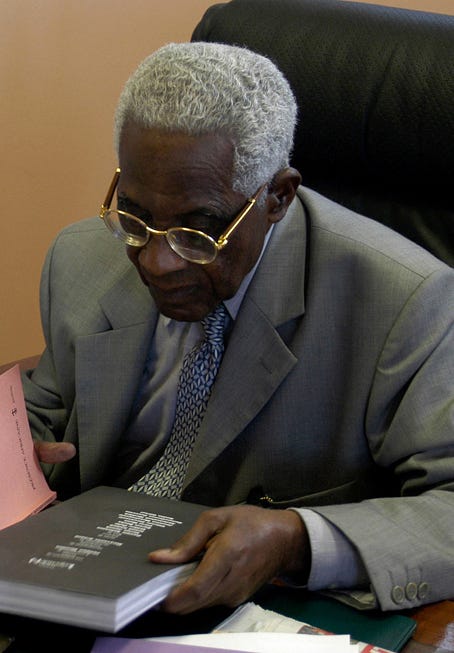
The poet Aimé Césaire often described the French of colonial administration as a flattened, “normalized” instrument, ill-suited to convey the lived experience of Black communities. This contrasts with African and Creole oral cultures that teem with images, rhythms, and proliferating names for things. In his writing, Césaire bent French “to his will,” saturating it with neologisms, dense metaphors, and surrealist shocks so that it begins to mimic the generative, world-making power of those oral traditions. Rather than decorating French, he retooled it so it could see what standard French could not.
The reason to study languages is not just to communicate better with clients and colleagues. It is to acquire more lenses for seeing what monolingual peers cannot. A greater mastery of images, rhythms and words can replace stalemate with invention.
I often think of Césaire when I see how subtlety and nuance are changing in the age of digital and social media. The loss of non-verbal and contextual cues and the shifts in what counts as nuanced or expressive language challenge our understanding of what’s going on in ways that can blindside us to changing realities. There may even be a case, here, for intensive language classes in engineering and business school curricula. The reason to study languages is not just to communicate better with clients and colleagues. It is to acquire more lenses for seeing what monolingual peers cannot. A greater mastery of images, rhythms and words can replace stalemate with invention.
In my book, Architects of Change, my former colleague Jean-Noël Kapferer tells me about an interesting experience he once conducted, translating the word “luxury” into Chinese. He didn’t get one or two words, but five. Whereas in Western languages, “luxury” derives from the Latin luxatio (meaning dislocation or excess that can’t be rationally justified), Chinese offers only approximations, each emphasizing different aspects.
As I argue in the book:
The linguistic void Western luxury companies found in China forced a creative breakthrough. Brands couldn’t translate luxury; they had to invent it. Success required reimagining what luxury could mean in a culture with entirely different reference points.
Creativity is not necessarily recombining existing elements, but also creating entirely new frameworks and meaning when the old ones don’t translate or exist. This capacity to create new shared fictions, new focal points for coordination, is what separates knowledge workers from architects of change.
We've always known language is a form of power, since Césaire and perhaps before. When we find new words, we see differently. And when we see differently, we create new things.
Architects of Change is available wherever good books are sold.
Comments
Nothing yet. Say the first thing.
Sign in to join the conversation.