

I’astremuri des lendemains” (The star ripens from the morrow)
- Mallarme
“Worte Sonnen seien, die morgen aufgehn werden” (words are suns that will arise tomorrow)
- Hagen
It was Jean Gebser (1905-1973) who noted the poetic affinity between these two statements. Stephane Mallarme (1842-1898), a French poet penned these lines (“the star ripens from the morrow/tomorrows”) shortly before his death. Friedrich Hagen (1780-1856), a German philologist, was active a generation earlier. For Gebser, however, both of them shared a “fundamentally new ‘attitude’ or ‘demeanor.” Today this might be referred to as a ‘new worldview,’ although this term arguably falls too short of the sheer depth of transformation Gebser was attempting to articulate. It involves dramatic restructuring of modern consciousness, and a new relationship with space and time.
This new consciousness of time has been on my mind as I prepare the course materials for “The Future Arrives Through Strange Reversals,” a summer class I’ll be offering here at the end of July.
What if time was far more fluid, more elastic than we presume, and other futures were already present here and now?
What if we took that primordial leap of trust and we lived as if other futures were not merely abstract probabilities but actualized realities?
Can we create zones where ecological futures have already already arrived? This seems to suggest that the future is something which we must both make happen, in the sense that Anna Tsing has described as “making a life” in the capitalist ruins, and something which we let happen. By the latter I mean that we can cultivate an attitude of ‘sense-fullness’ towards what is present and in relation. As Cynthia Bourgeault discussed with me earlier this year, attention is the new time, and so futuring becomes a matter of tending and attending to the present.
In this way, the present blooms with the teeming colors of worlds that may-be and will have been, and it behooves us to tend and attend them, for you and I and all beings of the present share agency in shaping these worlds in common.
In the words of Rainier Marie Rilke: “our looking ripens things.”
I have come to appreciate a certain quality, perhaps a shared affinity, that I sense in the words of Bayo Akomolafe (who I am looking forward to being in dialogue with at the Imagine Retreat in September). “To the prophets of doom who insist we’re out of time,” Akomolafe describes,
“Yes. We are out of time. There’s no more time. But there is sanctuary.” (“The Untimely,” Long Now Foundation)
There is sanctuary. There are beings making a life in the ruins. Many futures dwell here, as T.S. Eliot poetically evokes: “The things that are to happen / have already happened.” There are words we are beginning to invent for this new consciousness of time. Solastalgia, for instance, means an anticipatory mourning for the loss of ecological habitat.
The world that has not yet vanished, and yet is already haunting us.
Systems thinker Nora Bateson has offered us another word that, as I will suggest in class, is necessarily entangled with our new temporal structure of feeling: aphanapoiesis, or “the unseen coalescence that brings about vitality” in living systems. If words are indeed “suns that will arise tomorrow,” then let us also attend to the ripening of this star.
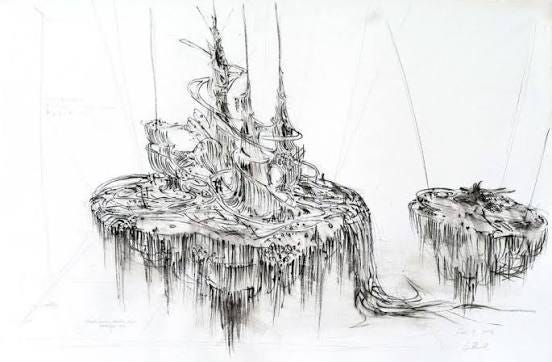
If we are to practice wayfinding towards planetary and regenerative futures, then we will need to attend to what is present. We must come to see the new time in all its fullness. The present radiates with a sheer excess of being. It brims with unbearable tensions and paradoxical “co-impossibilities” (Katherine Keller).
Perhaps we ought to start imagining this present as if it were a medicine bundle, or carrier bag, because we have a co-agentic role in shaping the kind of relationships that go in this bag.
Which ones are already present, and coalescing? What arrangement of tensions and synergies aid the (ongoing) process of moving towards vitality, healing, worldview shift?
What are the elements, relations, landscapes, that promote our mutual ripening?
The present is futuring when we grieve for the loss of certain tomorrows and the rupture of relations. The present is also futuring when we perceive that these cracks in the present are zones of refuge, sites where new ways of making a life in the ruins have already begun to take shape.
This is the temporality of the present we will practice embracing together in class. In the metaphysics of my own Mexican ancestry it is called nepantla: a liminal time when dissolution and solution, collapse and regeneration of the world are co-existent realities (Gloria Anzaldua).
It is in this middle that we must take our leap of primal trust, and find our footing in ecological futures.
May these futures ripen in us.
See you in class for “THE FUTURE ARRIVES THROUGH STRANGE REVERSALS.”
Comments
Nothing yet. Say the first thing.
Sign in to join the conversation.