
In July I made myself ask a question I’d been avoiding.
Is this dashboard actually giving me more value than Todoist would? Or is it just better looking, and am I more attached to it because I built it?
That’s an uncomfortable question to ask about something 250+ of you are running. But it’s the question that produced everything in this update, so I want to walk you through it honestly before I get to what’s new.
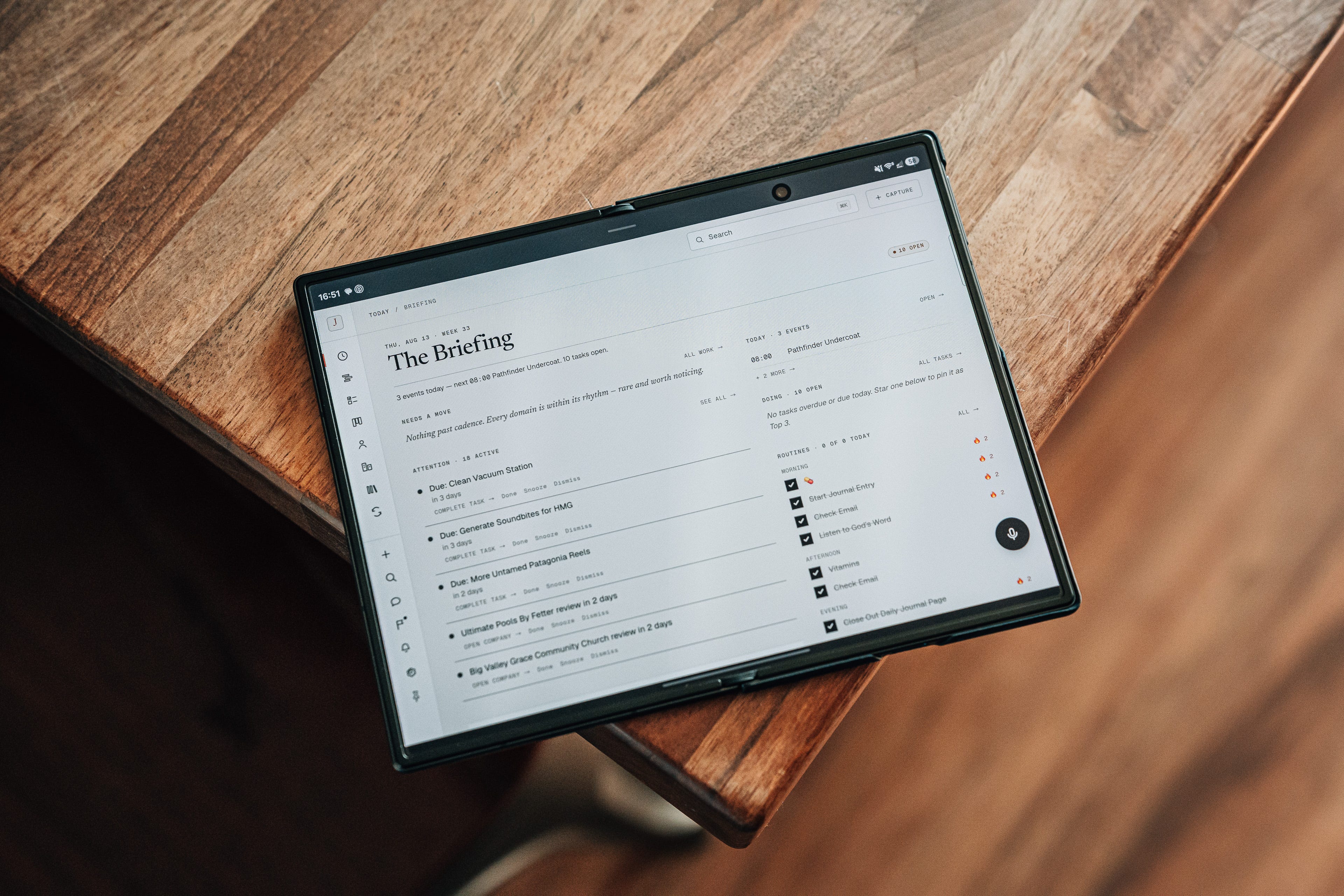
There was real friction I’d been living with. Adding tasks and connecting them to projects took more steps than it should have. Voice capture is genuinely great, but Todoist can do voice capture now too. The harder questions were the ones underneath: when I speak a task in, does it connect itself to the right project? And what happens when it doesn’t?
At the same time, I had just shipped a personal module into the system. A nightly shutdown at 8:30. Five checks I’d walk through about my day. A win rate. A weekly recap. On paper it was exactly what I’d wanted: the benefit of a coach who comes alongside you and says here’s what you did well this week and here’s where you fell short.
In practice, it was me checking boxes. Or not checking them, and watching a score go down.
I used it for about two weeks, and I knew before the first week was over.
The nightly timing worked against me. By 8:30 I’d already disconnected from work and been with my family. The shutdown asked me to jump back in, reopen the day, and grade it, sometimes while I was still carrying tension from the things that didn’t get done. Then I’d write a sentence of intention for tomorrow, and it felt strange writing it after checking off a day I wasn’t happy with. There was no joy in any of it.
Here’s the thing I keep having to relearn, and I suspect I’m not alone in it. A feature only removes friction if it connects to a challenge you’re actually facing. Sometimes you’re not even aware of the challenge you’re facing, and then the feature, however well designed, is just another thing to do. I don’t need more things to do every day. I need a better way of managing the things that already exist. And that has to come by subtraction, not addition.
The concept wasn’t wrong. I still think it’s a well-designed system. But I think it’s a coach’s tool. It works when someone else is looking at that information and using it to shape how they guide you. Implementing it on myself, every day, alone, was never going to hold. Maybe there’s a version where Claude plays that role dynamically, reading the day and adjusting its approach the way a person would. I don’t know how to prompt that yet, and I’m not going to pretend a scoring screen is the same thing.
So I pulled it out of the dashboard. I kept the prompting, the notes, and the structure in a document, because I don’t think the idea is dead. It’s just not a feature. What replaced it is one line: tomorrow’s focus. Optional. If I want to note it, it’s there. And I’ve gone back to picking the three main tasks I’ll work on the next day, with everything else waiting for leftover bandwidth.
That decision set the tone for everything else in this release.
That’s the biggest mindset shift to come out of this whole process.
The dangerous thing about being able to build whatever you want, whenever you want, is that proof becomes permission. Version one worked. People are using it, and it works well for me. So the pull is to stack on new features because I can, and because each one sounds good in the moment. Some of them would even solve an immediate need. But an immediate need is not the same as an ongoing benefit, and every feature is something that has to stay sustainable after the novelty wears off.
So version two isn’t a feature release. It’s an honesty pass. I went through the system asking what had actually earned its place after months of daily use, what was friction I’d been tolerating, and what was there because I’d been proud of building it.
Below is everything that changed: the redesigned briefing built around one question, the three states every piece of work now lives in, the structural crisis that almost had me rebuilding the foundation, a widget that turned into an Android app, how to upgrade your copy safely, and where the numbers stand after months of running this thing.
The rest of this post is for paid members, along with access to the updated 2.0 repository.
Comments
Nothing yet. Say the first thing.
Sign in to join the conversation.