
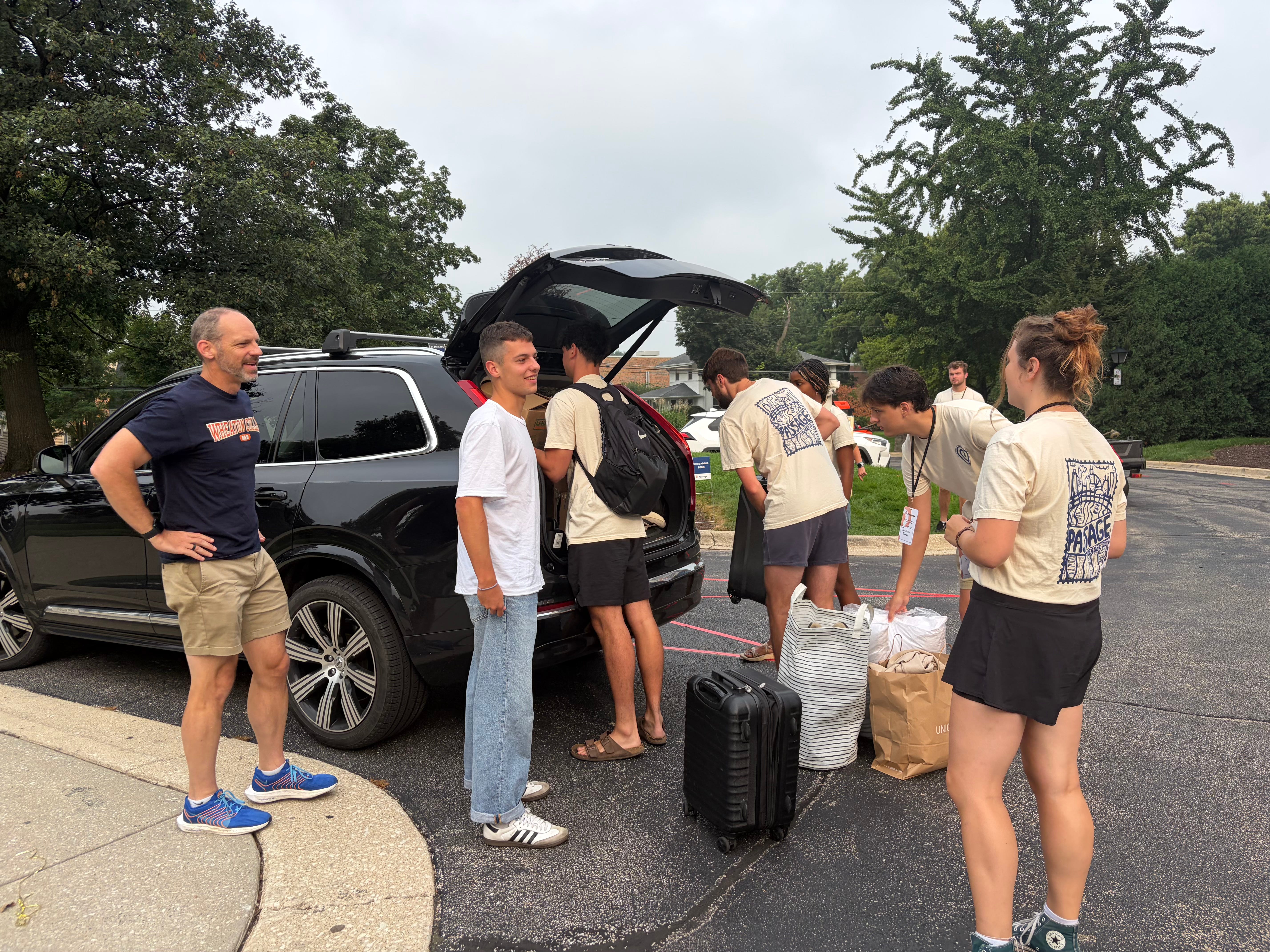
From the front passenger seat of our Volvo SUV, I am writing a first draft of this post. Four years ago, our minivan was stolen in the early hours of the morning from our driveway, someone having left the keys in the glove compartment. I miss the minivan only on the rarest of occasions—but today might be one of them. The rear seats are stuffed like sausages with most of the worldly possessions of one of my 18-year-old sons.
“Do you think people will know we’re moving a kid to college?” my husband asks. We both know the shower caddy at the top of the heap speaks with obviousness.
Except for the moment this son sat hugging the dog this morning, a moment of final goodbye, I haven’t cried much in recent days as we’ve marched toward our emptying nest. There is one more son to move next week, so maybe the dam will burst that day, when I come home to the quiet. A shroud? A hush? The metaphors for that quiet would tell their own truth, though I’m not forcing myself to choose one just yet. I can’t yet know what it means that twenty-five years have come to their end—twenty-five years of raising humans. Half my life—hevel, as the biblical writers might say.
Breath. Vapor. Mist.
When Ross Douthat gave a kind of exit interview from The New York Times on Ezra Klein’s podcast recently, he described his experience of the early 2000s. He was a copyeditor and copywriter for The Atlantic, and he was just emerging into the new blogging scene. I was not a published writer then, and he may as well have been describing his orbit of the earth in a spacecraft.
Beginning in 2001, for a good ten years, until these twin sons of ours went off to preschool, I was an at-home mother. Our days were scheduled with playdates, with music classes, with trips to the local public library and zoo. The daily “offices” of those years involved meals and snack time and reading before bed. These were days recognized for the regularity at which I swept the kitchen floor, a memory two college students who lived with us at the time have recalled with vivid clarity. “So. Much. Sweeping.”
But now those days are swept into the tide of years, and it is time for goodbye to these last of my sons as they wing their way into the world of emerging adulthood. What will I do with myself on this side of change?
“I can write!” I startle awake one morning, weeks ago, with the most obvious of epiphanies. I will write my way into this change that I can’t stop and might yet wish to hold off. When I dropped these two little boys off to preschool and skipped home, both hands free, I started to write—and will continue to write even now. I will write, listening to my life—and to God in my life—and remember that paying attention can be its own act of worship. I will write—and remember that my life was never limited to my role as mother (though it was a really good run, if I can say that).
The psalmist often speaks of the “multitude of mercies” we receive from God. It’s a phrase that suggests a brimming plenteousness, an abundance that can’t be contained. The phrase comes to mind now, as I search for a way to capture what I’m trying to hold, to name, to release. I should have taken more pictures, should have printed more albums, should have written all the mundanities the grandmothers told me I’d forget. These 25 years have been good—and hard and loud and harrowing and happy and ordinary and monotonous and unrepeatably beautiful. How do I let them go? How do I let them be what they were without demanding they continue, sure to decay in my clenched fists? As my friend Laura Fabrycky wrote so vividly in her poem, “Kumquat,” How else can I eat you but whole?1
I had to live these years whole—and now must remember them whole. And when I do that remembering, I will write.
No posts
Comments
Nothing yet. Say the first thing.
Sign in to join the conversation.