
By the time she turned eighteen, Doris Day was already carrying responsibilities that would have been daunting for someone much older. She was a single mother with an infant son, little financial security, and a career that had only just begun to take shape. The marriage that had promised stability had collapsed into violence, leaving her with one clear priority: providing a life for herself and her baby, Terry.
In early-1940s America, that situation carried a stigma as well as a financial burden. Divorce—particularly for a young woman—was still widely viewed as a moral failing rather than an escape from danger. Single motherhood existed largely outside the boundaries of what society considered respectable. Women in that position were often expected to retreat quietly into dependence on family or low-paid domestic work.
Doris chose another path.
There was only one thing she could rely on: her voice.
Music had already redirected her life once. After the car accident in her teens ended her dream of becoming a professional dancer, singing had emerged almost unexpectedly as a new direction. Now that talent became something more than artistic expression. It became survival.
The big band world that had first introduced her to professional performing now became the foundation on which she rebuilt her life. In the early 1940s swing orchestras remained central to American entertainment. Ballrooms across the country filled with dancers, radio broadcasts carried orchestras into homes, and band vocalists were an essential element of the sound.
Doris returned to that circuit determined to make it work.
Touring with orchestras was demanding rather than glamorous. Musicians traveled constantly, moving from ballroom to ballroom, performing late into the night before packing up and heading to the next city. For a young mother the logistics were complicated.
During these early touring years, Terry remained primarily in Cincinnati with Doris’s mother, Alma Sophia Kappelhoff. Family support made it possible for Doris to work the national band circuit. Alma provided stability for the baby while Doris traveled, earning the money that would support them both.
Like many working women of the era, she depended on relatives to help raise a child while she pursued employment. Whenever touring schedules allowed, she returned home between engagements, maintaining as close a connection with her son as the rhythm of the road permitted.
It was not an easy arrangement, but it allowed her to keep moving forward.
Her first significant opportunity came with the orchestra led by Jimmy James. James was a regional bandleader whose group toured Midwestern ballrooms and dance halls during the early years of the decade. His orchestra was part of the extensive network of bands that sustained the swing era—professional ensembles that might not have been nationally famous but provided steady work for musicians.
Doris was hired as the band’s vocalist after recommendations circulated among musicians who had already noticed her voice. In the big band world, word of mouth mattered enormously. Singers were often hired through informal networks of players and bandleaders who passed along the names of promising performers.
With Jimmy James, Doris gained essential experience. Night after night she sang for dancers in packed halls across the Midwest, learning how to hold a room’s attention and how to deliver a lyric so that it felt natural rather than rehearsed. These performances sharpened her instincts and built the professional confidence that would later define her.
Her next step up the ladder of the swing world brought her into the orbit of Bob Crosby.
Crosby—brother of the already famous Bing Crosby—led one of the most respected orchestras of the late swing era. His ensemble was nationally known, appearing on radio broadcasts and performing major ballroom engagements. Working within that musical environment placed Doris among some of the most accomplished musicians of the period.

The big band circuit functioned as a kind of traveling professional network. Musicians moved between orchestras, recommended one another for jobs, and kept track of emerging talent. As Doris continued performing, her reputation as a vocalist with a warm, natural style began to spread.
What made her distinctive was the quality of her delivery. Rather than approaching a song with theatrical flourish, she sang with an easy, conversational warmth. Listeners felt as though she were speaking directly to them. That sincerity resonated strongly in dance halls filled with young couples navigating the uncertainties of wartime America.
Word of that voice eventually reached the bandleader who would change the course of her career: Les Brown.
Brown’s path to success had been unusual. Born in Pennsylvania and educated at Duke University, he had first built his reputation leading the college dance band known as the Duke Blue Devils. By the late 1930s he had transformed that ensemble into a nationally touring orchestra, Les Brown and His Band of Renown, admired for its tight arrangements and polished musicianship. The group became a staple of radio broadcasts and major ballroom engagements across the country.
Brown valued clarity and warmth in his singers—qualities that matched the elegant, accessible sound he cultivated with his orchestra.
In 1944 the band found itself in need of a new female vocalist. Musicians who had heard Doris perform began recommending her name. The big band world was small, and talent circulated quickly through its informal networks.
Brown arranged an audition.
When Doris sang for him, the response was immediate. Her voice carried exactly the qualities he was looking for: sincerity, warmth, and an unforced intimacy that made listeners feel personally addressed. She did not overwhelm the band; she blended with it, letting the melody breathe.
Brown hired her.
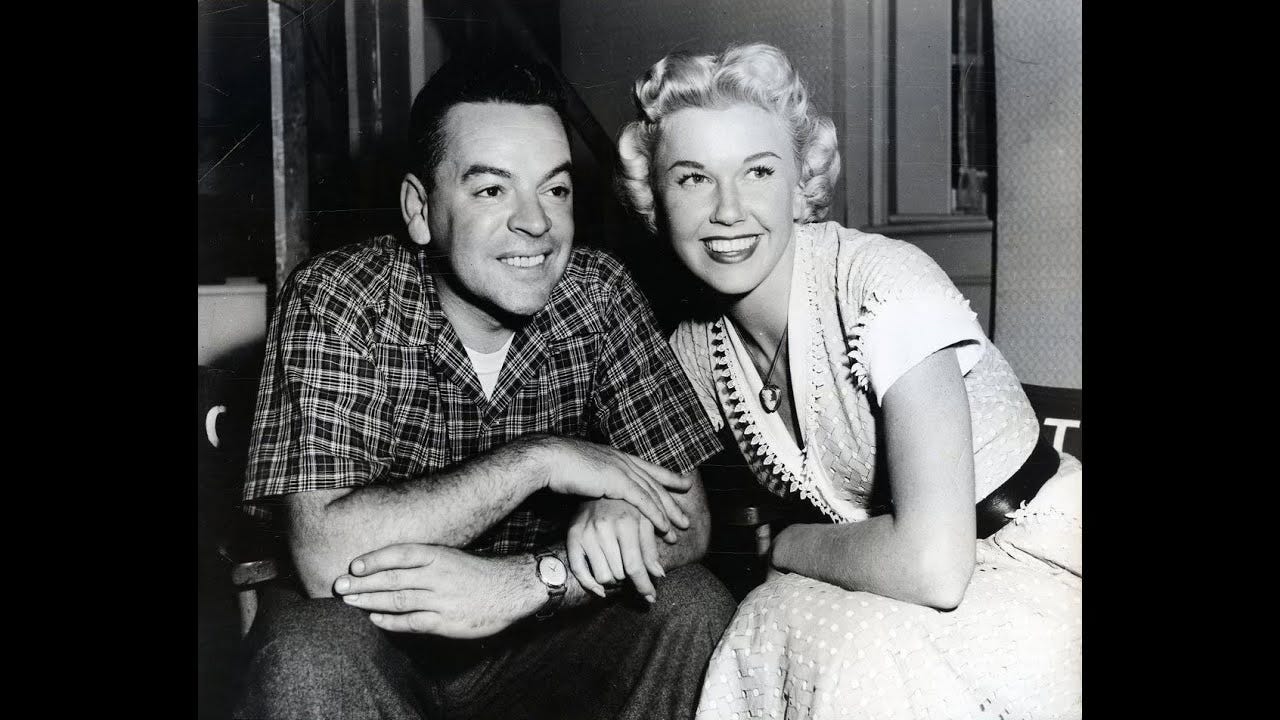
The partnership proved transformative for both singer and bandleader. With Brown’s orchestra Doris stepped onto a much larger national stage, performing in major ballrooms and appearing regularly on radio broadcasts. Audiences quickly responded to the natural ease of her delivery.
It was with Brown that she recorded the song that would change everything: “Sentimental Journey.”
The timing could not have been more powerful. As World War II drew to a close, millions of Americans were thinking about home—soldiers stationed across the globe, families waiting anxiously for their return, communities preparing for reunions after years of separation.
“Sentimental Journey” captured that mood perfectly.
Doris sang the song with gentle sincerity, giving voice to the longing and hope shared by an entire nation. The recording quickly became one of the defining songs of the moment, played constantly on radios across the country as soldiers returned home.
Almost overnight Doris Day was no longer simply another vocalist traveling the band circuit.
The record launched her national career.
Comments
Nothing yet. Say the first thing.
Sign in to join the conversation.