

On the High Holidays of Rosh Hashanah and Yom Kippur, the prayer Hineni is sung by the cantor in preparation for teshuvah, the practice of self-reflection, repair, and repentance for the wrongs we have committed.
Hineni in Hebrew translates to “Here I am.”
It is not a declaration of being physically present.
It is presence.
It is a declaration that we are ready for what we are called to in this moment.
Time bends.
It has been three weeks. It has been 75 years. It is 1948. It is 1973. It is 1967. It is 1917...
Time is tearing through our bodies, shattering reality and raining down shards of truths.
October 7th, 2023 Hamas carried out a devastating attack killing 1,2001 Israelis and kidnapping over 200 hostages. There are no words to describe the horror.
In Judaism one of the most important rituals we perform is sitting Shiva following the death of a loved one. The ritual of remaining home for seven days as our community and loved ones gather around us is a commitment to mourn. To grieve collectively. To be held in our grief. To create a communal space to let grief live without distraction so we can move through and integrate loss into our lives.
October 7th, 2023 the Israeli government declared war on Hamas, and on grief. It called up its greatest army of unhealed generational trauma, fear, denial, and vengeance protected by its ironclad shield of self-defense. At the time of this writing Israeli Defense Forces have killed just over 7,000 Palestinians, over 2,900 of which are children. Western journalists clearly state the numbers of Israelis that Hamas killed but neglect the golden rule of not using the passive voice and overwhelmingly report that Palestinians “have been killed.”
The passive voice is now wrapped in a warm blanket of skepticism by the US government that the number of Palestinians who “have been killed” are in question because they distrust the number reported by the Palestinian Health Ministry in Gaza, despite corroboration by international organizations including Human Rights Watch.
We will remember this day of debating numbers and word-policing genocide.
We will remember October 7th.
We will forget what we want to erase from existing.
October 7th, 2001, the US dropped the first bombs launching the war on Afghanistan—marketed as the War On Terror—as payback for 9/11. It went on until the last US troops withdrew in August 2021.
Did you remember?
The October 7th, 2023 Hamas attack is being referred to as Israel’s 9/11.
Time bends and begs us to stop forgetting.
Arundhati Roy helps us never forget in her searing 2002 speech Come September on the anniversary of 9/11, in conversation with Howard Zinn at the Lannan Foundation in a tapestry of words only she can weave.
Since it is September 11th we’re talking about, perhaps it’s in the fitness of things that we remember what that date means, not only to those who lost their loved ones in America last year, but to those in other parts of the world to whom that date has long held significance. This historical dredging is not offered as an accusation or a provocation. But just to share the grief of history. To thin the mists a little. To say to the citizens of America, in the gentlest, most human way: “Welcome to the World.”
September 11th has a tragic resonance in the Middle East, too. On the 11th of September 1922, ignoring Arab outrage, the British government proclaimed a mandate in Palestine, a follow-up to the 1917 Balfour Declaration which imperial Britain issued, with its army massed outside the gates of Gaza. The Balfour Declaration promised European Zionists a national home for Jewish people. (At the time, the Empire on which the Sun Never Set was free to snatch and bequeath national homes like a school bully distributes marbles.) How carelessly imperial power vivisected ancient civilizations. Palestine and Kashmir are imperial Britain’s festering, blood-drenched gifts to the modern world. Both are fault lines in the raging international conflicts of today.
The greatest violence I commit is when I decide my story exists without yours.
I am here in mourning and hope and solidarity that are inextricably linked.
I am here with fellow Jews and a global voice calling for an immediate ceasefire, the safe return of all hostages, and an end to the siege on Gaza.
I am here in solidarity with those working to end the 75-year Israeli occupation and create impossible peace.
I am here as a Jewish American mother who will do whatever I can in my lifetime to ensure I weave my small part in the collective liberation of all people so my children see we can create a new world.
I am here collectively mourning and healing the generational trauma we carry so we stop weaponizing it in the name of protection and safety.
We are not free until everyone is free.
I am here knowing that Palestinian liberation is bound up in all liberation and in our liberation from relying on the false promise of nationalism as the only way we can exist and be safe as a Jewish people.
I have been unraveling my Judaism from Zionism since I went on a program called the March of the Living in April 1994 when I was 17 years old. I traveled with 5,000 Jewish teenagers from around the world alongside Holocaust survivors to Poland (Auschwitz, Birkenau, Treblinka, Majdanek, Warsaw, Kraków) and to Israel (Tzfat, Golan Heights, Tiberias, Tel Aviv, Jerusalem, Mt. Scopus, Ammunition Hill, Latrun, Masada).
It was seven months after Yasser Arafat and Prime Minister Yitzhak Rabin shook hands in front of the world upon signing the Oslo Accords. They would go on to jointly be awarded the Nobel Peace Prize alongside then Israeli Foreign Minister Shimon Peres.
It was a year and a half before Yitzhak Rabin was assassinated by ultranationalist Yigal Amir at an anti-violence rally in support of what would come to be the false hope of the Oslo Accords. Far-right ultranationalists and the conservative Likud party were adamant that the Oslo peace process and any return of the occupied territories to Palestinians was heresy and a surrender to Israel’s enemies.
The head of the Likud party at this time (1993-1996) was Benjamin Netanyahu.
In his role as Likud party leader Netanyahu lead anti-Rabin protests including a mock funeral procession with a coffin and hangman’s noose surrounded by chants of “Rabin is a traitor!” and “Death to Rabin!” The chief security council at the time alerted Netanyahu about a plot to assassinate Rabin and asked him to tone down the violent rhetoric of the protests. Netanyahu refused.2
Who do we really fear?
Unraveling my own Judaism from Zionism is a story that is still being written. I find the 2019 podcast Diaspora to be a deeply reflective examination of Zionism and the Jewish Diaspora that illuminates what has brought us to this moment. Please give it a listen.
This unraveling by many of us, and the simultaneous tightening the knot by many others, is at a crisis point as we are writing our history in relentless grief and painful fractures. I mourn for and with my community.
This moment is millennia in the making. And while we have always navigated our interpersonal divides directly with one another in insular community spaces (the refrain “two Jews, three opinions” needs no explanation), what we are facing in this moment is an agony beyond words. We are facing each other. And the world.
It is tearing through some of my beloved relationships. It is creating tectonic shifts in our communities.
I wake up in the middle of the night and write in desperation, “Who will tend to this? Who will tend to this? WHO will tend to this?”
I am staying close to those who are tending to the multitude of truths as we remain focused on the simplicity of centering our collective humanity.
To hold nuance is not to obfuscate clarity.
This article The Tangled Grief of Israel’s Anti-Occupation Activists written by Russian-American journalist, author, and activist Masha Gessen holds immense nuance with clarity in a way I rarely see.
To hold nuance is not to deny simplicity.
This article The Palestine Double Standard written by Palestinian-American poet and psychologist Hana Alyan is a must-read as we unequivocally center the humanity of the Palestinian people. Full stop. Yes, it is that simple.
How we got here is anything but simple. And who gets to speak in the name of Judaism in this moment, especially here in the US, is shining a flood light onto a deal with the devil some of us are making that we will not come back from.
Written in 2007, I am just now reading Melanie Kaye/Kantrowitz (may her memory be a blessing) The Colors of Jews: Racial Politics and Radical Diasporism and she speaks to this point directly and almost prophetically in her final chapter “Toward a New Diasporism.”
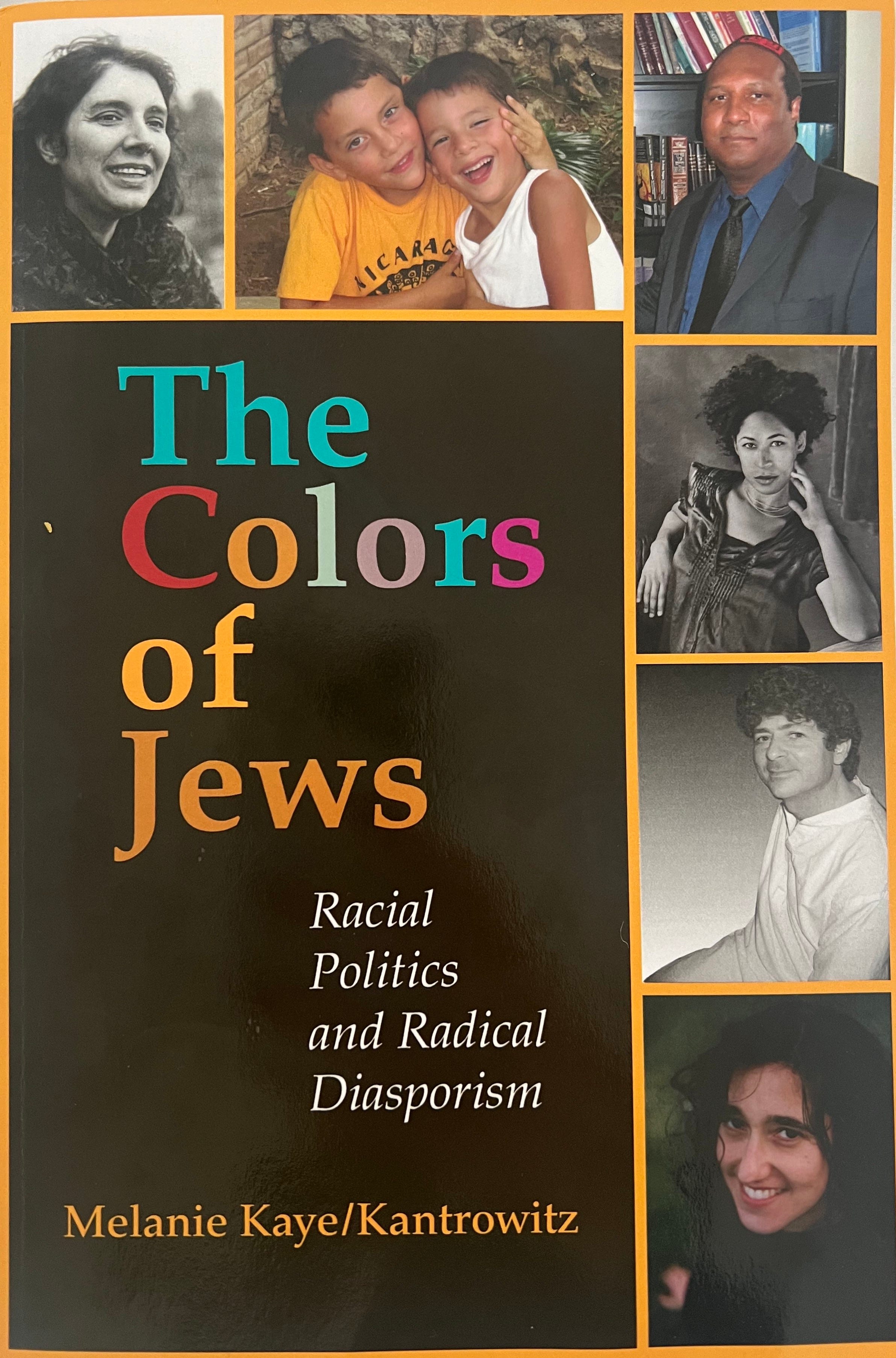
Her work and Jewish social justice organizing are guiding us to re-center the diversity of diasporic Jews, understand and de-center the European Ashkenazi Jewish experience as the dominant and only history that shapes our collective narrative, and directly center Jews of color, Black, Indigenous, Sephardi, and Mizrahi Jews in our commitment to collective liberation.
To do this we are reckoning with where we are in this moment. She does not mince words and says the quiet part out loud.
At the center of the U.S. Jewish world, folks have risen to the occasion so beautifully on queer rights, on choice, healthcare, immigrant rights, civil liberties, and even on opposing anti-Arab racism. Yet on this one issue, Israel/Palestine, it’s still acceptable at the Jewish center to forget that Palestinians are people too.
We know in our soul it is willful forgetting. We are making calculated choices. And for some of us I see these choices are against every fiber of our moral being. I do not envy the internal conflict and mental gymnastics that it takes to relinquish your voice and let supremacist nationalism speak for you when you want to cry out for humanity.
The point is, Jews, like everyone else, make political choices. Whatever privilege the moment grants us, we, people of the book, people of history, should understand the danger of racism. With whose interests will we identify and stake our future? Many Jews engage in justice-seeking work, some as visible Jews, many more invisible as Jews, doing their political work as progressives, as women, as workers, as queers, as whites, as people of color…Meanwhile Jewish political conservatives are highly visible, claiming the Jewish voice. In this way some of us relinquish to the Jewish center and right-wing the claim to represent the Jewish community. We neglect powerful traditions of Jewish radicalism, a potential source of instruction, inspiration, and courage.
I know we are scared. We are scared for beloveds in Israel/Palestine. We are scared for collective and individual safety. We are all in an impossible place.
Antisemitism is real and weaponizing antisemitism is real.
We are going to have this come-to-Jesus conversation.
(just grant me that brief moment of Jewish levity)
We can start with reading On Antisemitism: Solidarity and the Struggle for Justice from Israeli, Jewish, Palestinian, Muslim and Christian contributors who are confronting this head on as Judith Butler lays out in the Introduction:
If the charge of antisemitism becomes a tactic to suppress open criticism and debate on the State of Israel, its practices of dispossession and occupation, its founding and the ongoing implications of that founding for Palestinians, then it will lose its claim to truth. It will be understood as a tactic that actually knows the untruth of what it claims. Who will believe the charge when it is used to name and oppose rising forms of fascism or actual ideologies bound up with its actual toxicity? We should not waste our words, the words we need to name and oppose forms of oppression that are on the rise with new forms of nationalism and populism. We should be trying to build a world in which injustice is named and all forms of racism, including antisemitism, are opposed as equally unjust and unacceptable…When the struggle against antisemitism becomes allied with all struggles against racism, including anti-Black and anti-Arab racism, we will be surely on the way to building a world in which language still means, and justice names, the passion that motivates critique.
We can do this.
I will answer the question: Does Israel have the right to exist?
The question is a lie. Still, my tears won’t stop.
The question is simple. Still, the agony persists.
The question is a portal.
No nation state has the right to exist.
Every Palestinian has the right to exist.
Every Israeli has the right to exist.
Every Jew and Palestinian across the Diaspora has the right to exist.
Every human has the right to exist.
Every inch of this land has the right to exist.
No nation state has the right to exist.
No.
And now I ask the question: How did the nation state of Israel come to exist?
No, not just that one.
The question that must necessarily follow: Who gets to answer this?
I am here not to answer.
I read Light in Gaza: Writings Born of Fire.
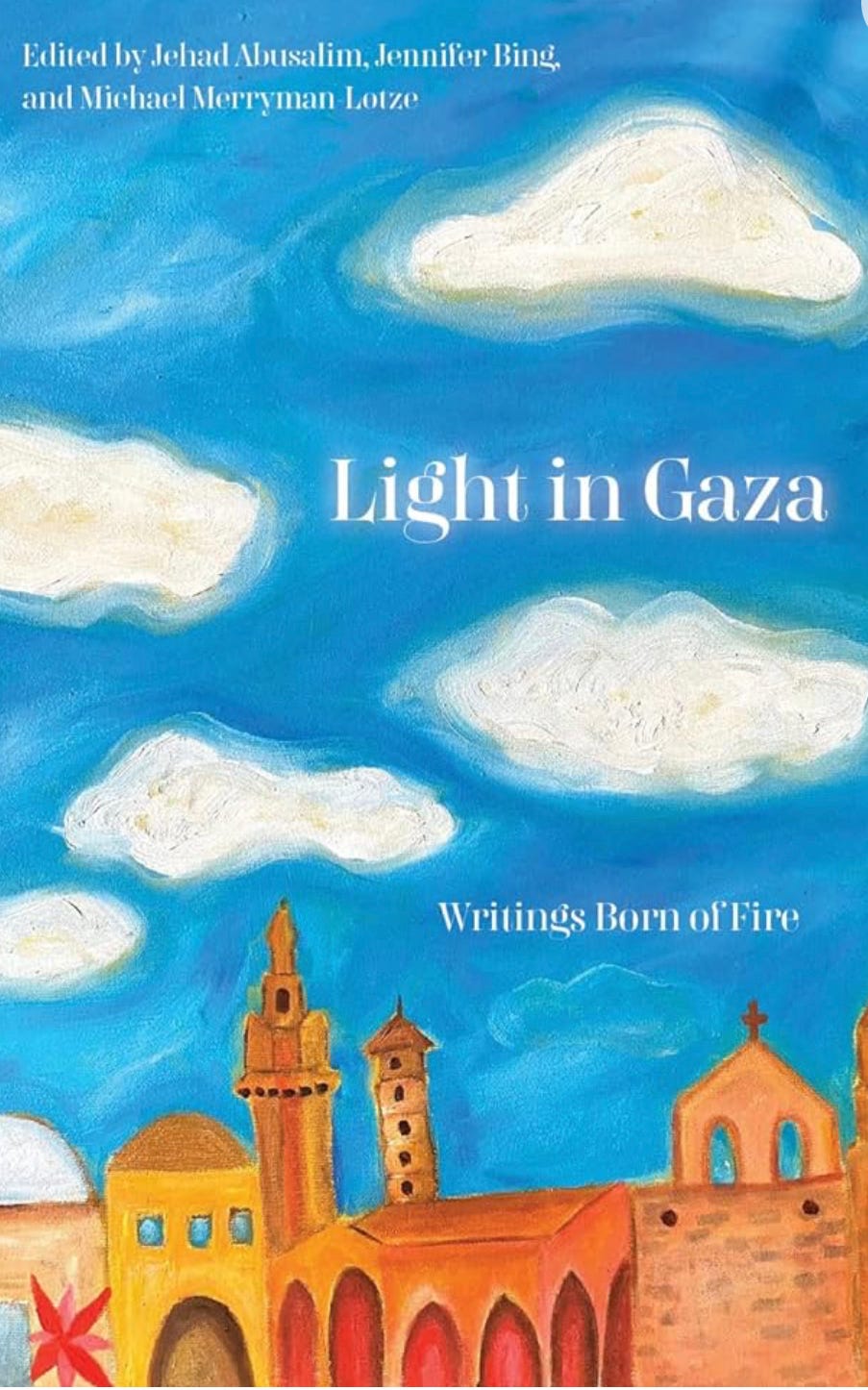
I bear witness to writers, artists, activists, poets who are speaking themselves into existence in ways they should never need to.
The continuation of the Nakba as a process can be described as a painful but straightforward equation: Israel’s existence as a Zionist and Jewish majority state must be at the expense of Palestinian existence. This is very clear in continuing the plight of the refugees and other Palestinians plight regarding the loss of land and lack of rights. For Israeli Jews to realize their potential, enjoy self-determination, sovereignty, and access to rights, including the right to land, property, and safety, Palestinians were—and to varying degrees still are—deprived of these rights and privileges.
– Jehad Abusalim, Executive Director at the Jerusalem Fund for Education and Community Development
I just looked up Jehad Abusalim’s information to hyperlink to his name and came across his Twitter/X post from several hours ago stating he just lost all contact with his family in Gaza. Israel has cut off all telecommunications and electricity and unleashed unprecedented bombardment in Gaza as I type on this Shabbat evening, October 27th, 2023.
As we lit the Shabbat candles tonight we sent the light out to all who need it.
I ask that you join me and demand the US government call for a complete ceasefire, release of the hostages, and end to the siege in Gaza.
I am here with you as we call our representatives, gather in local action, and come together in mourning.
Time bends. Time begs. Time is now.
Arundhati Roy speaks our truths then and now.
Nationalism of one kind or another was the cause of most of the genocide of the twentieth century. Flags are bits of colored cloth that governments use first to shrink-wrap people’s brains and then as ceremonial shrouds to bury the dead. When independent-thinking people (and here I do not include the corporate media) begin to rally under flags, when writers, painters, musicians, film makers suspend their judgment and blindly yoke their art to the service of the “Nation,” it’s time for all of us to sit up and worry.
I need you to read Come September in its entirety. I need us to read and bear witness to Palestinian voices. I need us to commit to learning what we didn’t learn.
I need us to listen very carefully.
I need us to read and speak into existence what we have erased in self-centered fear.
Even when—especially when—we cannot bear to live with the fear and we don’t know who we are without it.
The time has come, the Walrus said. Perhaps things will become worse and then better. Perhaps there’s a small god up in heaven readying herself for us. Another world is not only possible, she’s on her way. Maybe many of us won’t be here to greet her, but on a quiet day, if I listen very carefully, I can hear her breathing.
I need us to find ourselves.
Please feel free to share this.
Comments
Nothing yet. Say the first thing.
Sign in to join the conversation.