
Welcome to a course that is also a dream and also a map and also a rhizome and also a symphony and also a story.
During my brief time in academia wherein I got paid—which did very little to the $100K+ of student loan debt I accumulated from Stanford, of which a huge chunk still remains 17 years later in a cat and mouse game where the cat mostly ignores me because, relatively speaking, I have little meat on my bones and I simply hope the cat will die before I do—I was an adjunct professor in an advanced gender and sexuality course in the Department of Women’s Studies at San Francisco State.
I love teaching and I do not love speaking in front of people and yeah that’s kind of a thing but the key takeaway here, I say pointing emphatically to the imaginary whiteboard behind me, is that my absolute favorite part of teaching was putting together the syllabus. And holding office hours where we commune together.
Putting together a syllabus is kind of like conducting an orchestra (so says the person who has no experience conducting an orchestra but should have an honorary PhD in metaphors and analogous thinking). There are all of these brilliant thinkers doing their thing and I see the mycelium of thought and hear the symphony in my head and so I bring them together and conduct music as I hear it and listen to what it tells me. And then I listen to what you are hearing.
What instrument would you add? What notes sounded off? What harmony makes you gasp, goose-bumps all over, a tear falling that you don’t wipe away as you leap up in a 5-minute standing ovation?
The rumblings of late stage capitalism eroding under our feet keep revealing that it has always been a house of cards but nevertheless there are those among us who keep hedging bets on the invisible hand of the market, swearing there is an ace in there if we keep feeding the monster.
Speaking of that invisible hand of the market coined by Adam Smith in Wealth of Nations, which marked the birth of modern capitalism as well as modern economics as we know it: it is a theory of human behavior grounded in his self-proclaimed observation of humans and particularly his observation of the self-interest of man. Which of course begs the question as to what precise population of humans he was observing and what populations he was most certainly not observing and what populations he abjectly erased as he opined and wrote Wealth of Nations in 1776 in his mother Margaret Douglas’ home in Scotland as she fed, clothed, and cleaned up after him because that is where he lived his entire adult life.
The truth is there are far more among us who have now “made a life out of reading people’s faces, and knowin’ what their cards were by the way they held their eyes.”
And while it’s tragic because we can see we’re out of aces…
(Go ahead, belt it out)
“You gotta know when to hold ‘em, know when to fold ‘em, know when to walk away, know when to run…”
So as the cards fold, let’s create a crowd-sourced syllabus as a collective offering. Not as an academic project but as compass points on this wayfinding expedition to inhabit enough. As a symphony. As a practice. As a [insert metaphor of your choosing].
Divesting from the cult of productivity and living from enough is not a prescriptive process. It is an embodied practice. It is radical life redesign. It is profound mindset transformation. It is a collective creative act.
And for the love of whatever your spiritual guide may be, can we please not commodify and sell enoughness. Let’s just not.
OK here is my beginning of a syllabus as symphony, compass points, myriad other metaphors I’ll likely drum up…
To even begin to embody enough we must cultivate a practice to stop participating in the cult of productivity. Even for a moment. And while the cult of productivity is destroying all humans, capitalism is racial capitalism and we must center rest and reparations for those whose lives and labor was stolen, so we can restore a way of living where we all thrive.
Capitalism was created on plantations. The roots of it are violence and theft…To understand and meditate on this truth may place us all in a space of grief…
Keep repeating to yourself: I am enough now.
Embrace knowing that you have been manipulated and scammed by a violent system as powerful evidence. Now with this knowledge you can grieve, repair, rest, and heal. We can rejoice for the beauty of a veil being removed. This is the beginning of the new world we can create. Resting is an embodied practice and a lifelong unraveling. – Rest Is Resistance
If we want to create a path forward we must take the blinders off and understand where we have been and how we got here. Let’s go deeper than decrying “capitalism sucks” and truly understand how things like self-interest, scarcity, productivity, and growth (eventually GDP) came into being through the minds of predominantly white men who built their lives on and then erased the unpaid care economy, continued to abstract farther and farther from any lived reality of both human behavior and reciprocity of planetary resources until the most devastating Multi-Level-Marketing scheme to ever exist became infused into our consciousness as simply the natural order of things.
It is more than a little ironic that twentieth-century economics decided to define itself as a science of human behaviour and then adopted a theory of behaviour – summed up in rational economic man – which, for decades, eclipsed any real study of humans…more crucially, during that process, the discussion of the economy’s goals simply disappeared from view…this created a vacuum of goals and values, leaving an unguarded nest at the heart of the economic project. And, as every cuckoo knows, such a nest must be filled…
One person who was willing to risk political suicide was the visionary systems thinker Donella Meadows – one of the lead authors of the 1972 Limits to Growth report – and she didn’t mince her words. ‘Growth is one of the stupidest purposes ever invented by any culture,’ she declared in the late 1990’s; ‘we’ve got to have an enough.’ She argued, we should always ask, ‘growth of what, and why, and for whom, and who pays the cost, and how long can it last, and what’s the cost to the planet, and how much is enough?”
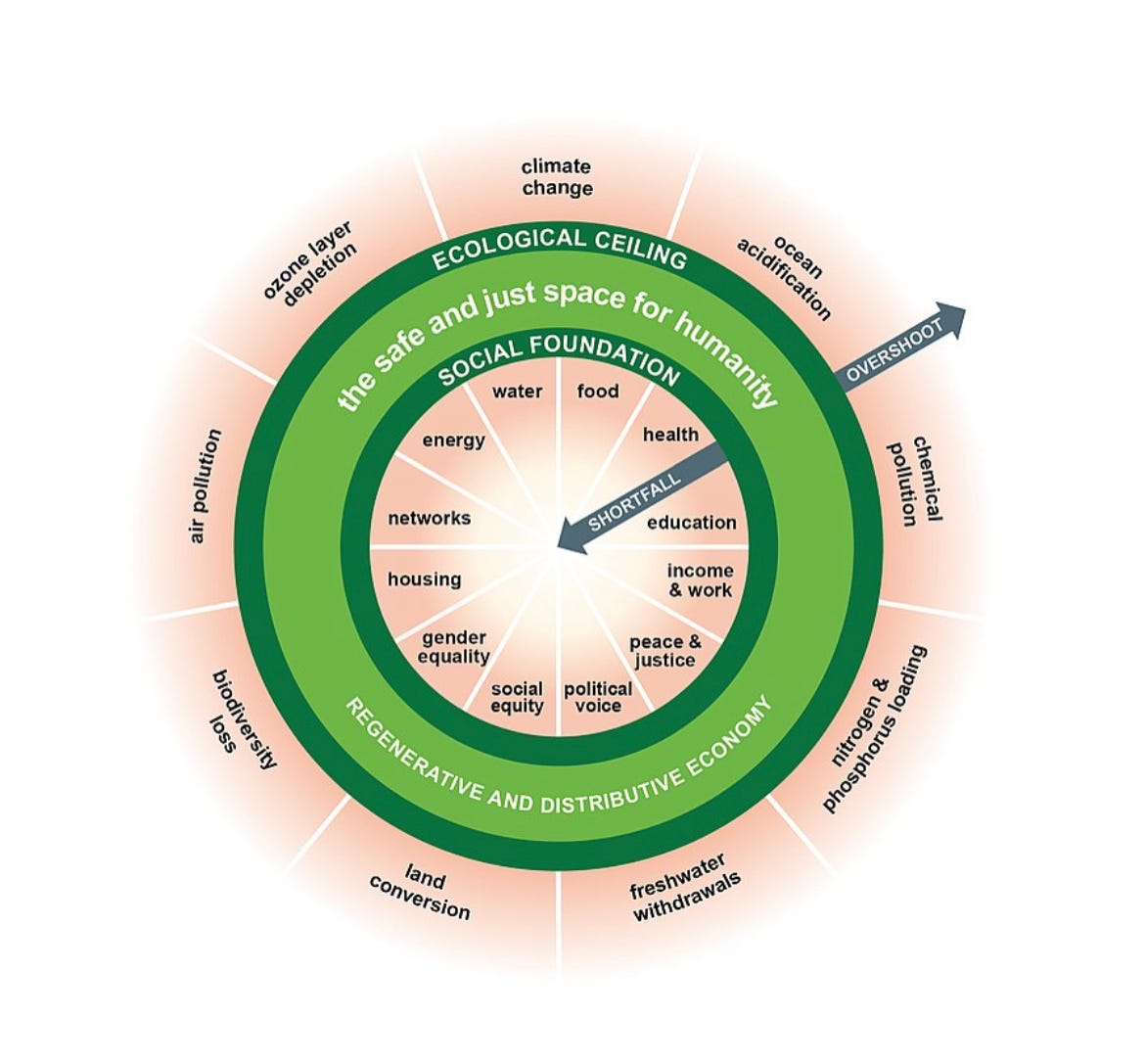
The twenty-first century task is an unprecedented one: to bring all of humanity into that safe and just space. – Doughnut Economics
It still amazes me the fears people project onto abolitionist praxis when it is quite literally the joyful radically creative path toward meeting our collective needs that we are all craving. Queer black feminist/womanist abolitionist liberation thinkers, organizers, activists are and always have been our guides. Full stop. We can see clearly what is possible when we get out of our own way and get in formation.
Abolitionist praxis offers us an opportunity to dream of a world where our families and communities are provided with the utmost care. Abolitionist praxis exists in a world where our governments are no longer reliant on police, jails, prisons, courts and military. Abolitionist praxis is rooted in our collective healing. It is rooted in a deep and profound trust for all beings and our ability to love each other.
I once read that people will always lean toward joyful things. So we must make seeking justice joyful. Where is that world? We live in it. We just have to imagine it. — An Abolitionists’ Handbook
This one might be a surprise but trust me. “Enough” will elude us until we recover from our addiction to scarcity. That is not a mindset shift, that is a daily practice of embodying our inherent capacity to create. Beautifully.
Listening to the siren song of more, we are deaf to the still small voice waiting in our soul to whisper, ‘You’re enough’. — The Artist's Way
Read the whole book of course and in the moments when we are broken and cannot imagine how to escape the grip that scarcity has around our neck, lets start a ritual where we gather and read the closing essay Defeating Windigo.
Let’s read it out loud. Let’s weep and laugh in awe that the final medicine to defeat monstrous greed is the place we begin. Again and again.
Let me tell you a story…
In this time of transformation, when creation and destruction wrestle like Skywoman’s mythic grandsons, gambling with the future of the earth, what would it take for us to follow Skywoman? To jump to the new world, to co-create it? Do we jump because we look over our shoulder at the implacable suffering marching toward us and jump from fear and portent? Or perhaps we look down, drawn toward the glittering green, hear the birdsong, smell the Sweetgrass and yearn to be part of a different story. The story we long for, the story that we are beginning to remember, the story that remembers us.— Braiding Sweetgrass
Now it’s your turn. What are your compass points? What is your symphony syllabus? What is your collective offering?
Don’t make me call on you…
Comments
Nothing yet. Say the first thing.
Sign in to join the conversation.