
Recently, on Threads, a debate emerged about whether or not Black people can be “pro-Black” if they are dating or in some form of romantic relationship with white people. The post went semi-viral as the original poster articulated that they do not believe anyone who is dating or married to a white person can be pro-Black. In the comments, there were tons of people in agreement. Some argued that it is impossible to be pro-Black while romantically connected to someone who benefits from anti-Blackness and white supremacy. Others argued back saying that they themselves were in interracial couplings and maintain their pro-Blackness.
While I saw the Thread and the subsequent responses, I chose not to involve myself in the debate as it was framed. First, I felt that there was too much black/white thinking (pun intended) and that the format of Threads (like Twitter/X) rarely leaves enough room for critical nuance. A conversation this complex, in my opinion, begs for a full analysis and conceptual framework. Second, I noticed that the debate largely stemmed from people’s personal choices and “preferences.” So, rather than having an objective (or at least, somewhat unbiased) discussion about pro-Blackness, attraction, desire, body politics, and the like, folks were essentially defending themselves and/or attacking others.
Instead of engaging in the brawl, I took to my own Threads page to share this:
“I'll be honest: I look at Black folks with white partners (esp. Black men and masculine lesbians) with caution. Not because they may not be pro-Black but because they may not understand how problematic notions of desire, preference, and attractiveness are shaping their romantic choices.”
I want to explain this comment in detail here because, honestly, these conversations on social media have been bereft of nuance and rigor.
As a political scientist and scholar of Black Feminism, I think frequently about the work of Ida B. Wells-Barnett who, in the late eighteenth and early nineteenth centuries, worked to tell the truth about lynching in the United States. She exposed what she called the “threadbare lie” that Black men rape white women in her pathbreaking text Southern Horrors: Lynch Law in All its Phases. In the pamphlet, Wells-Barnett told the gruesome details about Black men, women, and children who were often beaten, maimed, and murdered by white mobs who used white women’s testimonies to enact all manner of violence against the broader Black community.
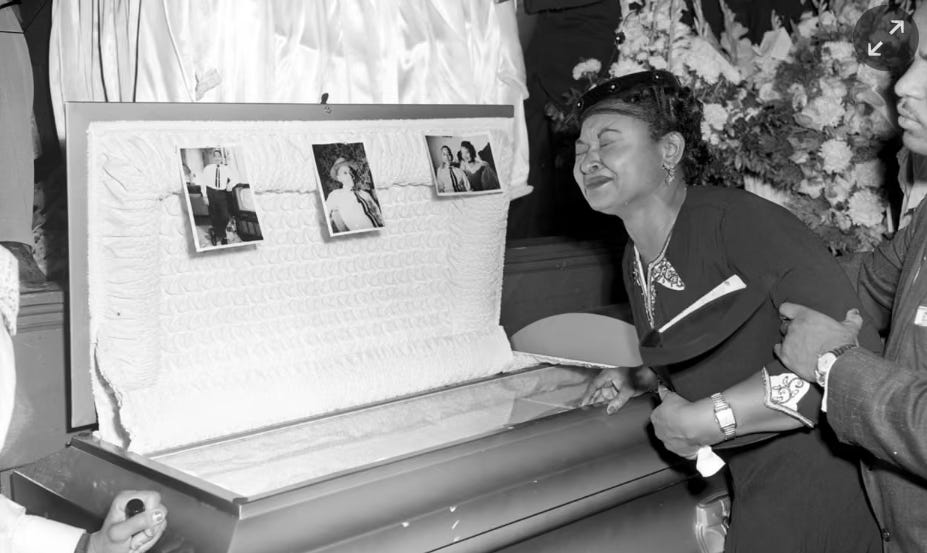
In these instances, white women knowingly elected to center their own feelings of shame and anti-Blackness while Black lives were under imminent and real threat. One of the most well-known cases of this phenomenon is that of Emmett Till who was only 14 years old in 1955 when a white woman named Carolyn Bryant accused him of whistling at her. Till was visiting cousins in Mississippi but was from Chicago. In response to Bryant’s accusations, Bryant’s husband and brother-in-law kidnapped Till. They brutally beat him, gouged out his eye, shot him in the head, and tied a 74-pound cotton gin fan around his neck with barbed wire and dumped him into the Tallahatchie River. Till’s murder galvanized Black people all over the country and kickstarted the Civil Rights Movement. Five decades later, Bryant admitted she lied. So, Till was completely innocent.
I situate this conversation on pro-Blackness and desire in this era because it was often Black women whose bodies were hypersexualized, and brutalized without remorse or recourse. When Black women were raped, beaten, and harmed, white jurors and judges often looked the other way. Why? Well, because, since the era of slavery, Black women were considered “unrapeable.” They were not allowed to defend themselves against slavers nor were they allowed to deny sexual advances and abuse. Black women were not able to consent into sexual relations with white men at all because, by law, we did not belong to ourselves.
This context is important because harmful stereotypes about Black women dating back to slavery have long situated us in a raced-gendered hierarchy which privileges white women and Eurocentric beauty ideals. In many ways, desire in the United States has always been shaped by racial hierarchy wherein Black women are situated at the bottom. And, for many Black men, this has meant that dating, marrying, and having children with white women is seen as an accomplishment in and of itself.
The converse of this elevating of white women has multiple harmful effects on Black communities. Namely, Black men are often assumed to be sexually lascivious and deviant beings who want to rape and abuse white women. Meanwhile, Black women are frequently viewed as less marriageable and less desirable than white women.
Kali Gross writes in her text Vengeance Feminism about the ways that Black women in the nineteenth century frequently had to defend themselves from both Black men and white people who diminished them and often left them exposed to sexual, emotional, and financial harm. Thus, while many people in the present day reduce sex politics to matters of “preference,” we must always consider how history shapes those preferences in ways we may not always be conscious of.
Getting back to my comment on Threads, this is why I am cautious and suspicious when encountering Black people who date white people. The troubled, laden, and fraught history of race in this country means that every choice we make is rooted in a broader context. We must always consider these contexts when discussing something as capacious as pro-Blackness.
In my book, Black Women Taught Us: An Intimate History of Black Feminism, I explain how efforts to caricature Black women’s bodies have been elevated in popular culture. The Kardashian-Jenners are a prime example of the ways that Black women’s bottoms, lips, and shapeliness have been packaged for mass consumption while Black women themselves are treated as disposable. This reaches back to the experiences of Saartjie “Sarah” Baartman, also known as the “Hottentot Venus,” who was essentially enslaved and put on display all over the world because of white people’s fetishizing of her large breasts and bottom. Baartman was paraded around London and Paris, dressed in elaborate costumes, billed as a “savage,” and made into entertainment for white viewers. Though Baartman died in 1815, her skeleton and sex organs were on display in Paris until 1974. Her body wasn’t repatriated to her homeland of South Africa until 2002.
This is a layered issue. But, Baartman’s life illustrates that preference and desire can never be considered in isolation from other aspects of society. Further, pro-Blackness, in my opinion, is a non-starter as long as members of the Black community are being harmed.
But, there is more to this story. In 2015, according to Pew Research, Black men were twice as likely as Black women to marry a non-Black person. In fact, Black men’s likelihood to marry non-Black people increased with their education levels. This suggests that more educated Black men were more likely to seek non-Black partners despite Black women being the most educated of any other race-gender group. Black women have often been identified as the “least desirable” women on online dating apps. And, the “Black manosphere” has grown in reach, popularity, and cultural presence.
I include a brief clip below of a BET Late Night Show entitled “Don’t Sleep” hosted by TJ Holmes. The clip is interesting because, a few years after this segment, Holmes cheated on his wife Marilee Fiebig (a woman of color) with his co-host Amy Robach (a white woman) ending their 12-year marriage. The irony is unavoidable.
To me, being pro-Black means investing one’s self in the survival and elevation of all Black people. It means loving the least of us and centering those who are most vulnerable. Pro-Blackness means committing to a way of life and living that centers the concerns, struggles, and issues facing Black Diasporic people. For me, personally, being pro-Black absolutely means romantically privileging Black people, specifically Black women, enbies, and other trans people. It means building a Black family with another Black person. And, it means that I have never and will never build a household or family with someone whose livelihood and identity is rooted in the annihilation of Black people.
But, that’s what pro-Blackness means for me. Everyone has to define pro-Blackness for themselves. And, we have to be honest about the fact that it just may not be everyone’s goal.
I have written here before about how whiteness is fashioned in opposition to Blackness in ways that make truly centering Black life challenging for white people. I’m not saying white people can’t be pro-Black. But, I am saying it would be antithetical to whiteness itself.
I think the more important intervention here is less about who we sleep with or marry and more about who we protect and who we leave unprotected.
Frankly, I struggle to understand how many cisgender, heterosexual Black men can be considered pro-Black when they fail to protect Black women and often enact harm within our own communities.
No Black man can call himself pro-Black while watching his friends and comrades engage in Black femicide and transphobia. No Black person can be pro-Black while investing themselves in degradation of and annihilation of other Black people. That means that Black cisgender women who actively exclude and harm Black trans women are just as anti-Black as the Black men who refuse to marry them.
If we really want to have this discussion, these should be the terms. And, rather than debating our sexual politics in isolation, we have to offer a more comprehensive vision of what pro-Blackness is and what it is not.
Comments
Nothing yet. Say the first thing.
Sign in to join the conversation.