
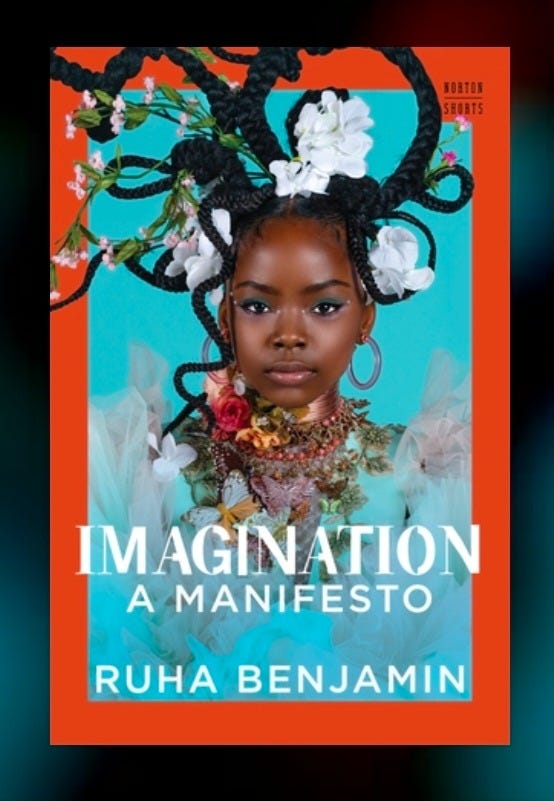
Book Summary:
There are some texts that are meant to help us understand ourselves. There are other texts that are meant to help us understand the world. Imagination: A Manifesto by Ruha Benjamin is meant to do both.
Benjamin’s innovative and thoughtful text centers the ways in which we must imagine ourselves beyond the axes of domination and oppression which govern mass society. She uses common experiences like childhood education, sports, and media culture to articulate how a general lack of imagination often keeps us bound up, repressed, and bereft of liberatory potential.
A term Benjamin introduces in the Preface is “sociological imagination.” This term refers to “the capacity to link individuals’ personal problems with broader social processes.” This is a term in sociology that is widely used as a basis for analyzing broader society. Benjamin notes that her approach is “unruly.” She oscillates between both imagination and imaginaries. For her, imagination refers to “collective projections of a desirable and feasible future.” This framing is helpful as it lays the foundation for the remainder of the text.
Benjamin opens the text with a reflection on her own education and background as it relates to being a “gifted” student. In doing so, she illustrates how gifted programs frequently create partitions within groups of students meant to label some students as high performers and others as low performers. She notes that, in and of itself, is a failure of imagination because it presupposes expectations of aptitude and scholarly performance without considering that greater financial support or training might make each child “gifted.”
Later, Benjamin convincingly compares our orientations toward imagination through the lens of technology, mourning, and grief. In many ways, technology is often assumed to be a site of potential liberation and empowerment. However, the existing axes of domination shape who gets to imagine new futures and what they imagine for themselves. For example, Benjamin explains that capitalism itself is a killer of imagination in that it thrives off of exploiting racial, gender, and class hierarchies rather than pushing humans to challenge their existing ways of being.
Importantly, Benjamin provides a host of practices and exercises meant to encourage imagination and creativity. She notes that, for many people, we are not equipped or empowered to imagine alternative futures for ourselves and our communities. This is a technique we often must develop on our own.
This book made me think hard about what it means to be an abolitionist and organizer in this political moment. In a time when so many people have leaned into old, archaic tropes about race, gender, sexuality, ability, and the like, we are seeing what happens when mass society is bereft of imagination. Not only that, we are witnessing the kinds of damage and harm that play out when tech billionaires and the ruling class use our reliance on technology to delimit justice and liberation.
This book is a call to action, one that we severely need in this moment.
Our next book in the Black Feminist Book Club is Marsha: The Joy and Defiance of Marsha P. Johnson, by Tourmaline.
Are you enjoying these book summaries? You may benefit from paying a monthly subscription. Paid subscribers receive access to chapter-by-chapter summaries, thought questions, key takeaways, and recommended readings.
Comments
Nothing yet. Say the first thing.
Sign in to join the conversation.