
I finished the first draft of my first book – the one I decided was ready for the world to see – in December of 1999. I remember going to Kinkos, making printouts of the manuscript (single-spaced, double-sided) and sending the whole thing to three potential dream agents who, in my hopeful imagination, would fight over the chance to represent me.
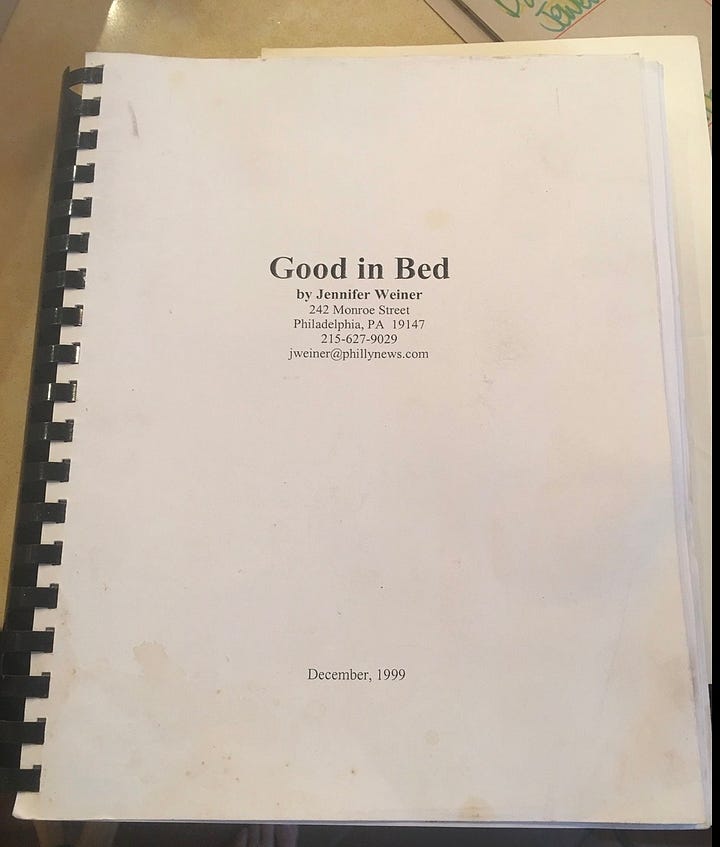
All three of them rejected me. One sent a slightly snippy note informing me that manuscripts should be double-spaced, single-sided, and only sent after they’d been requested.
Oops.
I made another list, querying twenty-five agents, and getting twenty-four rejections. Not looking for new clients. Not looking for new fiction. Not looking for new women’s fiction. Not looking for new young women’s fiction. Not looking for you.
Finally, I heard from an agent who was interested. I sent her the full manuscript and crossed my fingers, and was over the moon when the agent offered me representation.
Then she told me she liked the book but did not like the fat protagonist. I’ll never sell the film rights. No one wants to make a movie about a lonely, pathetic fat girl. Her suggestion was to make Cannie maybe fifteen pounds overweight. That might be okay.
I spent a weekend agonizing. Should I listen to this very impressive, successful agent – the only one so far who’d shown any interest in my book? Should I stick to my guns?
I told the agent I was grateful for her time, and started my search again. I asked a woman who worked in the first agent’s office if she knew any other agents with free time and low standards who might be interested in what I’d written.
Two weeks later, I was sitting at my desk at the Philadelphia Inquirer when the phone rang. On the other end of the line was an agent who wanted to represent me.
She was young. I was young. She’d never sold fiction. I’d never finished a novel. But she believed in the story I was telling.
We spent months revising the book together and then, that spring, I took a train to New York City and met with editors.
A few days later, three of those editors were bidding on GOOD IN BED.
I ended up signing a two-book deal with what was then Pocket Books, which would be my home for the next seventeen more novels and twenty-four years.
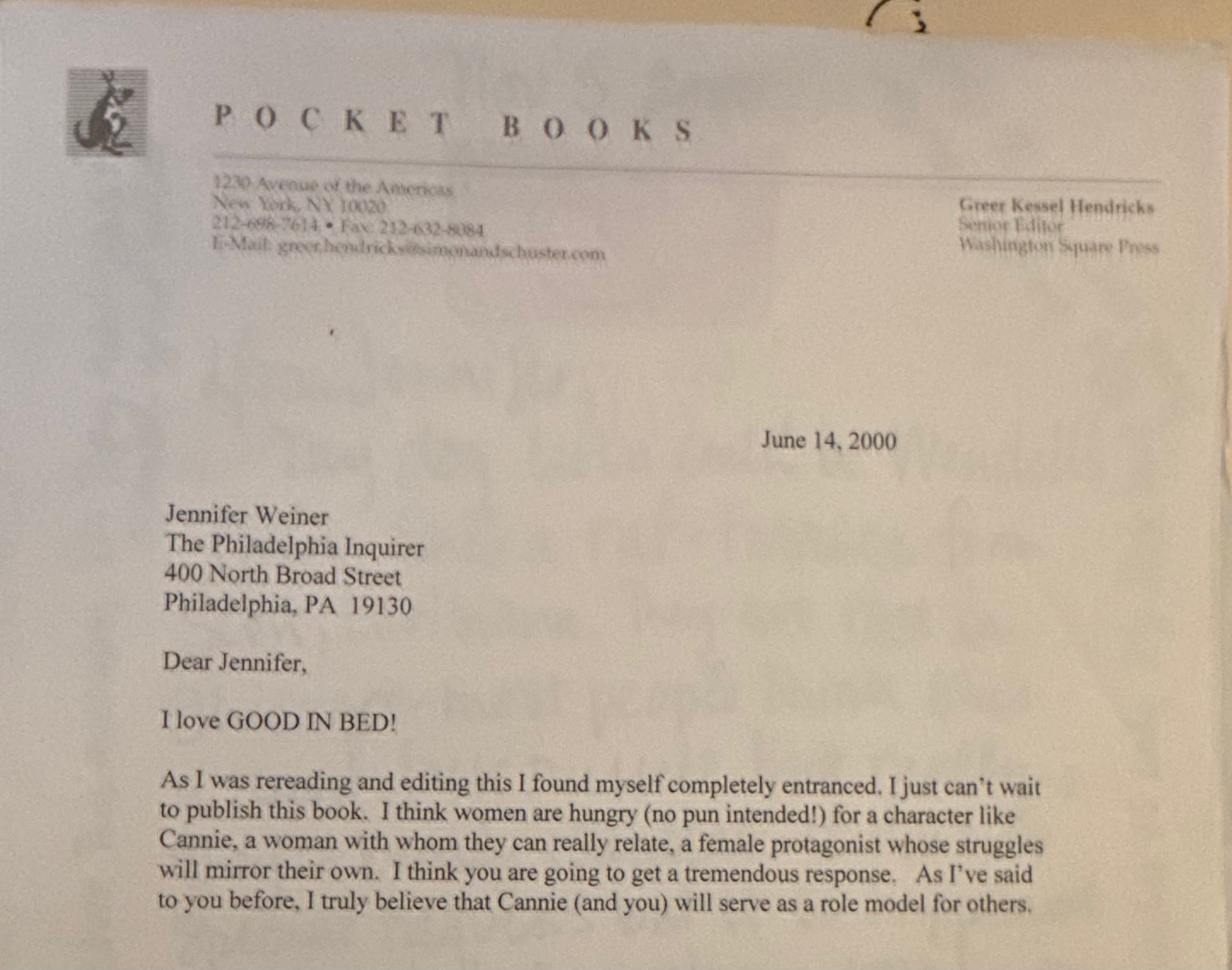
Then I got to tell my mom that my book was going to be a book, out in the world, not just living on my hard drive, or in a box under my bed.
Everyone says that the happiest day of a writer’s life is when she gets to tell her parents that someone is publishing her book. I assume this is true for every writer whose first book is not called GOOD IN BED.
For as long as I’d been writing, my mom had been highly dubious about the project, so telling her it had sold was beyond thrilling, even if it didn’t go exactly as I’d dreamed.
“Fran!” I said. “Remember my novel?”
“Oh yes!” she said, draping her hand across her forehead. “Your novel!”
“Well! An imprint of Simon & Schuster offered me a two-book deal! And HBO’s calling about the film rights, and foreign rights have been sold in thirty countries!”
For a minute, Fran stared at me, her eyes wide with astonishment. Then she opened her arms and hugged me. “I’m so proud of you!” she said. It was a perfect moment…until she drew back and asked, “What’s it called?”
“Good in Bed,” I muttered.
“What was that?” asked Fran.
“Good in Bed,” I repeated.
My mom frowned. “Good and Bad?”
“No,” I said. “Good in Bed.”
My mother’s expression went from proud and pleased to horrified.
“Jenny,” she said, “HOW MUCH RESEARCH DID YOU DO?”
After that, things unfolded like the very best kind of dream.
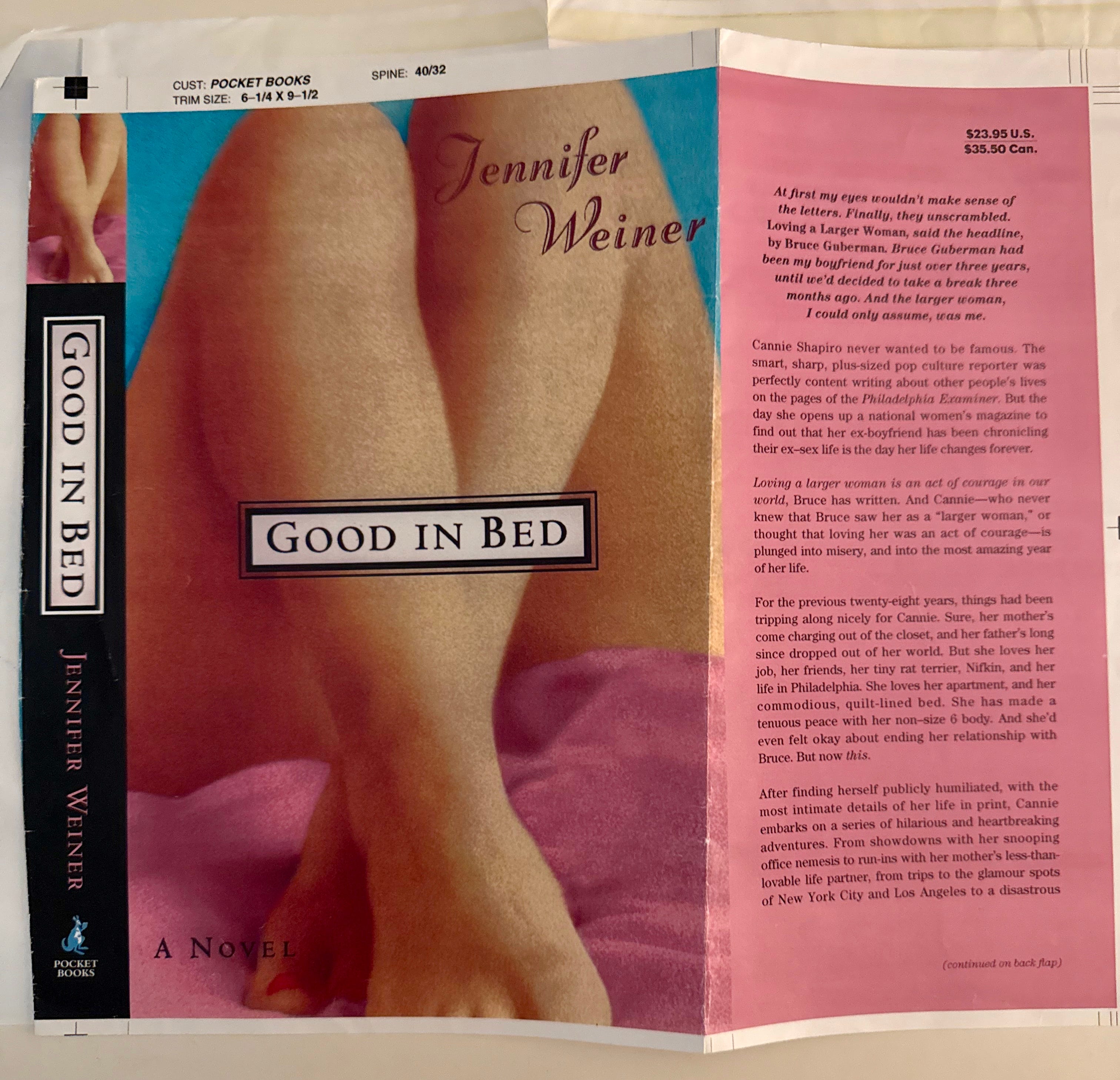
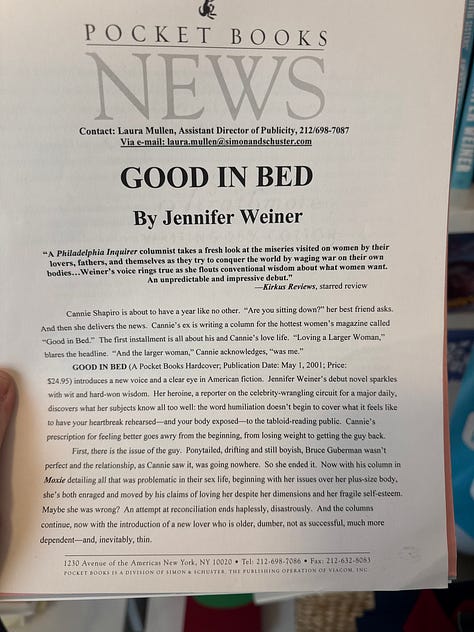
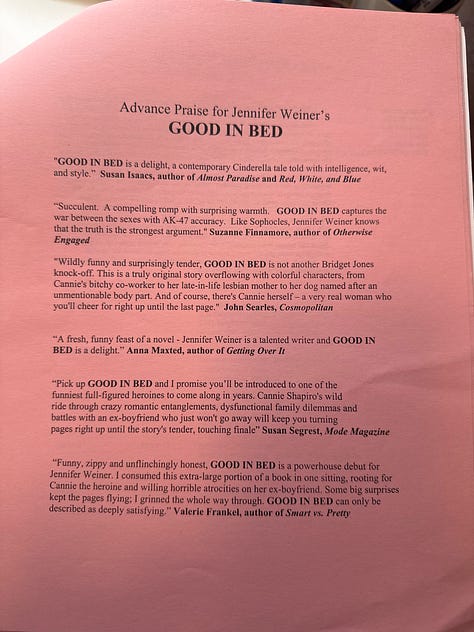
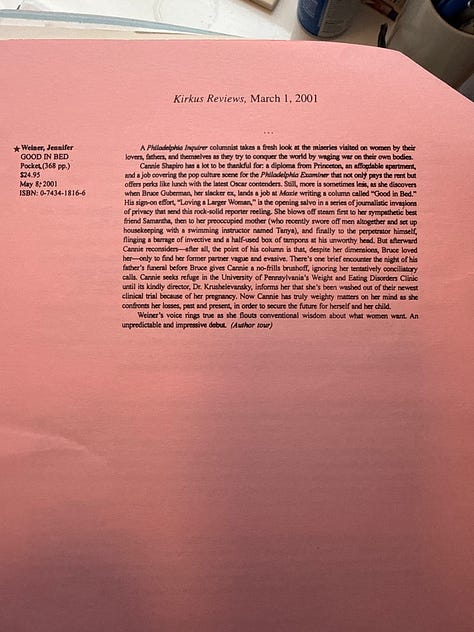
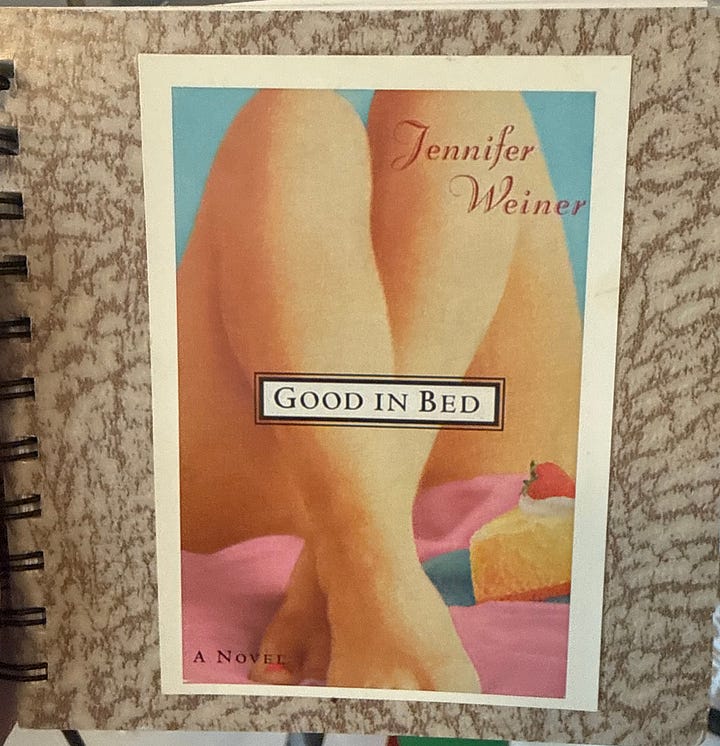
I remember standing at the fax machine on the third floor of 400 North Broad Street and seeing the gorgeous cover for the first time as it rolled off the fax machine…and my editor calling to tell me that Susan Isaacs had given me a blurb….and my publicist calling to tell me that I’d gotten a starred Kirkus review, and then explaining what Kirkus reviews are, and why they matter.
Things have changed a lot since then, starting with….
Then: When my career began, there were the Big Seven publishers. There was barely any internet, which made researching editors, publishers and agents hard. If you wanted to find an agent, you got names by combing through the acknowledgements of books you’d loved, cross-referenced them with a reference volume like A Writer’s Guide to Literary Agents, sent out snail-mail query letters, printed on paper, sent in an envelope, with stamps, and prayed that they hadn’t died since the last guide had been printed.
And if you couldn’t get an agent, and a traditional publishing deal, that was the end of your road, unless you paid for a vanity press. Self-publishing was not yet a thing. In 2001, when GOOD IN BED came out there were somewhere between 120,000 and 130,000 novels published.
Now: The Big Seven have shrunk down and now the Big Five, and the expectation is that authors are writers, and also, marketers (and that’s if you’re traditionally published. If you’re self-publishing, you’re a writer, and a marketer, and an editor and a publisher!)
The internet is very much a thing and authors are expected to be there, with websites and Facebook and Instagram pages. We’re on X and on Threads. We had blogs, and now we have Substacks. We write our books and we build our brands, interacting with readers, sharing our lives, our process, details of our upcoming book and the chapters we cut from our last one.
And if you can’t get an agent or a traditional publishing deal, or didn’t want to pursue that path? You have options. You can hybrid publish. You can self-publish. And plenty of writers have taken advantage of those possibilities. In 2025, there were more than four million new books published, all of them struggling for what’s generally acknowledged to be a diminishing pool of readers.
No doubt, it was simpler, back in the day…but, in some ways, it was scarier. What if your publisher didn’t send you on tour? What if no magazines or newspapers wanted to cover your book? Back then, there wasn’t much you could do. My mom’s girlfriend designed postcards for GOOD IN BED, and I sent them to any person, place or thing I thought would care – independent bookstores, plus-size swim clubs, boutiques that sold extended sizes. When websites were a thing, I had a website. When blogs emerged, I had a blog.
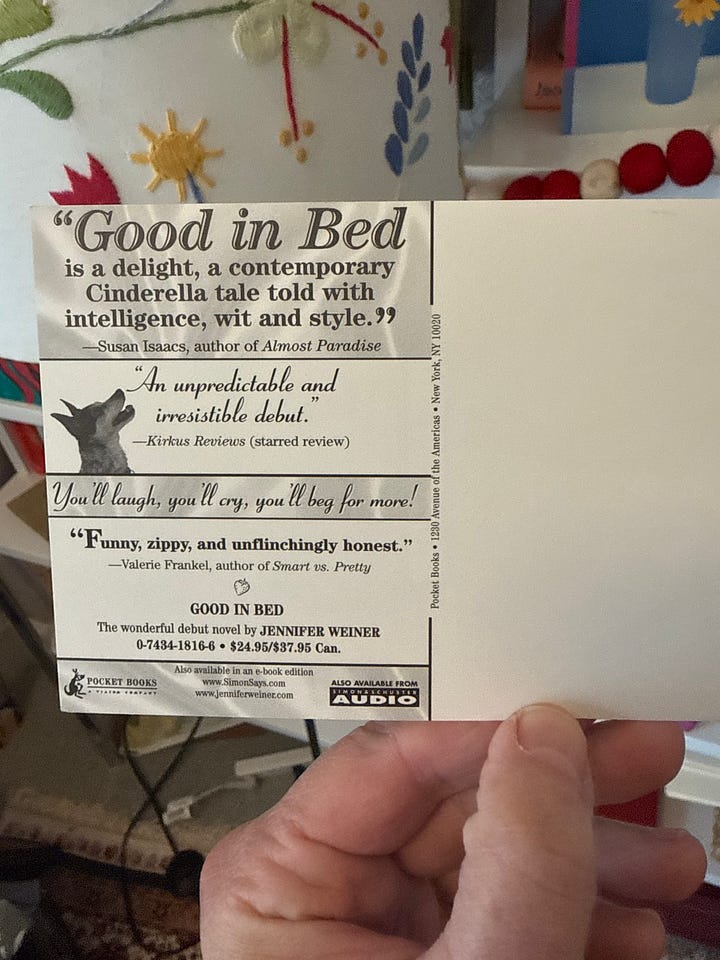
Now there’s plenty of things you can at least try, in order to connect with readers. You can start a Substack. You can buy Facebook ads. You can make fun Tiktoks and Reels. The jury’s still out on how much it helps, but publishers expect writers to do it.
Then: When I was getting started, there were newspapers and magazines, with in-house critics and, sometimes, free-standing book review sections. The Philadelphia Inquirer, where I used to work, had a robust book section. There was one celebrity book club – Oprah’s – and if Oprah picked your book, it was pretty much a guaranteed number-one New York Times bestseller.
Now: The only paper with a freestanding book review is the New York Times, and even big, prestigious papers are cutting their coverage, radically or completely. It’s a lot harder to get mainstream media attention…but that doesn’t mean interest in, or coverage of, books has gone away. In 2001, your publicist might have tried to get you a newspaper review or a magazine profile. Now? She’s probably trying to get you on a hot podcast, or mentioned by the biggest Booktok account. The outlets that used to reliably move the needle – morning television, People Magazine – aren’t so reliable any more. The celebrity book club landscape has changed – there’s Oprah, minus her TV show, and there’s Reese and Jenna, with some of those celebrity book clubs morphing into publishing operations.
Then: You had healthy chains, including Borders, Barnes & Noble, Books-a-Million, Waldenbooks and B. Dalton, plus independent booksellers. Superstores like Wal-Mart and Target, Sam’s Club and Costco, sold books. Amazon was barely a glimmer in Jeff Bezos’s eye. Audiobooks were around – back then, they were books on tape. E-books and e-readers were making their first appearances. People wondered if hardcovers would survive in this new landscape.
Now: Borders is defunct, Waldenbooks and B. Daltons are both kaput, and book sales at the megastores are in jeopardy. Barnes & Noble has reinvented itself, empowering store managers to curate their selections as if they were running an independent bookstore, and real indies are fighting the good fight, with new romance-centric stores popping up nationwide. Hardcovers are thriving – the fancier, the better – while inexpensive mass-market paperbacks have gone the way of the dinosaur. The headline is Amazon, and its domination of the retail space. Amazon sells between 40 to 50 percent of all titles, and has its own publishing imprints. Is that healthy for the publishing ecosystem? Probably not. But that toothpaste isn’t going back in the tube. Amazon is here to stay.
Then: When I was getting started, when a man wrote a book, unless it was very obviously genre fiction, the assumption was that it was literature, and it would be treated with respect. Even if he wrote about dating and families and twenty-something workplace woes, even if he was funny, critics would operate as if he’d written a book that had something to say about the world. And if a man was writing genre fiction? Good news! Even places like the New York Times and the Wall Street Journal reviewed best sellers like Stephen King and John Grisham.
Newspapers and magazines would ignore them. Literary authors and editors would sneer at them….and at the women who read them (remember Jonathan Franzen turning down Oprah’s offer to be on her book club, because he didn’t think daytime talk-show viewers had the smarts to appreciate his genius?)
As for the genre of fiction most read, and written by women – romance – newspapers and magazines ignored it, except on Valentine’s Day, when the New York Times would exhume some ancient English professor and give him two pages of prime Book Review real estate to pontificate about the terrible writing, complain about the laughable sex scenes, and crack jokes about Fabio.
And if you were a woman who noticed this disparity, if you talked about the differences in how books by men and books by women were treated, if you used your social media to point out the New York Times’ penchant for lavishing two reviews and a profile on the hot male literary author of the moment, woe is you. You could expect attacks from the authors, editors and critics invested in preserving the status quo. You are jealous, they would tell you. Your books are crap. You do not deserve any attention at all. Just shut up and enjoy your sales, and stop asking for more!
Now: Things are…better?
They’re not perfect. But, after bestselling women writers began complaining, other people started counting, and discovered that, indeed, there was a real disparity.
Once it was clear that there was an actual problem, things changed. The magazines that had been reviewing two or three or four men for every women resolved to do better. Many of them did. The New York Times stopped reviewing the same book in the daily paper and the Sunday review and started covering romance, and more commercial women’s fiction. Even my books get reviewed!
But there’s still work to be done. If you don’t believe me, go to your local bookstore and ask where you can find the women’s fiction. I suspect they’ll point you toward romance or upmarket book-club novels. If you ask where you can find the men’s fiction, you will get a blank look. That’s just fiction. Male authors are still the default.
Then: After GOOD IN BED sold to Pocket Books, there was a lot of buzz and foreign sales and, eventually, HBO optioned the film rights. Then there was a lot of Who is the right size to play Cannie? Can we think of anyone? It felt like there were only ever maybe two or three non-size-zero actresses working at any given moment, and I didn’t want a thin woman in a fat suit – which, in the days of Fat Monica on “Friends” and “Shallow Hal,” was very much a thing.
I have vivid memories of a film agent saying, “Maybe some A-lister will get pregnant and not lose the baby weight,” and feeling hopeful every time a big-name leading lady would announce her pregnancy. Dark days.
Now: Welp!
It felt like there was a brief and shining moment when things were moving in the right direction. Now, if anything, the situation’s gotten worse. Last week I had a conversation with the team trying to get a book-to-film version of a more recent title off the ground, and the conversation was, Who is the right size to play the protagonist? Can anyone think of anyone?, and Who can we get to before the Ozempic does? Everything old is new again, I guess!
Me
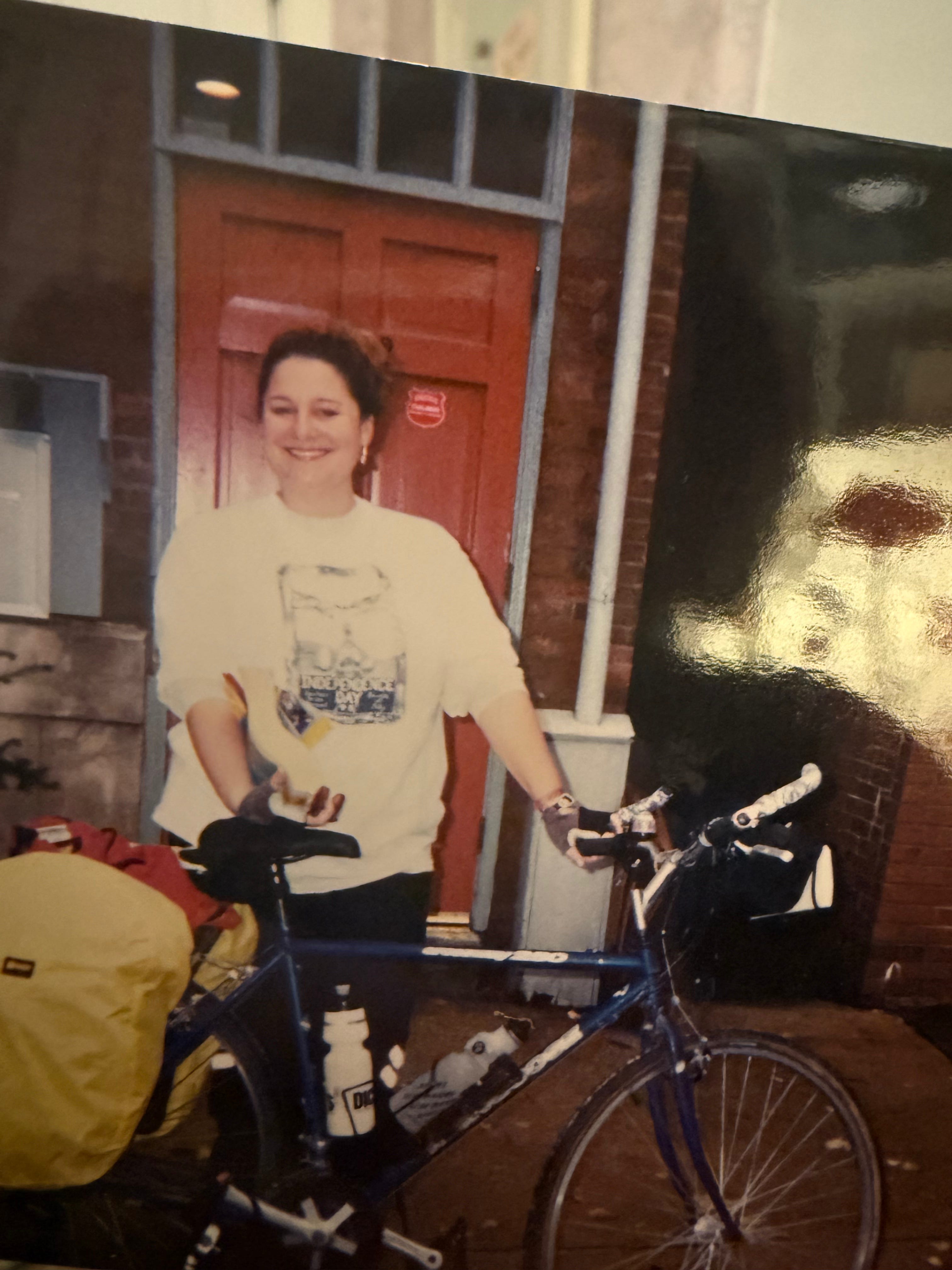
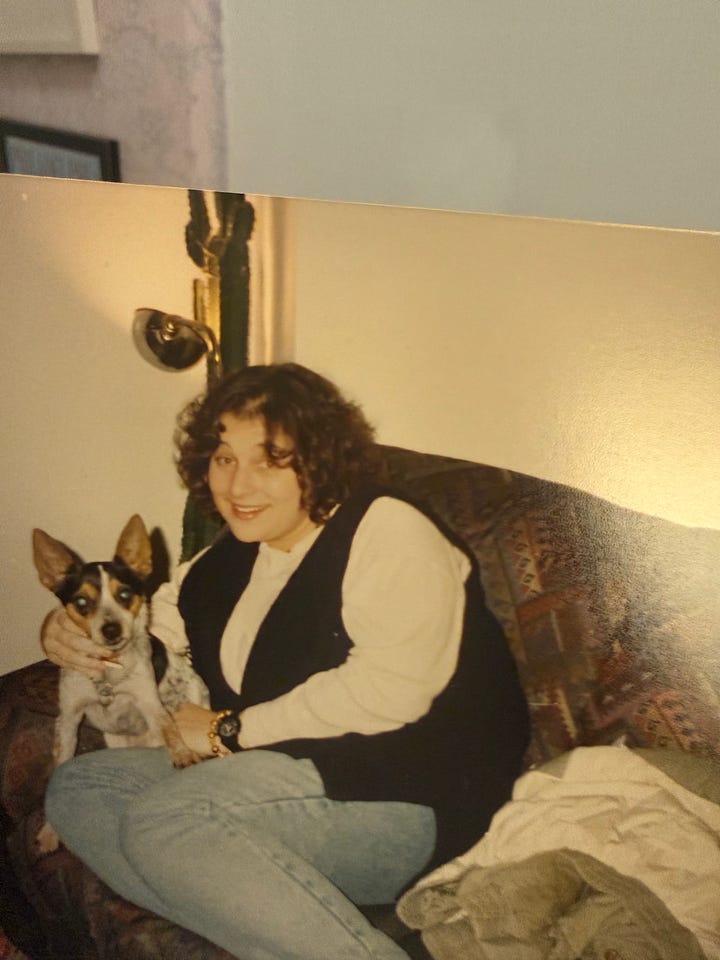
Then: When I wrote GOOD IN BED I was working as a reporter at the Philadelphia Inquirer and living in an apartment in Philadelphia, with my small, spotted, judgmental rat terrier, Wendell, who appeared as Nifkin in GOOD IN BED. I was single, and sad. My thirtieth birthday was approaching fast, and I wasn’t married, and I hadn’t sold a novel, or even finished one. My father was out of the picture. My mom had fallen in love with her first girlfriend. I thought I’d hit the wall, the pinnacle of my professional achievements, and that I’d be working as a newspaper reporter for the rest of my life (little did I know the trouble that the Internet spelled for legacy media).
Now: I’ve published eighteen novels, plus an essay collection and three middle-grade books. I got married and became a mom, and now, my daughters are young adults. Wendell was followed by Moochie, another rat terrier, and Moochie was followed by Levon, a Jack Russell/rat terrier mix. And I still live in Philadelphia, a block away from the apartment where I wrote GOOD IN BED.
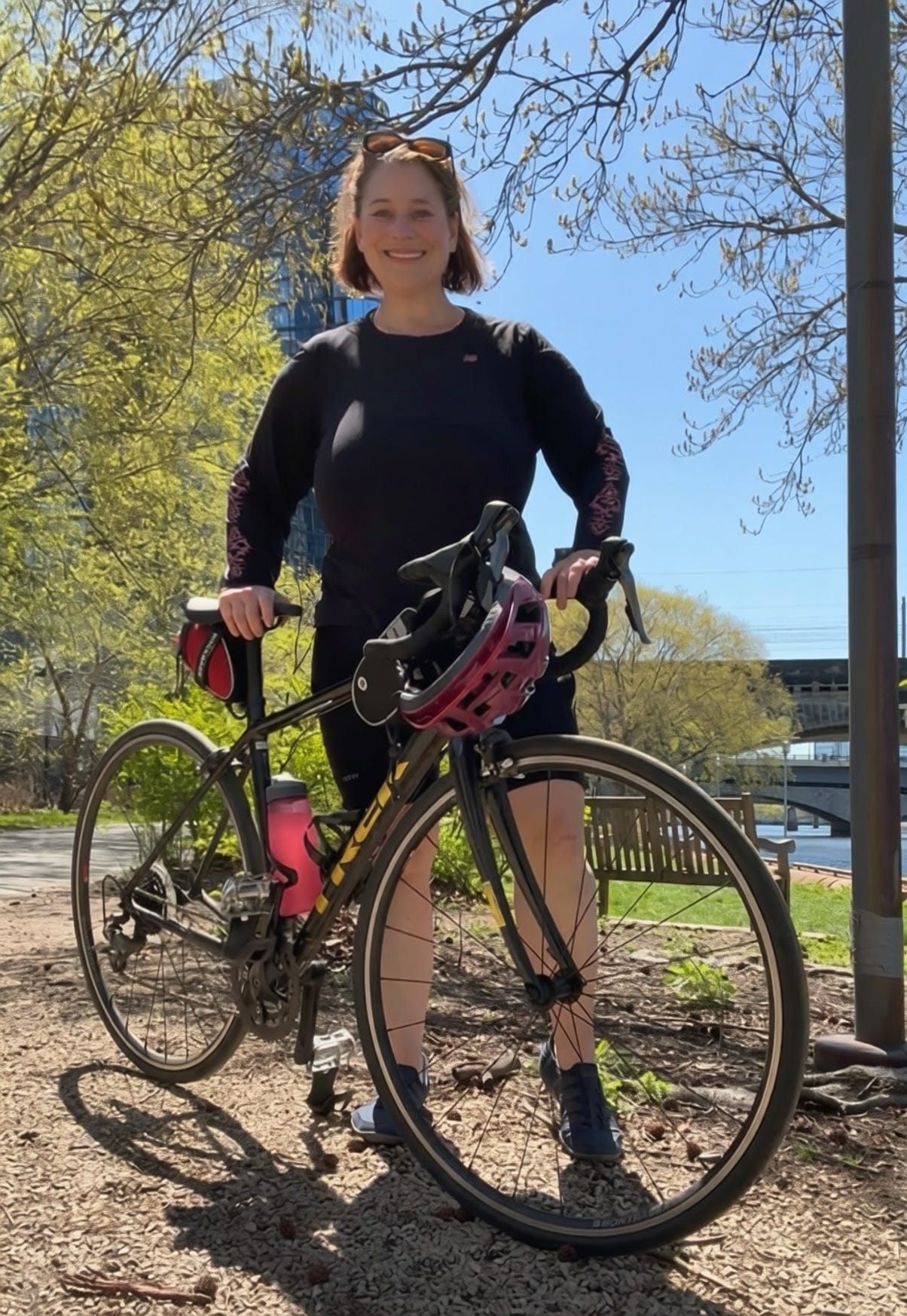
What hasn’t changed is how lucky I feel. I never expected GOOD IN BED to take off the way it did, and it’s still amazing and a little astonishing that it happened, because that’s not normally how things go. The majority of debut novels sell between 3000 and 5000 copies, and fewer than half of the people who publish a debut novel even get a chance to publish a follow-up.
For better or worse, the world is full of challenges for women, whether it’s the erosion of reproductive rights, sexism or ageism or the questions that come with empty nests and middle age, when you’re finally coming up for air, looking around and asking Who am I now? What’s my life going to look like? What’s next? What’s left?
If you’ve read my work, thank you.
If you’ve ever bought, or borrowed, one of my books, or recommended one, if you’ve ever seen yourself and your life or your body or your struggles in one of my characters, if you’ve come to one of my readings, or if you read my blog then, or if you read my Substack or my New York Times essays now, from the bottom of my heart, thank you.
Thank you for coming with me this far.
Here’s to many more years and many more stories.
No posts
Comments
Nothing yet. Say the first thing.
Sign in to join the conversation.