
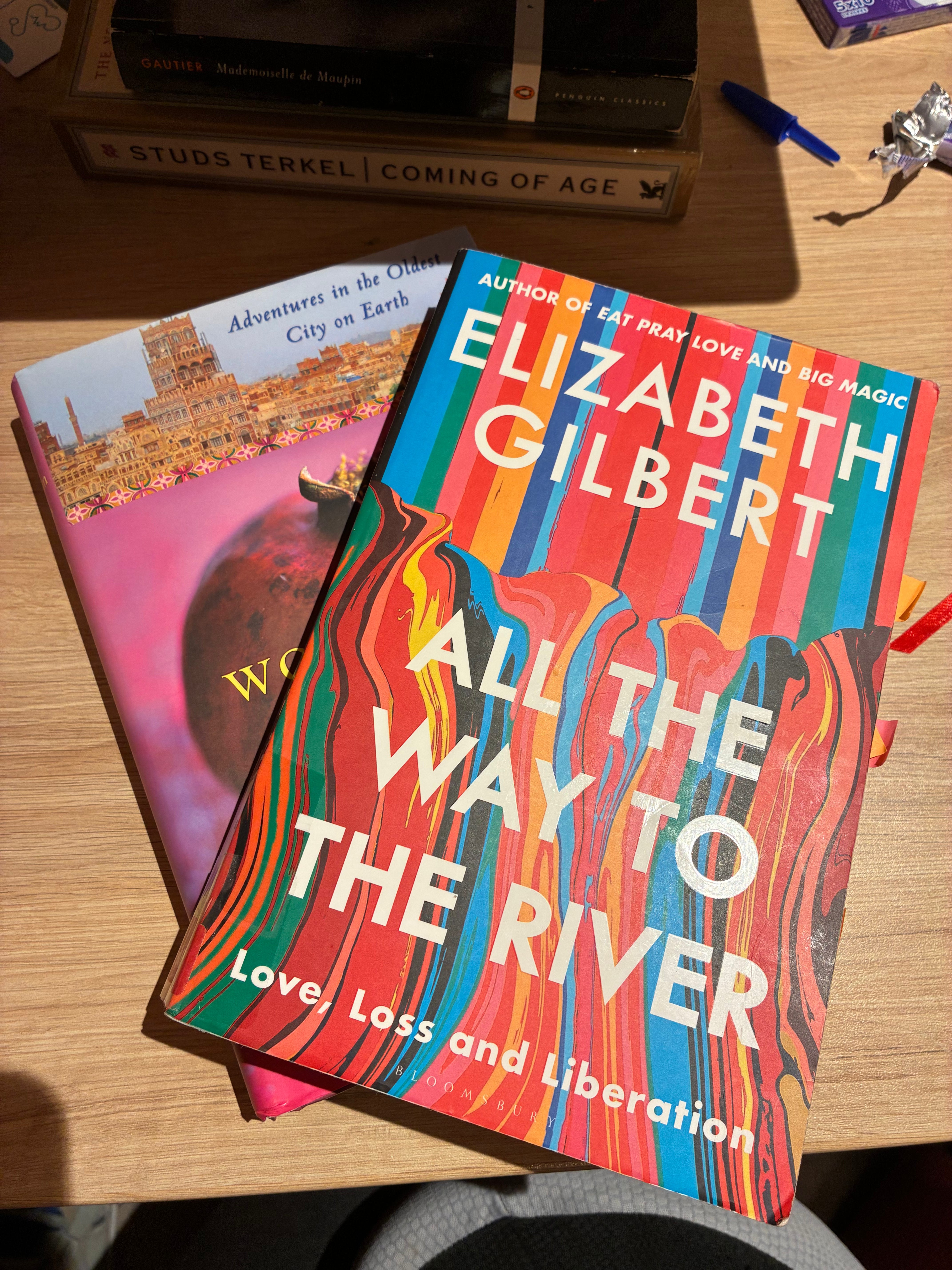
Elizabeth Gilbert’s memoir All the Way to the River was an unbelievably brave thing both to write and to put out into the world. I have an enormous respect for Gilbert for being so willing to expose the worst decisions she has ever made. How many of us would be willing to do that? Those of us who write memoir, including me, usually like to think of ourselves as the heroine of the story. But Gilbert makes it clear from the beginning that that is not her project here.
I didn’t seek this book out. I have read the reviews and they were not kind. But I found it at the library last week and couldn’t resist reaching for it. I have always loved Elizabeth Gilbert and have read most of her books. Not just Eat, Pray, Love, which the entire world has read, but Signature of All Things, City of Girls, and Committed, as well as her earlier works. I appreciate the depth of her research and the lucidity of her prose. I have, like many others, always wanted to be friends with her. I think we would get along.
It is hard to review a memoir, because it is difficult to separate the author from the work. Many reviews of All the Way to the River spend a lot of space criticizing Gilbert as a human. This happens all the time to authors of memoir, especially if those authors are women.
Example: Men are allowed to write about having sex with hundreds of people including married people and people over whom they had power, and reviewers just review the book, ignoring the man’s personal failings. But if a woman writes about having had sex with hundreds of people, she is called a slut and her actual book is ignored. Her person become more important than the text. (No one has accused Gilbert of being a slut, by the way, the above is just one example of the way women’s memoirs are often reviewed).
It is thus unsurprising that Gilbert announced on social media that she would not be reading any reviews of All the Way to the River. She knew how things would go down.
When I was editing my first book, the memoir The Woman Who Fell From the Sky, it included a chapter on my romantic history. My editor had asked me to write something about it. Happy to oblige, I did so, as frankly as possible. But after she read it, she rang me. “I think you need to cut that chapter,” she said. It would not show me in a good light; people would make judgements. It would turn readers away. It would probably make me unrelatable.
Thank god she gave me this advice. Because she was absolutely right. I faced enough criticisms of me as a human after the book came out without that chapter. Had I included an honest account of my life, it would have been far worse. Yet at the same time, it infuriates me that women are not allowed to tell the truth about their lives without facing deeply personal and often misogynistic attacks. Many of which also manage to be inaccurate.
The day after Theadora was born, when we were still in the hospital, the UK tabloid the Daily Mail ran an “exposé” about me and Tim. In a libelous, definitely not fact-checked hit piece, it claimed, among other things, that I was a flame-haired (!) temptress who had ruined Tim’s life and hinted that my pregnancy had been a way to entrap him.
The “entrapment by pregnancy” was a hilarious claim, given that Theadora’s birth was the least accidental pregnancy in history. We spent months considering whether we wanted a child, and then many more months pursuing IVF in order to create a Theadora. She was the most on-purpose child in the universe.
Also, Tim and I had been together for more than two years at this point. Our relationship was hardly news. Nor was it newsworthy. Given that neither of us was famous, it was difficult to imagine any public interest in our personal lives.
Perhaps I would not have been so eviscerated had I not just given birth to my first and only child. I wanted to focus on figuring out how to parent, not on correcting malicious lies. Perhaps I would not have been so eviscerated had the writers had made the smallest attempt at accuracy.
It got worse. Daily Mail people (I refuse to call them journalists) stalked us to our house as soon as we brought Theadora home. They followed us to a breastfeeding clinic when Theadora was failing to thrive and we thought she might be dying. They published photos of us. I hate to think what real celebrities endure.
When my memoir came out, the UK papers described it as a tell-all memoir about my affair with Tim. At least one reviewer confessed she hadn’t even read it, which didn’t keep her from attacking it. The book, for the record, is about my tenure as the editor-in-chief of a newspaper in Yemen. It chronicles the lives of my Yemeni reporters, the newspaper, and my immersion in a new culture. What was most important to me was that readers come away with a new understanding of Yemenis, Yemen, and its journalistic landscape. In the US, hardly anyone could place Yemen on a map. People constantly asked me what language they spoke and whether they were all terrorists. To see this meticulously researched, serious memoir misrepresented made me physically ill for months.
Tim is only mentioned in the very last pages of my memoir. It originally did not include him at all, because he was not the point of the book. But my editor had met Tim and loved him and felt I should tell the truth. He is, after all, what happened. So I told the truth, exposing my questionable decision-making in the throes of love and the mess we created in other people’s lives. I lived to regret it.
Anonymous people emailed me or sent me messages on social media telling me that Al-Qaeda should have killed me when it had the chance. One Amazon reviewer said, “if I knew this author was a homewrecker I never would have read her book.” Amazon removed her comment as abuse. But she was only doing what so many reviewers do, reviewing me rather than the actual story. Which after all, was about the newspaper.
I’ve gone far afield from Gilbert’s memoir. But reading it has reminded me of the perils of writing memoir while female. It has also somehow given me the courage to write openly about what happened to me in the wake of my first book and how damaging it was to me both personally and professionally.
This is not to say I don’t have criticisms of All the Way to the River. I have several. And as I think about my criticisms, I too am wrestling with how to review the book rather than the author. Let me start with her words. The story is compelling and it is beautifully written. I read it in two days. The only writing I didn’t like was the poems interspersed throughout the prose. These were usually addressed either to or from God. The sickly-sweet endearments made my skin crawl. And the language is very self-helpy.
Not to say that the entire book doesn’t resonate with self-help language, the language of AA, and Gilbert’s own epiphanies. But this is fair enough. It is a book about addiction, after all, both hers to love and sex and her partner Rayya’s to opioids. And addicts need structures to cling to, language to help them get where they want to be.
The sticking point for me—and this is just my personal reaction, which I realize not everyone will share—was the emphasis on surrendering to God. Gilbert makes it clear that people in AA have infinite definitions of the word God. It doesn’t have to be related to Christianity. Some people think nature is God. Some worship a Goddess. Some, Gilbert included, think God is love. So far, I am okay with this.
It’s the surrendering, the handing over that bothers me. If we admit we are powerless over our own lives, doesn’t that remove all our agency? And any motivation to act? None of us are completely powerless. Many addicts make the decision to go to AA. That is agency. That is a choice. Some make the decision to stop using drugs or alcohol or sex, which is also a choice that is in the power of only the addict. There is agency. I don’t know why we need to be powerless. We can admit we only have limited power over our own lives, but we do have some.
Also, what if we don’t believe anyone or anything will catch us if we release control? What if we take our hands off the wheel of our lives and they simply skid off the road? No matter what definition one has of God, it doesn’t necessarily mean that God will step in to make all your decisions. We were given (limited) free will for a reason. I believe in the power of mountains and trees and insects and lakes and cats and in an energy that infuses us all. But I don’t think the trees will step in to manage my life for me.
We’re powerless enough as it is. I can’t cure my cancer. I can’t extend my life. I can’t make people read my books. Sometimes I can’t get out of bed. But when we have a chance to exercise agency, shouldn’t we use it? Every day I choose to do ballet and yoga. I choose to write. I choose to walk. No one else is going to make these decisions for me.
Gilbert is fortunate enough to hear voices from beyond the grave. To have experiences of the divine. To believe in some kind of happy afterlife. To receive direct messages from her version of God.
But I receive no such messages. I have never heard from a ghost.
Gilbert suggests that the universe is using Rayya to teach her something she needs to learn and that it is using her to teach Rayya something she needs to learn. But this suggestion that the universe has a plan for us that makes any kind of sense is not something I have ever believed. My dearest friends have lost children to cancer. Children. Was there supposed to be an important life lesson for a five-year-old boy or an eight-year-old girl? Was there supposed to be some kind of educational lesson for their parents? Such a thing horrifies me. No lesson in the world justifies this suffering.
When I turn my focus to the broader world, it would equally horrify me to believe that the Yemenis are being taught some kind of universal lesson by starving to death. That the Sudanese women have to be taught life lessons through rape and violence. Not everything that happens to us makes us better or wiser.
I don’t mind Gilbert having these beliefs. Everyone is entitled to the beliefs that help them navigate the world. Her beliefs help her. Who am I to want to take that away? I don’t even want to take them away, as they sound like comforting things to believe. I just don’t share them.
Critics have accused this memoir of being “priv lit,” as Gilbert is a privileged, beautiful, rich, successful white woman. This is true. But she cops to all that. I think she deserves her literary success. She’s a wonderful writer. She made her own money. Throughout the book she constantly forces herself to tell us truths she does not want to tell us. Because she knows that unless she is honest, her words won’t help anyone. This takes guts, people.
I have one criticism that veers towards criticizing Gilbert, rather than her story. I found the rampant materialism repellent. I worried—though she never does—that Rayya was using Gilbert for her money. Rich and famous people can never know if people love them for themselves or for the things they can do and buy for them. (Though I am sure Gilbert is appealing enough without the money!). She takes Rayya on trips around the world, buys her everything her heart desires, houses her for free for years, helps her write her memoir and gives it the kind of publicity those of us without famous writer partners can only dream of. This creates a massive imbalance in the relationship.
I want to believe in the authenticity of their love. And for the most part I do. I really do. But there are just so many material transactions between them. Even in the last months of her life, Rayya is asking for a Rolex and designer boots. This shocked me. My experience of having a terminal disease is that it takes away any desire to acquire more things. Even when I get tired of my same five dresses, I think, why spend money on something I will only use for a few months? I feel guilty for the gift of new sneakers because how much use will I get out of them? There is no physical object I long for, only experiences. What I envy most is that Rayya gets to travel to everywhere she ever wanted to go.
In the final days of her life, Rayya asks for an Apple watch. It makes no sense. It makes even less sense that Gilbert buys it for her. But I accept that dying and watching someone die can make you insane. You have to understand, Tim said, when someone has as much wealth as she does the cost of an Apple watch is like nothing to her, it’s like buying a candy bar. He then reminded me of his journeys around the UK accompanying the Crown Prince of Brunei. One day the prince decided to buy an expensive car, worth about 400,000 pounds. The same day, he became upset that the price of a Mars bar had risen by a penny. They’re the same things to him, Tim said. (I kept reading parts of the book to Tim, so he’d know how easy he has it as a caretaker. At least I’m not off my head on cocaine! At least I’m not hurling abuse at him! At least I don’t make him empty his bank account to buy drugs for me!)
Despite these criticisms, I was moved by the book. I know this because when Tim came in the bedroom as I was reading about Rayya’s actual, painful, violent death, I started to cry. It also makes me fear my own death even more. I would like to think that Gilbert’s view of the afterlife is real. But I won’t know anything about the afterlife until I am there. I won’t know which religion, if any, is right until I die and can see for myself. Or I won’t know anything. I will just peacefully fertilize a cherry tree.
Thanks for reading Liminal with Jennifer Steil! This post is public so feel free to share it.
Comments
Nothing yet. Say the first thing.
Sign in to join the conversation.