
I was planning to write a book explaining and debunking the “Alpha Myth”—the myth that supports fascist ways of thinking, associating, and communicating. I was going to maybe call it Fascism is for Losers. I’d still like to write that book. Now more than ever. The draft of the Introduction and the TOC are below. I had a final draft of the proposal ready in September 2024. It never went out on submission. The timing wasn’t right, they said. Things have been weird in publishing, I think, but I hope someone is interested in this. Seems…relevant.
“What is Germany like under the new Nazi government?” American journalist Dorothy Thompson wondered as she drove along the road from Austria to Berlin in August 1934. She planned to spend a few weeks in Germany talking to old friends and sources to see what she could find out. That morning, she noticed few other cars on the road, which she found peculiar but not surprising. As a foreign correspondent for the New York Post, Philadelphia Public Ledger, and Saturday Evening Post, Dorothy had been writing about the economic troubles facing Europe for years. She knew that few German tourists were vacationing in Austria those days—the cost of visas was too high, and the region was impoverished after the Great War.
Mostly Dorothy was surprised by all the new flags.
The flags were “bright red with a black swastika in a white circle in the middle,” and Dorothy saw them everywhere. She saw them flapping outside of every business and every home. She saw some houses with two or more—multiple families lived there, she guessed. She saw flags so big they hung from the second story to the ground, covering German homes like a shroud.[i] Big or small, the flags were all the same, which Dorothy thought “made the streets look very gay, as though there were a festival.”
Because Dorothy arrived in Germany just days before the August 19 election, she also saw hundreds of election banners and posters proclaiming “Ja dem Führer!” (“Yes to the Führer!”). President Hindenburg had just died, and Adolph Hitler had appointed himself both Chancellor and President. “In other countries when there is an election you vote whether you want one candidate or another,” Dorothy had written for Harper’s, “but in Germany Hitler made himself President and it was a law, and then people voted whether they liked the law or not. If they liked it, that meant he was President; and if they didn’t, that meant he was President anyhow.”
On election day, Hitler’s Storm Troopers watched the polling stations, “creating a terror-atmosphere,” and making each vote cast a high-stakes test of loyalty to Hitler and the new Nazi regime.[ii] The Nazis had already shut down opposition newspapers, forced out or arrested opposition political party members, and censored books and university professors.[iii] Though there was no alternate candidate on the ballot, Hitler wanted to claim that he represented the will of the German people, so Storm Troopers marched political groups to the polls and voters had to cast their ballot in public, under the watchful eye of the police. Ballots came pre-marked anyway, or were forged, or were counted as a “yes,” even if marked “no.” When the polling was over, the Nazis reported that 89.93% of the votes were “yes.”[iv]
During her journey through Austria and Germany, Dorothy spoke with paupers and diplomats, folks who’d earnestly “gone Nazi” (as she called it) and others who only pretended to “go Nazi” to get by. She saw a lot of men in uniform and a lot of black armbands, some worn in support of the Nazis, some worn in mourning. Whether people were mourning Austrian Chancellor Dollfuss (murdered in a recent Nazi coup) or Storm Trooper leader Ernst Rohm (murdered in a recent Nazi purge of the Storm Troopers known as the “Night of the Long Knives”), or President Hindenburg (died of lung cancer), Dorothy couldn’t tell. “One black armband looks like another, after all.”
The flags and uniforms and posters and banners and arm bands were outward signs of the drastic hidden changes Dorothy saw among the German people. She had always found Germans so open and friendly, but on this trip, she found that most “wouldn’t say anything at all.” They were frightened to death, Dorothy thought. Some were afraid of the Nazis, but others were afraid of outsiders, believing the Nazi propaganda that told them that “the whole world” was “preparing to make war on us,” as one old friend told her. That the whole people of Germany were in danger—from threatening outsiders and corrupt insiders—and that Hitler was the only one who would protect them, seemed to be a widespread belief among the people Dorothy met who’d “gone Nazi.” Hitler was the only one standing between the people and their enemies; like the posters said, the German people owed Hitler their votes, loyalty, and lives.
To Dorothy, Hitler’s plan to normalize Nazi ways of thinking—by terrorizing the adults and indoctrinating the children—seemed to be working.[v] A Catholic priest told Dorothy that “in the Nazi outlook nationalism is elevated to a mystic religion, and the state claims not only the bodies of the people but the souls.” Through her many conversations as she travelled, she saw that the Nazis had essentially turned themselves into a “reigning cult.” Hitler had made himself into a religion, deified by the efforts of his Minister for Public Enlightenment and Propaganda Joseph Goebbels, with new laws—like those governing all those new flags Dorothy saw—designed to enforce Hitler’s deification.[vi]
The morning after Dorothy settled into her hotel in Berlin on August 24, 1934, she learned how easy it was to be targeted by these new Nazi laws. A Secret Police officer found Dorothy at the hotel and delivered the order that she must leave Germany immediately. She’d been found guilty of violating German “national self-respect”—forbidden by Hitler’s 1933 Editorial Law.”[vii]
That she’d even been allowed into Germany in the first place was remarkable. Three years earlier, in 1931, Dorothy had interviewed Hitler before he and his party took power. Upon meeting him, she hadn’t found the German Übermensch (Superman or Overman) that she had been told to expect from Hitler’s propaganda. Instead, she found him “inconsequent and voluble, ill-poised, [and] insecure.” Dorothy wrote about what she saw in Hitler in a magazine article that appeared in Cosmopolitan in the US and in Nash’s Pall Mall Magazine in Britain, which she then turned into a short 1932 book I Saw Hitler. Hitler was “awkward,” Dorothy wrote. She had been told that he was the epitome of virile male machismo, but she saw him as “soft,” “hysterical,” “embarrassed,” and “unattractive”—“a man whose countenance is a caricature.” Dorothy found that you couldn’t carry on a conversation with him because he ranted and raved and pounded the table. He preferred to dominate a conversation with monologue rather than engage in the give and take of dialogue, which, to Dorothy, made Hitler a tiresome bore.
In I Saw Hitler, Dorothy dared to pierce Hitler’s propagandistic hero narrative by telling the story of his pathetic biography: Hitler believed in German superiority, but he himself was from the “Austrian provinces”—he didn’t even speak (or write) German properly. Hitler’s father was a “petty official,” and perhaps he would have become a small-time official too, but Hitler had higher aspirations “to be a painter, an artist.” Twice rejected from studying the arts—first from the painting academy in Vienna, then from the architecture school—he ended up as a “house painter, on new constructions. He combined, to be sure, architecture and painting,” Dorothy noted drolly, “but not exactly as he had imagined.”
Dorothy saw that Hitler was a loser who appealed to other losers by promising them a better future: “I thought him a Little Man,” she wrote, “but perhaps therein, exactly therein, lies the secret of his enormous success.” She thought that Hitler appealed to those “Little People” who were “weighted with a feeling of inferiority. Hitler too, is weighted with it.” His fascist rhetoric lifted them all. Afterall, she wrote, “patriotism is the cheapest form of self-exaltation. If one is in debt, if one has not made a success of life—still, says Hitler, one belongs to the RACE.” His “shabby audiences” listened to him because “they feel themselves exalted. Better times are coming.”
Though he had not yet seized power when she wrote I Saw Hitler, Dorothy believed that Hitler’s future was pre-determined by his past. All that insecurity, that failure, that lust for power made Hitler dangerous. Hitler was dangerous for the German republic, which he planned to abolish, and for the Jewish people, whom he planned to eradicate. She wrote at length in I Saw Hitler and in a series of articles for the Jewish Daily Bulletin about how he had framed the Jewish people as hate-objects—scapegoats that he could use to take the blame for his and Germany’s failures.
Dorothy had started her 1934 trip wondering how Germany had changed under the new Nazi regime. Though her trip was cut short, she got her answer. She encountered the nation in the process of “going Nazi.” In her writing we see the tactics the Nazis used to normalize fascism as an idea and a political system—placing it in a new context where it’s seen less as abhorrent and more like common sense. Once fascist ideas and ways of understanding the world become normalized, they become a part of a society’s disciplinary apparatus: acting according to the new “norms” is required for good standing within that society; failure to do so is punished. Those who had “gone Nazi” had been normalized; those who pretended to “go Nazi” to get by recognized the disciplinary power Hitler had over Germany and adjusted their actions accordingly.
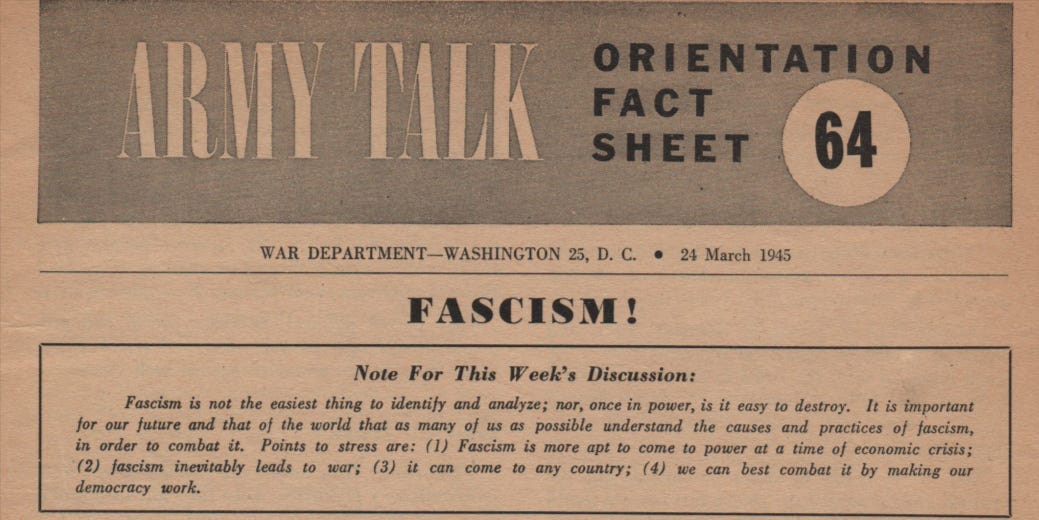
Dorothy saw that the German people were impoverished, demoralized, scared, humiliated, frustrated, and cynical. She saw that a population with those characteristics was vulnerable to an authoritarian takeover. She saw the nation awash in widespread propaganda efforts to normalize Nazi ways of thinking and acting, enforced with violence, terror, and intimidation. She saw that the Nazi practices of saturating the nation with party symbols like uniforms, arm bands, and flags, conducting sham elections, silencing opposition parties and newspapers, censoring books and professors, conducting extra-judicial killings and violence—and, above all, constantly testing German citizens’ loyalty to the Nazi regime in both thought and action—had already succeeded in changing Germany. When she took a critical look at Nazi propaganda efforts, she saw appeals to emotion over reason, the widespread use of fear appeals, and the creation of a sentimental and pseudo-religious narrative that made Hitler a demigod and Nazism a religion. Dorothy saw that in the new Nazi Germany outsiders were framed as threats, disloyal insiders were framed as corrupt, and Hitler was framed as Germany’s only hope.
As an outsider—a foreign correspondent—Dorothy could see how the cult tactics of isolating people from all other forms of information, banishing non-cult members, indoctrinating children, and keeping people in a constant state of fear and agitated alert worked on the German mind. She knew that part of why she was ejected from Germany was because her outsider perspective was dangerous to the success of Hitler’s Nazi indoctrination—not only could she report what was happening inside Germany to the rest of the world, but she could pierce the cult’s propaganda by showing the German people that Hitler’s narrative was a tragic farce. Hitler tried to normalize fascist ways of thinking and acting, but Dorothy’s writing had the potential to expose him as a fraud. What Hitler would try to make normal, Dorothy would try to make weird. She was dangerous in the way that truth-tellers are always dangerous for fascist regimes.
When Hitler ordered her out of Germany, Dorothy received a tremendous amount of support from her friends in the foreign press corps, but she also faced some criticism for the way that she wrote about Hitler. Dorothy didn’t care. She wrote what she wrote because that’s how she thought journalists ought to do their job—without fear or favor for the sensitive feelings of wannabe fascists or their propagandists.[viii]
Dorothy was the first foreign correspondent to be banished from Germany, but she worried that she would not be the last.[ix] Despite complying with Hitler’s order, Dorothy was defiant. Though she didn’t get the chance to defend herself against the charges in a court of law, Dorothy did defend herself in the court of public opinion. “As far as I can see,” she wrote, “I really was put out of Germany for the crime of blasphemy.” She had seen through Hitler’s pretense and said so. She knew that the Hitler Übermensch “strongman” persona was an act. “To question this mystic mission is so heinous that, if you are a German, you can be sent to jail,” she wrote just after she left Germany. “I, fortunately, am American, so I merely was sent to Paris. Worse things can happen to one.” Dorothy changed nothing but her location.[x] She would not be cowered by the force of Hitler’s strongman propaganda.
Once back home in the United States she went on a speaking tour, hosted a weekly NBC radio news program, and wrote a syndicated newspaper column called “On the Record” that reached more than 8 million readers, three times a week.[xi] By June 12, 1939—a few months before Hitler invaded Poland—she was on the cover of Time magazine, which wrote that “she and Eleanor Roosevelt are undoubtedly the most influential women in the U.S.”
That same year, the German-American Bund (the American Nazi party) held a rally at New York City’s Madison Square Garden. The rally drew a huge crowd—with twenty thousand attendees, and at least that many protestors outside. The Nazis had draped the stage in American and Nazi symbols, including a giant George Washington banner hung alongside Nazi flags. As the drums beat and the Nazis marched down the center aisle toward the stage, the crowd—many wearing Nazi uniforms and black arm bands—made the “Heil Hitler” salute to the Nazi flag.
Dorothy was there. She saw that the same normalizing tactics that she had witnessed in Germany in 1934 had come to America. Like she had done when she wrote I Saw Hitler, Dorothy heckled the Nazi rally’s main speaker, Bund publicity director Gerhard Wilhelm Kunze. Dorothy laughed loudly throughout his speech and shouted, “BUNK, BUNK, BUNK!” loud enough to attract the attention of the Nazi guards.
Of course, those Nazis kicked Dorothy out too.[xii] She didn’t mind too much. She was right, after all. Fascism is bunk. Like Dorothy, who is now known to history as one of Hitler’s foremost critics, we shouldn’t be afraid to say so. Fascism is for losers.[xiii]
Book TOC
Introduction: Democracies Go Fascist
Chapter Intro: Dorothy Saw Hitler
Intro.1 The Eternal Struggle between Democracy and Authoritarianism
• The World Historical Struggle Against Fascism
• Cycles in Government and Unnatural Corruption
• The Fascist March on Democracy
Intro.2 Creating the Conditions for Fascism
• Normalizing Fascism
• Controlling the Tubes
• Information Warfare and Rhetorical Tricks
Intro.3 Politics as Perpetual War
• Fascists Hate Peace
• Chaos and Democratic Erosion
• Politics is War and the Enemy Cheats
Intro.4 We Can Stop It From Happening Here
• Who Wants Fascism and Why?
• How They Get Us: Their Alpha Myth Lie
• Book Overview: Debunking that Bunk
Chapter 1: People Go Fascist
Chapter Intro: Would You Go Fascist?
1.1 Fascist Leaders and Fascist Followers
• Social Dominators Have a Will to Dominate
• Right-Wing Authoritarians Have a Will to Submit
• Everyday Fascism: Trolls and Bullies; Victimhood and Humiliation
1.2 Parents Raise Fascists
• Raising for Fascism: Obedience, Hierarchy, Group Cohesion
• Raising for Fascism: Isolation, Terror, and Violence
• Raising for Fascism: Hurt, Humiliation, and Coercion
1.3 Societies Make Fascists
• Making Enslavers
• Making Nazis
• Making Religious Right-Wing Authoritarians
1.4 Resisting Fascism
• Breaking Cycles of Fascist Trauma
• Heroes Who Reject Racial Fascism
• Heroes Who Reject Religious Fascism
Chapter 2: “Strongman” is a Strawman
Chapter Intro: This Dumb Angry Bird
2.1 The Alpha Myth
• Alpha Wolves, Alpha Men
• Men Hunted, Women Gathered
• Hierarchy is Good: Strongmen Should Lead
2.2 The Alpha Myth is Bunk
• Actually, a Wolf Pack is a Family
• Actually, Warrior Grandmas
• Actually, Equality is the Way
2.3 The Übermensch Farse
• The Fascist Will to Heroize the Fascist as Übermensch
• The Ridiculous Übermensch Aesthetic
• Übermenschen on Drugs
2.4 Telling a Story of Democracy, Not Dominance
• The Democratic Motive
• We Need Each Other: We Can’t Survive Without Cooperation
• Trust is Strength, Ethics is Contagious
Chapter 3: Fascists Aren’t Macho
Chapter Intro: The Scary Bathroom Panic
3.1 The Fascist Will to Normalize Gender
• Nazis and Transgender Panics
• The “Trad Wife” Lie
• Activating the Posse I: Bathroom Checks
3.2 Fascist Masculinity is a Tragic-Ironic Fraud
• #NotADragQueen
• Fascists Have Terrible Relationships
• Lonely Men are Useful Idiots for Fascism
3.3 Fascists Need Babies to Sacrifice to Fascism
• Keeping Women in their Place, Making Babies to Replace the Race
• You were Born to Die for Fascism
• Activating the Posse II: Abortion and Fugitive Slave Laws
3.4 Y’all Means All
• Actually, Animals are Pretty Gay
• Patriarchy Hurts Men Too
• Call Them In
Chapter 4: Fascists Aren’t the Fittest
Chapter Intro: The War of All Against All Sucks
4.1 Amygdala Hijacking in Progress
• Can’t Think or Solve Problems if Your Amygdala is Jacked Up
• What a Mean World
• Activating the Posse III: “Stand Your Ground”
4.2 Unfit and Maladapted
• Fascism Rejects the Conditions Conducive to Life
• Fascism is the Bad Place: Worse Health, Excess Deaths, Deaths of Despair
• Fascists Don’t Dominate Nature, Nature Dominates Fascists
4.3 Paranoid, Yikes!
• Long Knifing and Other Coup Proofing Strategies
• Our Thoughts are Pure, Dear Leader
• Activating the Posse IV: Conspiracy Clowns
4.4 The Benefits of a Society of Equals
• Only Connect
• Affirm Human Dignity
• Trust for Happiness
Chapter 5: Fascists Aren’t Problem Solvers
Chapter Intro: The Trains Didn’t Run on Time
5.1 Fascist Corruption
• Lying
• Cheating
• Stealing
5.2 Fascist Chaos
• Because I Said So
• No Plan
• Unstable
5.3 Fascist Trickery
• Unfreedom
• Their Goals Become Your Goals
• Control is an Illusion
5.4 Democracy Works
• We’re Smarter Together
• We’re Stronger Together
• We’re Safer Together
Chapter 6: Fascists Aren’t Heroes
Chapter Intro: Dear Glorious Leader God Emperor
6.1 Fascists Con Their Marks
• Political Con Men
• The Status Con
• The Violence Con
6.2 Fascists Die Horrible Deaths
• Literal Deaths
• Symbolic Deaths
• Fascism is a Death Cult
6.3 Fascists are History’s Villains
• Fascists Get Memory Holed
• Fascism is a Lost Cause
• Hitler is the Worst
6.4 Eternal Fame is for Liberators, Not Oppressors
• Unforgettable, the Spur of Fame
• Cincinnatus, Never Seek Power
• The Arc of the Moral Universe Bends Toward Justice
Conclusion: Democracy is for Winners
Con.1 Fascists Have Already Lost the Future
• Fascists are Residual Culture
• Nobody Wants Fascism Except Fascists
Con.2 How to Communicate for Democracy
• John Dewey and Democracy as a Way of Life
• Zulu Personal Statement and Affirming Human Dignity
• Think, Associate, and Communicate for Democracy
Con.3 Democracy is the Way!
• Embrace and Perfect Democracy
• 10 Things We Can All Do to Make Democracy Thrive
[i] https://archive.harpers.org/1934/12/pdf/HarpersMagazine-1934-12-0018860.pdf
[ii] https://books.google.com/books/about/The_Third_Reich_in_Power.html?id=iG4ud0PxeDMC&printsec=frontcover&source=kp_read_button&hl=en&newbks=1&newbks_redir=0#v=onepage&q&f=true
[iii] https://avalon.law.yale.edu/subject_menus/nca_v4menu.asp
[iv] Voters were asked the question: The office of the President of the Reich is unified with the office of the Chancellor. Consequently all former powers of the President of the Reich are transmitted to the Führer and Chancellor of the Reich Adolf Hitler. He himself nominates his substitute.
Do you, German man and German woman, approve of this regulation provided by this Law? https://en.wikipedia.org/wiki/1934_German_referendum
[v] Hitler’s Mein Kampf can be read as a propaganda manual, both for teaching propaganda strategies and for providing the content for propagandistic messages.
[vi] Karl Christian Führer, “‘Hoist the Flag!’: Flags as a Sign of Political Consensus and Distance in the Nazi Period,” in Private Life and Privacy in Nazi Germany, pp. 156 – 181.
[vii] Frederick T. Birchall, “Dorothy Thompson Expelled by Reich for “Slur” on Hitler,” New York Times, August 26, 1934. https://avalon.law.yale.edu/imt/2083-ps.asp
[viii] We have a pretty good sense for how Dorothy thought journalists should handle Hitler and other political leaders from a book review she wrote two months before her trip to Germany. In June, 1934 Dorothy published a review of her friend and fellow foreign correspondent H.R. “Red” Knickerbocker’s 1934 book, The Boiling Point: Will War Come to Europe? in the Saturday Review of Literature. “There is material here for a thoughtful book,” Dorothy wrote, “It is too bad it is not better used.” Dorothy criticized Red’s book for being stenography more than journalism. “If I give way to irritation, it is because I believe that Mr. Knickerbocker has many of the qualities of a first-rate journalist. He is intelligent. He is untiringly energetic. He has a commendable passion for accumulating accurate facts. It is only regrettable that he seems to think that the lack of any philosophy of history or of politics is identical with objectivity. The question of whether or not there will be war in Europe, within foreseeable time, cannot be answered by mere reporting. It demands a careful analysis of historical and political dynamics. Mr. Knickerbocker is capable of making this analysis, but he does not do so. He runs about and interviews people, most of whom, as he perfectly well knows, are unimportant factors in the answer to the question…And in any case the answer to the question of this book is certainly not going to be arrived at by asking it in every chancellery in Europe. The interview, I have always thought, is one of the more meretricious forms of journalism. Mr. Knickerbocker has been seeking to gather up pearls of wisdom from every chancellor or governor from Danzig around Europe to London, and all of them say just what you would expect them to. Mr. Knickerbocker hands out these statements with a fine impartiality, and, too often, with an irritatingly straight face. Does he, for instance, really think that the balderdash talked by Regent Horthy of Hungary is in the least important? Presumably he does.”
[ix] Deborah Cohen, Last Call at the Hotel Imperial, 2022.
[x] “Dorothy Thompson Tells Of Nazi Ban” By Dorothy Thompson.
New York Times (1923-); Aug 27, 1934; ProQuest Historical Newspapers: The New York Times
pg. 8
[xi] Thompson, Dorothy, “Columnist To Conclude Long Career of Writing,” The Austin Statesman (1921-1973); Aug 25, 1958.
[xii] They let her back in once they realized that she was a reporter. “Whenever he made one of his blanket indictments against all Americans not purely Aryan, the audience applauded and howled with joy. Between Mr. Kunze’s speech and a wholesale pogrom is a very short step...I laughed because I wanted to demonstrate how perfectly absurd all this defense of ‘free speech’ is, in connection with movements and organizations like this one.” Thompson, Dorothy, “Miss Thompson Issues Statement on Bund Rally,” The New York Herald Tribune, February 21, 1939, pg. 3.
[xiii] Peter Kurth, American Cassandra (Little Brown & Co (January 1, 1991).
Comments
Nothing yet. Say the first thing.
Sign in to join the conversation.