
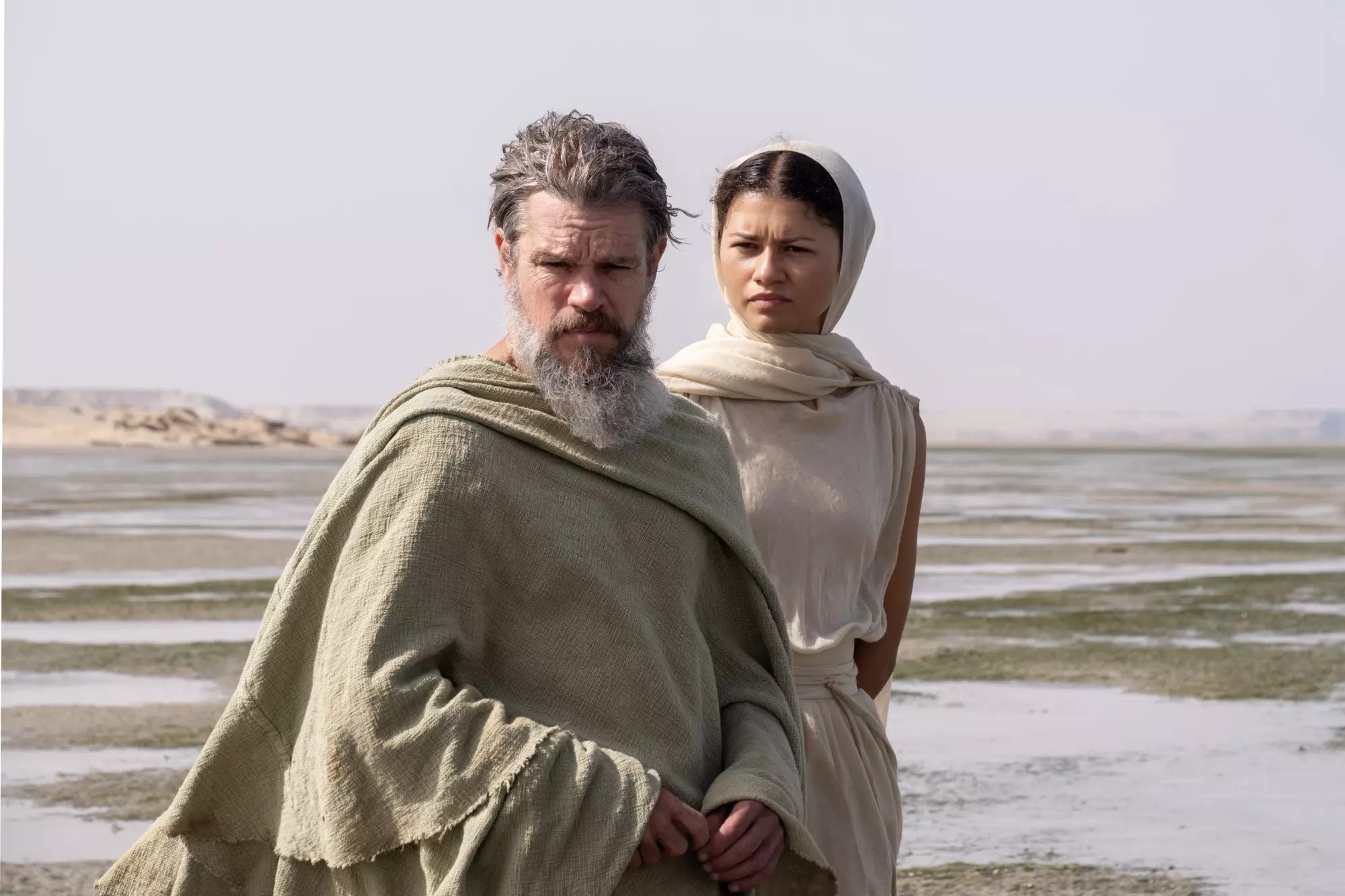
It seems nearly everyone in America has seen Christopher Nolan’s The Odyssey, and thus has received this version of the Homer epic’s plaintive and clear message: It’s about the collapse of civilization brought on by the widespread abandonment of civility, tolerance for outsiders and the poor, and use of the written word.
It’s about the end of the Bronze Age, technically. But, you guys, I think he’s talking to us. We’re the ones abandoning civility, we’re the ones on the brink of collapse.
It’s no exaggeration to say that at least the more liberal-minded among us have been experiencing a level of political malaise of late. And by “of late,” I mean the last ten years or so, a decade that by some great coincidence has matched up with the time that we have been dealing with Donald Trump as a national political figure. All of us have felt, at one time or another in the last decade, a profound sense of discouragement and distrust when it comes to our American project.
It can feel as if things are falling apart more and more every day. Wars in Ukraine, Gaza, and Iran. Mass shootings. A president literally taking a wrecking ball to the White House and slapping his name on everything in D.C. The ridiculous Reflecting Pool debacle (which would have been kind-of funny if it hadn’t resulted in actual people being falsely charged with vandalism; thank goodness sense finally prevailed, in the surprising form of Jeanine Pirro). The barrage of bad news often feels unbearable.
But what if there is hope in the fact that it has always been so? I have been interested in the ways that optimism wins out in difficult political times because of the subject of my most recent book, Parks and Rec, which argues just that. To give in to cynicism is to do nothing, and Leslie Knope believes, more than anything else, in doing something.
I also recently found hope in an unlikely place: the Billy Joel song “We Didn’t Start the Fire.”
I have loved and hated this song throughout my life. It is exactly the kind of song that seems deep to a 15-year-old, which is what I was when it came out in 1989. Whoa, it references a barrage of historical events, some of which I was familiar with from history class and some of which I wasn’t! “South Pacific, Walter Winchell, Joe DiMaggio … Joe McCarthy, Richard Nixon, Studebaker, television … North Korea, South Korea, Marilyn Monroe …” I was a nerd, so the chance to look up “Walter Winchell” in an encyclopedia was a thrill for me. As an adult, however, I came to hate this song: It felt like lazy songwriting in which Joel got out that same encyclopedia and just found rhyming words and called those lyrics. On top of all of that, I read it as a screed of Boomer apologism. We aren’t responsible for any of the bad things! They’ve always been there! We’re off the hook! (To his credit, Joel doesn’t much like it either in retrospect.)
But I recently heard the song in a café, a few days after my partner Jesse and I saw The Odyssey, and began to turn around on it. When I started reflexively complaining about it, we joked that Odysseus would disagree. At the end of the film, he’s basically admitting—insisting—that he started the fire. As critic Amy Nicholson wrote in her LA Times review, Nolan casts his Odysseus in a similar mold to that of his last hero, physicist J. Robert Oppenheimer: “Not only does he steal, slaughter and pillage while expecting to be treated with kindness, but he’s also brainstormed the atomic bomb of his day: the Trojan horse, a deceitful invention planted into the sandy beaches of Troy that marks the decline of civilization like the Statue of Liberty in ‘Planet of the Apes.’”
Jesse insisted, despite his general distaste for Joel, that maybe the guy had a point. Maybe Odysseus was taking too much responsibility. Hell, now that I think about it, maybe Nolan’s Odysseus is a bit narcissistic, whereas Oppenheimer really did start a pretty significant fire.
Jesse is always arguing that things are not as bad as people say they are. Overall, the world has made great progress over the course of modern times. Global life expectancy is increasing, and poverty is shrinking (though some of these trends are, admittedly, slowing). He gave a whole talk about this to our Zen community, citing the attitude of the Buddhist being Kanzeon: “What I want you to notice is, even though Kanzeon hears the cries of all the suffering beings of the world, she’s smiling. Or at least, she looks peaceful.”
As I began to think more about “We Didn’t Start the Fire” in this context, it seemed perhaps even a bit prophetic. It is mimicking what social media would eventually feel like: a barrage of stuff, both good and bad, trivial and important, endlessly entwining. “Roy Cohn, Juan Peron, Toscanini, Dacron … Dien Bien Phu falls, ‘Rock Around the Clock’ …" Joel’s relentless recitation shows that it has long been so, whether or not we experienced it quite like the firehose we endure now. There’s a great new Olivia Rodrigo album and a president experimenting with fascism, some of which he’s gotten away with and some of which he hasn’t. Both can be true, and one doesn’t have to blot out the other. This struck me when doing research for the novel I’m writing, which takes place in 1967 and 1968. They didn’t have social media feeds then, but the firehose was on: anti-Vietnam War protests, peak Summer of Love, the first successful heart transplant, a treaty banning nuclear weapons in space, the release of Sgt. Pepper’s Lonely Hearts Club Band, Aretha Franklin’s “Respect,” Loving vs. Virginia. Hell, go back to World War II: the war starts, Batman comics debut, Gone with the Wind is released, the New York World’s Fair happens … Churchill becomes prime minister, FDR is elected to third term, Disney’s Fantasia is released, the first commercial television broadcast airs, the first McDonald’s opens.
You get the idea.
I liked Nolan’s The Odyssey, and I appreciated his big swing at tying it to our current times. And even though it’s hardly historical fact, I agree that we should watch ourselves, as Odysseus warns, lest we lose the beautiful, imperfect civilization humans have built over the last millennia. It’s not a given that America will remain relatively free or safe or literate or artistic, and our current loss of civility and literacy are ominous signs.
Nolan’s Odyssey is so big that it naturally invited backlash. Some of that reaction started before the movie even came out, extremely boring nonsense about its color-blind casting. More recently and interestingly, Emily Wilson, the foremost modern Odyssey translator—and first woman to do so—eviscerated Nolan’s interpretation in a very fun to read, if at times unfair, screed about how, among her other complaints, the film didn’t have enough sex or scrumptious-looking food. (Metrics that should be included in all film reviews from now on, in my opinion.) My interpretation of her interpretation: She knows too much to tolerate Nolan’s broad take, the same way it has always been hard for me to fully enjoy the very enjoyable journalism-based films Never Been Kissed and 13 Going on 30.
Hey, look at us, engaging in very literate discourse about an ancient text in a time when we are supposedly losing our literacy. Talk about hope. “Our mistakes will again be forgotten,” Odysseus intones at the end of the film, leaving open the question of whether this is a good or bad thing.
Ukraine, too much rain, Donald Trump is insane … Rodrigo’s “Stupid Song” and Nolan’s Odyssey … Strait of Hormuz, arrests at the Reflecting Pool, Zendaya and Tom Holland are in everything …
No posts
Comments
Nothing yet. Say the first thing.
Sign in to join the conversation.