
It’s been an astounding couple months back here behind the radio silence, both epic and informative.
Epic: Got out and did the extraordinary, unlooked for, awesomely awesome adventure. Wildly fun. Thanks for your prayers in making that happen.
Informative: We’ll talk about that at the very bottom.
I want to start by thanking Cecilia Cicone, who’s on substack at A Letter from Rocco, for this essay on what it’s like to be Catholic and dealing with serious, life-altering mental illness:
My mental health symptoms have led to diagnoses of post-traumatic stress disorder (PTSD) and dissociative identity disorder (DID), which was formerly known as multiple personality disorder. Since that first time when I was hospitalized, I have been in treatment and hospitalized three more times. I take medication and I have been in therapy for years, both with varying degrees of success.
I try to remain rooted in my identity as a beloved daughter of God, but my symptoms impact nearly every aspect of my life. One of the most painful aspects of my mental illness -- and this is true for many Catholics I’ve met who experience similar symptoms -- is the impact it has on the ability to practice our faith.
Read the whole thing, short and to the point.
I’m thankful because for the most part mental health exists in a “those people” space in Catholic life, right up there with homelessness in the category of people we minister to, not people we count as our peers. In evangelization: People we do works of mercy for as a signal to the world of . . . something . . . but never quite invite to join the daily life of the nearest parish.
Not a coincidence, since the Venn diagram of “homeless” and “mentally ill” has a fair bit of overlap. But also, what I love so much about Cecilia Cicone speaking so forthrightly is that profound mental illness also involves regular, under-the-radar people who are at Mass, involved in ministry, and so forth.
Meanwhile, if I were to hazard an opinion on why tough-cases are not invited into the parish, I’d guess it’s one-quarter Never Really Considered It and three-quarters My Gosh How Would That Even Work?!
Recall, I am no stranger to the challenges. I get it. But also I want to highlight this moment:
A particular moment of miraculous grace: When I went to pick up birthday cakes the same day we learned of our close relative’s death, my friend who did the baking was able to say, “Yes, I understand,” because she’d been through it herself. I had an hour of sitting in the quiet of her dining room, unloading my day on someone else who knew what it’s like to have a close loved one self-destruct from drug addiction, someone who understands grace and mercy and hope and also the complicated feelings of a complicated grief.
Let me just say that loving people is risky. Any kind of people. All of it passes through the cross, sooner or later. If you want the big Easter you have to take the big Lent. 10/10 recommend.
Last fall at the Catholic Writer’s Retreat I had a brief chance to meet and talk with Colleen Orchanian, who shared some of her experiences in launching parish mental health ministries.
She recommended this podcast episode “Be Healed” as an intro to her perspective on mental health and spiritual warfare.
==> Gonna say right here that if you’ve ever had someone try to solve, say, your lifelong anxiety disorder with “Obviously you just need to pray more and trust Jesus” you know the trepidation with which one clicks such a link. So, short version: If you’re struggling with the belief that God loves you unconditionally, seek healing through all avenues, including the sacraments but also therapy as appropriate, and know that usually the healing is going to unfold slowly over time.
She ministers at St. Francis of Assisi parish in the Archdiocese of Atlanta, and while it’s not super easy (at this writing) to find their grief support and other mental health offerings, I want to give a shoutout to that parish for the easy to find “Get Help” page for practical stuff like where to find food and shelter.
I’m going to toss out links that I’ve come across just in my writing today, no personal affiliation or acquaintance, so that you can have an idea of what types of work are being done out there and get your head around some possibilities:
The International Association of Catholic Mental Health Ministers
Catholic Charities of Atlanta Counseling Services (I have grave reservations about the chatbot, but the human work is worth benchmarking)
Here’s an older article from The Georgia Bulletin but which gives a good overview of the concept of mental health ministry.
Holy Family Counseling Center, private practice, one of many such out there. I know quite a few Christians who prefer a secular therapist, but also I’m in tight with an Evangelical friend who is a professional therapist and who absolutely has her head on straight, on top of the science, and whom I would totally recommend (not linked here for privacy reasons). It can go either way. I’m saying: This is a thing to include in the options.
St. Francis Cabrini parish, diocese of San Jose, has an onsite mental health team. This is a realistic goal for any parish or team of parishes in a mid-size city or larger — if not as parish staff than as a resource list of local professionals who are supportive of counseling from a Catholic perspective.
Takeaway message: Even if all this seems like an impossible thing? It is not an impossible thing. It’s happening even now.
Finally I’m going to pass on a message from my friend Cathy Lins, who is actively working behind the scenes on growing Catholic parish mental health ministries. We caught up again last week, and she reports that there is incredible interest both from the US bishops and in Rome.
She gets very, very positive responses from the priests she works with, because they understand how important mental health support is at all levels — not least among the clergy.
Her focus is trauma-informed evangelization and parish ministry, which, abuse crisis much, is absolutely core to where our parishes and dioceses need to be ministering in the years ahead. The good news is that the clergy she works with understand this viscerally — often from their own experiences of being the vulnerable person targeted by a predator — and want to bring healing to their congregations.
Lots of good work quietly going on out there. Amen.
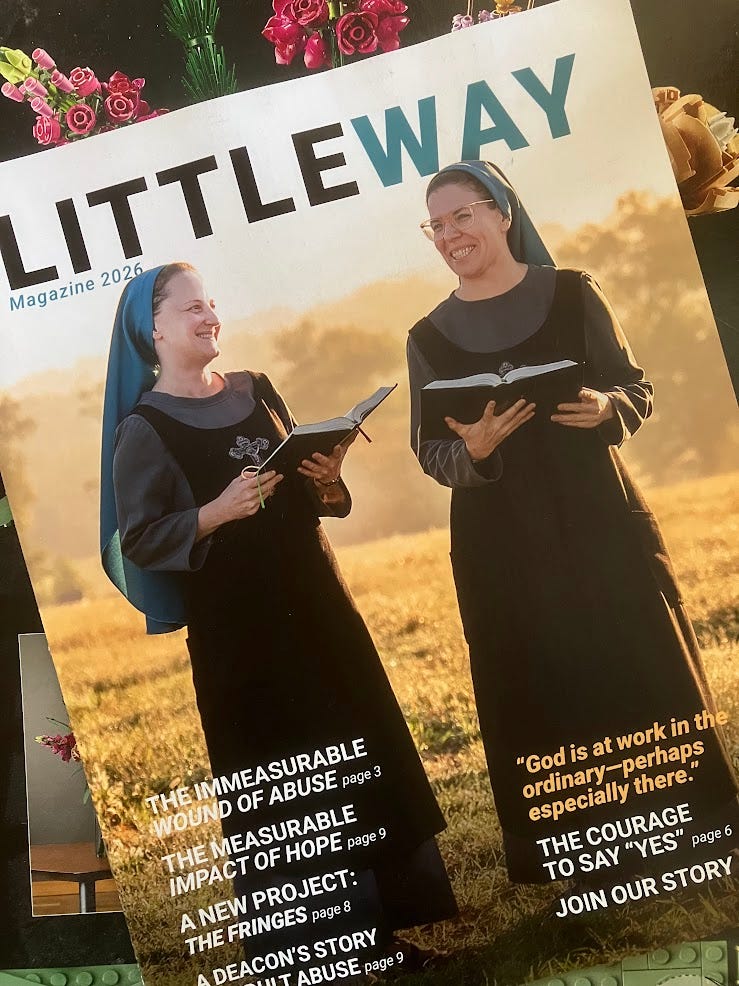
Related: Just got the most recent update, pictured below, from The Sisters of the Little Way, whose charism is reaching out to those recovering from clerical abuse. They need a bigger house, if you happen to own such a thing in Lexington, KY.
In my conversation with Cathy Lins last week, something she mentioned is how the DSM, used by psychiatrists for prescribing and for coding insurance reimbursements, tends to neglect trauma-related mental health problems.
We talked about the generational impacts of trauma, and I touched on my rant about the how my grandparents’ generation (those who served in WWII), and their parents’ generation likewise, were deeply emmeshed in a culture of never admitting to nor speaking of the very seriously traumatic experiences that utterly formed who they were — often creating a painful, even harsh disconnect with their boomer children and grandchildren. Topics to expand on another day.
But here’s the other side of that gap, the side I’ve been living in: Sometimes the mental is physical.
==> Emotional trauma can unleash hormonal and epigenetic changes that cause physical effects, but also, other way around, physical illness can impact your brain, and therefore your affect your ability to think.
Insight from the recent adventure: I was pleasantly surprised, traipsing around on my epic vacation, at how much, physically, I could accomplish. And then I was surprised at how much, returning after a few hours to a tranquil, quiet apartment, finally alone with my laptop and plenty of time to write about all the things (including some evangelization stuff) on my mind . . . the brain was just done. Emotionally and mentally elated, but physically the energy was all used up.
Energy-limiting disease, you can have an absolutely lovely day out in the sunshine enjoying beautiful, inspiring moments, but the body only produces so much energy, don’t spend it all in one place.
Part 2 . . . Got home from the big adventure, recovered from jet lag, accomplished a few major projects around the house, and having quit being quite so obsessive about not getting sick, got waylaid by something. Who knows. The kind of thing you get when you go near people without wearing an N95. Nothing serious, but the energy it takes for me to mount an immune response is energy that can’t be spent on other stuff. Like writing. Or doing the taxes. Or going for a walk.
And thus a second wave of information: Activities (like doing the dishes) and contexts (my happy, prosperous home life) that were previously easy and pleasant were suddenly overwhelming and anxiety-provoking. One week I’m zipping along deep cleaning the library and getting to the gym, next week I’m unable to make breakfast if anyone’s in the vicinity.
Weird stuff.
So that’s another face of our many-sided die. Worth knowing about if you minister to the sick.
And bringing it back around: If you are physically worn out from a vocation that is depriving you of adequate sleep, nutrition, recovery time, and so forth . . . your ability to think and to regulate your emotions will be compromised, no matter how dearly you love every single moment of your cherished calling. No matter how swimmingly your ministries are humming along. The human brain is a physical thing that must be stewarded, which means caring for the body that maintains it.
Happy Passiontide, and take of care of those gifts entrusted to you.
Comments
Nothing yet. Say the first thing.
Sign in to join the conversation.