
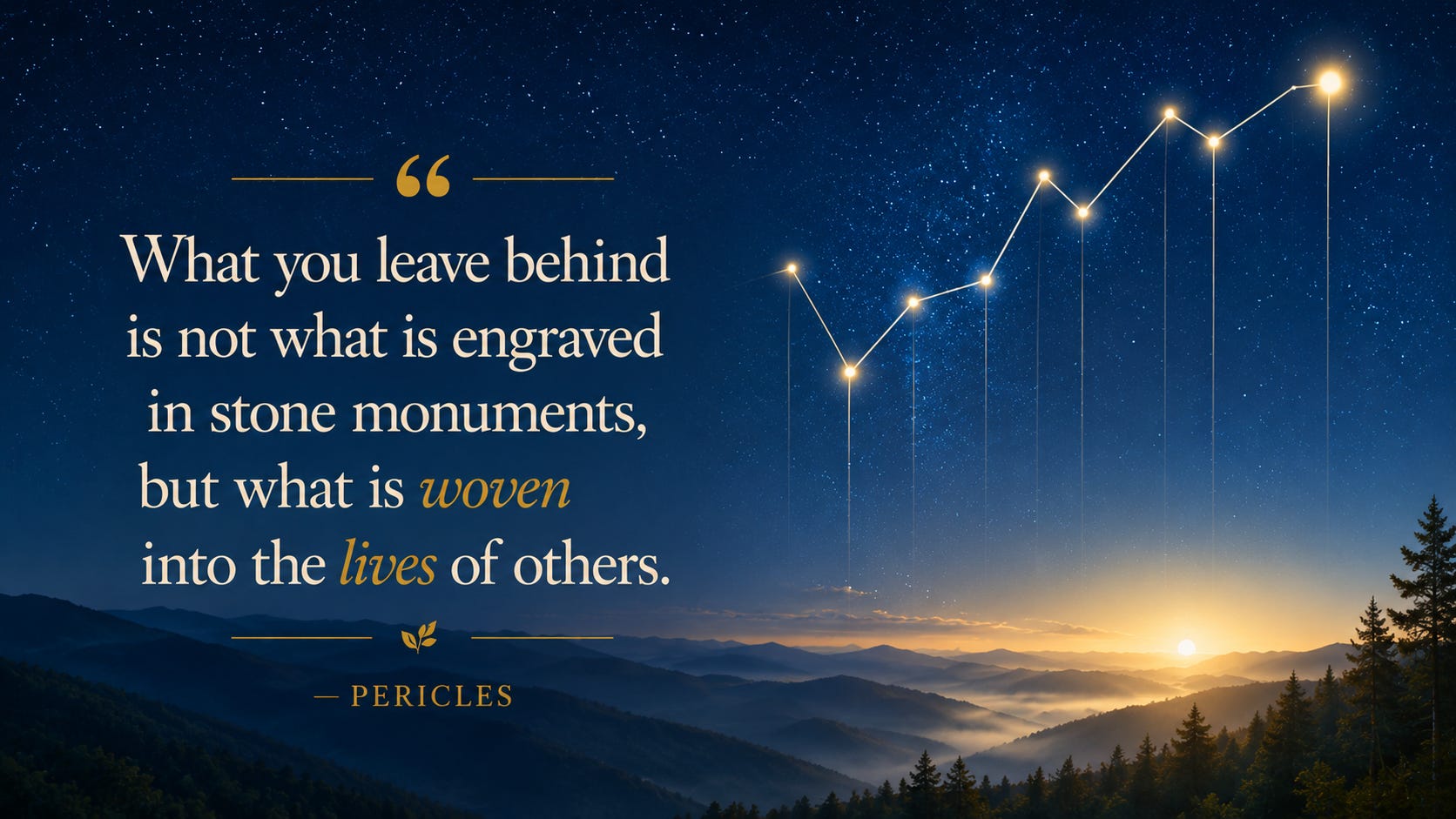
“What you leave behind is not what is engraved in stone monuments, but what is woven into the lives of others.” — Pericles
One of the most powerful exercises I’ve ever participated in wasn’t related to investing, business strategy, or leadership. It was an assignment in a Stanford Business School course taught by Professor Rod Kramer called Lives of Consequence, where we were asked to write our own obituary.
At first, it seemed like an unusual exercise. But as I sat down to write, I realized how rarely most of us spend time reflecting on how we hope to be remembered. We devote enormous energy to planning the next quarter, the next promotion, the next investment, or the next milestone. Yet very few of us pause to consider the larger arc of our lives and the legacy we are creating through our daily choices.
That question has surfaced repeatedly throughout my own journey.
I was present for the passing of both my mother and my grandmother, experiences that profoundly shaped my understanding of what matters most. My mother’s final words were, “Frightening but beautiful,” a phrase that has stayed with me ever since. It captured something essential about mortality: while it can feel unsettling to contemplate, it also has a remarkable ability to clarify our priorities.
Many wisdom traditions recognize this. Whether through the Buddhist practice of mindfulness of death or the ancient concept of memento mori, the purpose is not to create fear. Rather, it is to help us live with greater intention. When we remember that our time is finite, we begin to see more clearly which pursuits are meaningful and which distractions are consuming energy that could be directed elsewhere.
Over the years, I have had the opportunity to interview dozens of investors, entrepreneurs, and leaders for The Enlightened Bottom Line. What struck me most was that many of the people creating extraordinary impact were not primarily motivated by personal achievement. They were motivated by a desire to contribute to something that would outlast them.
Calvin Mackie’s work with STEM NOLA is a powerful example. His efforts to expand opportunities for young people in science and technology are not simply about education; they are about creating pathways that can transform communities for generations. Elizabeth Garlow’s work on reimagining economic systems similarly begins with a long-term view of human flourishing rather than short-term gain. Leaders like Samir Goel at Esusu and Benji Fernandes at NALA have built companies that seek to address systemic barriers while creating economic opportunity at scale.
What connects these examples is not a particular industry or business model. It is a commitment to stewardship.
We often talk about success in terms of accumulation—more revenue, more assets, more influence. Yet one of the questions Elizabeth Garlow raised in our conversation was far more provocative: What is the risk of not having a livable future?
That question shifts the frame entirely. It challenges us to think not only about returns, but about responsibility. It asks us to consider whether the systems we are building are creating the conditions for future generations to thrive.
This perspective became especially tangible during a visit to the Amazon with the Pachamama Alliance, where I spent time with the Achuar and Sápara communities. Their relationship with the rainforest reflects a deep understanding of intergenerational stewardship. Decisions are not made solely based on immediate needs, but with an awareness of how those choices will affect future generations and the broader web of life.
That experience reinforced something I have come to believe deeply: legacy is not a distant concept reserved for the end of life. It is being shaped every day through how we allocate our time, our attention, our capital, and our care.
The word “invest” comes from the Latin investire, meaning “to clothe.” I love that image because it suggests that our investments are not simply financial transactions. They are expressions of what we choose to wrap ourselves around and protect. In that sense, every investment, every business decision, and every act of leadership reveals something about what we value most.
Perhaps that is why reflecting on mortality can be such a powerful teacher. It encourages us to step back from the urgency of the moment and ask whether our actions are aligned with the future we hope to help create.
The question is not whether we will leave a legacy. We all will.
The more important question is whether we are building it consciously.
If you were writing your own obituary today, what would it reveal about the life you are currently living—and what might you want to change?
Look forward to hearing your thoughts,
Jenna
Please fill out the form below if you want to participate in a cohort focused on the Enlightened Bottom Line.
You can see my upcoming events below:
Jenna is the President of LightPost Capital, an investment and acquisition firm. She is an active angel investor and has invested in over 3 unicorns. She is also the CEO of Impact Experience.
In her groundbreaking book, Enlightened Bottom Line, Jenna Nicholas explores the powerful intersection of spirituality, business, and investing—an intersection too often overlooked in a world driven by profit alone. Drawing on moving stories of entrepreneurs, investors, and leaders who are living out this integration, along with cutting-edge research, Nicholas reveals how spiritual wisdom can guide ethical choices in finance and business.
Please consider supporting my work on Substack. As a paid subscriber you will receive a free book, access to the archive and other perks.
No posts
Comments
Nothing yet. Say the first thing.
Sign in to join the conversation.