
Imagine me at 23. I was newly out of college with a degree and loan debt, but also a free apartment, working at a small university, making $24,500 a year. I’m not sure how I survived on this, but the year was 2006.
It was the era of low-rise fitted jeans and cute tops. Wavy hair. Expendable income! My first full-time job, a new car, and something to prove.
Having to make my own goal posts, rules, and playbook with no report cards or ascending grade level to aim for… only the rest of my life and endless choices for what to do with it.
The world and my future were both full of possibilities. Wide open. Shiny.
And scary AF.
It was during this year of freedom, confusion, second-guessing, excitement, fun, recklessness, and youth that I began practicing yoga regularly.
I was introduced to it a few years prior as an undergrad during annual Resident Assistant training with the Department of Residence Life & Housing at my alma mater in central Pennsylvania (although in Pennsylvania, we just say “PA”). Apart from occasional small-town market festivals, dirt speedway spectatorship, Walmart, 24-hour Dunkin Donuts, exactly 5 bars, and a couple of restaurants, there wasn’t a lot to do.
But this little yoga studio - with a straight-up yogi who I remember calling himself Sadharma - was the site of one of the first true cross-cultural experiences I can remember.
There we were - a bunch of teens and young adults, squeezing into the sanctuary of an old church, all of its pews removed, as we listened to Sadharma’s pleasant, peppy, yet soothing voice fill the tall, open, warm space. His long beard and flowy, white cotton outfit made us feel like we were in another world.
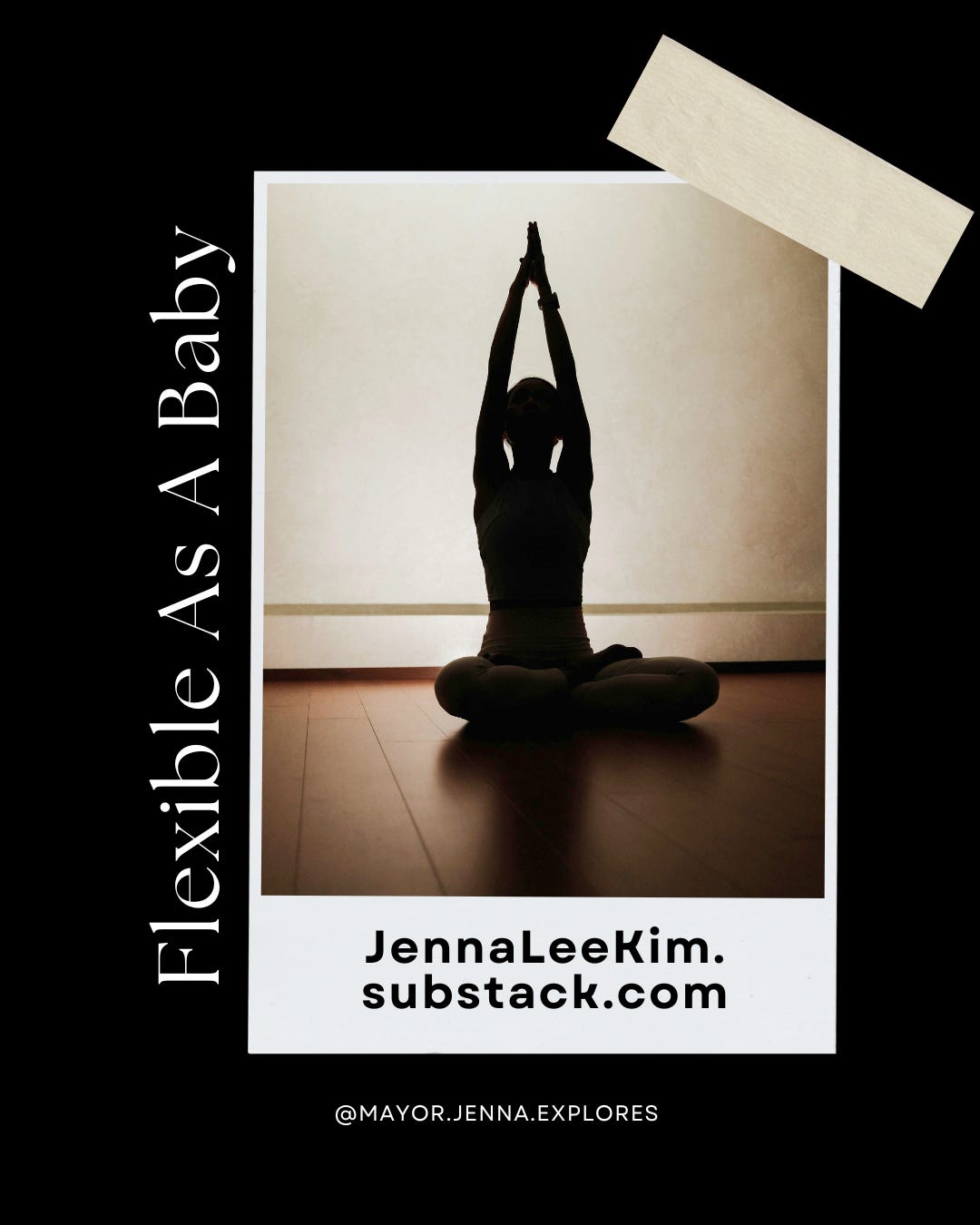
He’d sit, his old nimble knees hitting the floor to his sides, a small smile on his gentle face as he talked to us about life. How as a baby, all of us are able to do each pose in yoga with no problems, as the stressors and tension and expectations of life have not yet hit our muscles and our bones.
Each of the poses came easily to me. He stood over me, the rest of my peers watching, instructing me to put my leg that way, my arm under there, my other leg there. “Do you feel a stretch yet?” he asked. I paused, believing I was supposed to say, “Yes,” but feeling bold and comfortable enough to tell the truth - a rarity in those days - “No…”
Put that arm there, then. Move your shoulder that direction, open up your chest.
Eventually, we found a position where my body turned outward and I felt a satisfying stretch in my limbs.
It’s a privilege to discover something that is effortless for your body to do, like any athlete who first throws a ball or hits a puck. But I’m no athlete. My body is naturally flexible, but the yin to this yang is my lack of physical strength to accompany it.
That year after college, with more expendable time than I’d ever experienced in my life, no one to answer to, and each decadent day to make my own… I panicked. Slowly. Instead of reveling in the spare time, it gave me anxiety.
Too much time to be in my own thoughts.
Restlessness.
These are feelings I wouldn’t recognize or address for another 20 years.
But it was during that time I started yoga in the tiny living room of that first long winter after college.
Across 2 DVDs, it was the kind of yoga that featured slow, swoony, melodic music while a woman with impossibly controlled movements and a great ass practiced yoga on a beach at sunset, waves behind her. This wasn’t hot yoga, aerobic yoga, aerial yoga, or anything that would be trendy by today’s standards.
From these DVDs, I learned the movements of the sun salutation, how to position my body to stand correctly by pushing my thighs with my hands, creating the proper alignment of my back.
At 23, I didn’t have to worry about pulling a muscle in my tense neck, and I didn’t think much about engaging my core while I did the movements. It was simply enough to get into Warrior 1, 2, and 3 and move my body, taking it for granted the way only a young person can. Lying in savasana at the end is the closest thing to peace I felt that year in between weeping unexpectedly in parking lots, unsure of what direction to take with my life, putting pressure on my Self to make all of the “right” decisions.”
At some point, I had a decision to make: take a leap and move to NYC… try and make it there the way I’d always fantasized about. Get back together with my toxic, on-again, off-again boyfriend from college. Stay in that suburban town in Maryland for another year, bored at work, doing yoga, having fun on the weekends. Or return to central PA, to the tiny town next door to Sadharma, for a great job opportunity, familiar friends and places.
My therapist at the time - her name was Robin and the first person in my life to really challenge the way I was thinking - told me in so many words: Don’t take the path of least resistance.
Back then, I didn’t understand what this meant.
I never returned to see Robin after the session where she told me something I knew to be correct in my heart but rejected strongly with my brain. It was easier. At 23, I was decades away from understanding what it meant to listen to my body, to push back against my logical brain, to stop trying to do anything that starts or ends with a “should.”
So, I packed up, and I moved back to a small town of 5,000 people. I went on to succeed in a career that I built for myself, with great friends, amazing experiences, a marriage, a first house, a fence (black aluminum, not picket, but close), and a couple of dogs… and eventually, a different small, 5,000-person town, another fence (split board), and a couple of kids.
And zero time for yoga.
Instead, I spent many years being busy. Very busy, putting myself last but believing I was building a life I should be creating. The stress, tension, and weight of this slow and invasive pressure creeping into my body like liquid lead.
Until the day I stepped into a yoga studio in Korea, 20 years after my own personal living-room sessions in Maryland.
There, amongst other Korean moms, the instructor with her low, calming voice, her body moving with control and grace, making each chaturanga look easy and fluid.
Still flexible, there are differences now.
My neck and shoulders are tight.
My knees crack during floor exercises.
I’m aware of my lower back in downward dog and how my arms shake when lowering myself to the ground, my shoulders devoid of any strength from these past 20 years of writing at my laptop.
And.
After yoga, I feel incredible.
I feel physically and mentally good in a way that someone in her young 20s, who can still move in any direction without thinking about it, is unable to understand without the life experience in front of her.
Because the class is in Korean, I have to stay present and in tune the entire time, completely in the moment with the women around me, watching them from the corner of my eye to know which direction to turn, listening to the tones of our instructor’s voice that tell me she’s simply speaking in a soft cadence to encourage us, or asking us to change, move, or try something new.
She walks around, giving gentle corrections with her hands, showing us what our bodies are capable of, how they’re meant to be.
“Power,” she said to me once, pulling my hips upward, tapping my stomach. Engage your core. Lift up from your center. Feel the stretch along the entire side of your body. Use the natural angles your body is creating to build strength as you place a hand on your leg, or push your hips to the side, look behind you.
The earth is your resistance but also your guide. You can fall into her, use her to brace yourself, and find center as you balance on one leg, your favorite mountain out the window in front of you.
Standing with my hands clasped behind me, pulling my shoulders and head backwards toward the ground, I couldn’t relax my upper body enough to let my head drop naturally and not feel pain.
I felt our instructor’s warm presence in front of me even before I felt her touch.
She looped her arms through mine and pulled up, elongating my spine toward the sky. I swear I could actually feel my vertebrae unclick and release, one by one. Because she was there, I knew I wouldn’t fall backwards. I let my neck release and my head drop. And for a moment, I felt suspended in the air, safe in my own body in this room with Koreans, in the country where I was born, where I have felt the most amount of the world’s hardships and personal stress, expectations, disappointments, struggle, and grief.
… And the place where I learned - slowly - to let all of that go. Vertebrae by vertebrae.
Like Sadharma said more than 20 years ago… before his unexpected and untimely death… when he was living a simple and peaceful life in central PA with the rest of us, talking to a bunch of teenagers, imparting life wisdom and knowledge onto us long before we were ready to understand the true meaning of his words…
We were all able to be free and fluid, moving easily when we were babies. Before the world made us rigid and unsure.
I don’t know yet if I’m in touch with that baby. That little girl. That inner child people talk about. But I do know the woman I am right now is someone she would be in awe of.
Together, though there are STILL no clear goal posts, rules, or playbook for determining success or what’s next… we now understand the specific path and however we define “success” aren’t what’s important.
Whatever is next is open and free. Instead of being scary, it’s now full of peace, knowing that whatever comes, I can trust myself to take us there: Me and that little baby inside.
Follow me on Instagram, Facebook, or learn about my professional background on LinkedIn or Linktr.ee.
Questions? Comments? Leave a comment here and I’ll respond to it on my Spotify Podcast: Exploring with Jenna Lee Kim in an “unplugged” and unscripted way! You can also email me at jenna.tae.hee.kim@gmail.com
Comments
Nothing yet. Say the first thing.
Sign in to join the conversation.